


What if the Marriott name on the sign isn’t the name of the party responsible for your injury? After a fall, pool accident, or other incident, it may be unclear who controlled the area or whether the dangerous condition could have been prevented. A lawyer for injury at Marriott can investigate what happened, identify potentially responsible parties, and work to preserve evidence before it disappears.
You may also be dealing with medical bills, missed work, and insurance calls while trying to recover. If you were hurt at a Marriott in Miami or in Fort Lauderdale, this article explains practical steps to take, evidence that may help establish responsibility, and how a Florida premises liability claim may work.
Personal Injury Attorney in Fort Lauderdale represents people with premises liability and other personal injury claims. Whether you’re searching for a personal injury firm near me, attorneys for personal injuries, attorneys personal injury, an injury lawyer near me, or a personal injury lawyer near me, legal counsel can help investigate the incident, preserve relevant evidence, and handle insurance communications. The firm also represents people injured in vehicle crashes, including those seeking lawyers for auto accidents or auto accident lawyers near me. Every claim depends on its facts. The Marriott brand alone doesn’t determine responsibility.
Key Takeaways
- Get medical care, report the incident, and document the scene. Keep records, photographs, and witness details that may help explain what happened.
- An injury at a hotel doesn’t automatically establish responsibility. The facts and which person or business controlled the area may matter under Florida law.
- Incident reports, photographs, witness accounts, maintenance information, and medical records may help show what happened and whether a responsible party knew about a hazard.
- Depending on the evidence and applicable law, a claim may involve medical expenses, lost wages, future care, and other losses.
- A lawyer for injury at Marriott can investigate, preserve evidence, and handle insurer communications. Call Now: (954) 390-2228 Available 24 Hours a Day, 7 Days a Week.
Injured at a Marriott in Florida? Take These Steps First
A hotel injury can leave you shaken, hurt, and unsure what to do next. An accident by itself doesn’t establish legal responsibility. The condition involved, how the incident happened, and who controlled the area may all matter. Prioritize your health and record what you can while the details are fresh. You can consider your legal options after addressing immediate medical needs.
What should I do immediately after a Marriott injury?
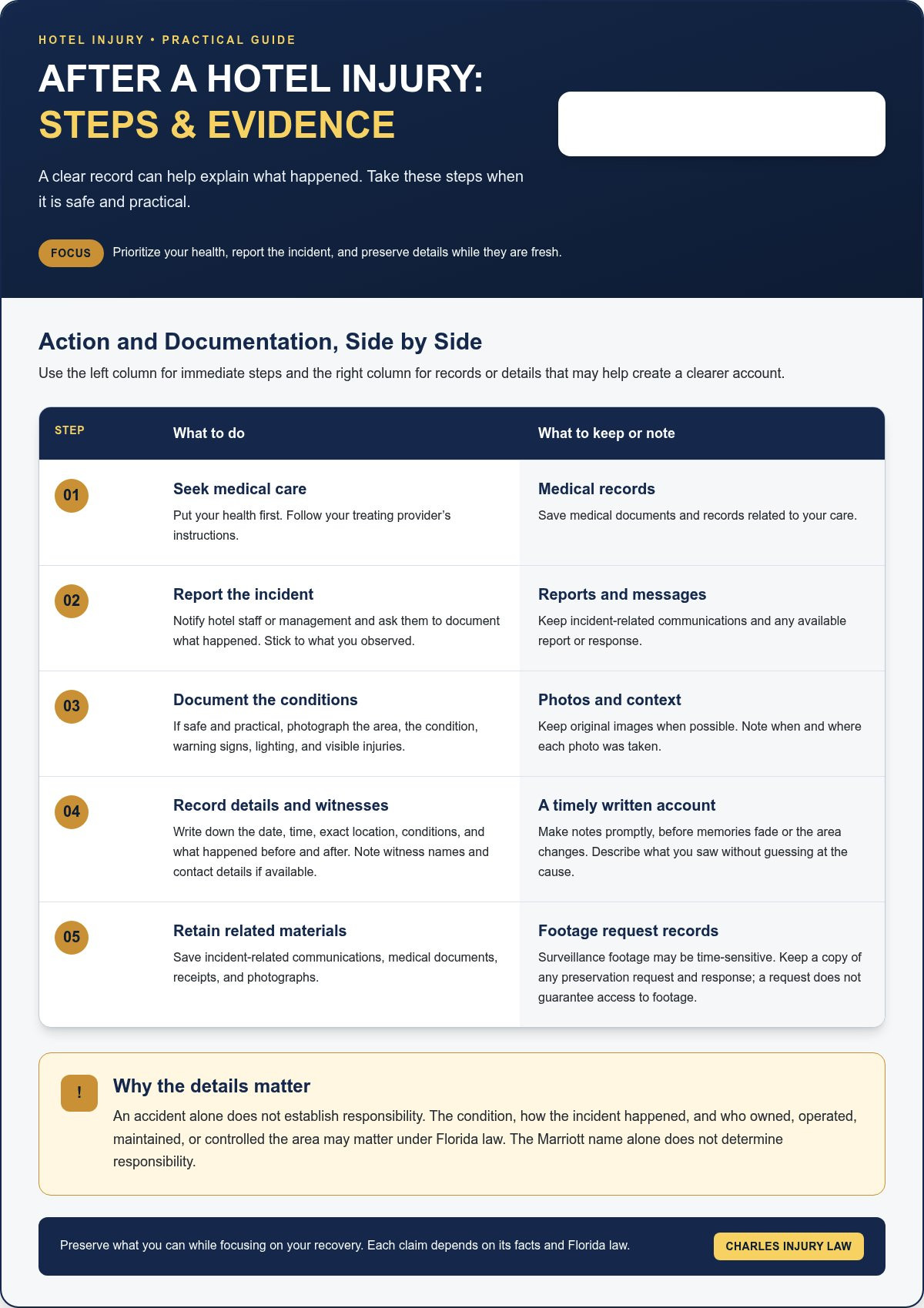
Take these steps as soon as it’s safe and practical. If you’re in pain, get medical attention and follow your treating provider’s instructions. Notify hotel staff or management and ask them to document the incident. Stick to what you observed rather than guessing at the cause or minimizing your symptoms. Record the date, time, exact location, conditions, and names and contact details of witnesses, if available.
- Seek medical care. Put your health first and follow medical instructions.
- Report the incident. Notify staff or management and ask that the event be recorded.
- Document the conditions. Note what you observed, including warning signs, the surface, and lighting conditions.
- Identify witnesses. Write down names and contact details if witnesses are willing to share them.
- Retain records. Save incident-related communications, medical documents, receipts, and photographs.
Make notes promptly, before memories fade or the area changes. Include what you saw, where you were, and what happened immediately before and after the incident. A lawyer for injury at Marriott can later assess how those facts relate to a potential claim. You don’t need to decide what to pursue while addressing an immediate medical need. For information about Florida personal injury representation, Charles Injury Law can explain how legal counsel may help.
What evidence should I preserve after a hotel accident?
If it’s safe and practical, photograph the area, the condition involved, nearby warning signs, lighting, and visible injuries. Keep the original images when possible, and note when and where you took them. Save messages or other communications about the incident, medical records, and receipts connected to your care. Together, these materials may help create a clearer account of what happened and how it affected you. Premises liability describes the broader legal concept involving injuries connected to property conditions; whether it applies depends on the facts and Florida law.
Surveillance footage may be time-sensitive. You can request that relevant footage be preserved, but a request doesn’t guarantee access to it. Keep a copy of your request and any response. Charles Injury Law investigates hotel incidents and works to preserve relevant evidence while you focus on recovery.
Call Now: (954) 390-2228 Available 24 Hours a Day, 7 Days a Week
Who Is Responsible for a Marriott Injury in Florida?
Premises liability addresses whether someone may be legally responsible for an injury connected to a property’s condition or upkeep. An accident alone doesn’t establish negligence, and each claim depends on its facts and Florida law. The Marriott name identifies a brand, but it doesn’t establish which person or business owned, operated, maintained, or controlled the area where someone was hurt.
Does Marriott automatically become responsible for an injury at its property?
No. The brand name alone doesn’t prove negligence or identify every potentially responsible party. An investigation may need to determine who owned or operated the specific property, who managed or maintained the area, which staff members were involved, and who controlled the condition connected to the injury. Responsibility shouldn’t be assumed based on a sign, reservation, or uniform.
The relevant questions may differ depending on where the injury occurred, such as a guest room, pool area, or shared hallway. Records and other evidence can help establish who handled the location and what they knew about the condition. Florida Statutes Chapter 509 addresses public lodging establishments. Review Florida’s lodging statutes alongside the facts of the claim.
Which hotel incidents may raise premises-liability questions?
These circumstances don’t automatically establish fault. A review of the evidence can help identify which facts and records matter before responsibility is assigned. Charles Injury Law investigates hotel injury claims and evaluates the evidence under Florida law. If you’re unsure which party controlled the area, a lawyer for injury at Marriott can investigate that question and explain your options.
Call Now: (954) 390-2228 Available 24 Hours a Day, 7 Days a Week
How Can You Prove Negligence After a Marriott Hotel Injury?
Proving negligence takes more than showing that you were hurt. The evidence must help establish what happened, what condition contributed to the incident, who was responsible for the area, and how the injury caused losses. General negligence concepts include duty, breach, causation, and damages. The Cornell Legal Information Institute’s overview of negligence explains those concepts, but Florida law governs a claim brought in Florida.
Think of proof as a connected record, not a single document. A photograph may show a hazard, while a witness account or maintenance record may help explain how long it was there or who knew about it. Medical documentation can connect the incident to treatment and symptoms. The evidence must be considered together to assess how well it supports the legal issues.
What evidence can help clarify a hotel injury claim?
Useful evidence may include:
- Incident details: An incident report, photographs of the area, and communications with hotel staff may help establish when and where the event occurred.
- Witness information: Names and accounts can help clarify what people saw before, during, or after the incident.
- Condition and notice: Maintenance or inspection records, when obtainable, may shed light on a reported hazard and the response to it.
- Injury and loss: Medical records can document symptoms, treatment, and injury-related care. Keep related receipts and records of other losses as well.
Records created close to the incident can help clarify disputed details by capturing what people observed before memories fade and conditions change. No single item proves negligence by itself. The evidence must be assessed as a whole.
What if the hotel or insurer disputes responsibility?
A denial doesn’t end the investigation. People involved may describe the event differently, so compare their accounts with photographs, reports, witness statements, available maintenance information, and medical records. An injury alone doesn’t establish that a hotel or another party was negligent. Evidence must support the relevant issues, including responsibility and the connection between the incident and the harm.
Charles Injury Law investigates hotel incidents, gathers records, and works to preserve relevant evidence. If the injury involved a fall, read about Florida slip-and-fall claims. A lawyer for injury at Marriott can assess disputed facts and explain how they may affect a claim under Florida law.
Call Now: (954) 390-2228 Available 24 Hours a Day, 7 Days a Week
What Compensation May Be Available After a Hotel Injury in Florida?
A hotel injury can affect your health, income, and daily life. Depending on the evidence, the facts, and applicable Florida law, a claim may seek compensation for financial losses and personal harms. No category is automatic, and no particular amount can be assumed. Keep documents that show the losses following the incident and help connect them to the injury.
Which losses may be considered in a Florida injury claim?
Financial losses may include medical expenses, future care supported by medical evidence, wages lost while recovering, and reduced earning capacity when supported by evidence. Non-economic harms may include pain, emotional distress, and effects on everyday activities. Permanent disability and emotional distress require an individualized, fact-specific assessment. The table lists examples of records that may help document these categories.
| Possible loss | Examples of supporting documentation |
|---|---|
| Medical expenses and future care | Medical records, bills, treatment plans, and provider assessments |
| Lost wages | Employer records, pay documentation, and records of time missed |
| Reduced earning capacity | Work history and assessments that address how the injury affects future work |
| Pain, emotional distress, or lasting effects | Treatment records, provider notes, and documentation of changes to daily activities |
These are examples, not a guarantee that a loss will be recovered. A lawyer for injury at Marriott can review the available evidence and explain how Florida law may apply to your claim.
How do insurers assess hotel injury claims?
An insurer may review the incident, evidence about responsibility, medical records, and the losses being claimed. Gaps in records or questions about whether the incident caused a particular condition can complicate negotiations. Keep bills, treatment records, wage information, and communications organized. Make sure the losses you claim are supported by evidence.
An insurer’s position doesn’t decide the legal merits of a claim. If the insurer disputes responsibility or damages, Charles Injury Law can assess the evidence, handle insurer communications, and pursue the claim through negotiation or litigation when necessary. If a claim has been denied, the article “How to Fight a Denied Insurance Claim in Florida” may help explain possible next steps.
Discuss your hotel injury claim with Charles Injury Law. Call Now: (954) 390-2228 Available 24 Hours a Day, 7 Days a Week
How a Marriott Injury Lawyer Can Help You
After a hotel injury, you may be managing treatment, missed work, and insurer questions while trying to understand who was responsible. Charles Injury Law can handle the investigation and claim process with personalized attention and assertive advocacy. A lawyer for injury at Marriott can help connect the incident evidence, potentially responsible parties, injuries, and documented losses into a clear claim.
What should I expect when I work with Charles Injury Law?
The process starts with the facts. Charles Injury Law investigates how and where the incident happened, identifies potentially responsible parties, and works to preserve relevant evidence. The firm gathers records, including incident materials and medical documentation, and may obtain expert opinions when they’re relevant to evaluating the claim. You communicate directly with the attorney and receive personalized attention as the case develops.
Next, the firm assesses losses supported by the evidence and handles communications with insurers. If the insurer disputes responsibility or the extent of your injuries, the firm can press your position through negotiation. If a fair settlement isn’t reached, Charles Injury Law can litigate when necessary. Learn more about hotel injury and premises liability guidance and the firm’s approach to personal injury representation.
Representation is handled on a contingency-fee basis: you owe no attorney fees unless Charles Injury Law recovers compensation. That arrangement doesn’t guarantee a result, and the facts of each claim matter.
When should I speak with a Florida injury lawyer?
Consider seeking legal guidance promptly if your injuries are serious, responsibility is unclear, important evidence may be at risk, or an insurer is questioning your account or losses. An early investigation can help preserve relevant facts. You don’t have to resolve every question before asking how the process works.
Charles Injury Law can review the circumstances, explain potential next steps, and pursue accountability while you focus on recovery. Call Now: (954) 390-2228 Available 24 Hours a Day, 7 Days a Week
Protect Your Recovery and Take the Next Step
An injury at a Marriott doesn’t automatically establish who is legally responsible. The property’s brand name alone may not identify who controlled the area or condition. Preserve incident details, witness information, photographs, and medical records promptly. These records can help clarify what happened and support an informed review of potential losses under Florida law.
A lawyer for injury at Marriott can investigate the incident, identify potentially responsible parties, assess documented losses, and handle insurer disputes. Charles Injury Law has recovered millions of dollars for injured clients, but every claim depends on its own facts, and past results don’t guarantee an outcome. The firm represents clients on a contingency-fee basis, so there are no attorney fees unless it recovers compensation.
You don’t have to face unanswered questions or insurer pressure alone. For direct guidance about your situation, Call Now: (954) 390-2228 Available 24 Hours a Day, 7 Days a Week. Charles Injury Law is ready to listen and help you understand a path forward as you focus on recovery.
Frequently Asked Questions
Can I sue Marriott if I was injured at a hotel in Florida?
Possibly, but an injury at a Marriott doesn’t automatically mean Marriott is legally responsible. A claim depends on the incident, the evidence, and which person or business owned, operated, maintained, or controlled the relevant area. A lawyer for injury at Marriott can investigate those facts and assess whether there may be a basis for a claim under Florida law. The brand name alone doesn’t settle who may be responsible.
What should I do after a slip and fall at a Marriott?
Get appropriate medical care first, then report the fall to hotel staff or management and ask that it be documented. If it’s safe, photograph the area, the surface, warning signs, and lighting. Write down the date, time, and location, and collect witness details if possible. Keep medical records, receipts, incident communications, and photographs. Describe what you observed accurately, and don’t guess about the cause or minimize your symptoms.
Who is responsible for an injury at a Marriott hotel?
Responsibility depends on the property-specific facts, not just the Marriott name. An investigation may examine who owned, operated, managed, maintained, staffed, or controlled the area where the injury occurred, as well as who was responsible for the condition involved. Potential responsibility shouldn’t be assumed without evidence and legal review. Florida law and the circumstances of the incident determine whether a claim may proceed against a particular party.
What evidence should I save after an injury at a Marriott?
Save photographs of the hazard, surrounding area, warning signs, lighting, and visible injuries when safe and practical. Keep incident reports, messages with hotel staff, medical records, bills, and receipts. Record witness names and contact information, along with your own account of what happened. Maintenance or inspection records may also be relevant if obtainable. If surveillance footage may exist, request that it be preserved, but don’t assume access is guaranteed.
Can I make a claim if the hotel says the accident was my fault?
Yes, a hotel’s claim that you were at fault doesn’t automatically end the matter. Review the circumstances and available evidence, including photographs, witness accounts, incident records, and information about the condition involved. Avoid guessing or making assumptions about fault in discussions with the hotel or insurer. Florida law may consider the parties’ responsibility when evaluating a claim, so get advice based on the specific facts.
What compensation may be available after a Marriott injury?
Depending on the evidence and Florida law, a claim may seek documented medical expenses, future care, lost wages, reduced earning capacity, pain, or emotional distress. These losses aren’t automatically recoverable; the facts and supporting records matter. Medical documentation may help connect treatment to the injury, while employment records may help show missed work. A case review can assess which categories may apply to your circumstances.
How much does a Florida injury lawyer cost if I was hurt at a Marriott?
Charles Injury Law handles injury claims on a contingency-fee basis, so clients pay no attorney fees unless the firm recovers compensation. The firm represents injured people throughout Florida, including in Fort Lauderdale, in Miami, in West Palm Beach, in Boca Raton, in Delray Beach, in Boynton Beach, in Lake Worth, in Orlando, and in Tampa. Call Now: (954) 390-2228 Available 24 Hours a Day, 7 Days a Week.
Disclaimer
The information provided on this blog is for general informational purposes only and does not constitute legal advice. Viewing this content does not create an attorney-client relationship with the firm. You should not act or rely on any information contained herein without seeking legal advice from a qualified attorney regarding your individual situation.