



What if important evidence after an injury at a Residence Inn or Fairfield Inn is something you can’t see, such as hotel video or an incident record that may not be kept indefinitely? If you need a lawyer for injury at Residence Inn / Fairfield Inn, acting promptly can help preserve information about what happened and who controlled the area.
It’s understandable to feel unsure about what to do while you’re in pain, arranging medical care, missing work, or facing unexpected expenses. Photos, witness details, hotel records, video, and medical documentation may help clarify how the incident happened. Personal Injury Attorney in Fort Lauderdale represents people injured in hotel incidents and helps them assess their legal options.
People searching for a personal injury firm near me, an injury lawyer near me, or a personal injury lawyer near me may also have questions about other claims. Personal Injury Attorney in Fort Lauderdale represents people injured in hotel incidents and handles auto injury matters, including claims that may lead people to search for lawyers for auto accidents or auto accident lawyers near me. This article explains practical steps to take, how responsibility may be evaluated under Florida law, and how the firm can help you pursue a claim.
Key Takeaways
- Get appropriate medical care first, then write down what happened while the details are fresh.
- Photos, witness information, incident reports, available video, and medical records may help clarify how the injury occurred.
- An injury on hotel property doesn’t automatically establish liability. The specific facts, including who controlled the area, matter.
- A lawyer for injury at Residence Inn / Fairfield Inn can investigate the circumstances, preserve evidence, and address insurer communications while you focus on recovery.
- Charles Injury Law offers contingency-fee representation, so clients pay no attorney’s fees unless the firm recovers compensation. Call Now: (954) 390-2228 Available 24 Hours a Day, 7 Days a Week
Injured at a Residence Inn or Fairfield Inn? Understand the Hotel Injury Claim
Start with your health. Seek appropriate medical attention and follow the instructions of your treating professionals. When you’re able, make a clear record of what happened: where you were, what you noticed, and how you were injured. Writing down those details while they’re fresh can help preserve your account.
A hotel injury claim is a fact-specific premises liability matter. An injury alone doesn’t prove that a hotel or another party was legally responsible. An investigation considers what happened, the condition involved, who controlled the location, and what evidence may clarify the events. A lawyer for injury at Residence Inn / Fairfield Inn can examine those facts and assess whether they support pursuing a claim.
An injury is evidence that someone was hurt; it is not, by itself, proof that another party is legally at fault. The location, hazard, control of the area, and available records or witness accounts may all matter. For general background on hotel-related legal principles, see Hospitality Law.
For injured people in Miami or in Fort Lauderdale, personal injury representation from Charles Injury Law includes investigating the circumstances and identifying evidence relevant to responsibility. The firm handles premises liability claims, including hotel injuries, where establishing what happened at a particular property is central to evaluating the case.
Which incidents at a hotel may raise premises liability questions?
A wet or obstructed walkway may be involved in a slip or trip and fall, but a fall does not automatically establish that the property caused it. Other incidents may involve a pool area, an elevator or escalator, or alleged inadequate security. Each situation calls for a careful review of the circumstances and available evidence. Photos, witness accounts, records, or video may help show what condition existed and how the incident unfolded.
Who might be involved in investigating a hotel injury?
Depending on the location and circumstances, relevant parties may include the hotel, property owner, management, maintenance personnel, or another party with a role in the area. The hotel’s name or brand alone doesn’t determine responsibility. Investigators look for evidence about who controlled or maintained the specific location and what the evidence shows about the incident. The facts determine whether any party may be liable.
How a Florida Hotel Injury Claim Is Investigated
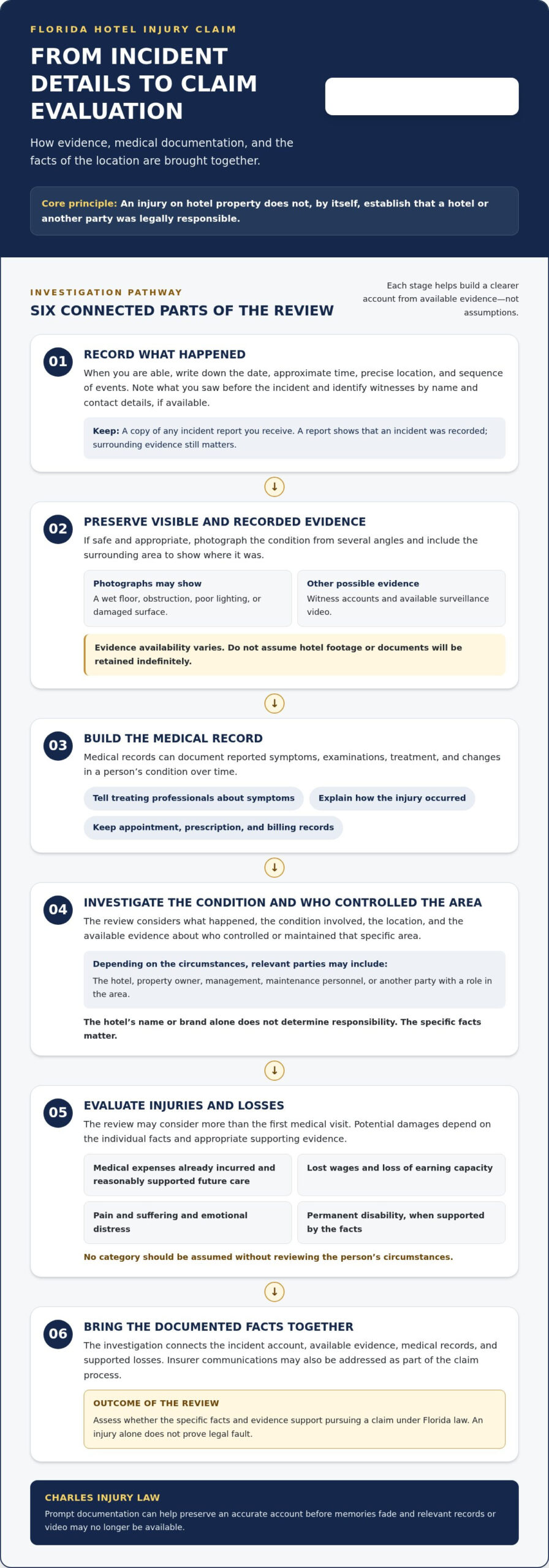
A hotel injury investigation brings scattered details together to clarify what happened. The process typically includes documenting the incident, identifying evidence, reviewing medical records, evaluating losses, and addressing insurer communications. Each step helps establish what can be supported by evidence rather than assumptions about responsibility.
Prompt documentation can help preserve an accurate account before memories fade and relevant records or video may no longer be available. You don’t need to investigate the incident on your own. If you can, write down what you remember and keep copies of related records. Evidence availability varies, so don’t assume hotel footage or documents will be retained indefinitely.
What evidence can help explain how the injury happened?
Start with a written account. Record the date, approximate time, precise location, and sequence of events. Note what you saw before the incident and identify witnesses by name and contact details, if available. Request or keep a copy of any incident report you receive. A report documents that an incident was recorded, but the surrounding evidence still matters.
Photographs can capture conditions that may change, such as a wet floor, an obstruction, poor lighting, or a damaged surface. If safe and appropriate, take pictures from several angles and include the surrounding area to show where the hazard was. Available surveillance video or witness accounts may provide additional context. The AHLA Safe Stay Guidelines provide background on the hotel industry’s safety initiative, but a general resource cannot determine what happened in a particular incident or establish legal responsibility.
Medical records can document reported symptoms, examinations, treatment, and changes in a person’s condition over time. Tell treating professionals about your symptoms and how the injury occurred, and keep appointment, prescription, and billing records. In Florida, the evidence in a premises liability claim must be evaluated in light of the specific facts, including the condition, location, and circumstances of the incident.
How are injuries and losses evaluated?
The investigation considers more than the first medical visit. Depending on the evidence, damages may include medical expenses already incurred, reasonably supported future care, lost wages, and loss of earning capacity. Pain and suffering, emotional distress, and permanent disability may also be relevant when supported by the facts and appropriate evidence. No category should be assumed without reviewing the individual’s circumstances.
Charles Injury Law gathers medical records and expert opinions to assess present and future damages. This review can help connect documented injuries with treatment needs and work-related effects. A lawyer for injury at Residence Inn / Fairfield Inn can also organize available evidence and address insurer communications as the claim is evaluated. The goal is a clear, supported picture of the injury and its consequences, not a guess based on one record or conversation.
Who May Be Responsible for a Residence Inn or Fairfield Inn Injury?
An injury on hotel property doesn’t automatically establish that the hotel, property owner, or anyone else is legally responsible. The key questions are what happened, what contributed to the injury, who had a role in the area, and what the evidence supports. Responsibility can’t be determined from a hotel’s name or the location alone.
Several parties may be relevant to an investigation. Their potential involvement depends on the specific area and circumstances, not assumptions about how a hotel is organized.
| Possible party | Connection to the area | Evidence that may clarify involvement |
|---|---|---|
| Hotel operator | May operate the hotel or coordinate guest-facing services. | Incident records, communications, and information about who addressed the reported condition. |
| Property owner | May own the building or grounds where the injury occurred. | Ownership and property records, along with documents identifying who managed or maintained the area. |
| Management company | May handle day-to-day hotel operations or oversee particular spaces. | Management records, policies, and communications about the location or incident. |
| Maintenance provider | May perform work in or around the area involved. | Work orders, inspection or repair records, and information about work performed. |
| Another responsible party | May have a separate role related to the place or condition. | Contracts, witness accounts, video, and other records tied to the incident. |
How can the incident location affect the investigation?
A guest room, common walkway, pool area, elevator, and parking or access area may involve different records, witnesses, and people connected to the space. For example, an investigation of an elevator incident may look for available maintenance records, while a pool-area incident may call for evidence about the specific location and what was observed there. Control and maintenance information, witness accounts, and available video can help clarify the circumstances. None of these locations, by itself, proves who was responsible.
What if the insurer says the injury was your fault?
An insurer may dispute how an incident happened, whether it caused the reported injury, or whether claimed losses are supported. Test a disputed account against available records, photographs, medical documentation, and witness information. Don’t assume an initial disagreement settles the question. If a fall caused the injury, the evidence-specific issues discussed in this Florida slip-and-fall guide may be relevant.
Florida law and the specific evidence guide the evaluation. A lawyer for injury at Residence Inn / Fairfield Inn can investigate which parties had a connection to the area and assess what the records show, without treating an allegation as proof. The goal is a grounded account of responsibility, not a conclusion based only on the property’s name or an insurer’s position.
What to Do After an Injury at a Hotel in Florida
Put your health first. Get appropriate medical care and follow the instructions of your treating professionals. You don’t need to solve the claim while you’re hurt. Once you’re able, take practical steps to keep the details organized and make it easier to explain what happened.
What should you document before details fade?
Keep your notes factual. Record what you remember, separate what you personally observed from what someone else told you, and don’t guess about details you’re unsure of. If you can’t recall an exact time or sequence, say so rather than filling in the gaps.
- Write down the incident details. Note the date, approximate time, specific hotel area, and sequence of events. Include what you were doing immediately before the injury and what you noticed afterward.
- Preserve relevant photographs and communications. Keep pictures of the area or visible conditions, along with messages, emails, or other communications related to the incident. Save a copy of any incident report you receive.
- Keep witness information. Write down the names and contact details of people who saw the incident or its immediate aftermath, if available. Don’t assume you’ll remember how to reach them later.
- Organize medical and expense records. Keep copies of medical records and bills, appointment information, prescriptions, receipts, and documents that may show time missed from work or changes to your work capacity.
- Update your notes as circumstances change. Record new symptoms, follow-up care, and work effects as they occur. Date each entry to keep the timeline clear.
How should you handle insurer communications?
If an insurer contacts you, be accurate and careful. Answer based on what you know, don’t speculate about disputed details, and don’t agree with an account that doesn’t match your recollection. Keep copies of communications and note who contacted you and when. If you’re uncertain how to respond, legal guidance can help you understand the next step.
Charles Injury Law investigates relevant evidence, gathers records, evaluates damages, and communicates with insurance companies on clients’ behalf. This support can help keep the claim organized while you focus on care and recovery. A personal injury claim should be assessed using the specific facts and available documentation, not assumptions. A lawyer for injury at Residence Inn / Fairfield Inn can help identify what information may matter and address questions about the claim.
After you’ve addressed immediate medical needs and saved the information you have, you can contact Charles Injury Law to discuss your hotel injury and the evidence that may help clarify what happened.
How Charles Injury Law Helps With Hotel Injury Claims
A hotel injury claim can involve scattered records, questions about who controlled the area, and insurance communications while you’re trying to recover. Charles Injury Law brings those moving parts into a focused investigation and represents injured people throughout Florida, including in Fort Lauderdale, in Miami, and in Orlando.
What can clients expect from the firm’s case approach?
Each case starts with the incident facts. Charles Injury Law investigates what happened, identifies parties with a connection to the area, and works to preserve relevant evidence. That may include available video, incident records, witness information, maintenance documents, and photographs. Early attention can help keep important details from being overlooked.
The firm also gathers medical records and, when appropriate, expert opinions. These materials help evaluate how the injury affected your health and daily life, including present treatment needs and potential future damages. The assessment depends on the evidence and your individual circumstances. No two hotel injury claims are identical.
Insurance companies may challenge responsibility, the cause of an injury, or the losses being claimed. Charles Injury Law communicates with insurers and advocates for a fair evaluation, while keeping clients informed through direct communication and case updates. You can focus on medical care as the firm handles the claim process and presses for accountability.
Negotiation may resolve a claim, but a settlement isn’t assured. If a fair resolution isn’t reached, the firm can pursue litigation when appropriate. A lawyer for injury at Residence Inn / Fairfield Inn can help organize the evidence, explain the process, and evaluate available options without promising a particular result.
How can an injured guest take the next step?
Share what you remember about the incident, where it occurred, the injuries you experienced, and any concerns about records or insurer communications. You don’t need every document organized before asking for guidance. A clear conversation can help identify questions that may need investigation and what information could be useful next.
Charles Injury Law is available 24 hours a day, 7 days a week. If you were hurt at a hotel and want to discuss your situation, reach out directly. Clients pay no attorney’s fees unless the firm recovers compensation.
Call Now: (954) 390-2228 Available 24 Hours a Day, 7 Days a Week
Take the Next Step Toward Clarity
Choosing whether to pursue a claim can feel like another burden when your attention belongs on healing. You don’t have to predict the outcome before asking for guidance. A case review can help you understand what information may matter, what questions remain, and whether the evidence supports further action. You can also raise concerns about medical care, work, or the strain an injury has placed on your daily life.
If you’re considering a lawyer for injury at Residence Inn / Fairfield Inn, Charles Injury Law can listen to your concerns and discuss possible next steps. The firm has recovered millions of dollars for injured clients, but every claim depends on its own facts, and no result can be promised. You deserve clear answers and an advocate who takes your situation seriously.
Start with a conversation. Call Now: (954) 390-2228 Available 24 Hours a Day, 7 Days a Week to reach Charles Injury Law. Share what happened and ask about your options. Taking that first step can bring clarity and help you move forward with greater confidence.
Frequently Asked Questions
Can I sue Residence Inn or Fairfield Inn if I was injured on the property?
Possibly, but being hurt on hotel property doesn’t by itself establish legal responsibility. A lawyer for injury at Residence Inn / Fairfield Inn can review where the incident occurred, what contributed to it, and which parties had a connection to that area. Florida law and the available evidence guide the evaluation. The hotel brand alone may not identify every potentially responsible party, so the specific ownership, management, and maintenance arrangements may need investigation.
What should I do immediately after an injury at a Residence Inn or Fairfield Inn?
Seek appropriate medical care first and follow your treating professionals’ instructions. If you’re able, make a dated note describing what you remember, and keep original photos and messages related to the incident. Save discharge papers, appointment information, and treatment instructions together so you can find them later. If pain or medication makes writing difficult, someone you trust may help record your account, clearly distinguishing your recollection from what they observed.
How much does a hotel injury lawyer cost in Florida?
Charles Injury Law handles hotel injury cases on a contingency-fee basis. Clients pay no attorney’s fees unless the firm recovers compensation. This fee arrangement doesn’t guarantee that a claim will succeed or that compensation will be recovered. The firm represents injured people throughout Florida, including in Fort Lauderdale, in Miami, in West Palm Beach, in Boca Raton, in Delray Beach, in Boynton Beach, in Lake Worth, in Orlando, and in Tampa.
What happens if the hotel or its insurer denies responsibility?
A denial is the insurer’s position, not a final determination of what happened. Keep the denial and related correspondence, including any claim reference information, and compare the stated reasons with the incident details and records. Charles Injury Law can review the response, communicate with the insurer, and negotiate; litigation may be considered when necessary. The appropriate next step depends on the evidence and applicable Florida law, not on the denial alone.
Can I make a claim for a pool, elevator, or slip-and-fall injury at a hotel?
Those incidents may support a premises liability claim, but the type of location doesn’t decide the issue. An elevator malfunction, a pool-area condition, and a fall on a walkway involve different circumstances to examine. The investigation must consider whether the evidence connects the condition or event to the injury and supports responsibility under Florida law. A claim shouldn’t be assumed valid or invalid based only on where the incident occurred.
What compensation may be available after a hotel injury in Florida?
Depending on the evidence and applicable Florida law, a claim may include documented losses such as treatment expenses, missed income, or effects on future work capacity. Other damages, including pain and suffering or emotional distress, depend on the individual circumstances and supporting information. Keep records that show how the injury affects daily activities, treatment, and work over time. No category or amount is automatic, and the available evidence shapes the assessment.
Disclaimer
The information provided on this blog is for general informational purposes only and does not constitute legal advice. Viewing this content does not create an attorney-client relationship with the firm. You should not act or rely on any information contained herein without seeking legal advice from a qualified attorney regarding your individual situation.