



What if the Hampton Inn’s name matters less than the evidence showing how your injury happened? After a hotel accident, it’s natural to wonder who may be responsible, whether important evidence will be preserved, and how you’ll manage medical care or missed income. A personal injury firm near me can help assess the facts, and a lawyer for injury at Hampton Inn can explain what evidence may matter. Charles Injury Law represents people in hotel injury and other personal injury matters in Florida.
Whether you’re considering attorneys for personal injuries, comparing a personal injury lawyer near me with an injury lawyer near me, or looking into attorneys personal injury services, choose guidance that fits the incident. The same is true if your situation involves a different type of injury, such as one that may call for lawyers for auto accidents or auto accident lawyers near me. This article focuses on what to do after a Hampton Inn injury, what evidence may matter, and how Charles Injury Law can help with a Florida claim.
A hotel stay in Fort Lauderdale, Miami, West Palm Beach, Boca Raton, Delray Beach, Boynton Beach, Lake Worth, Orlando, or Tampa can involve different circumstances, but the hotel’s name alone doesn’t determine responsibility. The condition, the circumstances, and the available evidence all matter. Clear information and legal guidance can help you understand possible next steps while you focus on your recovery.
Key Takeaways
- After an injury, seek medical care, report what happened, and make a clear record of the incident.
- An injury alone doesn’t establish legal responsibility. The hazard, who controlled the area, and what they knew may require investigation.
- Photos, witness accounts, incident records, maintenance history, and medical documents may help clarify what happened.
- A Florida claim may involve documented losses, such as medical expenses and lost wages, as well as pain and emotional distress where applicable.
- A lawyer for injury at Hampton Inn can investigate the facts and guide you through the claim process. Call Now: (954) 390-2228 Available 24 Hours a Day, 7 Days a Week
Injured at a Hampton Inn in Florida? Take These First Steps
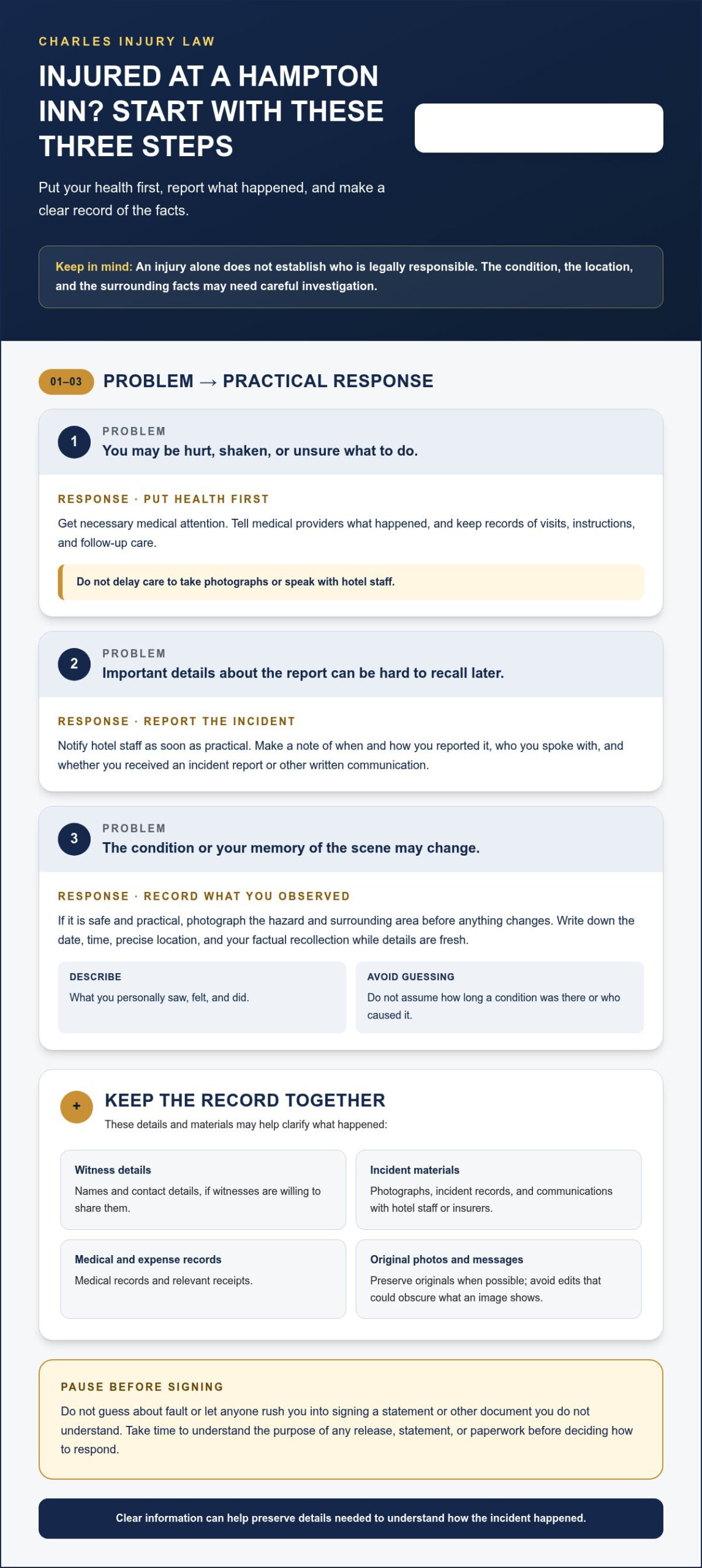
An injury at a hotel can leave you shaken, hurting, and unsure what to do next. Start with your health, then make a clear record of what happened. An injury alone doesn’t establish who is legally responsible. The location, condition, and surrounding facts matter, and they may need careful investigation. Don’t guess about fault or let anyone rush you into signing a statement or other document you don’t understand.
Use this sequence when you can:
- Get necessary medical attention. Don’t delay care to take photographs or speak with staff. Tell medical providers what happened and keep records of visits, instructions, and follow-up care.
- Report the incident. Notify hotel staff as soon as practical. Note when and how you reported it, who you spoke with, and whether you received an incident report or other written communication.
- Record what you observed. If it’s safe and practical, photograph the hazard and surrounding area before anything changes. Write down the date, time, precise location, and your factual recollection while details are fresh.
Prompt documentation can help preserve details needed to clarify how the incident happened.
What should I do immediately after a hotel injury?
Put immediate safety first. Move away from an ongoing hazard if you can do so safely, and seek medical attention for injuries that need care. When you’re able, report the incident to hotel staff and note the time, method, and person you notified. Photograph the condition and nearby area only if doing so won’t put you or anyone else at risk.
For general background on hotel-related duties and liability concepts, see Hospitality Law and Hotel Liability. That overview isn’t a substitute for evaluating the specific facts under Florida law.
What information may help document the incident?
Stick to what you personally saw, felt, and did. Note whether the incident happened in a hallway, entrance, guest room, or another area, and describe the condition without guessing how long it was there or who caused it. If witnesses are willing, record their names and contact details. Keep relevant receipts, medical records, photographs, and communications together, including messages exchanged with hotel staff or insurers.
Preserve original photos and messages when possible, and avoid editing images in ways that could obscure what they show. Don’t post assumptions or unverified allegations online. If you’re asked to sign a release, statement, or other paperwork, take time to understand its purpose before deciding how to respond. A Florida personal injury claim depends on the evidence and circumstances, not assumptions about the hotel or incident.
A lawyer for injury at Hampton Inn can help assess what information may matter and address evidence-preservation concerns. Charles Injury Law represents people in Florida premises liability matters, including hotel injuries. Call Now: (954) 390-2228 Available 24 Hours a Day, 7 Days a Week
When Could an Injury at a Hampton Inn Support a Florida Claim?
Premises liability addresses injuries connected to the condition or use of property. But being hurt at a hotel doesn’t, by itself, prove that a business or property owner is legally responsible. A claim depends on evidence connecting the injury to a dangerous condition and showing that the responsible party may be accountable under Florida law.
Responsibility for a hotel injury depends on the facts and the Florida law that applies. An investigation may examine where the incident occurred, what condition caused it, who controlled that area, and whether the relevant party knew or should have known about a hazard. For a slip and fall involving a transitory substance, Florida Statute § 768.0755 addresses what must be shown about the business’s actual or constructive knowledge of the condition. The precise facts matter.
Florida’s lodging statutes provide context about lodging establishments, but they don’t automatically resolve who is liable for a particular injury. The Florida Statutes for Lodging Establishments should be considered alongside the premises-liability rules and evidence relevant to the incident.
Who may be responsible for a hotel injury?
The responsible party may depend on who controlled the area and the condition that caused the injury. A hotel’s brand alone doesn’t establish whether the brand, property owner, operator, or another business had control. Records about the location, property management, maintenance, and incident may help identify the appropriate party. Don’t assume that a particular company owns or operates a property based only on its name or signage.
How does the incident affect the liability analysis?
The type of incident shapes which facts need review. A fall on a wet floor, an injury involving equipment, a pool incident, and harm connected to security concerns raise different questions. For a spill, evidence about its visibility, how long it may have been present, and whether staff knew about it can matter under Florida law. No incident type proves negligence on its own.
Other evidence may include inspection and maintenance records, reports of earlier problems, witness accounts, and available photographs or video. The purpose is to establish what happened, not to rely on assumptions or allegations about unrelated properties. Charles Injury Law’s Florida premises liability representation involves evaluating property-related injuries against the evidence and applicable Florida law.
If the responsible party or key facts are unclear, a lawyer for injury at Hampton Inn can help assess which records and evidence may clarify the claim. Charles Injury Law can review the circumstances and explain practical next steps without assuming that the hotel brand alone determines liability.
What Evidence Can Clarify Responsibility After a Hampton Inn Injury?
A thorough investigation starts with what can be verified. Your observations, photographs, witness accounts, and medical records may help explain what happened. Online posts, rumors, and allegations about other properties don’t establish what occurred where you were injured. Keep your account factual, and distinguish what you saw from what someone else told you.
Evidence can help answer practical questions: Where was the hazard? What did it look like? Who saw it? Was the condition reported or documented? Different records may reveal different parts of the story, and no single item automatically proves responsibility.
Which records and observations may matter?
Photographs can show the condition and surrounding area as they appeared at the time. Witnesses may describe what they observed before or after the incident. An incident report or related communications may record when the event was reported and what information was shared. If the injury involved a fall, photos of the walking surface, lighting, and nearby warning signs may be relevant. The firm’s Florida slip and fall guidance addresses why incident-specific details matter.
Maintenance or inspection records may help clarify how a reported property condition was handled. Medical documentation can connect the incident to the care you received and describe the injury’s effects. Which records are available and relevant depends on the circumstances and investigation.
Surveillance video may also be useful if it captured the area or incident. Its existence, coverage, and availability can’t be assumed. Don’t rely on online descriptions or secondhand claims as proof that footage exists or shows what happened.
Why act promptly to preserve evidence?
Conditions can change. A spill may be cleaned, an object moved, or a repair made. Memories can also fade. That doesn’t mean evidence will always be lost, but a clear record made close to the incident can help preserve details for later review.
Keep original photographs, videos, and messages when possible. Record when and where each image was taken, and avoid altering files in ways that could affect what they show. Save relevant communications and medical documents in one place. If you have only a brief note or a single photograph, preserve it anyway; an incomplete record can still provide a useful lead for further investigation.
Charles Injury Law investigates hotel accidents, gathers relevant records, and works to preserve critical evidence. When appropriate, the firm may consult experts to help assess technical questions raised by the facts. A lawyer for injury at Hampton Inn can evaluate firsthand evidence, identify gaps, and separate supported facts from assumptions. That careful review can help clarify what happened and who may be responsible under Florida law.
What Compensation and Claim Challenges May Matter in a Florida Hotel Injury?
A hotel injury claim may involve financial losses and personal harms, but no category guarantees compensation. The facts, available documentation, medical evidence, and Florida law all affect what may be considered. Keep records as your care and recovery continue. They can help show how the injury has affected your health, work, and daily life.
Which losses may be considered?
Potential damages are generally grouped into economic losses, which can be documented financially, and non-economic harms, which relate to personal effects. The table offers examples, not a promise of recovery. Whether a loss applies depends on the injury, supporting evidence, and applicable law.
| Category | Examples and possible supporting information |
|---|---|
| Documented financial losses | Medical expenses and future care may be supported by bills, treatment records, and medical recommendations. Lost wages may be documented through employer or payroll records. A claim for reduced future earning capacity is distinct from missed pay and may require information about how the injury affects the ability to work. |
| Non-economic harms | Pain and suffering, emotional distress, and lasting effects may be considered where applicable. Their relevance depends on the injury and evidence describing its impact, including medical documentation and information about changes to everyday activities. |
Keep copies of records related to the injury and its effects. Don’t assume that an expense, missed shift, or ongoing symptom will automatically be included in a claim. The connection between the incident, the injury, and the loss must be evaluated.
What can complicate a hotel injury claim?
Disagreements can arise over how the incident happened, who controlled the area, whether a hazardous condition existed, or what the evidence shows. An insurer may assess responsibility and damages differently from the injured guest. Medical history, gaps in treatment, or conflicting accounts may also prompt questions about causation, meaning whether the incident caused or worsened the claimed injury.
Florida follows a modified comparative negligence rule under Florida Statute § 768.81. In general, a person found more than 50% at fault is barred from recovering damages; if the person is 50% or less at fault, damages are reduced by their share of fault. How the rule applies depends on the facts and legal claims involved.
Filing deadlines in Florida can be strict, and the applicable deadline may depend on the circumstances and law governing the claim. Don’t rely on assumptions or wait to have the timing assessed. A lawyer for injury at Hampton Inn can review the evidence, claimed losses, and potential fault issues without estimating a case value or promising an outcome.
If you’re dealing with medical costs, lost income, or disputed responsibility, contact Charles Injury Law to discuss your Florida hotel injury claim.
How Charles Injury Law Helps After an Injury at a Hampton Inn
A hotel injury claim can leave you handling pain, paperwork, and questions from an insurer at the same time. Charles Injury Law provides hands-on representation for premises liability claims, with direct attorney access and clear communication. The process focuses on understanding the facts, building the claim, and pursuing a resolution while keeping your recovery in view.
The work generally moves through four stages:
- Evaluation and investigation: An attorney reviews the incident, available records, injuries, and potential responsible parties. The firm investigates the facts and works to preserve relevant evidence.
- Negotiation: Once the evidence and damages can be evaluated, the firm communicates with insurers and negotiates for a fair resolution supported by the claim.
- Litigation preparation: If negotiations don’t produce a fair settlement, the firm prepares the case for litigation. Trial-ready preparation helps organize the evidence and legal arguments for the next step.
- Resolution: The firm guides you through available options and the resolution process. No outcome is guaranteed, and decisions depend on the facts and applicable law.
What happens during a free consultation?
During a free consultation, an attorney reviews what happened, answers your questions, and discusses possible legal options. Share a clear account of the incident and any records you have, such as photographs, medical documents, or communications. You don’t need to know who is legally responsible before speaking with the firm. The consultation is a chance to discuss the facts, not a promise that a claim will qualify for compensation or achieve a particular result.
How does the firm move a claim forward?
If the firm moves forward with representation, it investigates the incident, gathers relevant evidence, reviews medical documentation, and handles communication with insurers. The team evaluates current losses and potential future effects, using available information to understand how the injury may affect treatment, work, and daily life. Direct attorney access and clear updates help you understand what is happening and what decisions may be ahead.
Negotiations are grounded in evidence, not assumptions. If a fair settlement isn’t reached, Charles Injury Law can continue preparing the case for litigation and trial. This approach supports the claim while keeping your options clear.
Charles Injury Law represents people in premises liability matters, including hotel injuries. The firm works on a contingency-fee basis: No Fees Unless We Win, meaning no attorney fees are owed unless the firm recovers compensation for you.
If you were injured at a Hampton Inn, a lawyer for injury at Hampton Inn can help assess the evidence, potential damages, and next steps. Call Now: (954) 390-2228 Available 24 Hours a Day, 7 Days a Week
Take the Next Step Toward Clarity
You don’t have to resolve every question before asking for legal guidance. Start with the concern that weighs on you most, whether it’s uncertainty about responsibility, the effect of the injury on your work, or what to expect from an insurance conversation. A lawyer for injury at Hampton Inn can discuss the circumstances with you and help you consider a practical path forward under Florida law.
Before reaching out, jot down your questions and gather any records you can readily access. Don’t worry if your information is incomplete. Clear guidance can help you understand what may matter in your situation and which steps make sense next.
Charles Injury Law is ready to hear your concerns and discuss your options. Call Now: (954) 390-2228 Available 24 Hours a Day, 7 Days a Week
One informed step can make the way forward feel more manageable. You deserve support while you focus on healing.
Frequently Asked Questions
Can I pursue a claim if I was injured at a Hampton Inn in Florida?
Possibly. A lawyer for injury at Hampton Inn can review whether the circumstances may support a Florida claim and explain what information could help assess it. For a useful review, note the incident date, when symptoms began, any treatment dates, and communications about the event. A clear timeline can help connect the incident with what followed and identify questions that still need answers.
Can Hilton be responsible for an injury at a Hampton Inn?
That depends on the facts. A claim against Hilton would need support connecting the company to the relevant events or property responsibilities. Booking confirmations, receipts, messages, and paperwork given to you after the incident may help clarify which businesses were involved. Keep the original documents and note who sent them. Charles Injury Law can review those records and discuss possible legal options under Florida law.
How long do I have to file a Florida hotel injury lawsuit?
For most Florida negligence claims, the general filing deadline is two years from the incident under Florida Statute § 95.11. A different deadline may apply depending on the claim and parties involved. Incidents before March 24, 2023, may fall under the prior four-year deadline. Don’t rely on these general rules to calculate your own deadline; share the incident date and relevant details with an attorney promptly.
Can I recover compensation if I was partly at fault for my hotel injury?
Possibly. If you’re concerned about something you did before or during the incident, write down the full circumstances rather than relying on a brief exchange with an insurer or hotel representative. Keep notes of questions asked and answers given, and don’t treat an early opinion as a final legal assessment. An attorney can review the complete account and discuss how Florida law may apply without promising a particular result.
Does filing a hotel incident report prove that the hotel was negligent?
An incident report records a reported event; it doesn’t decide the legal claim. If you receive a copy, check that basic details such as the date, time, and location match your recollection. Make a separate note of anything you believe is missing or inaccurate, and keep the report with related correspondence. That gives you a clear record to refer to if questions arise later.
Will insurance pay my medical bills after an injury at a Hampton Inn?
Payment isn’t automatic. Coverage and the handling of medical bills depend on the policies and circumstances involved. Keep each bill, payment notice, and insurer letter together, and note any response deadlines or requested documents. If an insurer asks for a statement or records, understand what it’s requesting before responding. Charles Injury Law can review the available information, communicate with insurers, and explain potential sources of recovery in your situation.
Disclaimer
The information provided on this blog is for general informational purposes only and does not constitute legal advice. Viewing this content does not create an attorney-client relationship with the firm. You should not act or rely on any information contained herein without seeking legal advice from a qualified attorney regarding your individual situation.