

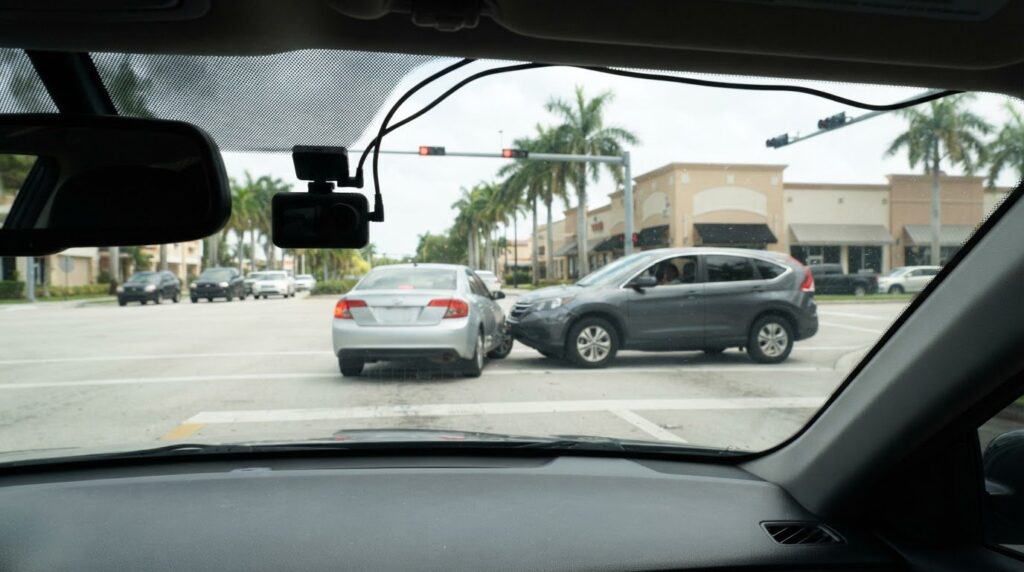

What if the clearest recording of your crash is on someone else’s dash cam? Using dash cam footage in a car accident case can help show what happened, but it does not automatically prove fault. It may also raise questions about your own actions. Even a clear video may not tell the whole story or resolve a claim.
It makes sense to hope the recording will speak for itself. But a court may consider whether the footage is relevant, authentic, and presented in context, while an insurer may focus on details that support its interpretation. Video can also miss events outside the camera’s view.
This article explains how dash cam footage may strengthen or hurt a Florida car accident case, how its reliability and limitations are assessed, and what to do promptly if another driver, a business, or a bystander may have recorded the crash. It also explains how legal help can support the preservation and evaluation of video evidence.
Key Takeaways
- Preserve the original recording and storage device, and avoid editing or posting the footage.
- Video may help clarify driver actions and crash details, but it can also reveal conduct that raises questions about fault.
- Courts may assess whether footage is relevant, authentic, and presented with enough context to show what it depicts.
- If another vehicle or nearby camera may have captured the crash, act promptly to help preserve the recording.
- Legal guidance can help evaluate video evidence and its role in a Florida car accident injury claim.
Can Dashcam Footage Ever Hurt My Case?
Yes. A recording can support your account, but it may also show conduct an insurer argues contributed to the crash. Preserve the complete file and its context before deciding how to use it.
Preserving Original Recordings and Devices
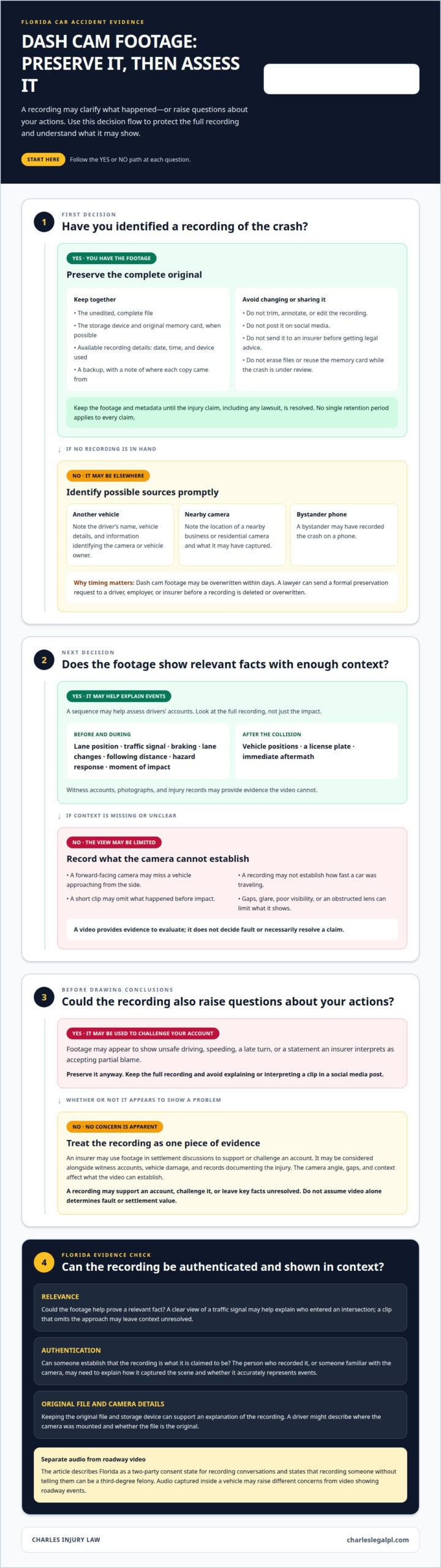
Preserve the original recording by keeping the unedited file, its storage device, and details such as the recording date, time, and device used. Trimming, annotations, or missing context can prompt questions about accuracy. Save a backup, keep the original memory card when possible, and note where each copy came from.
Don’t post the video on social media or send it to an insurer before getting legal advice. A short clip may omit what happened before impact or make a driver’s actions appear different from the complete recording. Preserve the full file, not just the seconds that seem helpful.
Keep the footage and metadata until your injury claim, including any lawsuit, is resolved. No single retention period applies to every claim, so don’t erase files or reuse a memory card while the crash is under review.
Another driver’s camera may hold important evidence, but its owner may not provide a copy voluntarily. Record the driver’s name, vehicle details, and any information identifying the camera or vehicle owner. Act promptly. A lawyer can send a formal preservation request to the driver, employer, or insurer before the recording is deleted or overwritten.
Dash cam footage may be overwritten within days. If you know a vehicle recorded the collision, request preservation promptly rather than waiting for settlement discussions. Other possible sources include a nearby business or residential camera, or a bystander’s phone. Note each camera’s location and what it may have captured.
Footage and Case Outcomes
Dash cam footage may affect comparative negligence by showing actions relevant to each driver’s responsibility. An insurer may also use it in settlement discussions to support or challenge an account of events. The complete recording matters: a clip showing your vehicle entering an intersection may omit what happened just before.
Footage can hurt if it appears to show unsafe driving or a statement accepting partial blame. Preserve it anyway, and avoid explaining or interpreting a clip in a social media post. In a Florida car accident injury claim, the recording is one piece of evidence; its angle, gaps, and context affect what it can establish. Don’t assume a video alone determines fault or settlement value.
How Do Dash Cams Help a Personal Injury Case?
A dash cam can record a sequence that drivers remember differently after a collision. Video may show lane position, a traffic signal, braking, or the moment of impact. For example, footage showing one vehicle entering an intersection as another approaches can help assess each driver’s account. The camera does not decide fault; it provides evidence to evaluate.
Useful footage often captures more than the impact. The seconds before a crash may show whether a driver changed lanes, followed closely, or reacted to a hazard. The immediate aftermath may show vehicle positions or a license plate. A witness may explain details beyond the camera’s view, while photographs and injury records can provide evidence the video cannot.
Context matters. A forward-facing camera may miss a vehicle approaching from the side, and a recording may not establish how fast a car was traveling. Review the full sequence alongside other evidence instead of treating a short clip as the whole event. Gaps, glare, poor visibility, or an obstructed lens can limit what the footage establishes.
Dash cam evidence can also work against the person who recorded it. A video might appear to show speeding, a late turn, or a statement an insurer interprets as accepting blame. Preserve the full recording and avoid drawing conclusions from a single frame. An insurer may weigh the video alongside witness accounts, vehicle damage, and records documenting the injury.
Comparative fault and no-fault rules vary by jurisdiction, so a rule from another state does not determine how a Florida claim is assessed. In Florida, the available evidence is considered in relation to responsibility and the injury claim. A recording may support a driver’s account, challenge it, or leave key facts unresolved. Settlement discussions may reflect these competing interpretations.
Privacy depends on what the dash cam records. Florida is described as a two-party consent state for recording conversations, and recording someone without telling them can be a third-degree felony. Audio captured inside a vehicle may therefore raise different concerns from video showing roadway events.
If footage raises questions about fault or liability, discuss how it relates to your injury claim. A careful review can place the camera’s view beside the other evidence, identify what the video supports, and distinguish visible facts from assumptions.
Authentication and relevance for admissibility
In a Florida car accident case, dash cam footage is useful only if it can help prove a relevant fact. Its reliability matters too: the video should fairly and accurately show the collision and surrounding events. A clear view of a traffic signal may help explain who entered an intersection, while a clip that omits the approach may leave important context unresolved.
Authentication means establishing that a recording is what someone claims it is. The person who recorded the footage, or someone familiar with the camera, may need to explain how it captured the scene and whether it accurately represents the events. For example, a driver could describe where the camera was mounted and whether the file is the original recording.
Preserving the original file helps support that explanation. Keep the recording in its original format, along with the storage device and available details about the camera and recording time. If the video has a gap, note it rather than trying to fill or edit it. An unexplained interruption can raise questions about what happened before or after the footage.
Relevance concerns whether the recording helps establish a disputed point. A forward-facing camera showing a vehicle crossing a lane may relate to how a collision occurred. A camera pointed away from the impact may show weather or road visibility, but not which driver caused the crash. Consider each clip for what it actually captures.
Image quality can affect how a court assesses footage. Darkness, glare, an obstructed lens, low resolution, or missing frames may make a vehicle’s movement difficult to interpret. The video might show brake lights without revealing when the driver began braking. A witness familiar with the scene can explain visible details, but should not guess about speed or distance the recording cannot establish.
In a Florida civil case, relevant and reliable footage may support a claim, but a recording is not automatically accepted simply because it exists. A court may consider whether it is edited, misleading, incomplete, or affected by evidence or privacy concerns. Opposing counsel may challenge the camera angle, image quality, gaps, or interpretation. The complete file and a clear account of how it was created can help address those challenges.
Before presenting footage to an insurer or in court, connect each relevant moment to a specific issue, such as lane position, a signal, or the sequence of impact. Keep your explanation within what the video shows. If the image cannot establish weather or timing, other evidence may be needed to explain those details.
Is Dash Cam Footage Admissible as Evidence in Florida?
In a Florida car accident claim, dash cam footage may help establish what happened, but recording a crash does not guarantee the video will be admitted. Relevance, authenticity, and context matter.
Showing Accident Events and Driver Behavior
Footage can document visible events, such as a driver changing lanes, braking, or leaving the scene. That sequence may help explain how a collision occurred and give insurers or a court details to assess.
A camera may capture a fleeing vehicle’s license plate, road conditions, or the immediate aftermath. But it may show only what falls within its field of view, missing a vehicle approaching from the side. Compare the recording with other evidence before drawing conclusions about driver behavior or fault.
Footage That May Undermine a Case
A recording can show conduct an insurer may argue contributed to the crash. For example, footage might appear to show unsafe driving or a statement that could be interpreted as accepting partial blame. Review the complete recording and its context, not just a favorable clip.
Video cannot capture a person’s pain or fully establish the severity of an impact. It may also miss events outside the lens or the sequence before impact. Those limits matter when footage is used to challenge a compensation claim.
Obtaining and Analyzing Another Driver’s Footage
In Florida, a driver or vehicle owner generally is not required to share a recording unless it is subpoenaed. In a Florida lawsuit, footage may also be requested through discovery or sought by subpoena or court order. If another vehicle may have recorded the crash, promptly identifying its owner matters because recordings can be overwritten.
Obtaining, enhancing, or analyzing footage may involve different costs. The price depends on the case and is provided after a quote request. Factors may include retrieval, enhancement, expert analysis, and litigation needs. Enhancement may clarify visible details, but it cannot recreate events the camera never captured.
In Florida, a court may consider whether footage is relevant and can be authenticated. The person who recorded it, or someone familiar with the device, may need to explain its accuracy. Editing, gaps, poor quality, or privacy concerns can affect its use. Keep the original file and document how it was preserved.
If another party’s recording may help clarify a crash, discuss how to preserve and assess the footage.
Finding dash cam footage from other vehicles
A witness may have recorded a collision even if your vehicle had no camera. Finding that driver promptly can help preserve footage before it is overwritten or lost.
Start with the vehicles and people present at the scene. Note descriptions, license plates, vehicle types, and any visible camera mounted near a windshield or dashboard. A rideshare vehicle, delivery truck, or car stopped nearby may have recorded the roadway. Ask witnesses whether they saw a camera or know who was driving it.
Write down witnesses’ names and contact details, along with what each person remembers about the vehicle and recording. Keep notes factual. For example, record that a witness saw a camera facing the intersection rather than assuming it captured the impact. This helps an attorney identify useful leads without overstating what the video may show.
Act promptly. Dash cam systems may overwrite footage within days, so a delay can erase a useful view of the crash. If you identify the driver or vehicle owner, send a clear request to preserve the recording. Include the collision date, approximate time, location, and enough vehicle details to identify the relevant camera and footage.
The driver or owner generally is not legally required to share a recording unless it is subpoenaed. A lawyer may send a formal preservation request to the driver, an employer, or an insurer before the file disappears. If a lawsuit proceeds, dash cam footage may be subject to discovery requests, subpoenas, or court orders. Keep notes on when and how you identified each potential recording.
Other cameras may fill gaps. A nearby business could have security video covering its driveway, while a residential camera may show traffic approaching the intersection. A bystander’s phone might capture the immediate aftermath. Record the business or property location and the camera’s likely direction, then identify who controls the footage. Another source may show events your vehicle’s camera could not capture.
Once footage is located, assess what it actually shows. A front-facing camera might capture a vehicle’s approach but miss a car entering from the side. A recording could identify a hit-and-run vehicle’s license plate without showing who was driving. Video may also contain statements or sounds that need separate review. Keep the complete recording and avoid relying on a short clip alone.
If another driver, employer, or insurer may hold relevant footage, contact an attorney about preserving the recording. A timely preservation effort can protect evidence while its source and role in the crash are still identifiable.
Personal Injury Attorney in Fort Lauderdale
Personal Injury Attorney in Fort Lauderdale, a personal injury firm in Fort Lauderdale, can assess dash cam footage in an injury claim after a Florida crash. The firm represents people injured in car, truck, and rideshare accidents and can evaluate how video evidence fits the claim.
When choosing a personal injury lawyer in Fort Lauderdale, Miami, West Palm Beach, Boca Raton, Delray Beach, Boynton Beach, Lake Worth, Orlando, or Tampa, look for counsel who can assess a recording alongside your account. Personal Injury Attorney in Fort Lauderdale represents people injured in vehicle accidents and can help explain how footage may affect a claim.
If you have questions about crash footage or an injury claim, contact Personal Injury Attorney in Fort Lauderdale.
Call Now: (954) 390-2228 Available 24 Hours a Day, 7 Days a Week
Make Your Next Move With a Clear Plan
The next step is to connect the recording to the broader account of the crash. A timeline can show how the video relates to witness statements, photographs, and records of your injuries. That context matters when another party challenges what the footage appears to show.
A lawyer can assess how using dash cam footage in a car accident case fits the evidence, identify unanswered questions, and help you consider how to respond to an insurer. If the recording came from another vehicle, explain what you know about its source and when you learned it may exist. Keep your account factual, and don’t assume the video proves more than it captures.
Personal Injury Attorney in Fort Lauderdale represents people injured in vehicle accidents. If you want help understanding how video evidence may affect your claim, contact Personal Injury Attorney in Fort Lauderdale to discuss your situation. A thoughtful next step can help you move forward with greater clarity.
Frequently Asked Questions
Do You Need a Lawyer If You Have Clear Dash Cam Footage?
Not automatically. Clear video can clarify a disputed sequence, but it does not assess injuries, damages, or events outside the lens. A lawyer may help if the recording contains statements an insurer could interpret against you, another driver controls the camera, or the claim involves serious injuries. Counsel can review the footage alongside medical records and communications before you decide how to present it. This information is general and is not legal advice.
How Can Dash Cam Footage Help After a Car Accident?
It can create a visual timeline of events before, during, and just after impact. For example, footage may show when a vehicle entered an intersection in relation to a traffic signal, then help compare that sequence with witness accounts. It may also capture vehicle positions immediately after a collision. Reviewing the full clip alongside photographs and records can reveal details that a brief verbal description might omit.
Can Dash Cam Footage Prove Who Was at Fault?
Footage can support or challenge a driver’s account, but it does not prove fault by itself. A camera might show one vehicle crossing a lane line yet fail to capture a car approaching from the side. The camera’s view, recording quality, gaps, and events before impact affect what the video can establish. Consider whether other evidence supports the same interpretation before treating a visible action as proof of responsibility.
How Does Dash Cam Footage Affect an Insurance Claim?
An insurer may use footage to assess the sequence of events, compare drivers’ accounts, and evaluate disputed responsibility. The same clip can support one part of a claim while raising questions about another. For instance, a video may show the impact clearly but not explain the resulting injuries. Keep your account accurate and don’t treat the recording as a complete picture of your losses.
How Can Dash Cam Footage Help Prove Fault in a Car Accident Case?
When using dash cam footage in a car accident case, connect specific images to the disputed issue. A frame showing a vehicle beside a lane marking may clarify its position; the seconds that follow may show whether it moved before impact. Note what the camera actually captures rather than assuming it establishes speed or distance. Other evidence may be needed to explain details beyond the video’s view.
How Do Courts Authenticate Dash Cam Footage and Establish That It Has Not Been Altered?
A court may consider testimony from the person who recorded the video or someone familiar with the camera. That person can explain where the device was mounted and whether the footage accurately depicts the events. Keeping the original file, its metadata, and the storage device can help explain its source and handling. Editing, unexplained gaps, or misleading presentation may prompt challenges to the recording’s reliability.
What Steps Should I Take to Preserve and Back Up Dash Cam Footage After a Crash?
Save the complete recording in its original format, then make a separate backup without changing the original file. Keep the memory card or storage device when possible. Record the date, time, device used, and where each copy is stored. Preserve footage from before and after the impact, not just the collision itself. Keep the files and metadata while the injury claim is being resolved, and don’t post or annotate the recording.
Can Police, Insurance Companies, or Opposing Lawyers Require Me to Provide Dash Cam Footage?
In Florida, a driver or vehicle owner generally is not required to share footage unless it is subpoenaed. In a Florida lawsuit, recordings may also be sought through discovery or a court order. The circumstances of a police request may differ, so this is not a blanket rule for every request. Before providing footage to an insurer or another party, get legal advice about the specific request. This FAQ provides general information, not legal advice.
Disclaimer
The information provided on this blog is for general informational purposes only and does not constitute legal advice. Viewing this content does not create an attorney-client relationship with the firm. You should not act or rely on any information contained herein without seeking legal advice from a qualified attorney regarding your individual situation.