

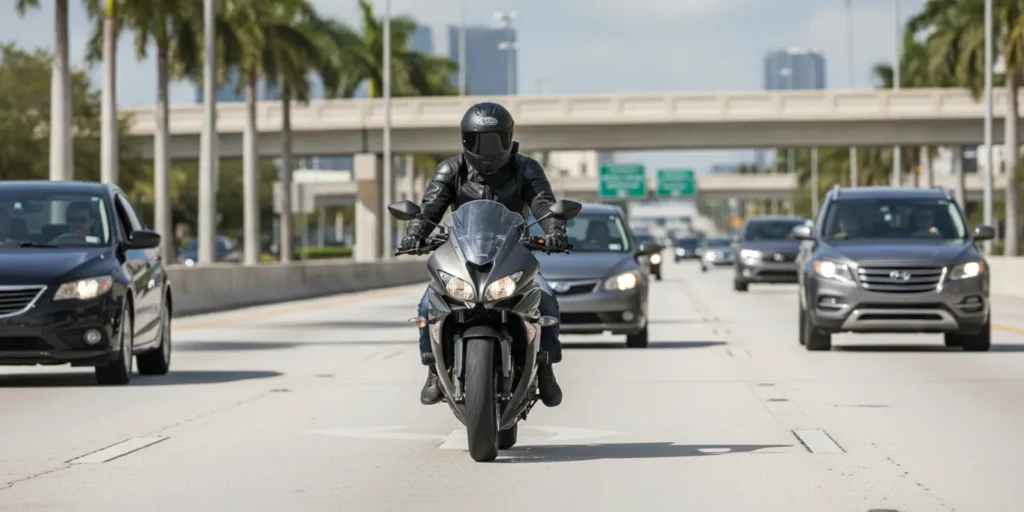
If you are researching a motorcycle lane splitting Florida crash, the short answer is that Florida generally prohibits a motorcycle from riding between lanes of traffic or between adjacent lines or rows of vehicles. A crash still needs a careful, fact-specific review: the rider’s position is important, but so are the actions of drivers, the road layout, and the available evidence.
Call (786) 525-8784 or request a car accident case review.
This article gives general information, not legal advice. It cannot determine who caused a particular collision or whether a specific person has a claim. If a crash has left you injured, consider getting medical attention and preserving available information before drawing conclusions about fault.
What does lane splitting mean?
Lane splitting generally describes a motorcycle moving between lanes of traffic traveling in the same direction. A rider may travel along the painted line between two lanes, passing cars that are moving or stopped. People may also use terms such as “white-lining” or “filtering,” although the words are not always used consistently. The practical question is where the motorcycle was in relation to marked lanes and other vehicles when it moved through traffic.
That is different from a rider traveling within a normal lane while cars occupy the lanes beside it. It is also different from a motorcycle changing lanes through an available gap and then continuing within the new lane. Those situations can have different facts, even if a witness casually describes all of them as “weaving.” A careful review should focus on what actually happened rather than relying on a label.
For example, imagine a motorcycle following a car in the same lane, then moving into an open adjacent lane before proceeding. That is not the same movement as riding on the lane divider between a line of cars. Or imagine a motorcyclist traveling in a marked lane while a car drifts across the line. A collision near a lane marker does not by itself establish which vehicle crossed it first or why.
When discussing any crash, be precise about whether the motorcycle was between lanes, changing lanes, traveling in a marked lane, or stopped. The difference can guide what evidence to look for and what questions should be answered.
Is lane splitting legal in Florida?
Florida generally prohibits a person from operating a motorcycle between lanes of traffic or between adjacent lines or rows of vehicles. In plain terms, a motorcyclist should not ride down the space separating two lines of traffic. The rule is different from permitted lane use by a motorcycle within a lane, and it should not be confused with another jurisdiction’s rules. Traffic laws can be amended and their application depends on the circumstances, so have a Florida attorney verify the current law before relying on it for a specific situation.
Florida also treats motorcycles as vehicles that use the roadway and lanes, subject to traffic laws that apply to their operation. A rider should not assume that a narrow gap becomes an authorized lane simply because cars are stopped or moving slowly. Similarly, a driver should not assume that a motorcyclist’s unlawful movement gives every other road user permission to disregard ordinary care.
The distinction matters after a crash. If evidence supports that a rider was traveling between lines of traffic, that conduct may become part of the liability analysis. But it does not automatically resolve every issue. Investigators may still need to ask several questions. Did a driver change lanes, open a door, turn, or move without checking? Where was each vehicle, how quickly was it traveling, and did anyone have a reasonable chance to avoid the impact?
Because this is a legal rule and the details matter, this draft should receive attorney review before publication. Do not treat a general explanation as a ruling on a particular crash, or as advice to ride in any specific way.
What is the difference between lane splitting, lane sharing, and a lane change?
These phrases describe different riding patterns. Separating them can prevent a witness’s brief description from taking the place of the evidence.
- Lane splitting: A motorcycle proceeds between lanes or lines of vehicles traveling in the same direction. Florida generally prohibits this movement.
- Lane sharing: People sometimes use this phrase for two motorcycles riding side by side within one lane. Do not assume that “sharing” and traveling between lanes mean the same thing; the actual position and applicable law need review.
- Lane change: A motorcycle moves from one marked lane to another and then travels within that lane. Relevant facts may include whether there was space, how the movement was signaled, and whether another vehicle was already occupying the path.
- Riding in a lane: A motorcycle travels within a marked lane. A crash can still occur if another road user enters that lane or if the rider loses control for another reason.
This list is a plain-language guide, not a technical legal definition for every circumstance. When a collision happens near a lane line, it is useful to record the positions of the vehicles and the sequence of movements instead of relying on a single term.
How do these motorcycle movements differ?
| Movement | What it generally describes | Why it may matter after a crash |
|---|---|---|
| Lane splitting | A motorcycle moving between lanes or rows of vehicles traveling in the same direction. | The review may focus on where the motorcycle was relative to marked lanes and nearby vehicles. |
| Lane sharing | Two vehicles using the same lane, sometimes side by side. | The available space, each vehicle’s position, and any change in direction can all matter. |
| A normal lane change | A vehicle moving from one marked lane into another. | Signals, mirrors, speed, and whether the receiving lane was open may be part of the account. |
How can a motorcycle lane splitting Florida crash affect a claim?
Lane position may be one part of the account of how a crash happened. If a rider was between lanes, that fact can raise questions about whether the rider’s movement complied with traffic rules and whether it contributed to the impact. If a car crossed into the motorcycle’s lane, that movement may also need investigation. The facts may point in more than one direction, and responsibility cannot be determined from the type of vehicle or one person’s initial description alone.
A review commonly starts with a sequence of events: where each vehicle was before the collision, what each person did, when those movements began, and where the impact occurred. Road markings, traffic signals, stopped or moving vehicles, sight lines, lighting, weather, and obstructions may help explain that sequence. The condition of the roadway and the location of debris or vehicle damage can also be relevant, depending on what can be reliably documented.
For instance, a driver may say a motorcycle appeared suddenly between two rows of cars. The rider may say a vehicle moved across the lane line without warning. A camera may show part of the event but not the approach, while a witness may have seen the approach but not the contact. Each account should be compared with the physical and recorded evidence. A conclusion reached before that comparison may miss important details.
Fault may be disputed even when one traffic rule appears relevant. A lawyer reviewing a potential claim may consider whether a party’s conduct contributed to the collision, what evidence supports that account, and how Florida law applies. Do not assume that a traffic citation, an insurance adjuster’s early view, or a driver’s apology answers every civil-liability question. Those facts may matter, but they are not necessarily the complete analysis.
To understand how a collision investigation can relate to an injury matter, see the firm’s car accident practice page. It describes the firm’s stated approach to reviewing accident matters. A page description cannot predict whether the firm will accept a particular case or what its outcome might be.
Which evidence may help explain what happened?
Evidence is most useful when it helps establish time, location, movement, visibility, or impact. A person involved in a crash may not be able to collect everything, and safety should come first. If it is safe and practical, preserving what is already available can make later discussions more specific.
Photographs and video
Photographs of the scene may show lane markings, intersection layout, traffic controls, sight lines, vehicle positions, damage, and visible road conditions. Take images from a safe place; do not enter traffic or interfere with emergency responders. A close-up of vehicle damage may be useful, but wider views can show context that a close-up cannot. Note when and where the images were taken, and keep original files when possible.
Nearby cameras may capture a roadway or business entrance, while a vehicle camera may record part of a trip. Video can be overwritten or unavailable, and a camera may not show the full sequence. If someone knows of a recording, record who controls it and when the footage was identified. Avoid editing or circulating a clip as though it shows the entire event if it is only an excerpt.
Witness accounts and official records
Witness names and contact details can be helpful, especially when people saw the vehicles before impact. Memories can fade, and witnesses may have seen different portions of the event. Write down what each person says in their own words rather than trying to make separate accounts match. If law enforcement responded, retain the available report information and ask how to obtain a copy. A report can document observations and statements, but it may not answer every question about fault.
Vehicle and roadway details
Record the vehicles involved, visible damage, approximate points of contact, and where the vehicles came to rest if that information is available. Preserve relevant repair estimates, towing documents, and communications from insurers. Do not assume that damage alone proves the exact movement of a vehicle; it should be considered alongside scene evidence, photographs, accounts, and other reliable material.
Conditions can matter, too. Note whether traffic was stopped or moving, whether the road was wet, whether light or glare affected visibility, and whether construction or parked vehicles limited sight lines. A short factual note made soon after the event may help someone remember details later. Avoid adding guesses about speed or distance when you do not know them.
Medical and personal records
If you were hurt, seek appropriate medical care and follow the instructions of your treating professionals. Keep records of appointments, symptoms, recommended follow-up, and expenses. This is not a substitute for medical advice. A legal reviewer may need to understand the reported injury and its connection to the collision, but no single document guarantees a legal conclusion.
Keep communications about the crash organized. Save letters, claim numbers, messages, and the names of people you spoke with. Be accurate if you describe the event. If you do not remember a detail, it is better to say so than to fill in a gap with an estimate presented as fact.
What should you do after a motorcycle crash involving lane splitting?
The right immediate response depends on safety and the condition of the people involved. The following steps are practical considerations, not a substitute for emergency services, medical care, or legal advice.
- Get to safety if possible. Move away from immediate danger only when you can do so safely. Call emergency services when needed and follow responders’ directions.
- Get medical attention. If you may be injured, seek appropriate care. Do not delay necessary care while trying to investigate the legal implications of lane position.
- Exchange and record basic information. When safe, collect the names and contact details of the people involved and available witness information. Note the responding agency or report details if applicable.
- Preserve what you can safely preserve. Photograph the scene, vehicles, and visible conditions from a safe location. Save original images and relevant messages or records.
- Make a factual timeline. Write down what you remember about the route, traffic, lane positions, and sequence. Separate what you saw from what someone else told you and from what you are unsure about.
- Be careful with conclusions. Avoid guessing about fault, speed, or legal responsibility. If you receive questions about the event, answer truthfully and consider getting advice about your situation before making statements you do not understand.
- Ask a lawyer to review case-specific questions. A lawyer can consider the available facts and explain what additional information may matter. Asking for a review does not itself establish representation.
These steps do not guarantee that evidence will be available or that a claim will succeed. They are intended to help preserve a clear record while prioritizing safety and care.
What questions help reconstruct the sequence of a crash?
A useful review turns a broad disagreement into smaller questions. “The motorcycle came out of nowhere” or “the car cut me off” may show how someone experienced the collision. Neither phrase describes every movement. A more useful account identifies what the person saw, where it happened, and what happened next. This does not require a witness to know the law or to guess at another person’s intentions.
Where was each vehicle before the contact?
Start with the roadway layout. Was there one lane in each direction, several marked lanes, a turn lane, a merge area, or a nearby intersection? Which lane was the motorcycle using? Was it between two lanes, crossing a lane line, or fully within a lane? Where was the other vehicle? A quick sketch made from memory can help explain relative positions, provided it is labeled as approximate rather than presented as a measured diagram.
People often remember the point of impact more clearly than the moments before it. Still, the approach can matter. If the motorcycle had been behind a vehicle and then moved left, the account should describe when it began moving and how far it traveled. If a car moved right or left, describe what happened before the motorcycle became visible, if known. If the witness did not see the approach, make that limitation clear.
What changed just before impact?
Identify the event that immediately preceded contact. Did a vehicle brake, turn, merge, open a door, or move across a line? Did the motorcycle change direction or position? Was another vehicle obstructing the view? Did traffic speed up or stop? These questions are not prompts to invent an answer. “I did not see what happened before impact” is a useful boundary on what a person can report.
Timing may matter. People who have not measured a distance or speed should avoid giving a false precision. “The car moved into the next lane shortly before contact” may be more accurate than estimating a number of seconds. If a camera or other record provides a different level of detail, a reviewer can compare it with the person’s recollection.
What does the scene show, and what does it not show?
Lane lines, turn arrows, traffic signals, signs, curbs, barriers, and road surface conditions can provide context. A photograph of a line may show where lanes were marked, but it may not show where a moving vehicle was seconds earlier. A final resting position can help establish where vehicles stopped, but it does not necessarily establish their precise paths. Debris, scuffs, or damage may provide clues, but interpretation should account for when and how the scene was documented.
Look for the boundaries of each record. A photograph taken after vehicles were moved may not preserve their original positions. A video camera may face away from the approach or capture only one side of an intersection. A witness may have been looking in another direction. Knowing what a source cannot show is part of assessing what it can support.
Are the separate accounts consistent with independent information?
Compare each account with available records without assuming that a difference means someone is dishonest. A person may remember the impact differently after a frightening event. Two witnesses can observe different parts of the same sequence. A report may summarize what someone said rather than independently establish each detail. Reviewers should distinguish firsthand observations from later conclusions, and note when a detail is uncertain or disputed.
For a rider, driver, or witness, it can help to make a timeline while memories are relatively fresh. Note where the trip began, the direction of travel, the road and traffic conditions, and the events just before and after the collision. Keep the timeline factual. If a point is unclear, mark it as unclear rather than filling in a blank. Preserve the original notes and update them separately if new information changes your understanding.
Which questions remain unanswered?
A careful review may leave open questions. Perhaps the available video does not show the full approach, or no one saw whether the motorcycle was between lanes at the exact moment of impact. Write down the missing information. A list of open questions can help identify whether another witness, record, or photograph might be relevant. It can also prevent an early assumption from being repeated as if it were proven.
Not every unanswered question can be resolved. The available evidence may be incomplete, and different people may continue to disagree. The purpose of organizing the information is not to promise certainty. It is to give a lawyer or other appropriate reviewer a clearer basis for explaining what can be supported, what remains disputed, and what additional information may be worth seeking.
What facts can make a lane-splitting crash harder to review?
Some situations leave conflicting accounts. A rider and driver may each say the other moved first. A witness may have noticed the impact but not the approach. Video may begin after the key movement or show a blocked view. A road marking might be difficult to see in a photograph taken later. These gaps do not prove one version or another; they show why a conclusion should be based on the full available record.
Other complications include multiple vehicles, changing traffic patterns, a collision near an intersection, or a crash in a location where lane markings are unclear. A person may be unable to remember events because of injury or shock. A delayed report can make it more difficult to locate witnesses or recordings. These issues can affect how much can be confirmed, but they do not automatically determine the legal result.
Descriptions can also be imprecise. One person may call a motorcycle “between cars” when it was actually changing lanes. Another may say a car “cut off” a rider without knowing the other driver’s view. When possible, replace shorthand with observable details: which lane, what direction, the approximate position, and what happened immediately before contact.
Finally, a claim may involve questions beyond lane position, including the nature of an injury, insurance coverage, causation, or the applicable legal deadlines. Those matters depend on the specific facts and current law. Do not rely on a general online article to calculate a deadline, determine damages, or decide whether a claim is legally viable.
How can an attorney review a potential motorcycle crash claim?
An attorney-led review can begin by listening to the account of the collision, identifying the key disputed facts, and considering what records may help clarify them. For a lane-splitting question, that can include whether the motorcycle was between lanes or within a marked lane, how nearby vehicles moved, and what evidence documents the approach and impact. It may also involve considering the reported injury and the claim process that could apply.
Charles Injury Law describes its injury work as involving investigation, communication with insurers, and preparation for litigation when appropriate. Those are descriptions of the firm’s stated approach, not a promise about staffing, timing, acceptance, or outcome in an individual matter. Whether the firm can assist depends on a case-specific review. Its motorcycle accident page offers more information about the practice area, and its frequently asked questions page addresses general questions about injury claims.
An initial inquiry or case review is not the same as an agreement for legal representation. The firm’s disclaimer explains that an inquiry or consultation does not create an attorney-client relationship; representation ordinarily requires a written agreement. Past results, if discussed elsewhere, do not guarantee a future outcome. Read the legal disclaimer and ask about any terms that apply to your specific matter.
Injury-fee arrangements also require matter-specific explanation. Do not assume a fee structure, responsibility for expenses, or other term applies universally. Ask the lawyer to explain the proposed written agreement before deciding whether to proceed. A free initial case review does not promise that a firm will accept the matter or that a recovery will result.
Request a case review at (786) 525-8784.
Frequently asked questions
Can a motorcyclist lane split in Florida when traffic is stopped?
Florida generally prohibits riding a motorcycle between lanes of traffic or between lines or rows of vehicles. A traffic jam does not, by itself, make the space between lanes an authorized lane. Verify current law with a Florida attorney if you have a specific legal question.
Does lane splitting automatically make the motorcyclist responsible for a crash?
No single fact should be treated as an automatic answer to every liability question. Lane position and compliance with traffic rules may matter, but the other road users’ actions, the sequence of events, and the available evidence may matter too. A specific collision requires a case-specific review.
What if a car changed lanes into a motorcycle?
The account should be checked against the available evidence. Useful details may include where the motorcycle was, when the car began moving, what either driver could see, the point of impact, witness accounts, and any available video. The fact that a motorcycle was involved does not establish which person moved improperly.
Should I speak with an insurance company after a crash?
Insurance communications may be part of the claim process, but this article cannot tell you what to say or whether to provide a particular statement. Be truthful, keep copies of communications, and consider asking a Florida attorney for advice about your situation before responding to questions you do not understand.
Does contacting a lawyer mean the firm represents me?
No. The firm’s stated disclaimer is that an inquiry or consultation does not create an attorney-client relationship, and representation ordinarily requires a written agreement. Ask the firm to explain any proposed agreement and do not assume a case has been accepted until the required steps are complete.
Florida generally prohibits lane splitting, but the facts of a motorcycle crash still need careful review. If you were injured, prioritize your health, preserve what information you can safely keep, and seek advice specific to your circumstances before making assumptions about fault or the result of a claim.