



Table of Contents
-
What is Personal Injury Law? Defining Legal Advocacy in Florida
-
Common Personal Injury Claims: From Car Accidents to Premises Liability
-
The Personal Injury Legal Process: Why Aggressive Litigation Wins
-
Proving Liability: What Your Personal Injury Team Needs to Win
What is Personal Injury Law? Defining Legal Advocacy in Florida
When you’re injured because of someone else’s carelessness, the legal system offers a path to justice called personal injury law. In the Florida court system, this area of law allows victims to seek financial compensation for their losses. The core principle is negligence: when a person or entity fails to act with reasonable care, causing you harm, they can be held legally responsible.
It’s crucial to understand the difference between a high-volume "settlement mill"—a firm that quickly settles cases for less than they’re worth—and a trial-ready personal injury firm. A true advocate acts as your Protective Champion, shielding you from aggressive insurance adjusters while fighting relentlessly for the maximum results you deserve. (What is Personal Injury Law)
-
Personal Injury (PI) Law: Legal services dedicated to representing individuals who have been physically or psychologically injured as a result of the negligence or wrongdoing of another person, company, or entity.
-
Negligence: The failure to exercise the level of care that a reasonably prudent person would have exercised under the same circumstances.
-
Trial-Ready Firm: A law firm that prepares every case as if it will go to trial, signaling to insurance companies that they will not accept lowball settlement offers.
-
Protective Champion: Your legal advocate who manages every aspect of your claim, allowing you to focus on recovery while they focus on the fight.
Personal Injury vs. Private Investigation
A common point of confusion is the term "PI." While it can refer to a private investigator, in a legal context, it stands for Personal Injury. For a lawsuit, you don’t need a detective; you need an experienced lawyer. Our personal injury legal team uses evidence—police reports, medical records, witness testimony—to build a powerful case for court, proving the other party’s liability and demanding full compensation for your damages.
The Scope of Personal Injury Law in South Florida
In South Florida, personal injury law covers a wide range of incidents. The most common practice areas include motor vehicle accidents and premises liability claims. At Charles Injury Law, we focus our expertise on cases in Broward County, Miami-Dade County, and Palm Beach County. Navigating the specific Florida statutes that govern your right to recover damages is critical, and having a local, experienced attorney can make all the difference in the outcome of your case.
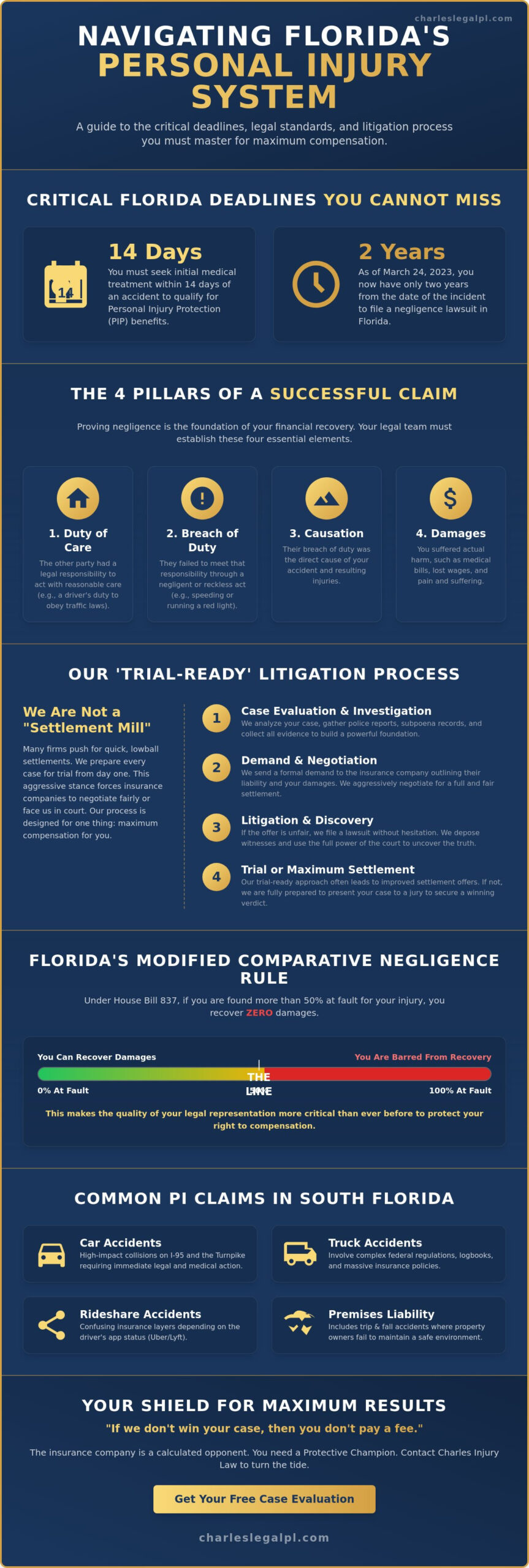
Common Personal Injury Claims: From Car Accidents to Premises Liability
While personal injury law is broad, certain claims are particularly frequent in the bustling communities of Fort Lauderdale and Miami. Car accidents are a daily reality, but the legal complexities extend far beyond a simple fender-bender. Trucking and rideshare accidents, for example, involve layers of corporate liability and insurance policies that require an aggressive legal strategy.
Likewise, premises liability is more than just a "slip and fall." It holds property owners accountable for maintaining a safe environment, whether you’re in a grocery store, apartment complex, or parking garage. (Florida Statutes on PI Claims)
Motor Vehicle and Trucking Litigation
Collisions on South Florida’s major highways like I-95 and the Florida Turnpike often result in devastating injuries. Litigating these cases, especially truck accident claims, requires a deep understanding of federal and state regulations that govern the trucking industry. Our firm operates on a "no win, no fee" contingency basis, which means our expert legal help is accessible to everyone. You pay us nothing unless we win your case.
Premises Liability and Negligent Security
Property owners have a duty to keep their premises reasonably safe. When they fail, and you get hurt, they can be held liable. This includes slip and fall accidents caused by wet floors or trip and fall accidents from unrepaired hazards. In areas like Miami or Boca Raton, premises liability can also involve negligent security, where a property owner fails to provide adequate protection—such as proper lighting, security guards, or working locks—leading to an assault or robbery.
The Personal Injury Legal Process: Why Aggressive Litigation Wins
The journey from accident to compensation is a structured legal battle. Insurance companies are not on your side; their goal is to pay out as little as possible. To defeat their tactics, your attorney must be prepared to take your case to trial from day one. This "Focused on Justice" mindset is what separates a passive firm from an aggressive one.
An attorney’s readiness for trial is their greatest leverage. When an insurer knows your legal team has the skill and determination to face them in court, they are far more likely to offer a fair settlement. Expert witnesses, such as medical professionals and accident reconstructionists, are often used to build an undeniable case and maximize the value of your claim. (Florida personal injury statutes)
-
Investigation & Evidence Gathering: We immediately collect all relevant evidence, from police reports to medical records.
-
Filing the Lawsuit: A formal complaint is filed in the appropriate Florida court, officially starting the legal proceedings.
-
Discovery: We use legal tools like depositions and requests for documents to uncover critical evidence the other side may be hiding.
-
Negotiation: Armed with a strong case, we negotiate from a position of power, refusing to accept lowball offers.
-
Trial: If the insurance company refuses to be fair, we are fully prepared to present your case to a jury and fight for a verdict in your favor.
Filing the Lawsuit and Discovery
Filing a complaint is the first formal step. This is followed by the discovery phase, where both sides exchange information. This is not a passive process. Our firm brings a warrior’s energy to depositions—the formal questioning of witnesses under oath—to expose weaknesses in the defense’s case and strengthen yours.
Negotiation vs. Trial
The goal is always to secure maximum compensation. Insurance companies test attorneys; they know which firms are willing to go to trial and which ones will fold for a quick, low settlement. Our trial-ready reputation forces them to negotiate seriously. We operate on a simple principle: if we don’t secure a financial recovery for you, you don’t pay us a dime in fees.
Proving Liability: What Your Personal Injury Team Needs to Win
To win a personal injury claim in Florida, your legal team must prove four key elements: Duty, Breach, Causation, and Damages. In short, we must show that the other party had a duty to act safely, they breached that duty, their breach caused your injuries, and you suffered quantifiable damages as a result.
Immediate evidence collection after an accident in Fort Lauderdale or Miami is vital. Furthermore, Florida’s "Comparative Fault" rule means that your final compensation can be reduced by your percentage of fault. An experienced attorney knows how to fight back against unfair blame placed on you by the defense.
-
Duty: The other party had a legal responsibility to act with a certain level of care.
-
Breach: They failed to meet that responsibility through their actions or inaction.
-
Causation: Their breach of duty directly caused your injuries.
-
Damages: You suffered real losses, such as medical bills, lost income, and pain and suffering.
The Critical Role of Medical Documentation
Consistent medical treatment is one of the most important parts of your case. Insurance adjusters love to use a "gap in treatment" to argue that your injuries aren’t serious or weren’t caused by the accident. Following your doctor’s orders creates an official record of your injuries and recovery process. Damages include all economic losses (medical bills, lost wages) and non-economic losses (pain, suffering, emotional distress). Maximum recovery means securing the total sum of all these losses.
Evidence from the Scene
The evidence available immediately after an incident is often the strongest. A Florida car accident report, photos of the scene and your injuries, and witness statements are invaluable. In today’s world, digital evidence from dashcams, surveillance cameras, or rideshare apps like Uber can completely change the dynamic of a case. Preserving this evidence is a top priority.
Choosing a Personal Injury Advocate in South Florida
When you’re facing a legal battle, you need an advocate who not only understands the law but also knows the local courts. Expertise in Broward, Miami-Dade, and Palm Beach County courtrooms is a significant advantage. Steve Charles, Esq., leads Charles Injury Law with a philosophy that is "Driven by Results." We are your legal shield, committed to fighting for the justice and compensation you deserve.
Your first step is a simple, no-risk conversation. A free consultation allows us to hear your story, evaluate your case, and explain how we can help you move forward.
Serving Fort Lauderdale, Miami, and Boca Raton
Our firm has deep roots in the South Florida legal community. We understand the unique challenges that injury victims face here, and we offer 24/7 availability because we know that emergencies don’t stick to a 9-to-5 schedule. Whether you’ve been in a car crash, suffered a fall, or lost a loved one due to another’s negligence, our commitment is to secure justice on your behalf.
Schedule Your Free Consultation Today
Don’t let an insurance company dictate your future. Under Florida law, you have a limited time to file a claim, so it is critical to act quickly to protect your rights. Our "No Win, No Fee" promise means there is no financial risk to you. Contact Charles Injury Law for a free, confidential case evaluation and let us start fighting for you.
Disclaimer
The information provided on this blog is for general informational purposes only and does not constitute legal advice. Viewing this content does not create an attorney-client relationship with the firm. You should not act or rely on any information contained herein without seeking legal advice from a qualified attorney regarding your individual situation.