



Your trauma is not an invisible injury, and it certainly isn’t a footnote in a police report. If you find yourself paralyzed by flashbacks or gripping the steering wheel in terror, you understand that the psychological damage of a crash is often heavier than the physical wreckage. You have the right to seek accountability. However, suing for emotional distress after a car accident in Florida requires a strategic, aggressive approach to overcome the state’s restrictive impact rule.
It is frustrating when insurance adjusters dismiss your mental anguish because they can’t see it on an X-ray. We agree that your suffering is valid and deserves a formidable shield. This guide will show you how the Florida impact rule shapes your claim and what steps you must take to secure maximum recovery for therapy and suffering. At Charles Injury Law, we help you navigate the two-year statute of limitations and the modified comparative negligence laws that govern cases in Miami and Fort Lauderdale. Your path to recovery starts with holding the negligent parties accountable.
Key Takeaways
- Learn how to distinguish between mounting medical bills and the legal definition of compensable psychological harm.
- Understand why the Florida impact rule makes physical evidence a necessity for most mental health claims.
- Discover how expert testimony from psychologists establishes the true, long-term cost of your trauma in court.
- Identify the strategic requirements for suing for emotional distress after a car accident in Florida to ensure full accountability.
- See how Charles Injury Law utilizes a trial-ready strategy to secure superlative financial recovery for invisible injuries.
What Qualifies as Suing for Emotional Distress After a Car Accident in Florida?
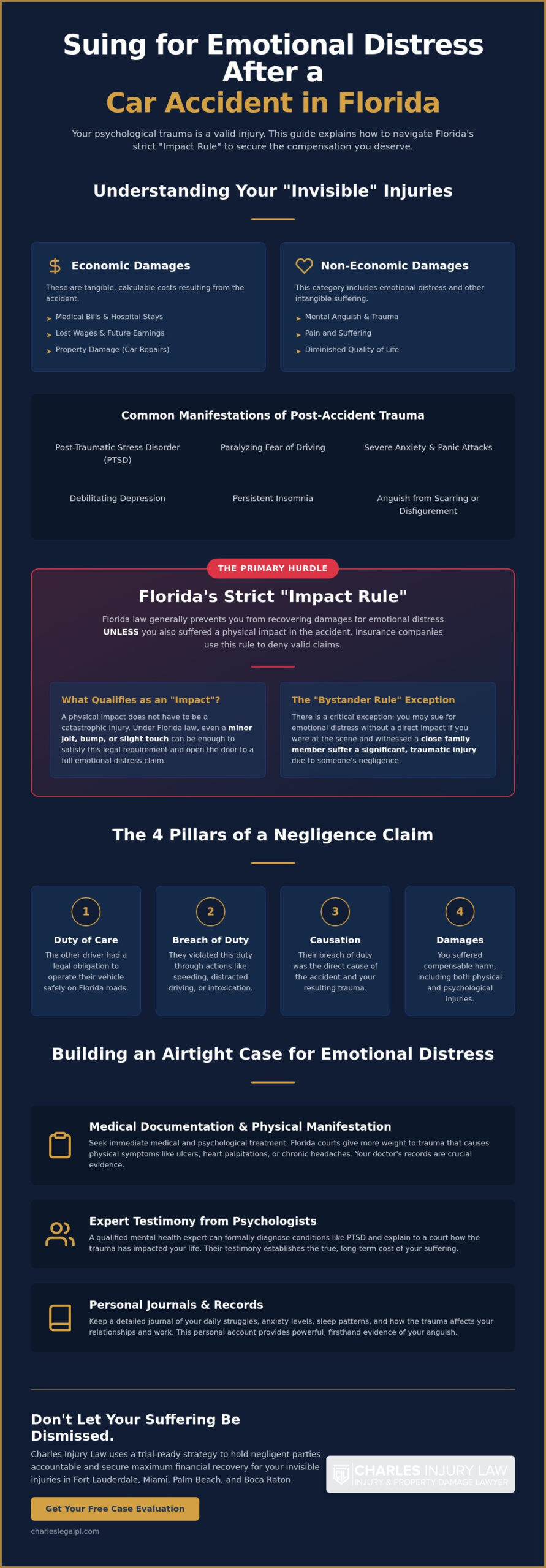
Emotional distress is not just a feeling. In the eyes of the law, it’s a recognized form of psychological harm that can be just as debilitating as a broken bone. When you are suing for emotional distress after a car accident in Florida, you are seeking compensation for the non-economic impact of a crash. Unlike economic damages, which cover tangible costs like hospital bills and lost wages, non-economic damages address your mental suffering and diminished quality of life. Florida law recognizes these claims, but it requires a specific legal framework to move forward. Your trauma deserves more than a dismissive glance from an insurance adjuster.
A successful claim often hinges on the concept of Negligent Infliction of Emotional Distress. This legal doctrine allows victims to recover damages when another person’s carelessness causes severe mental trauma. High-impact collisions in busy areas like Miami or Palm Beach often serve as the catalyst for these claims. If a negligent driver shatters your sense of safety, you deserve more than just a check for your car repairs. You deserve a professional force that views your recovery as a mission.
Common Manifestations of Emotional Trauma
Trauma looks different for everyone. Many victims suffer from Post-Traumatic Stress Disorder (PTSD), which can manifest as a paralyzing fear of driving in Miami or other congested cities like Boca Raton. This anxiety isn’t a choice; it’s a physiological response to a traumatic impact. You might also experience severe depression, persistent insomnia, or debilitating panic attacks. If your accident resulted in permanent scarring or physical limitations, the mental anguish of adjusting to a “new normal” is also compensable. Charles Injury Law understands that these invisible wounds require professional treatment and significant financial resources to manage. We fight to ensure those costs are covered.
The Role of Negligence in Your Claim
To hold a driver accountable, we must establish four pillars of negligence. First, the driver owed you a duty of care on Florida roads. Second, they breached that duty through speeding, distraction, or intoxication. Third, this breach must be the direct cause of your psychological state. Finally, you must have compensable damages. Documenting the scene is critical for your lawyers in Fort Lauderdale. If you take photos of the wreckage and keep a journal of your mental health struggles, you provide the evidence needed to build a winning case. We don’t just ask for compensation. We demand it through aggressive litigation from day one.
The Florida Impact Rule: The Primary Hurdle to Your Recovery
Florida law is notoriously strict regarding mental health claims. The Florida Impact Rule is a legal doctrine that prevents victims from recovering damages for emotional distress unless they suffered a physical impact. This rule acts as a gatekeeper. It is designed to limit the number of lawsuits filed for purely psychological reasons. If you are suing for emotional distress after a car accident in Florida, this rule is the first obstacle we must dismantle. Insurance companies use it as a weapon to devalue your suffering. We use our expertise to turn the tide in your favor.
Charles Injury Law does not accept the insurance company’s narrow interpretation of “impact.” A physical impact does not have to be a catastrophic injury. Even a minor jolt or a slight touch can satisfy the legal requirement under Florida case law. Our job is to document every detail of the collision to prove that an impact occurred. Once that threshold is met, the door opens for a full claim for your mental anguish. If the opposition tries to shut that door, we push back with aggressive advocacy.
The Physical Manifestation Requirement
Florida courts often look for a physical manifestation of your trauma. This means your emotional distress must cause a tangible physical symptom. Common examples include stomach ulcers, chronic heart palpitations, or severe nervous system disorders. Conditions like Post-Traumatic Stress Disorder can trigger these physical responses. Medical documentation is the only way to satisfy this legal standard. You must see a doctor and a mental health professional to bridge the gap between your mind and your body. We help you organize this evidence to build an airtight case in Miami or Boca Raton.
The Bystander Rule Exception
There is a critical exception to the impact rule known as the Bystander Rule. You may have a claim if you witnessed a horrific accident involving a close family member, even if you weren’t physically touched yourself. Florida law applies a three-part test for these claims. First, you must be at or near the scene of the accident. Second, you must have seen or heard the event happen. Third, you must have a close relationship with the victim, such as a spouse, parent, or child. We represent family members in Fort Lauderdale who have suffered immense trauma after witnessing a loved one’s injury. If your family is suffering, contact our dedicated team to discuss your legal options.
Proving Mental Anguish and PTSD After a Florida Car Accident
Proving an invisible injury is a combat mission. While a broken leg is visible on an X-ray, the terror of a high-speed collision leaves scars on the mind that insurance adjusters love to ignore. When you are suing for emotional distress after a car accident in Florida, the burden of proof rests on your shoulders. You cannot simply claim you are upset. You must demonstrate a profound, life-altering shift in your mental state through clinical evidence and credible testimony. Charles Injury Law acts as your shield, gathering the specialized proof required to make a jury understand the depth of your suffering.
Medical Records as the Foundation
Your recovery depends on immediate action. If you are struggling with flashbacks or anxiety, seek mental health treatment in Boca Raton or your local Florida city immediately. Consistent therapy records serve as the “receipts” for your mental anguish. They provide a chronological map of your trauma and the professional efforts required to manage it. Many victims make the mistake of “toughing it out.” In court, silence is a liability. If there is no record of treatment, the defense will argue that the injury does not exist. We ensure every session and diagnosis is documented to fortify your claim.
The Power of Testimony
Expert witnesses are the backbone of a successful mental health claim. We utilize psychologists and psychiatrists who can explain complex brain trauma to a Florida jury in simple, declarative terms. However, professional opinions are only half the battle. We also depose “before and after” witnesses. These are friends, family members, or coworkers who can attest to how your life has changed since the crash. They describe the loss of joy, the withdrawal from social life, and the fear that now dictates your daily routine. Learn more about our personal injury advocacy and how we use these narratives to secure superlative outcomes.
To win, you need a trial-ready strategy. Use this evidence checklist to help us build your case:
- Daily Logs: Maintain a journal documenting sleep disturbances, panic attacks, and missed activities.
- Prescription Records: Keep track of all medications prescribed for anxiety, depression, or insomnia.
- Witness List: Identify three people who knew you well before the accident and can describe the change in your personality.
- Professional Evaluations: Attend all scheduled appointments with mental health experts to establish a clear diagnosis.
A professional legal force is required to present this evidence effectively. We don’t just tell the jury you are hurting. We prove it with clinical precision and aggressive advocacy. If the negligent driver’s insurance company refuses to acknowledge your trauma, we prepare to hold them accountable in front of a jury.
Calculating the Value of Your Emotional Distress Claim
Putting a price on psychological pain is a complex mission. Insurance adjusters fight hardest against invisible injuries because they lack a fixed price tag. They want to minimize your suffering to protect their bottom line. When you are suing for emotional distress after a car accident in Florida, the calculation of your settlement isn’t arbitrary. It’s a strategic process designed to hold the negligent party fully accountable for every second of your trauma. Charles Injury Law acts as your formidable shield, ensuring that the insurance company pays for the mental wreckage they caused.
The Multiplier Method Explained
Lawyers in Fort Lauderdale often use the multiplier method to estimate the value of non-economic damages. This involves taking your total economic losses, such as medical bills and lost wages, and multiplying them by a number between 1.5 and 5. A “3x multiplier” is a common starting point, but it isn’t a guarantee. Factors like gross negligence or a DUI crash push this multiplier higher. If the defendant’s behavior was particularly reckless, we fight for a higher multiplier to reflect the egregious nature of the incident. This method ensures that your mental suffering is scaled proportionally to the physical and financial devastation you’ve endured.
Per Diem and Daily Impact
Another approach is the per diem method. This assigns a specific dollar value to every day you live with the consequences of the crash. We argue for a daily rate that covers the cost of living with PTSD, chronic anxiety, or night terrors. This rate often continues until you reach maximum medical improvement. Understanding car accident settlements requires looking at how these two methods intersect to create a comprehensive demand for compensation. We prepare every case for trial from day one to maximize our leverage during these negotiations. If the insurance company won’t play fair, we’re ready to present your daily struggles to a jury. Contact Charles Injury Law now to start calculating the true value of your recovery.
How Charles Injury Law Secures Compensation for Emotional Trauma
Your mental health is not a bargaining chip. We treat it as a priority. Suing for emotional distress after a car accident in Florida requires more than just filling out forms. It requires a confrontational spirit that refuses to settle for less than you deserve. Charles Injury Law operates as a Protective Champion for victims in Miami and Palm Beach. We believe in total accountability. While you focus on your therapy and healing, we handle the conflict on your behalf. We act as a formidable shield for the injured, utilizing an aggressive strategy to secure superlative outcomes.
If we accept your case, our commitment is absolute. We operate under a strict no-fee guarantee. If we do not win your case, you owe us nothing. This direct, risk-free approach removes the cognitive load for individuals in distress. It makes the path to professional legal representation clear and unobstructed. We don’t view the legal process as a bureaucratic journey. We view it as a mission to secure the financial restitution you need to pay for therapy and reclaim your life.
Trial-Ready Representation in South Florida
We don’t wait for a trial date to prepare for one. Meticulous case preparation begins the moment we take your case. Insurance adjusters in Fort Lauderdale and Boca Raton know our reputation. They understand that we are trial-ready lawyers who will not hesitate to present your story to a jury. This reputation creates immediate leverage. When the defense knows we are prepared to litigate in a Florida courtroom, they are often forced to offer higher settlements. We utilize our deep experience in South Florida courts to ensure your trauma is never ignored.
Your Shield Against Insurance Tactics
Insurers are experts at downplaying mental health struggles. They will try to frame your PTSD as a minor inconvenience or a pre-existing condition. We stop those tactics immediately. Our communication with opposing entities is rapid, high-frequency, and urgent. We use direct, action-oriented statements to force accountability from the defense. We don’t allow them to hide behind confusing legal jargon. Instead, we present the hard evidence of your suffering and demand a successful outcome.
Our firm is small enough to care personally but experienced enough to succeed against large insurance corporations. We serve as the expert advocate for the individual, ensuring that the first few hours after an incident are handled with the urgency they require. Contact Charles Injury Law for a free consultation today. Let us be the professional force that handles the fight while you focus on your recovery.
Secure Your Path to Accountability
Your mental health is a critical part of your recovery. Don’t let insurance adjusters convince you that your trauma is less valuable because it’s invisible. We have explored how the Florida impact rule creates high hurdles and why clinical proof is the backbone of a successful award. Whether you are dealing with PTSD or the mental anguish of a permanent injury, the law provides a pathway for restitution. Successfully suing for emotional distress after a car accident in Florida requires a professional force that understands the nuances of state statutes and case law.
Charles Injury Law offers trial-ready representation focused on maximum recovery. We provide aggressive advocacy against Florida insurance giants that attempt to devalue your suffering. Our expertise in navigating the complex Florida impact rule ensures that no detail of your collision is overlooked. We act as your shield so you can focus on healing while we handle the fight. Fight for the compensation you deserve—contact Charles Injury Law today. You don’t have to carry this burden alone; we are ready to stand by your side and win.
Frequently Asked Questions
Can I sue for emotional distress if I was not physically injured in Florida?
Generally, you cannot sue for negligent infliction of emotional distress without a physical impact. This requirement is known as the Florida impact rule. If you were not touched or jolted during the collision, your claim will likely fail unless a specific exception applies. However, if the driver acted with intentional malice or if you witnessed a horrific injury to a close family member, the rule may not apply. If you are unsure if your case meets this threshold, we will analyze the details of your crash to find the necessary legal standing.
How long do I have to file an emotional distress claim after a car accident in Florida?
You have exactly two years from the date of the accident to file a lawsuit for negligence in Florida. This deadline was shortened from four years to two years on March 24, 2023, following changes to Florida Statute § 95.11. If you miss this window, the court will likely dismiss your case regardless of the severity of your trauma. We act with urgency to ensure all evidence is preserved and your claim is filed well before this deadline expires.
What is the average settlement for emotional distress in Florida?
There is no official average settlement for emotional distress because compensation depends entirely on the severity of the crash and your resulting injuries. Settlements are typically higher when the psychological trauma is accompanied by a permanent physical disability or significant scarring. Your recovery is calculated based on medical records, expert testimony, and the impact the trauma has on your daily life. We fight for superlative outcomes that reflect the true depth of your suffering and the cost of your future care.
Do I need a therapist’s diagnosis to sue for mental anguish?
Yes, a formal diagnosis from a licensed psychologist or psychiatrist is essential for a successful legal claim. Without a professional diagnosis, your mental anguish is considered speculative by insurance companies. If you are suing for emotional distress after a car accident in Florida, your therapy records serve as the foundation of your evidence. These records act as clinical receipts that prove your trauma is real and requires professional intervention. We help you organize this documentation to build an airtight case for the jury.
Will my emotional distress claim be affected by Florida’s no-fault laws?
Yes, you must meet the serious injury threshold defined by Florida law to sue for non-economic damages like emotional distress. This means your injury must be permanent, involve significant scarring, or result in the loss of an important bodily function. Florida’s no-fault system requires your own Personal Injury Protection (PIP) insurance to cover the first $10,000 of medical bills. If your trauma is tied to a permanent injury, we push past these limits to hold the negligent driver and their insurer fully accountable.
Can I sue for emotional distress if I witnessed the accident but was not hit?
You can sue for emotional distress as a witness if you meet the specific requirements of the bystander rule. This exception allows you to recover damages if you witnessed the death or catastrophic injury of a close family member. You must have been at the scene and suffered a physical manifestation of your distress, such as severe nervous system shock. Our lawyers in Fort Lauderdale specialize in proving the proximity and relationship factors required to win these complex bystander claims.
How does Charles Injury Law prove my emotional distress to an insurance company?
We prove your emotional distress by utilizing expert witnesses and detailed personal documentation. We depose mental health professionals who can explain your diagnosis in declarative terms to a jury. We also use “before and after” witnesses who can testify to the visible changes in your personality and lifestyle. By presenting a trial-ready case from day one, we force insurance companies to acknowledge the reality of your psychological wounds. We don’t just ask for compensation; we demand it through aggressive advocacy.
What happens if the other driver’s insurance denies my emotional distress claim?
If the insurance company denies your claim, we prepare to litigate the matter in court. We do not accept lowball offers or dismissive denials from insurance adjusters. Charles Injury Law acts as a formidable shield for the injured, handling the conflict while you focus on your mental recovery. If the defense refuses to offer a fair settlement, we utilize our trial experience in Miami and Boca Raton to hold them accountable. We are always ready for a fight to ensure you receive the financial restitution you deserve.
Disclaimer
The information provided on this blog is for general informational purposes only and does not constitute legal advice. Viewing this content does not create an attorney-client relationship with the firm. You should not act or rely on any information contained herein without seeking legal advice from a qualified attorney regarding your individual situation.