


That “friendly” insurance adjuster calling you is not your ally; they are a professional negotiator trained to protect corporate profits by devaluing your suffering. If you provide a recorded statement without preparation, you risk handing them the evidence they need to deny your claim. It’s normal to feel overwhelmed by their aggressive tactics while you recover from an accident in Orlando or in Tampa. You must know what not to say to an insurance adjuster to protect your right to full compensation. At Charles Injury Law, we see how the pressure to settle quickly is a trap designed to make you accept pennies on the dollar.
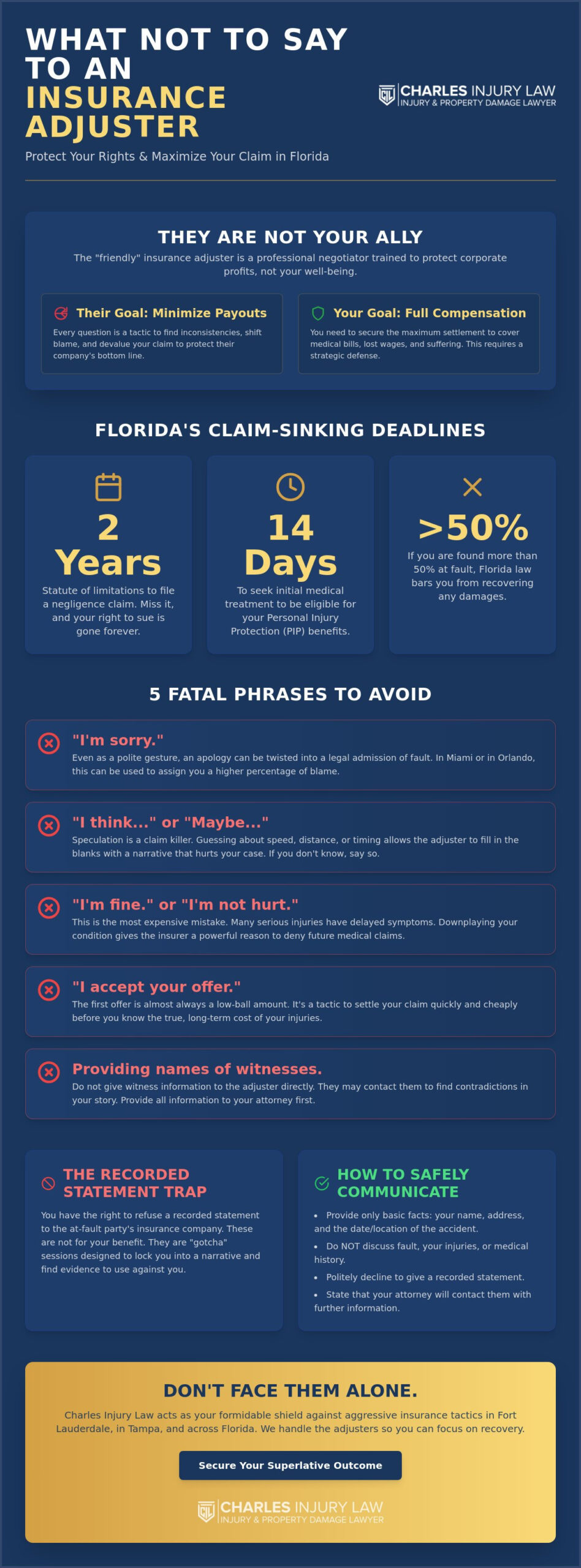
The legal landscape in Florida is now more restrictive than ever. You have only two years to file a negligence claim, and if you are found more than 50% at fault, you are barred from recovery. This guide reveals the critical mistakes that sink injury claims and explains how to navigate the 14-day PIP rule. If you want to secure a superlative outcome, you need a personal injury firm near me that acts as a formidable shield. We will show you how to maintain legal boundaries while maximizing your settlement value in West Palm Beach or in Fort Lauderdale.
Key Takeaways
- Recognize that insurance adjusters are professional negotiators trained to minimize payouts rather than assist you in your recovery.
- Identify the specific “fatal phrases” and what not to say to an insurance adjuster to prevent accidental admissions of fault in Miami.
- Understand your right to refuse recorded statements to the at-fault party’s insurance company to avoid “gotcha” questions that devalue your claim.
- Learn how to limit your communications to basic facts while referring all medical and legal inquiries to your personal injury lawyer near me.
- Discover how Charles Injury Law acts as a formidable shield to secure superlative outcomes against aggressive insurance tactics in Fort Lauderdale and in Tampa.
The Role of an Insurance Adjuster in Florida: Why They Are Not Your Ally
The insurance adjuster is a corporate sentinel. They don’t call to check on your health; they call to protect the insurance company’s bank account. By understanding the insurance claim process, you see that every question they ask is a tactical maneuver. They want to find a reason to pay you less. If you believe their “friendly” tone, then you have already lost the first round of negotiations. An insurance adjuster’s role is a risk-mitigation specialist dedicated to protecting the insurer’s bottom line.
In Florida, you deal with two distinct types of adjusters. Your Personal Injury Protection (PIP) adjuster handles your initial medical bills. The at-fault party’s liability adjuster handles the broader damages. Both are looking for inconsistencies. They often call within 24 to 48 hours of an accident in Orlando or in Tampa. They know you are in pain. They know you are vulnerable. This is when they listen for what not to say to an insurance adjuster to build their defense. Statements made this early in the process are nearly impossible to retract once litigation begins in Miami or in Fort Lauderdale.
The Financial Motivation Behind Adjuster Questions
Florida law now uses a modified comparative negligence standard. If a jury finds you are more than 50% at fault for your injuries, you recover nothing. Adjusters ask leading questions to shift that percentage onto you. A simple admission like “I didn’t see him coming” is a gift to their legal team. They use these early statements to lock you into a narrative before you even know the full extent of your physical damage. If you speak to them without an attorney, then you risk your entire settlement value.
Florida No-Fault Laws and Your Initial Statement
Your PIP coverage is mandatory, but it is limited. You must seek medical treatment within 14 days of your car accidents in Florida or you lose these benefits entirely. Even your own insurance company isn’t your advocate. They will look for reasons to claim your injury wasn’t an “emergency medical condition” to cap your benefits at $2,500. Don’t discuss the details of the crash or your physical state while you are still in shock. The “friendly adjuster” tactic is designed to lower your guard while you are in a state of distress. Protect yourself by staying silent until you have professional representation.
5 Fatal Phrases: What Not to Say to an Insurance Adjuster in Florida
A single sentence can dismantle your entire legal strategy. When the phone rings after an accident, you are entering a high-stakes negotiation where the opponent has decades of experience. You must understand what not to say to an insurance adjuster to keep your claim alive. These professionals listen for specific verbal cues that allow them to shift liability or minimize your pain. If you speak without a plan, then you are helping the insurance company win. Knowledge is your first line of defense.
- “I’m sorry.” Never apologize for the accident, even out of politeness. In Miami, adjusters translate “I’m sorry” into “I am at fault.”
- “I think…” or “Maybe…” Speculation is a claim killer. If you don’t know an answer, say so. Guessing allows the adjuster to fill in the gaps with a narrative that favors their bottom line.
- “I’m fine.” This is the most expensive mistake you can make. Downplaying your injuries before a doctor evaluates you gives the insurer a reason to deny future medical bills.
- “I accept your offer.” The first offer is a low-ball tactic. It is designed to make you go away for the lowest possible price before you realize the true cost of your recovery.
- Naming witnesses prematurely. Do not provide names of family members or witnesses until you have consulted with Charles Injury Law. The adjuster may contact them to find contradictions in your story.
The Danger of Admitting Fault or Apologizing
Florida operates under a modified comparative negligence system. If you are found to be more than 50% at fault for the incident, you are legally barred from recovering any damages. When you say “I didn’t see the other car” during a call in Boca Raton, the adjuster records it as an admission of negligence. Even if you believe you contributed to the crash, keep that information for your attorney. Learning how to make a car insurance claim properly means remaining polite while staying silent on the issue of liability. If you feel pressured to explain the mechanics of the crash, speak with a professional advocate before giving any statement.
Why “I Am Okay” is the Most Expensive Sentence You Can Say
Adrenaline masks pain. You might feel fine in the hours following a collision in West Palm Beach, but internal injuries and whiplash often take days or weeks to manifest. Adjusters use early “I am okay” statements to argue that your later treatments are unrelated to the accident. Medical diagnoses must only come from licensed doctors, never from the victims themselves. If you tell an adjuster you aren’t hurt, you are essentially signing away your right to compensation for injuries suffered from car accidents. Protect your health and your claim by deferring all medical questions to your records.
The Trap of the Recorded Statement: Protecting Your Rights in Miami and in Fort Lauderdale
The recorded statement is a tactical weapon. Insurance companies frame it as a standard procedure to “speed up your claim.” In reality, it is a tool used to dismantle your credibility. You are generally under no legal obligation to provide a recorded statement to the at-fault driver’s insurance company. If you agree to be recorded, then every hesitation and every mistake becomes permanent evidence. This is especially dangerous in West Palm Beach, where adjusters push for statements before the final police report is even available. Knowing what not to say to an insurance adjuster is your strongest defense against these predatory tactics.
Adjusters are trained to ask “gotcha” questions. They want to create inconsistencies between your initial call and your future testimony. If you provide a recording while in a state of shock, you risk locking yourself into a version of events that may be inaccurate. Under the 2026 legal standards in Florida, even a minor contradiction can be used to shift fault. You need attorneys for personal injuries present to ensure your rights are protected during any formal questioning. We stand between you and the insurance company to ensure your words aren’t twisted into a denial of coverage.
How Recorded Statements Are Used as Evidence
Insurance companies don’t just listen to your recording; they transcribe it. Defense lawyers in Miami will pore over every syllable to find a way to impeach your testimony in court. A subtle word choice can be magnified to make you look dishonest or negligent. For example, describing your speed as “about 40 miles per hour” can be used against you if forensic data shows a slight variation. If you are unsure of a specific detail, “I don’t know” is the only safe and honest answer. Guessing on record is a gamble where the house always wins. By understanding what not to say to an insurance adjuster, you avoid providing the data points they need to devalue your life.
Politely Declining the Request to Record
You have the power to say no. Declining a recorded statement is not an admission of guilt. It is a strategic move to protect your financial recovery. If an adjuster asks to record you, use this simple script: “I am not comfortable giving a recorded statement at this time.” This maintains your cooperation without sacrificing your legal standing. The experts at Charles Injury Law specialize in handling these high-pressure communications for you. If the insurer insists on a statement, then tell them to contact your legal team. We act as your shield so you can focus on your physical recovery while we handle the conflict in Fort Lauderdale or in Tampa.
How to Safely Communicate with Insurers Without Hurting Your Personal Injury Claim
Minimalism is your shield. When an adjuster calls, your goal is to provide the bare minimum required to identify the claim. Provide your name, address, and contact information. If they ask about the mechanics of the crash, then keep your answers strictly to the date, time, and location. Knowing what not to say to an insurance adjuster means recognizing that any detail about your speed or perceived distractions is a trap. If you provide these specifics, the insurer will use them to build a case for comparative negligence under Florida’s strict 2026 standards.
Never sign a medical release form without a professional review. These documents are often overbroad. They allow the insurance company to dig through your entire medical history in Miami or in Tampa. They are looking for pre-existing conditions to blame for your current pain. Refer all questions regarding your physical state to your medical records. Your health data should speak for itself through the proper legal channels. If you hand over your full history, then you are giving the insurer a map to devalue your recovery.
Limiting the Scope of the Conversation
Stick to property damage if you must speak at all. You can discuss the location of your vehicle or where it was towed in Boynton Beach. Avoid any conversation regarding your employment status or lost wages in Lake Worth. These financial details are sensitive. They require precise documentation that a personal injury lawyer near me should prepare. If the adjuster persists, then end the call. You are not being rude; you are being smart. A simple “I have another commitment and must hang up now” is a perfectly acceptable exit strategy that protects your interests.
The Power of “My Lawyer Will Handle That”
This phrase is your ultimate defense. Once you have retained a personal injury lawyer near me, Florida law dictates that the insurance company must communicate with your counsel instead of you. This immediately stops the high-frequency calls. It removes the cognitive load of negotiation while you recover from your injuries. You can view the Charles Injury Law practice areas to see how we manage these high-stakes interactions for our clients. By directing the adjuster to us, you ensure that every word spoken on your behalf is calculated for a superlative outcome. If you are tired of the pressure from aggressive adjusters, contact our team today to take control of your claim.
Why Aggressive Legal Representation from Charles Injury Law is Your Best Defense
Knowing what not to say to an insurance adjuster is a vital skill, but having a professional voice speak for you is a superior strategy. Charles Injury Law stands as a Protective Champion for victims across the state. We do not just negotiate; we prepare every case for the possibility of a courtroom battle. This trial-ready approach is essential for claims in Fort Lauderdale and in Tampa. If you have suffered due to the negligence of another, then you deserve a dedicated ally who understands the high stakes of Florida litigation. We act as a formidable shield against those who seek to devalue your pain.
Our firm operates on a contingency fee model. This means our goals are perfectly aligned with yours. If we don’t secure a settlement or verdict for you, then you pay nothing in attorney’s fees. This risk-free path allows you to focus on your recovery while we handle the aggressive tactics of the insurance company. We have secured superlative outcomes for victims of injuries suffered from truck, semi, and tractor-trailer accidents. These cases involve complex regulations and massive corporate defendants that require an assertive legal response.
Taking the Conflict Off Your Shoulders
We handle the heavy lifting of your claim. Our team manages all evidence preservation and coordinates with expert consultants to build a rock-solid case. We are small enough to care personally but experienced enough to win against the largest corporate entities. Our legal team remains available 24/7 for new clients in Florida. We ensure that no critical window for action is ever missed. By taking over all communications, we ensure you never have to worry about what not to say to an insurance adjuster again. Your only job is to get better.
Maximizing Your Recovery Through Litigation
Many firms settle for the first easy offer to avoid the work of a trial. We don’t. We are ready to take your case to a jury if the insurance company refuses to provide fair financial restitution. This aggressive stance is particularly effective for victims of injuries suffered by pedestrians in public. We fight to ensure every dollar of your medical bills, lost wages, and future care is fully covered. We don’t view your case as a bureaucratic journey; we view it as a mission to secure the compensation you need to move forward. Contact Charles Injury Law today for a free consultation.
Secure Your Financial Recovery Today
Silence is your most powerful asset when dealing with a billion-dollar insurance corporation. You now understand that adjusters are professional negotiators who use your words as weapons against you. By mastering what not to say to an insurance adjuster, you have taken the first step toward protecting your claim. Don’t let a single recorded statement or an accidental apology in Miami strip you of your right to full restitution. If you refuse to let them devalue your life, then you are ready for a superlative outcome.
Charles Injury Law acts as your formidable shield in Fort Lauderdale and in Tampa. We have recovered millions of dollars for our Florida clients through aggressive advocacy and relentless litigation. You deserve direct communication with your attorney and a legal team that won’t charge a single fee unless we win your case. Let Charles Injury Law fight the insurance companies for you; schedule your free consultation now. Your mission is to recover; our mission is to win. You don’t have to face this conflict alone.
Frequently Asked Questions
Do I have to talk to the other driver’s insurance adjuster in Florida?
You are under no legal obligation to speak with the at-fault driver’s insurance adjuster. Your only duty is to cooperate with your own insurer under your policy terms. Refer the third-party adjuster to your legal representative immediately. This prevents you from accidentally providing information that could trigger Florida’s 50% bar for modified comparative negligence.
What happens if I already gave a recorded statement to the insurance company?
If you have already provided a statement, then you must retain a personal injury lawyer near me to review the transcript. We can identify potential traps or inconsistencies that the adjuster may use against you later. Early intervention allows us to prepare a strategy that protects your compensation before the defense uses your words to impeach your testimony in court.
Can an insurance adjuster deny my claim if I refuse to be recorded?
An insurance adjuster cannot legally deny your claim simply because you refuse to provide a recorded statement. This is a high-pressure tactic used to make victims feel uncooperative. You have the right to provide information through written documentation or via your attorney. Standing your ground is a critical part of knowing what not to say to an insurance adjuster in Orlando or in Tampa.
Should I tell the adjuster about my previous injuries or medical history?
No, you should never volunteer information about your medical history or past injuries. Providing a history of past ailments is a primary example of what not to say to an insurance adjuster. They dig through your past to claim that your current pain is a pre-existing condition. Refer all medical inquiries to your current treatment records and let your lawyer handle the flow of health information in Miami.
How much should I ask for in a car accident settlement in Florida?
You should never provide a settlement figure without a full medical evaluation and legal review. The value of your claim depends on the severity of your injuries and the impact on your future earning capacity. Naming a price too early often leads to an undervalued settlement. We analyze your specific damages to ensure you seek the maximum recovery available under Florida law.
Is it okay to sign the medical authorization forms the adjuster sent me?
Do not sign any medical authorization forms without a lawyer’s approval. These forms are often blanket releases that give the insurer access to your entire medical history. They will use this access to find any excuse to devalue your current claim. Charles Injury Law will ensure that any release is limited only to the injuries directly related to your accident in Fort Lauderdale.
What if the insurance adjuster offers me a check immediately after the accident?
If an adjuster offers you an immediate check, then you should decline it until you have spoken with an attorney. Cashing that check usually requires you to sign a release that waives your right to seek further compensation. These early offers are almost always low-ball amounts that fail to cover the true cost of long-term medical care or lost wages in Boca Raton.
How long do I have to file a personal injury claim in Florida?
For incidents occurring on or after March 24, 2023, you have exactly two years from the date of the accident to file a negligence-based personal injury claim in Florida. This is a strict deadline under the current statute of limitations. If you miss this window, then you lose your right to seek financial restitution entirely. Act quickly to ensure your evidence is preserved.
Disclaimer
The information provided on this blog is for general informational purposes only and does not constitute legal advice. Viewing this content does not create an attorney-client relationship with the firm. You should not act or rely on any information contained herein without seeking legal advice from a qualified attorney regarding your individual situation.