



Table of Contents
-
Understanding Your Rights and the Shopkeeper’s Privilege in Florida
-
How Charles Injury Law Fights for Wrongfully Detained Victims
Understanding Your Rights and the Shopkeeper’s Privilege in Florida
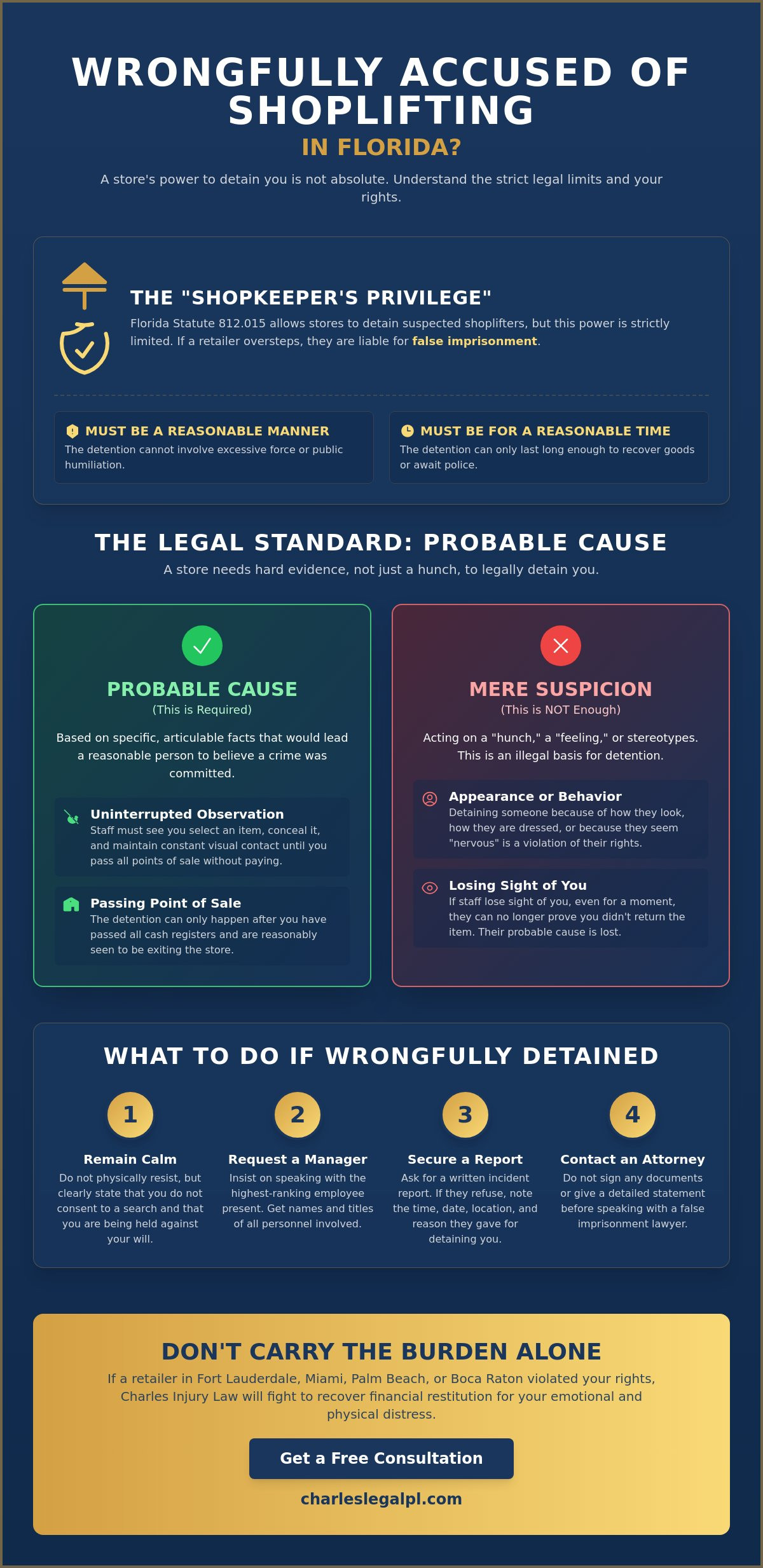
Being accused of shoplifting is a humiliating experience. When a store employee detains you, it can feel like you have no power. However, Florida law places strict limits on a retailer’s ability to stop and hold a customer. This right, known as the “Shopkeeper’s Privilege” under Florida Statute 812.015, is not a blank check for stores to act as they please. It is a narrow exception to false imprisonment laws, and if a store oversteps, it becomes liable for the harm it causes.
-
The Shopkeeper’s Privilege Defined: This privilege allows a merchant who has probable cause to believe a theft has occurred to detain the suspect in a reasonable manner for a reasonable length of time.
-
The “Reasonable Manner” Mandate: Any detention must be conducted without excessive force, public humiliation, or intimidation. The goal is investigation, not punishment.
-
The “Reasonable Time” Limit: A store cannot hold you indefinitely. The detention is only lawful for the brief period needed to investigate and contact law enforcement.
-
Inquiry vs. Forced Detention: A polite question is one thing; blocking your exit, grabbing your arm, or ordering you into a back room is a detention. Once you are not free to leave, the store’s actions must comply with the law.
-
Crossing the Line to Liability: When a store exceeds these limits—by using too much force, holding you for too long, or acting without probable cause—their legal protection vanishes. Their actions can become assault, battery, and false imprisonment.
What Qualifies as Reasonable Manner?
The requirement of a "reasonable manner" is designed to protect your dignity and physical safety. In Fort Lauderdale and across Florida, this means a store’s loss prevention or security staff cannot engage in abusive or overly aggressive tactics. Their actions are restricted by law.
-
Prohibition of Excessive Force: A security guard cannot tackle, choke, or roughly handle a person they suspect of shoplifting. Physical contact should be minimal and only what is absolutely necessary to prevent the person from leaving before police arrive.
-
No Public Shaming: Yelling “Stop, thief!” across a crowded store or parading a suspect through the aisles is a violation of reasonable conduct. This type of public shaming is a form of intimidation and can be grounds for a civil claim.
-
Private Questioning Required: Any investigation should be conducted away from public view, such as in a manager’s office. Public accusations and interrogations are designed to humiliate and are not considered a reasonable manner of detention.
The Legal Definition of Reasonable Time
Time is a critical factor in a lawful detention. The Shopkeeper’s Privilege does not grant retailers the power to hold someone for an extended period. The clock starts ticking the moment you are no longer free to leave.
-
How Long is Too Long?: While there is no exact minute count in the statute, courts in Miami and throughout Florida have interpreted "reasonable time" as the short period required to ascertain the facts and call the police. Typically, this means 15-20 minutes, not an hour or more.
-
Immediate Law Enforcement Contact: A store’s primary legal action is to call the police. Once they have a suspect detained, they must contact law enforcement without delay. Using the detention to coerce a confession or conduct an extensive search is illegal.
-
When Delays Violate Your Rights: Holding you while waiting for a regional manager to arrive, to review hours of video, or to pressure you into signing paperwork turns a brief stop into a potential civil rights violation and false imprisonment.
Probable Cause vs. Mere Suspicion in Florida Retail Stops
A store cannot detain you based on a "hunch" or because you "look suspicious." The law requires probable cause. This is a much higher standard than mere suspicion and demands a foundation of specific, observable facts that would lead a reasonable person to believe a crime has been committed. Without it, any detention is illegal from the start.
-
Defining Probable Cause: It is a set of articulable facts pointing directly to an act of theft. For example, seeing someone put an item in their bag and walk past the registers without paying constitutes probable cause.
-
Illegal "Profile-Based" Stops: Detaining someone based on their race, clothing, or how they browse is not based on probable cause. These discriminatory, hunch-based stops are unlawful and can be the basis for a lawsuit.
-
"Looking Suspicious" is Not Enough: A customer who appears nervous, carries a large bag, or watches a security guard is not, by law, a shoplifter. These behaviors do not meet the legal standard for probable cause to detain and search someone.
-
The Five Elements of Proof: Many retailers train their staff to confirm five specific elements before making a stop: seeing the person 1) approach the merchandise, 2) select it, 3) conceal it, 4) maintain uninterrupted observation, and 5) fail to pay for the item upon exiting. Failure to observe all these steps often means the store lacks true probable cause.
Visual Evidence Requirements in Florida
To establish probable cause, store employees must typically witness a sequence of events. Guesses and assumptions are not enough. In Boca Raton and across Florida, courts look for clear evidence that the detention was justified by what staff actually saw.
-
Approaching the Merchandise: The employee must have seen you approach and select the specific item they accuse you of taking.
-
Witnessing Concealment: The employee must have actually seen you conceal the item. If they only saw you with it and later found it missing, they may not have sufficient grounds for a stop.
-
Uninterrupted Observation: This is a critical legal standard. If the employee lost sight of you—even for a few seconds—they can no longer be certain that you did not discard the merchandise. Any break in observation severely weakens their claim of probable cause.
When a Search Becomes Illegal in Florida
After a store detains you, they may demand to search your bags, pockets, or purse. It is crucial to understand that their authority to do so is extremely limited. You have a right to privacy, and store employees are not law enforcement officers.
-
Limits on Employee Searches: A store employee or security guard has no legal right to search your personal belongings without your explicit, voluntary consent. They can ask to see inside your bag, but you can refuse.
-
Voluntary vs. Coerced Search: If you are told "you can’t leave until you let me search your bag," that is a coerced search. Consent given under threat or duress is not legally valid, and any evidence found may be inadmissible. A search conducted under these circumstances strengthens a false imprisonment claim.
-
The Role of Law Enforcement: Only a sworn police officer, with probable cause, can conduct a legal search of your person or property without your consent. A store’s job is to detain and call the police, not to conduct its own invasive searches.
When a Detention Becomes False Imprisonment in Florida
If a store detains you without probable cause, holds you for an unreasonable time, or uses unreasonable force, their actions may constitute false imprisonment. This is a serious civil violation that allows you to sue the retailer for damages. The moment a detention becomes unlawful, you become a victim of false imprisonment.
-
Elements of a False Imprisonment Claim: This claim requires proving that you were unlawfully and intentionally restrained against your will without a legal justification.
-
Lack of Probable Cause: The most common reason a retail detention becomes false imprisonment is the absence of probable cause. A mistake or a "hunch" is not a defense for the store.
-
"Implied Threats" and Restraint: You do not have to be physically touched to be restrained. If a large security guard blocks a doorway or threatens you with police action if you try to leave, that constitutes restraint.
-
Damages for Wrongful Detention: Victims can seek compensation for the emotional distress, public humiliation, anxiety, and any physical injuries suffered during the incident.
-
Learn more about how we fight for victims of false imprisonment claims.
Physical Restraint and Force in Florida
When store security uses physical force, they take on significant legal risk. Any force that is not strictly necessary to prevent escape can result in claims for both false imprisonment and battery.
-
Illegal Use of Handcuffs or Locked Doors: Retail employees are not police. Using handcuffs or locking a suspect in a room is almost always considered an unreasonable and excessive form of restraint.
-
The "Threat of Force" as Detention: If you are led to believe that force will be used against you if you attempt to leave, you are being detained. This implied threat is as powerful as a physical barrier.
-
Physical Injury During Detention: If you are bruised, cut, or otherwise injured by an overzealous security guard, the store can be held directly liable for your medical bills, pain, and suffering.
Psychological Coercion and Intimidation in Florida
False imprisonment is not just about physical restraint. Retailers who use psychological tactics to intimidate and control a person are also breaking the law. These actions can cause significant emotional and mental trauma.
-
Forced "Confessions" Under Duress: Many stores try to pressure suspected shoplifters into signing a statement admitting guilt. If you were threatened or told you could not leave until you signed, that document is worthless in court and is strong evidence for your false imprisonment claim.
-
Threats to "Never Let You Leave": Statements like "we can do this all day" or "you’re not going anywhere" are forms of psychological coercion designed to make you feel powerless.
-
Verbal Abuse and Emotional Distress: Insults, yelling, and degrading language are not part of a "reasonable" detention. This verbal abuse can be a key component of a claim for emotional distress damages.
Steps to Take After Being Wrongfully Detained in Florida
What you do in the moments after being wrongfully detained can significantly impact your ability to hold the store accountable. Your priority is to stay safe and preserve evidence for your case.
-
Remain Calm: Do not argue, shout, or physically resist. Stores will often use any resistance, no matter how minor, to claim you were the aggressor. Calmly state that you do not consent to any search and that you are being held against your will.
-
Request a Manager and Written Report: Ask for the highest-ranking manager on duty and insist that an official incident report is created. Get a copy if possible, or at least note who created it.
-
Identify Everyone Involved: Get the names and job titles of all employees and security guards who were part of your detention. If there were other customers who witnessed the event, ask for their names and phone numbers.
-
Demand Surveillance Footage Preservation: Immediately state, verbally and in writing if possible, that you want all surveillance video of the incident preserved. Retailers often tape over footage quickly, destroying crucial evidence.
Immediate Evidence Gathering to Prove your Case
Physical evidence is your strongest weapon against a store’s claims. Once you are free to leave, document everything you can before memories fade or evidence disappears.
-
Take Photos: Use your phone to take pictures of the location where you were held, any visible injuries like bruises or torn clothing, and the storefront.
-
Record Names: Write down the names of the security personnel from their name tags. If they refuse to provide them, note their physical descriptions.
-
Keep Your Receipt: If you made a purchase, your dated and time-stamped receipt is undeniable proof that you were a legitimate customer and can help establish a timeline of events.
Legal Documentation in Florida
After gathering immediate evidence, the next step is to take formal action to protect your legal rights. This involves putting the store on notice and consulting with an attorney before making any statements.
-
Send a "Spoliation Letter": Your attorney will send the retailer a formal letter, known as a spoliation letter, demanding the preservation of all evidence, including video footage, incident reports, and employee records. This prevents them from legally destroying evidence.
-
A store’s failure to provide a safe environment, including protecting you from its own aggressive staff, can fall under the umbrella of premises liability law.
How Charles Injury Law Fights for Wrongfully Detained Victims
When a retailer violates your civil rights, they must be held accountable. At Charles Injury Law, we see a wrongful detention not as a simple mistake, but as an act of corporate negligence and abuse. We provide the aggressive advocacy needed to fight back against powerful retailers and restore your good name.
-
Aggressive Pursuit of Justice: We don’t just send letters; we prepare every case for trial. Our firm aggressively investigates every detail of the incident to expose the store’s misconduct.
-
Contingency Fee Representation: Our "If-Then" promise is simple: If we don’t win your case, you owe us nothing. You pay no upfront fees, allowing you to pursue justice without financial risk.
-
Investigating Store Policies: We dig deep into a company’s history of similar incidents, their training protocols (or lack thereof), and past violations to build a powerful case for negligence.
-
Maximum Compensation for Humiliation and Trauma: We fight for a recovery that reflects the full extent of your damages, from the public embarrassment and emotional trauma to any physical harm you suffered.
-
Your case is a serious matter, and you deserve dedicated personal injury representation in Florida.
Holding Major Retailers Accountable in Florida
Taking on a large national chain can be intimidating. These corporations have teams of lawyers dedicated to minimizing their liability. Charles Injury Law has the experience and resources to level the playing field and hold them accountable for their actions in Miami and across South Florida.
-
Litigating Against Corporate Giants: We are not afraid to take on the biggest names in retail. We understand their defense tactics and know how to dismantle them in court.
-
Proving Negligent Security and Training: We work to prove that the incident was not just the action of one rogue employee, but the result of the company’s failure to properly hire, train, and supervise its staff.
-
Trial-Ready Representation: Our willingness to take a case to a jury sends a clear message to retailers and their insurers: we will not accept lowball settlement offers. We are prepared to fight for the full value of your claim.
Your Shield Against Wrongful Accusations
Being wrongfully detained and searched for shoplifting is an attack on your character and your freedom. You do not have to endure it alone. Charles Injury Law acts as your shield, defending your rights and fighting to restore your reputation.
-
Restoring Your Reputation: We are committed to clearing your name and securing a resolution that acknowledges the wrong you suffered.
-
Free Case Evaluation: The first step is a no-cost, no-obligation consultation. We will listen to your story, analyze the legality of the store’s actions, and explain your options for seeking compensation.
-
Immediate Legal Support: Do not wait for the store to control the narrative. Contact Charles Injury Law today for a free evaluation of your wrongful detention claim in Florida.
Disclaimer
The information provided on this blog is for general informational purposes only and does not constitute legal advice. Viewing this content does not create an attorney-client relationship with the firm. You should not act or rely on any information contained herein without seeking legal advice from a qualified attorney regarding your individual situation.