



What if the Hyatt name on the building doesn’t tell you who’s responsible for your injury? After a fall or other injury at a Hyatt Regency or Hyatt Place in Miami or Fort Lauderdale, the answer may depend on who controlled the area and what the evidence shows. If you’re looking for a lawyer for injury at Hyatt Regency & Hyatt Place, concerns about treatment, missed work, and disappearing evidence can add stress.
Finding a personal injury firm near me or attorneys for personal injuries is only a first step. The right legal approach depends on the incident. Searches for attorneys personal injury, injury lawyer near me, or personal injury lawyer near me may reflect different needs, while lawyers for auto accidents and auto accident lawyers near me address another type of case. This article focuses on what to do after a hotel injury, how Florida premises liability may apply, and how Charles Injury Law can help assess evidence and possible responsibility.
Key Takeaways
- Seek medical care promptly, describe your symptoms accurately, and keep records of your treatment.
- A Hyatt brand name alone doesn’t establish responsibility. A lawyer for injury at Hyatt Regency & Hyatt Place can assess who controlled the area and what the evidence shows.
- Preserve photographs of the hazard and its location, witness details, incident reports, and medical records.
- When comparing legal representation, consider Florida experience, evidence investigation, communication, and trial preparation. Charles Injury Law has 15+ years of experience, has handled 1,000+ cases, and reports 98% client satisfaction.
- A free consultation can help you understand possible legal options. Call Now: (954) 390-2228 Available 24 Hours a Day, 7 Days a Week
Injured at a Hyatt Regency or Hyatt Place? Start With These Priorities
An unexpected injury can leave you in pain, shaken, and unsure what to do next. Focus first on your health. The Hyatt name alone doesn’t establish who is legally responsible. That may depend on who controlled the specific area, what caused the injury, and what can be documented. A lawyer for injury at Hyatt Regency & Hyatt Place can assess those details, but your immediate priorities are getting care and preserving accurate information.
What should you do immediately after a hotel injury?
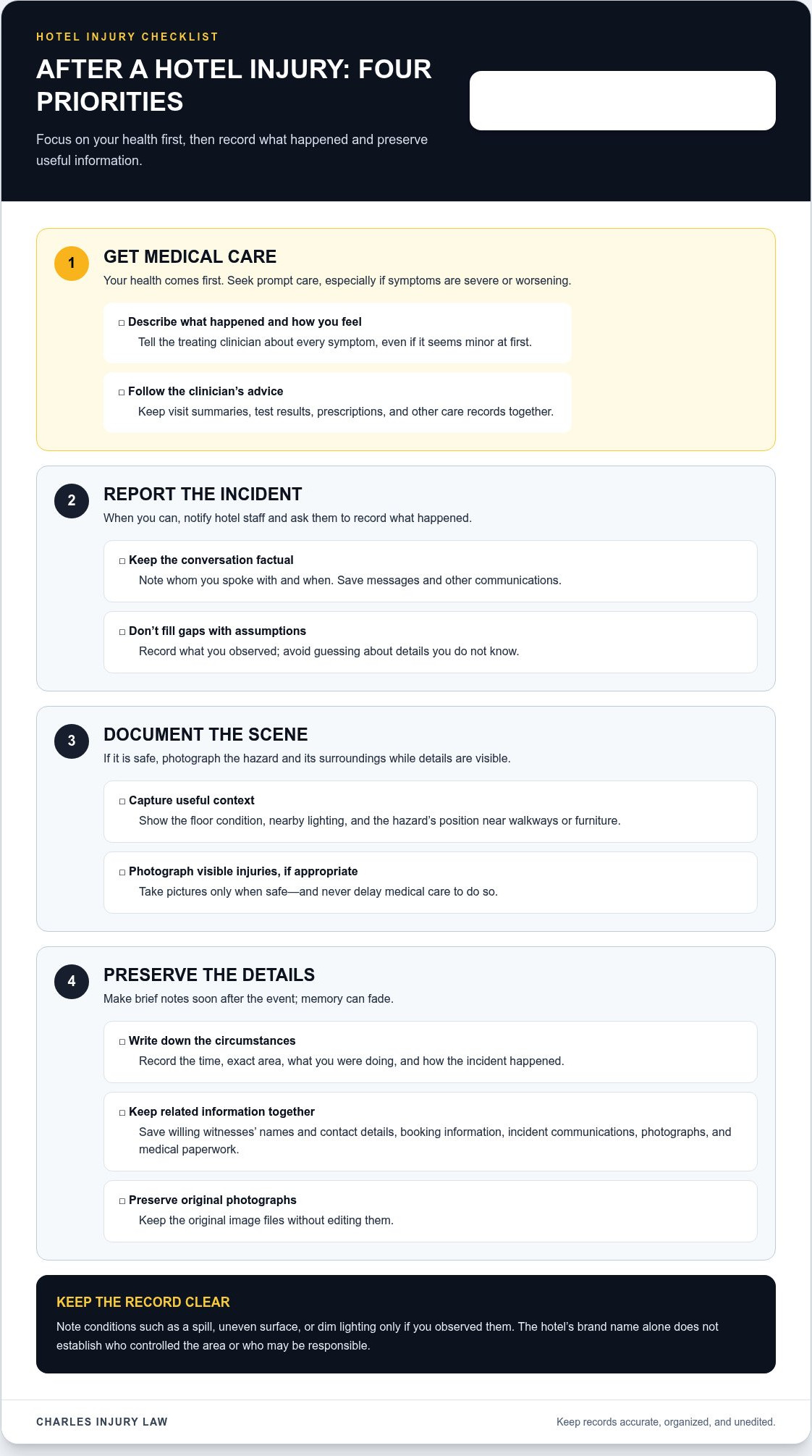
Seek medical attention promptly, especially if you have severe pain, a head injury, trouble moving, or symptoms that worsen. Tell the treating clinician what happened and describe every symptom accurately, even if it seems minor at first. Follow the clinician’s advice and keep visit summaries, test results, prescriptions, and other care records together. These records can show what you reported and when you received treatment.
When it’s safe, notify hotel staff and ask them to record the incident. Keep the conversation factual. Note whom you spoke with and when, and save any messages or other communications. If you can do so without risking your health, photograph the hazard and its surroundings. Capture details such as the floor condition, nearby lighting, and the hazard’s position in relation to walkways or furniture. Photograph visible injuries too, but don’t delay medical care to take pictures.
Which details should you record before leaving?
Memory can fade, so make a brief note soon after the event. Record the time, exact area, what you were doing, and how the incident happened. Note conditions such as a spill, uneven surface, or dim lighting only if you observed them. Don’t guess or fill gaps with assumptions.
If witnesses agree, collect their names and contact details. Keep booking information, incident communications, photographs, and medical paperwork together. Preserve original image files without editing them. These materials may help clarify the location and circumstances later.
Use this practical sequence:
- Get medical care. Describe symptoms accurately and retain treatment records.
- Report the incident. Notify hotel staff and ask that it be recorded.
- Document the scene. Take photographs when it’s safe, including the hazard and its surroundings.
- Preserve details. Record what happened, gather willing witnesses’ contact information, and keep related documents together.
Premises liability is a general concept for assessing responsibility when someone is injured on property. This Premises liability law overview provides background, but it isn’t a substitute for evaluating a claim under Florida law. For information about Florida personal injury representation, Charles Injury Law can discuss how the specific facts may matter. This section offers general information, not a case-specific legal conclusion. If you’re considering a lawyer for injury at Hyatt Regency & Hyatt Place, keep your records and questions ready for a conversation with counsel.
Call Now: (954) 390-2228 Available 24 Hours a Day, 7 Days a Week
How Florida Premises Liability May Apply to a Hyatt Hotel Injury
After an injury at a Hyatt Regency or Hyatt Place, it’s natural to focus on the hotel’s name. But a brand identifies the property’s affiliation, not automatically the person or business legally responsible for a particular hazard. Under Florida law, premises liability assesses responsibility for an injury connected to property based on the law and specific facts. The analysis turns on what happened, where it happened, and which party had relevant control.
An injury on hotel property does not, by itself, prove negligence. A claim requires a fact-specific assessment. For example, a guest injured in a lobby, parking area, restaurant, or pool area may raise different questions about who managed or maintained that space. The investigation should identify the location precisely and determine what evidence connects the condition or event to the injury. A logo or hotel booking alone cannot answer those questions.
Who may be responsible for an injury at a Hyatt property?
Responsibility depends on the incident, control of the area, and available evidence. Don’t assume who is responsible before those facts are investigated. Depending on the evidence, the inquiry may need to consider more than one party with a role in controlling or managing the location. That doesn’t mean each party is liable. It means the facts must be examined before responsibility can be fairly evaluated.
Consider a fall in a corridor compared with an injury in a dining space. The important questions may include who controlled that area, what condition or event caused the injury, and what information is available about it. The hotel brand itself doesn’t settle those questions. A premises liability claim should be assessed against the actual circumstances, not assumptions based on signage or branding.
How do Florida premises-liability principles shape a claim?
In general terms, negligence concerns whether a party’s conduct may have contributed to harm, while causation concerns whether that conduct is connected to the injury. The details matter. A claim involving a physical hazard differs from one alleging injury caused by a criminal act of a third party. For that narrower issue, Florida Statute 768.0701 addresses protection against criminal acts on business premises. Its relevance depends on the nature of the incident and the facts, so it shouldn’t be treated as a blanket rule for every hotel injury.
Florida’s comparative-fault principles may also affect recovery if the injured person and another party are found to share responsibility. The impact depends on how fault is assessed under the law that applies to the claim. No outcome can be predicted from the location alone. A lawyer for injury at Hyatt Regency & Hyatt Place can examine how the incident, property control, and evidence fit together. Charles Injury Law handles premises liability claims, including hotel injuries, and can explain how Florida law may apply to the facts.
Evidence That Can Strengthen a Hyatt Regency or Hyatt Place Injury Claim
Evidence can help explain what happened, where it happened, and how the injury followed. A close-up of an injury alone may not show the condition that caused it. For a hotel incident, document the hazard in context: its exact location, nearby features, and surrounding conditions. If you can’t safely gather evidence yourself, prioritize your health and ask someone you trust for help.
Records made close to the time of an incident can help a lawyer assess how it occurred. Clear, unaltered records may also identify questions that need further investigation. Focus on accuracy. Don’t guess about details you can’t remember, edit original photographs, or add information to a report after the fact without clearly identifying it as a later note.
What photographs and records may be useful?
Take photographs from more than one safe vantage point. Include a wider view showing where the hazard was and closer images capturing its details. A wide shot may show the hazard’s position in a walkway, while a closer view may record its condition. Include lighting or nearby objects if they may be relevant.
Keep a dated, organized record of materials connected to the incident. Useful items may include:
- Original photographs and videos, saved without filters, cropping, or edits.
- Medical records, treatment instructions, and receipts related to care.
- Booking or travel documents that help identify the hotel stay and dates.
- Incident reports, emails, messages, and notes about communications with hotel staff.
- A brief account of when and to whom you reported the incident.
Save digital files in a secure location and retain the originals. If you make a later note to clarify something, date it and distinguish it from notes written closer to the event. Keep copies of communications rather than relying on memory of what was said.
Why can witness accounts and hotel records matter?
A witness may recall details you didn’t see, such as when a condition appeared, what the area looked like, or the sequence of events. Write down what each person observed in their own words, if they’re willing to share it. Keep opinions separate from firsthand observations. A clear account of what someone saw is more useful than a conclusion about who was at fault.
Hotel records may also clarify the circumstances, depending on the incident. Identify potentially relevant records promptly and preserve any communications about them. Don’t assume surveillance footage exists, will be provided, or will be retained for a particular length of time. A lawyer for injury at Hyatt Regency & Hyatt Place can assess available material, identify possible evidence sources, and help organize a factual timeline without overstating what any single record proves.
Choosing a Florida Lawyer for a Hyatt Regency or Hyatt Place Injury
A hotel injury claim can involve more than showing that you were hurt. The investigation may need to establish what happened, who controlled the area, and how the incident relates to your injuries. When choosing a lawyer for injury at Hyatt Regency & Hyatt Place, look for a Florida-focused approach that takes evidence, communication, and case preparation seriously.
These case-specific criteria can help you understand how a lawyer may approach your claim:
| Criterion | What to look for |
|---|---|
| Florida experience | Familiarity with assessing premises-liability claims under Florida law and applying it to the incident facts. |
| Evidence work | A plan to review property-area control, incident materials, witness accounts, and relevant records. |
| Communication | Clear updates and a direct way to raise questions about your case. |
| Trial preparation | Readiness to develop the evidence and prepare for litigation if needed, without promising a result. |
Charles Injury Law provides personal injury representation for people seeking support after an injury in Florida. Each claim requires an individual review. A firm’s experience can inform its approach, but it doesn’t determine the outcome of a particular case.
What should your lawyer investigate?
A careful review starts with the incident: where it occurred, what caused the injury, and which party controlled the area. The investigation may examine available records, witness accounts, and communications related to the event. It should also consider how the injury affected you, using relevant medical records and, when appropriate, expert opinions to assess the nature and course of your care.
Present and possible future losses should be evaluated using evidence, not assumptions. That may include treatment documentation and information about how the injury affects daily activities or work. No particular valuation or outcome can be promised. Charles Injury Law prepares cases for negotiation and trial, presenting supporting evidence clearly and forcefully.
How does Charles Injury Law handle communication and fees?
Clients have direct attorney access, without case managers serving as the communication go-between. The firm handles cases on a contingency-fee basis under its “No Fees Unless We Win” model. Charles Injury Law serves Fort Lauderdale and Broward County, with experience in Broward, Miami-Dade, Palm Beach, and Monroe counties. Hotel injuries can also raise similar evidence questions for travelers in Fort Lauderdale, Miami, West Palm Beach, Boca Raton, Delray Beach, Boynton Beach, Lake Worth, Orlando, and Tampa. During your discussion with the firm, ask how updates are shared and what to expect as the case progresses.
If you’re weighing your next step, contact Charles Injury Law to discuss your hotel injury and the evidence that may matter.
Speak With Charles Injury Law About Your Florida Hotel Injury
An injury at a hotel can leave you managing pain, treatment, missed work, and insurance calls at once. Continue addressing your health needs, keep relevant documents together, and discuss the incident with counsel. You don’t have to resolve every question before seeking guidance. Charles Injury Law can review the circumstances and help identify what may need further attention.
What happens when you speak with Charles Injury Law?
An attorney can listen to your account, clarify details about the incident, and answer questions about possible legal options. Share what you know, including any gaps or uncertainty. The discussion can help establish which issues may require investigation and what decisions may be ahead. It won’t guarantee a particular result.
Charles Injury Law investigates hotel injury claims, communicates with insurers, evaluates damages, and prepares cases for litigation when needed. The approach depends on the facts and evidence in each matter.
What information can help you prepare?
You don’t need a perfect file before raising your concerns. Bring or make a note of the information you can access, then ask what additional details may be useful. Consider preparing:
- A short timeline of what happened and what followed.
- Any photographs, witness contact details, or hotel communications you have.
- Medical documents that help explain your treatment and current concerns.
- Questions about insurance contact, work-related effects, or the claim process.
If the incident involved a slip or fall, note the specific area and condition involved. Clear details can help focus the discussion, but don’t guess when you’re unsure.
Charles Injury Law provides direct attorney access, so you can raise questions with an attorney rather than a case manager. If you’re ready to talk through your situation, ask for guidance based on your circumstances.
Call Now: (954) 390-2228 Available 24 Hours a Day, 7 Days a Week
Take the Next Step Toward Clarity
You don’t have to determine on your own who controlled the area or whether the available facts support a claim. The next step is a focused conversation about what happened and what questions remain. A lawyer for injury at Hyatt Regency & Hyatt Place can assess the circumstances under Florida law and explain possible paths forward without treating the hotel brand as proof of responsibility.
Before speaking with counsel, consider what you most need to understand: how to handle insurer communications, what additional records may matter, or how an injury’s impact can be evaluated. Raise those concerns directly and get guidance tailored to the facts you share. A conversation can help replace uncertainty with a clearer plan.
If you’re ready to discuss your hotel injury, contact Charles Injury Law to talk about your next steps. You deserve the chance to focus on your recovery while your questions receive careful attention. A clearer path can start with one conversation.
Frequently Asked Questions
Is Hyatt automatically responsible if I am injured at a Hyatt Regency or Hyatt Place?
No. The Hyatt name alone doesn’t establish legal responsibility. The analysis depends on the incident, who controlled the specific area, and what the evidence shows under Florida law. The relevant facts may differ depending on whether an injury happened in a guest room, dining area, or shared space. A lawyer for injury at Hyatt Regency & Hyatt Place can review those details during a free consultation and explain possible options without promising a result.
Can I pursue a claim if I was partly at fault for a hotel injury in Florida?
Possibly. Under Florida’s modified comparative-fault system, an injured person generally may recover damages if found 50% or less at fault; a finding of 51% or more bars recovery under the current rule. The fault assessment depends on the evidence and how the incident occurred. Accounts of where you were walking or what you could see may matter. Don’t assume shared fault automatically ends the discussion.
What damages may be available after an injury at a Florida hotel?
Depending on the evidence and applicable law, a claim may involve medical expenses, future care, lost wages, reduced earning capacity, pain and suffering, emotional distress, property damage, or permanent disability. Not every category fits every case. If an injury affects your ability to perform job duties, records from your employer and care providers may help document that impact. Keep expense and treatment records so counsel can evaluate which losses may be relevant.
How long do I have to file a Florida hotel injury lawsuit?
Deadlines depend on the claim and when the incident occurred, so have a Florida lawyer assess the applicable filing period promptly. For negligence injuries occurring on or after March 24, 2023, Florida generally provides two years to file; incidents before that date may remain subject to the prior four-year period. Exceptions or other circumstances may affect the analysis. Don’t rely on a general estimate or wait until the deadline is close.
Should I sign a hotel or insurance company statement after an injury?
Don’t sign a statement or release until you understand what it says and how it could affect your claim. Read every page, ask for a copy, and avoid guessing about details you don’t remember. If someone requests a recorded or written account, note who made the request and when, then discuss it with a lawyer before responding. The document’s wording and the circumstances of the request can matter.
How much does Charles Injury Law charge for a hotel injury case?
Charles Injury Law handles hotel injury cases on a contingency-fee basis under its “No Fees Unless We Win” model. There are no attorney’s fees unless the firm recovers compensation for the client. The terms of representation should be explained before you decide how to proceed. A free consultation lets an attorney review the circumstances, answer your questions about the fee arrangement, and discuss possible legal options without guaranteeing a recovery.
What happens during a free consultation with Charles Injury Law?
An attorney reviews the incident details, listens to your concerns, and answers questions about possible legal options. You can ask how the investigation may address property control, what steps may follow if an insurer contacts you, and how case updates are handled. Bring any records you have, but don’t delay asking questions just because you’re still gathering documents. The consultation helps clarify next steps; it doesn’t promise a particular outcome.
Disclaimer
The information provided on this blog is for general informational purposes only and does not constitute legal advice. Viewing this content does not create an attorney-client relationship with the firm. You should not act or rely on any information contained herein without seeking legal advice from a qualified attorney regarding your individual situation.