

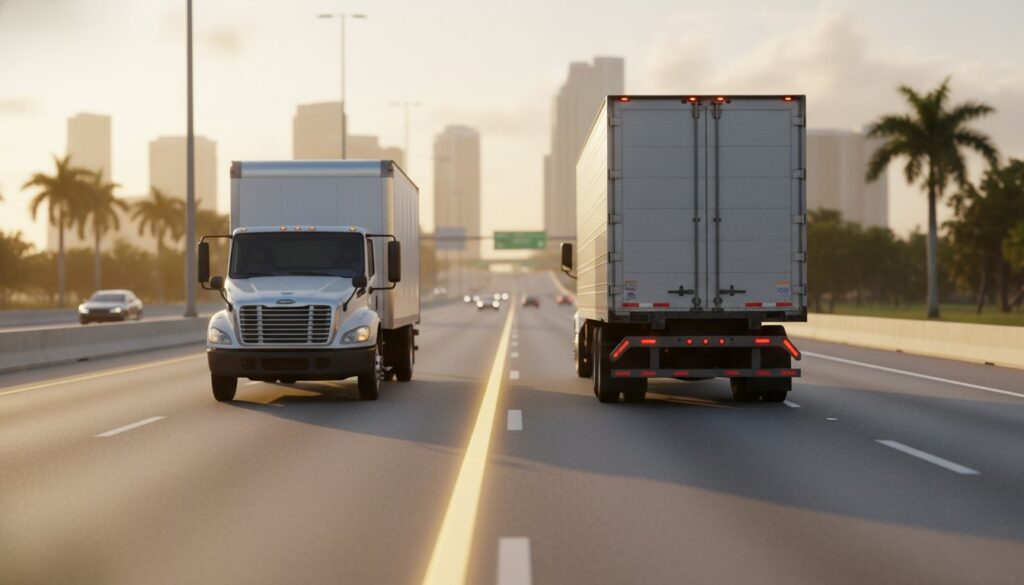

A single invisible line could be the only thing standing between you and the compensation you deserve. If a semi-truck hit you in Miami, the legal path depends entirely on whether that vehicle was crossing state lines or staying within our borders. This distinction of interstate vs intrastate trucking isn’t just industry jargon. It’s the foundation of your entire legal claim. Large corporations often hope this technicality will confuse you into accepting a smaller settlement.
You’re likely feeling overwhelmed by the pressure of dealing with insurance adjusters and corporate lawyers. At Charles Injury Law, we believe you shouldn’t have to decode complex statutes while you’re in physical pain. This article provides the clarity you need to understand which safety regulations were violated. You’ll learn how Florida law and federal mandates dictate everything from insurance minimums to electronic logging device requirements. We’ll show you how to hold these companies accountable and secure the financial restitution you need for a full recovery. We’ll also examine the 2026 FMCSA updates that impact your rights in Florida.
Key Takeaways
- Understand how the classification of interstate vs intrastate commerce determines which specific safety regulations apply to your accident in Florida.
- Identify the critical differences between federal safety standards and Florida statutes to pinpoint exactly where a trucking company failed you.
- Learn why interstate trucks often carry significantly higher insurance policy limits, which can drastically increase the total value of your injury claim.
- Discover how driver self-certification and medical exam records serve as vital evidence to prove negligence and hold the carrier accountable.
- See how Charles Injury Law utilizes these complex legal distinctions to act as a formidable shield and secure the financial restitution you deserve.
Understanding Interstate vs. Intrastate Commerce in Florida
The success of your truck accident claim hinges on a single legal distinction. You need to know if the vehicle that hit you was engaged in interstate vs intrastate commerce. This isn’t just a detail for a logbook; it’s the foundation of your right to compensation. Understanding Interstate vs. Intrastate Commerce requires looking at the constitutional authority that allows the federal government to regulate safety. If the truck was crossing state lines, the rules of the game change instantly. Charles Injury Law investigates these details immediately to ensure no evidence disappears.
What Qualifies as Interstate Commerce?
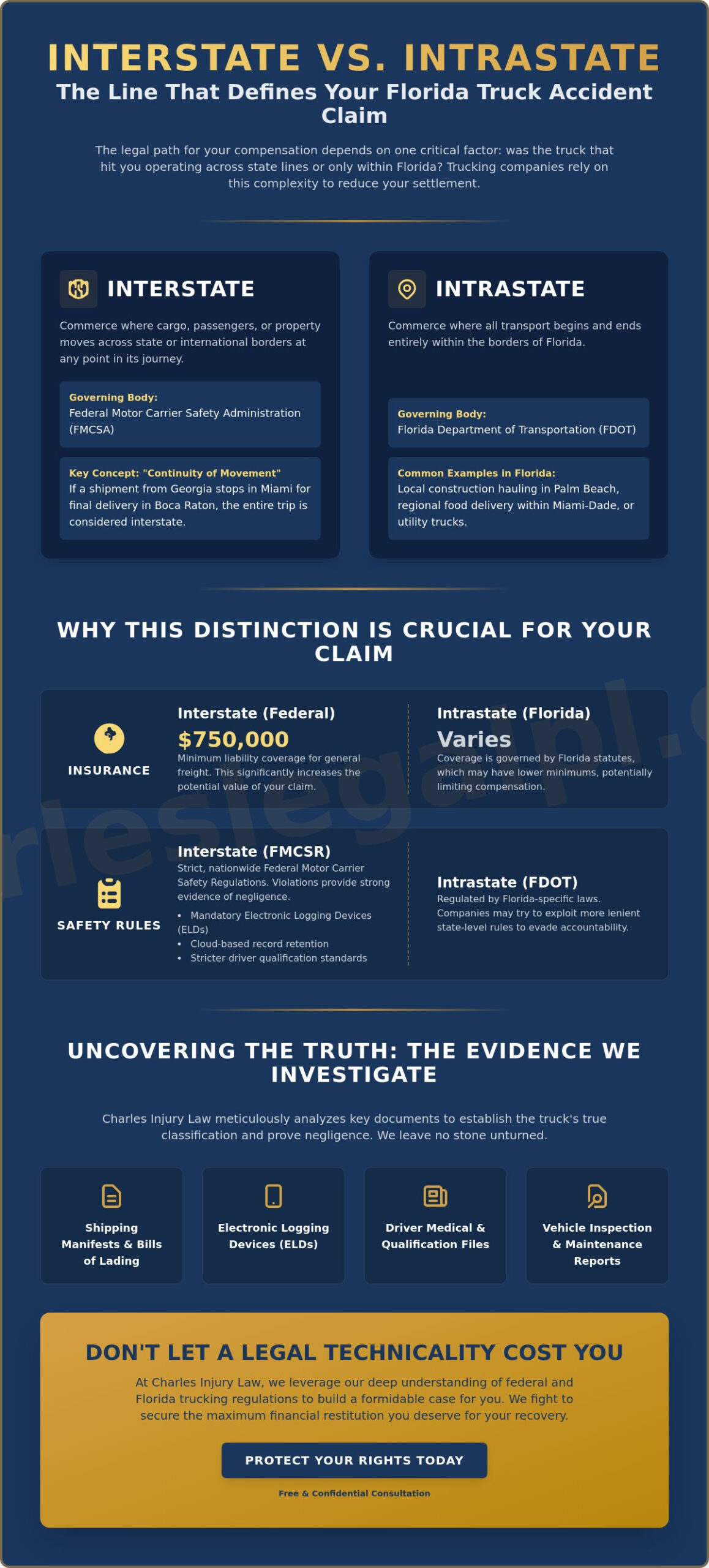
Interstate commerce happens when cargo moves across state or international borders. This includes more than just a long-haul driver from another country. It covers any transport where the goods originated outside of Florida. The Federal Motor Carrier Safety Administration (FMCSA) uses a concept called continuity of movement. If a shipment starts in Georgia and stops at a distribution center in Miami before its final delivery in Boca Raton, the entire trip is often considered interstate. The driver doesn’t have to leave the state for federal law to apply. The intent of the shipper at the start of the journey dictates the classification. If the intent was to move goods across state lines, then federal safety mandates are in play.
What Qualifies as Intrastate Commerce?
Intrastate commerce is restricted to trade and transport that occurs entirely within Florida borders. The journey begins here, and it ends here. The cargo is produced, sold, and delivered without ever crossing a state line. You see this often with specific local industries. If a company is hauling fill dirt for a construction site in Palm Beach or delivering locally grown produce within Fort Lauderdale, they are likely operating under intrastate rules. Common examples include:
- Local construction hauling for infrastructure projects in Miami.
- Regional food delivery services operating strictly within Miami and Fort Lauderdale.
- Waste management and utility trucks.
If the truck is purely intrastate, then Florida statutes and Florida Department of Transportation (FDOT) rules govern the case. This distinction determines the minimum insurance the company must carry. It dictates how many hours the driver is allowed to work. It even changes how we investigate the crash. Trucking corporations will try to hide behind the more lenient rules if they can. Charles Injury Law won’t let them. We dig into the bill of lading and the shipping manifests to prove the reality of interstate vs intrastate classifications. If a company violated federal safety standards, we use that evidence to hold them accountable. We fight for the superlative outcomes our clients deserve.
Federal vs. Florida State Regulations for Trucking Safety
The regulatory landscape for trucking in Florida is a battlefield of complex codes. Trucking companies often hide behind these complexities to evade accountability. You must know which set of rules governed the truck that hit you. The distinction between interstate vs intrastate regulations is often the smoking gun in a truck accident claim. If a carrier violates these specific safety mandates, it provides the evidence we need to secure your financial restitution. Charles Injury Law investigates every logbook and inspection report to find these violations.
The Role of the FMCSA in Interstate Safety
Interstate carriers must comply with the Federal Motor Carrier Safety Regulations (FMCSR). These are national standards enforced by the Federal Motor Carrier Safety Administration (FMCSA). These rules are strict. They mandate everything from cloud-based record retention for 90 days to the use of specific Electronic Logging Devices (ELDs). For example, as of May 2025, an English Language Proficiency violation is now an Out-of-Service violation for interstate drivers. Federal oversight is naturally more aggressive because these carriers move through multiple jurisdictions. They are required to carry a minimum of $750,000 in liability coverage for general freight. This high standard exists to protect the public from the massive risks of long-haul trucking.
Florida Department of Transportation (FDOT) Authority
Intrastate carriers in Florida operate under a different framework. These vehicles stay within our borders, but they are not exempt from safety requirements. The Florida Department of Transportation (FDOT) and Florida Statutes govern their operations. While Florida has adopted many federal standards, specific state rules apply to weight limits and inspections in Boca Raton or in Palm Beach. For instance, Florida law allows intrastate drivers to drive for 12 hours after 10 consecutive hours off duty. This differs from the stricter federal 11-hour limit. Insurance requirements for these local trucks are also based on Gross Vehicle Weight Rating (GVWR). A truck weighing over 44,000 pounds in Miami is only required by Florida law to carry $300,000 in liability coverage. Understanding the nuances of interstate vs intrastate safety codes is how we build a winning case.
State police enforcement plays a critical role in identifying these violations. When a crash occurs in Fort Lauderdale, we look for failures in vehicle maintenance or falsified inspection reports. The FMCSA increased penalties in 2026 for willful falsification of a Driver Vehicle Inspection Report to $19,000 per violation. We use these figures to show the court that the company’s negligence was a calculated risk. If the company ignored these codes to save time, they must pay for the damage they caused. You deserve an advocate who understands how these state and federal systems collide. If you are struggling with the aftermath of a collision, you should reach out to our team for a case evaluation. We act as your shield against corporate negligence and fight for the superlative outcomes you need to recover.
How Interstate and Intrastate Classifications Impact Your Legal Claim
Legal classification isn’t just a bureaucratic detail. It’s the roadmap for your financial recovery. The distinction of interstate vs intrastate trucking determines the size of the target we’re aiming for in your lawsuit. If a truck was crossing state lines, it’s bound by a higher standard of care. Charles Injury Law uses these classifications to identify every liable party involved. We don’t just look at the driver in the cab. We look for the parent corporations and shipping entities that allowed a dangerous vehicle on the road. Identifying a parent company often unlocks significantly higher insurance limits and corporate assets.
Insurance minimums vary wildly based on this classification. For interstate general freight over 10,001 pounds, federal law requires a minimum of $750,000 in liability coverage. If the truck was hauling hazardous materials, that requirement skyrockets to $5,000,000. Compare this to Florida’s intrastate requirements. A local truck in Miami weighing over 44,000 pounds is only required to carry $300,000 in liability coverage under Florida law. If the vehicle is smaller, the limits drop even further. Knowing which law applies is the first step in securing the maximum compensation you deserve.
Proving Negligence Under Federal Safety Standards
When we prove a violation of the Federal Motor Carrier Safety Regulations (FMCSR), we can often establish “negligence per se” in a Florida court. This means the act of breaking the federal safety rule is enough to prove the company was negligent. We hunt for the smoking gun in federal maintenance logs and Electronic Logging Device (ELD) data. Federal rules require cloud-based record retention for 90 days, giving us a digital trail of exactly how long a driver was behind the wheel. If you need an aggressive Truck Accident Lawyer in Florida, our team knows how to dismantle a trucking company’s defense using these federal mandates.
Liability Differences in Intrastate Accidents
Intrastate cases require a different tactical approach. We focus on Florida-specific insurance tiers and state safety statutes. If a local delivery company in Fort Lauderdale failed to properly train its drivers, we hold them accountable for that specific failure. Local businesses often take shortcuts with vehicle maintenance to save on overhead. These shortcuts lead to catastrophic failures on our roads. If a company’s negligence resulted in a fatality, we pursue Wrongful Death claims to ensure the family is protected. Whether the truck was a local van in Boca Raton or a massive interstate hauler in Palm Beach, we fight for the superlative outcomes our clients need to move forward.
Driver Requirements and Compliance Standards in Florida
A commercial truck is only as safe as the person behind the wheel. When a collision occurs in Miami, we look directly at the driver’s qualifications. The legal distinction of interstate vs intrastate commerce dictates which medical and licensing standards the driver had to meet. If a company puts an unqualified driver on our roads, they are responsible for the devastation that follows. Charles Injury Law deconstructs driver history to find the negligence that insurance companies try to hide.
CDL Classifications: Interstate vs. Intrastate Licenses
Florida drivers must self-certify their type of commercial operation. Category A drivers operate in interstate commerce and must meet all federal physical requirements. Category B drivers are restricted to intrastate commerce within Florida. If an intrastate-only driver is caught transporting out-of-state cargo in Fort Lauderdale, the company has committed a serious regulatory violation. We use these licensing errors to prove negligent hiring. If a firm fails to verify a driver’s certification, then they have prioritized profit over public safety. As of May 2025, even a lack of English language proficiency is considered an Out-of-Service violation. We check every detail to ensure the driver was legally allowed to be on the road.
Hours of Service (HOS) and Electronic Logging Devices
Fatigue is a leading cause of crashes in Palm Beach and in Boca Raton. To combat this, federal and Florida laws mandate strict Hours of Service (HOS) limits. Interstate drivers are generally limited to 11 hours of driving. Florida’s intrastate rules are slightly more lenient, allowing for 12 hours of driving after 10 consecutive hours off duty. However, 2026 updates have strengthened the mandates for Electronic Logging Devices (ELDs) to prevent drivers from “cooking the books.”
- Interstate drivers must use certified ELDs with real-time timestamp synchronization.
- Florida intrastate drivers must follow the 70-hour/7-day or 80-hour/8-day limits.
- Willful falsification of logs now carries fines up to $19,000 per violation as of 2026.
We analyze digital data to identify fatigued driving. If the logs show a driver was over their limit, we have the evidence needed to hold the trucking company accountable. We also verify medical certifications through the National Registry II system, which became fully digital in June 2025. This ensures the driver was physically fit to operate a massive vehicle. If you have been injured by a driver who shouldn’t have been behind the wheel, you need a Protective Champion. You should contact Charles Injury Law today to start your mission for financial restitution. We fight for the superlative outcomes our clients deserve while they focus on their recovery.
Securing Maximum Compensation with Charles Injury Law
Trucking corporations don’t wait for the dust to settle. They dispatch specialized “go-teams” to the crash scene in Miami or in Fort Lauderdale within minutes. These teams work to suppress evidence and shift blame before you even leave the hospital. You need a formidable shield to protect your rights from the moment the impact occurs. Charles Injury Law provides the aggressive advocacy required to stand up to these massive corporate entities. We understand that the distinction of interstate vs intrastate commerce is the key to unlocking the full value of your claim.
Our investigation is relentless. We dive into the carrier’s history to see if they’ve played fast and loose with safety codes. If a company operates across state lines, they must answer to federal authorities. If they stay within Florida, they must answer to our state statutes. We use this interstate vs intrastate status to determine which specific safety violations we can use as leverage. We don’t settle for the first offer. We fight for the superlative outcomes that reflect the true cost of your injuries and long-term needs.
Why You Need an Aggressive Advocate for Trucking Accidents
When you’re up against a multi-million dollar trucking firm, you aren’t just fighting a driver. You’re fighting an entire legal department. We act as your expert advocate by preserving critical evidence that the company might “lose” or delete. This includes black box data, satellite tracking records, and digital logbooks. If we identify a violation of hours-of-service or maintenance rules, we use it to prove liability. Our team at Charles Injury Law Personal Injury Practice handles the conflict so you can focus on your recovery.
Contact Us for a Trial-Ready Representation in Florida
We provide trial-ready representation for victims in Fort Lauderdale, Miami, Boca Raton, and Palm Beach. You won’t be handed off to a case manager. You get direct access to our legal team. We are a professional force that handles the high-stakes litigation necessary to hold negligent companies accountable. We operate with a clear mission to secure your financial restitution. Our firm offers a risk-free path to justice through our “No Fee Unless We Win” guarantee. If we don’t secure a recovery for you, then you don’t owe us any legal fees. Call us today to start your journey toward a successful outcome. We are always on and ready to fight for you in Florida.
Take Command of Your Recovery Today
Trucking companies and their insurance carriers will use every technicality to minimize your suffering. You now understand that the distinction of interstate vs intrastate commerce is a powerful tool in your legal arsenal. Whether your case involves federal safety violations or specific Florida statutes, the right evidence can secure your future. Charles Injury Law provides the aggressive advocacy needed to dismantle corporate defenses in Miami and in Fort Lauderdale. Our trial-ready legal team is prepared to hold negligent carriers accountable for every shortcut they took.
You deserve a partner who prioritizes your restitution above all else. If you or a loved one were injured in Palm Beach or in Boca Raton, the time to act is now. We offer a clear, risk-free path to justice. We don’t charge any fees unless we recover money for you. Let us handle the conflict while you focus on healing. Understanding these legal differences is the first step toward the superlative outcome you need to move forward with your life.
Your journey toward justice starts with a single call. We are standing by to be your protective champion.
Frequently Asked Questions
What is the main difference between interstate and intrastate trucking in Florida?
The primary distinction between interstate vs intrastate trucking lies in the origin and destination of the cargo. Interstate commerce involves trade across state or international borders. Intrastate commerce occurs entirely within Florida. This classification is the foundation of your claim. It determines whether federal FMCSA rules or Florida statutes govern the safety standards and insurance requirements of the vehicle that hit you.
Does a truck have to leave Florida to be considered ‘interstate’?
A truck does not have to leave Florida to be classified as an interstate carrier. If the cargo originated in another state and the truck is completing the final leg of the delivery in Miami, it is still considered interstate commerce. The “continuity of movement” rule means federal law applies to these local deliveries of out-of-state goods. We examine shipping manifests to prove the true status of the vehicle.
Are insurance requirements higher for interstate trucks than intrastate trucks?
Insurance requirements are generally much higher for interstate carriers. Federal law mandates a minimum of $750,000 in liability coverage for general freight over 10,001 pounds. In contrast, Florida law only requires $300,000 for intrastate trucks weighing over 44,000 pounds. If the truck was hauling hazardous materials, federal law requires at least $5,000,000 in coverage. This difference directly impacts the total financial restitution available for your injuries.
What happens if a driver with an intrastate CDL causes an accident in another state?
If a driver with an intrastate-only CDL crosses state lines and causes an accident, they have committed a major regulatory violation. This is evidence of negligent hiring and supervision by the trucking firm. They failed to ensure their driver was legally qualified for the route. We use these licensing errors to hold the company accountable and show they prioritized profit over public safety.
How do Hours of Service rules differ between interstate and intrastate driving in Florida?
Hours of Service rules differ in the specific driving limits allowed. Interstate drivers are generally limited to 11 hours of driving after 10 hours off duty. Florida intrastate rules are more lenient. They allow for 12 hours of driving after 10 consecutive hours off duty. We analyze digital ELD data to see if these limits were ignored. If the driver was fatigued, the company is liable for the collision.
Can I sue the trucking company if they violated federal safety regulations?
You can absolutely sue a trucking company for violating federal safety regulations. When a carrier breaks an FMCSA rule, it can establish “negligence per se” in a Florida court. This means the violation itself serves as proof of the company’s negligence. Charles Injury Law aggressively pursues these violations to dismantle the defense of massive trucking corporations. We fight for the superlative outcomes our clients deserve.
How do I know if the truck that hit me was an interstate or intrastate carrier?
Identifying the carrier’s status requires a professional investigation into the vehicle’s USDOT number and the bill of lading. We look for the “intent” of the shipment at the start of the journey. If the cargo was destined for a location outside of Florida or originated elsewhere, it is an interstate case. Our legal team handles this complex research immediately so you can focus on your physical recovery.
Why is the distinction between interstate and intrastate important for my injury settlement?
The distinction of interstate vs intrastate is vital because it sets the legal standards for your injury settlement. Interstate cases typically involve much larger insurance policies and stricter maintenance requirements. Identifying a federal safety violation makes it much harder for the insurance company to deny your claim. This clarity allows us to act as your protective champion and secure the maximum compensation allowed by law.
Disclaimer
The information provided on this blog is for general informational purposes only and does not constitute legal advice. Viewing this content does not create an attorney-client relationship with the firm. You should not act or rely on any information contained herein without seeking legal advice from a qualified attorney regarding your individual situation.