


If your landlord missed the 30-day deadline to claim your deposit, they’ve already lost the legal right to keep your money. It’s a common story for tenants in Miami and in Boca Raton. You move out, leave the place spotless, and then find that your landlord won’t return your security deposit while dodging your phone calls. You need that cash for your new rental, but instead, you’re facing unfair deductions for basic wear and tear. It feels like a losing battle when you’re being ignored.
We understand the stress of being silenced by someone who owes you thousands. At Charles Injury Law, we believe you shouldn’t have to pay out of pocket to get back what is already yours. If your landlord violated Florida law, we step in as your protective champion to demand immediate accountability. Our mission is to secure the financial restitution you deserve without the burden of high legal fees.
This article reveals the exact steps to recover your funds using Florida Statute 83.49. You’ll learn why the landlord might be forced to pay your legal fees and how we secure superlative outcomes for clients in Palm Beach and in Fort Lauderdale. We provide the clear path you need to reclaim your money and move forward with your life.
Key Takeaways
- Understand the strict 15 and 30-day deadlines that Florida landlords must follow to legally keep any portion of your money.
- Distinguish between normal wear and tear and actual property damage to prevent illegal deductions from your funds.
- Learn why you must provide a written forwarding address if your landlord won’t return your security deposit in Florida.
- Explore how the “Prevailing Party” rule allows you to recover your money while the landlord pays for your legal representation.
- Discover the aggressive strategies Charles Injury Law uses to audit landlord claims and fight for your full return in Palm Beach or in Boca Raton.
Table of Contents
Florida Security Deposit Laws: The 15 and 30 Day Rules
Florida law doesn’t leave room for "maybe" or "later." Your landlord is a business operator, and they must follow strict timelines. When a landlord won’t return your security deposit, they often hope you don’t know the law. If a landlord in Fort Lauderdale or in Miami ignores these rules, they lose their right to your money. Period. A security deposit is your property held in trust; it is not a slush fund for the landlord’s renovations.
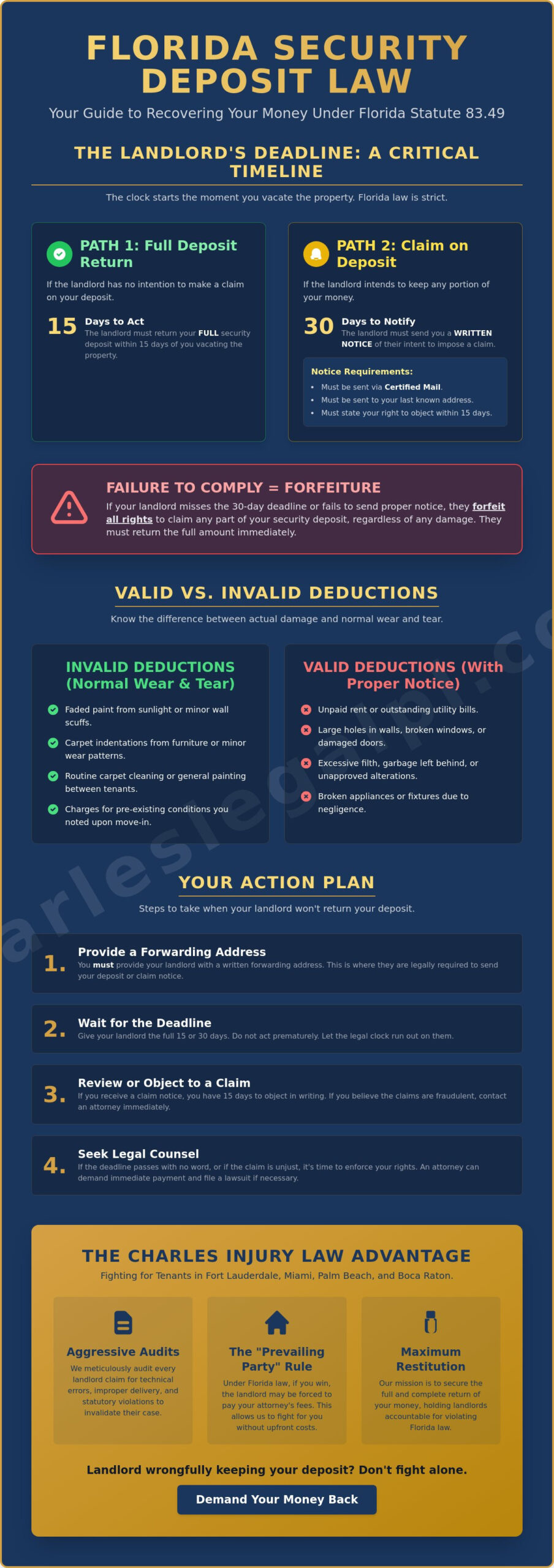
Under Florida Statute 83.49, the clock starts the moment you vacate the premises. If the landlord does not intend to make a claim, they must return your full deposit within 15 days. If they plan to keep even one cent, they have exactly 30 days to send you a written notice of intent. This notice must be sent via certified mail to your last known mailing address. If the landlord fails to use certified mail, the notice is legally insufficient. In cities like Boca Raton and in Palm Beach, we see landlords try to cut corners with emails or texts. These do not count under Florida law.
Understanding Florida Statute 83.49
This statute is your primary defense against bad-faith actors. It mandates that a landlord must state their intention to withhold funds in writing. They cannot simply keep the money and stop answering your calls. The notice must include specific statutory language informing you of your right to object within 15 days of receiving the claim. If the notice lacks this specific phrasing, the landlord’s claim is often dead on arrival. Charles Injury Law audits these notices to find every technical error that works in your favor. We look for missing signatures, incorrect dates, and improper delivery methods to ensure your rights remain protected.
Consequences of Missing the 30-Day Window
If your landlord won’t return your security deposit and missed the 30-day window, they’ve already lost the battle. Florida law is unforgiving on this point: failure to provide timely notice results in the total forfeiture of the landlord’s right to impose a claim. It doesn’t matter if there is actual damage to the unit. If they are late by even one day, they must return the full amount immediately. "I was out of town" or "my office was busy" are not valid legal defenses in Florida. We hold them to the letter of the law. If they missed the deadline, we demand the full return of your funds without delay.
Common Reasons Landlords Withhold Deposits in Florida
Landlords often treat your deposit like a bonus for their next renovation. They use your funds to refresh the unit for the next tenant, but this is illegal. If your landlord won’t return your security deposit because they want to paint the walls or clean the carpets, they are likely violating Florida law. A security deposit is not a slush fund for routine maintenance. It is your money, and it must be protected.
Florida law allows deductions for two main reasons: actual property damage and unpaid financial obligations. If you left the unit with unpaid rent or outstanding utility bills, the landlord can legally withhold those amounts. However, they must still follow the strict notice procedures outlined in Florida Statute 83.49. If they skip the mandatory paperwork, they skip the right to keep your money. Even a valid debt can become uncollectible from the deposit if the landlord misses a statutory deadline.
Defining Normal Wear and Tear in Florida
Landlords in Miami or in Palm Beach cannot charge you for "upgrading" their investment. Normal wear and tear is the expected decline in a property’s condition due to ordinary daily use. Faded paint from sunlight is a cost of doing business for the landlord. Carpet indentations from furniture and minor scuffs on the floor are not your responsibility. Florida courts generally require you to return the unit in a "broom clean" condition. If a landlord charges you for professional deep-cleaning without a specific lease requirement and proof of excessive filth, it is often an illegal grab for your cash.
Spotting Fraudulent Damage Claims
We frequently see landlords in Boca Raton charge tenants for pre-existing conditions. If the carpet was stained or the blinds were broken when you moved in, you don’t pay for them when you move out. Always demand actual receipts for any repairs the landlord claims to have made. An "estimate" is not a receipt, and an "invoice" from a company the landlord owns is a major red flag. If you suspect your landlord is inflating repair costs or lying about the unit’s condition, you can reach out to Charles Injury Law for a case review. We identify these fraudulent patterns and hold bad-faith landlords accountable.
Charles Injury Law acts as your shield against these predatory tactics. We audit every line item the landlord submits. We cross-reference their claims with your move-in inspection and photos. If the landlord is lying to keep your money, we expose the fraud and fight for your full recovery.
Steps to Take When Your Landlord Won’t Return Your Money
When a landlord won’t return your security deposit, silence is usually a calculated tactic. They hope you’ll get frustrated and walk away. Don’t let them win. You have a specific set of tools under Florida law to force their hand. First, you must provide your forwarding address in writing immediately after moving. If you haven’t done this, send it today via certified mail. This simple step triggers the landlord’s legal obligations under Florida’s Landlord/Tenant Law. Without a documented forwarding address, the landlord may claim they had no way to return your funds.
Once you receive a notice of claim, review it for statutory compliance. If the landlord missed their 30-day deadline or failed to use certified mail, they’ve already lost. If they did follow the rules but the deductions are unfair, you must act fast. You cannot simply call them to complain. You need a formal, written response to protect your rights in cities like Miami or in Boca Raton.
The Power of the Formal Notice of Objection
You have exactly 15 days from the receipt of the landlord’s notice to object in writing. This is a non-negotiable window. If you fail to object, you effectively waive your right to contest the deductions. Your Notice of Objection must be clear and assertive. State exactly which charges you dispute and why. Send this via certified mail with a return receipt requested. This creates a paper trail that no landlord in Fort Lauderdale can ignore. It signals that you know the law and you’re prepared to fight for your money.
Gathering Evidence for Your Claim
Your evidence is your ammunition. Before you move out of any unit in Palm Beach, take high-resolution photos and videos of every corner. Open every cabinet and closet to show they are empty and clean. If you hired professional cleaners, keep those receipts as proof of the unit’s condition. Witness testimony from friends or movers can also be vital if the case goes to court. Organize your lease agreement and all communication logs. If the landlord’s claims are fraudulent, this evidence becomes the formidable shield Charles Injury Law uses to secure your recovery. We turn your documentation into a mission for financial restitution.
Suing for Your Security Deposit: Small Claims and Beyond
Suing a landlord is often the only way to get their attention. When a landlord won’t return your security deposit, they are betting that you won’t take legal action. They assume the cost of a lawyer will be more than the deposit itself. They are wrong. In Florida, small claims court handles disputes for amounts up to $8,000. This is the standard path for tenants in Miami and in Fort Lauderdale who are tired of being ignored. Charles Injury Law steps in to disrupt the landlord’s gamble. We provide the aggressive advocacy needed to flip the script and secure your funds.
The legal system in Florida is designed to protect tenants from predatory property owners. You don’t have to fear the cost of representation. Because of specific state laws, the financial burden of the lawsuit often shifts entirely to the person who broke the rules. If your landlord won’t return your security deposit and forced you into court, they may end up paying far more than just your original deposit. We focus on superlative outcomes where the landlord is held fully accountable for their bad-faith actions.
Recovering Attorney’s Fees and Court Costs
Florida Statute 83.48 is your greatest weapon in a security deposit dispute. This law contains the "Prevailing Party" rule. It states that in any civil action brought to enforce a rental agreement, the winning party is entitled to recover reasonable attorney’s fees and court costs from the losing party. This levels the playing field for tenants in Boca Raton and in Palm Beach. If we win your case, the landlord pays our fees. This removes the cognitive load of legal costs and allows you to focus on your recovery. Once a landlord realizes they are on the hook for their own lawyer plus yours, they often settle immediately.
The Litigation Timeline in Florida Courts
The process begins when we file a formal complaint in the appropriate Florida court. After the landlord is served, the court typically schedules a pre-trial conference or mediation. In Florida, mediation is a mandatory step where both sides attempt to reach a settlement before a judge gets involved. If the landlord remains stubborn, we proceed to trial to present your evidence. After securing a final judgment, we don’t stop there. If the landlord still refuses to pay, we utilize legal tools like bank account garnishments to collect your money. You can contact Charles Injury Law today to start the process of holding your landlord accountable.
How Charles Injury Law Protects Florida Tenants
A tenant’s email is easy to ignore. A formal legal demand from Charles Injury Law is not. If your landlord won’t return your security deposit, they are likely counting on your silence to save them money. We replace that silence with aggressive advocacy. Our firm serves as a formidable shield for tenants in Fort Lauderdale and in Palm Beach who are being bullied by bad-faith property owners. We don’t just ask for your money back. We demand accountability. When a landlord sees our name on a letterhead, the power dynamic shifts instantly. They realize the cost of fighting a losing battle will far exceed the cost of returning your funds.
Our process begins with a meticulous audit of the landlord’s claims. We examine every detail of the notice they sent or the silence they’ve maintained. If they missed a deadline under Florida law, we use that failure to secure a superlative outcome for you. We identify statutory violations that the average tenant might overlook, such as improper holding of funds in non-Florida accounts. This technical expertise often forces landlords to settle before a single court date is ever set. They know that if they lose in court, they pay our fees. This directness removes the cognitive load from your shoulders.
Our Results-Oriented Approach to Landlord Disputes
Charles Injury Law acts as your Protective Champion against corporate landlords and massive management companies. We don’t settle for partial returns when you are entitled to the full amount. Our mission is the maximum recovery of your original deposit plus any applicable interest. This aggressive spirit is the same force we apply in all our practice areas. You can learn more about our Premises Liability expertise to see how we hold property owners accountable across Florida. We treat your security deposit recovery as a mission for financial restitution. You shouldn’t have to beg for what is legally yours.
Schedule a Consultation in South Florida
Time is your enemy in these disputes. The faster you act, the harder it is for a landlord to hide behind excuses or spend your money. We are available for tenants in Miami, in Fort Lauderdale, and in Boca Raton. If you are struggling because a landlord won’t return your security deposit, immediate action is required. We audit the facts, identify the violations, and provide a clear path to recovery. Our firm is small enough to care personally but experienced enough to succeed against large adversaries. Contact Charles Injury Law for a free consultation today to stop the landlord from keeping your money.
Secure Your Full Financial Recovery
You’ve learned how Florida law protects your money through strict deadlines and the prevailing party attorney fees provision. If your landlord won’t return your security deposit, the law is on your side. Landlords in Miami and in Boca Raton often rely on tenant confusion to keep funds illegally. We stop that cycle immediately. By utilizing aggressive Florida statutory enforcement, we ensure your rights are never ignored by property managers or corporate entities.
Fight for your money with Charles Injury Law today. You deserve a champion who fights for every cent you’re owed. We are ready to handle the conflict while you move forward with your life.
Frequently Asked Questions
How long does a landlord have to return a security deposit in Florida?
A landlord has exactly 15 days to return your full deposit if they don’t intend to make a claim. If they plan to withhold any amount, they must send a notice of intent via certified mail within 30 days. If they miss these deadlines in Miami or in Boca Raton, they forfeit their right to keep your money. We hold them to these strict statutory timelines to ensure your funds are returned quickly.
Can a landlord charge for carpet cleaning in Florida?
No, a landlord cannot typically charge for routine carpet cleaning that falls under normal wear and tear. If the carpet is damaged by excessive stains or pet odors, they might have a valid claim. However, they must provide a detailed invoice for the work. If your landlord won’t return your security deposit because of standard cleaning fees, they are likely overstepping their legal bounds and violating Florida law.
What happens if I didn’t give a 30-day notice before moving out?
If you have a month-to-month tenancy, Florida law now requires 30 days’ notice before the end of the monthly period. Failure to provide this notice might allow the landlord to deduct rent for the following month from your deposit. Always check your specific lease agreement in Palm Beach for additional notice requirements. If you’re unsure if a deduction is valid, Charles Injury Law can audit your lease for compliance.
Do I need a lawyer to get my security deposit back in Fort Lauderdale?
You aren’t required to have an attorney, but it’s often the smartest move. Because Florida law allows the winning party to recover attorney’s fees, hiring Charles Injury Law often costs you nothing out of pocket. We provide the aggressive advocacy needed to force a settlement when a landlord refuses to follow the rules. This levels the playing field against corporate landlords who have their own legal teams.
Can my landlord deduct for painting the walls?
Landlords cannot deduct for painting walls that have minor scuffs or faded color from sunlight. This is considered normal wear and tear. They can only charge you if you painted the walls a new color without consent or caused significant damage like large holes. If you left the walls in good condition, we fight to recover those illegal deductions and secure the superlative outcome you deserve.
What should I do if my landlord ignores my demand letter?
If your landlord ignores a formal demand, it’s time to escalate to litigation. You can file a case in small claims court if the amount is under $8,000. Alternatively, you can contact Charles Injury Law to handle the dispute for you. A lawsuit often forces a landlord in Miami to pay up once they realize they’ll be responsible for your legal fees and court costs.
Is the landlord required to pay interest on my security deposit in Florida?
It depends on how the landlord chooses to hold the funds. If the deposit is in an interest-bearing account, you’re entitled to at least 75% of the annualized average interest rate or 5% simple interest per year. If the account is non-interest bearing, no interest is due. The landlord must notify you in writing within 30 days of receiving the deposit about how your funds are being held.
Can a landlord keep my deposit if there was no move-out inspection?
Yes, they can still attempt to make a claim, but it’s much harder for them to prove you caused the damage. Without a move-out inspection report, the landlord lacks concrete evidence of the unit’s condition at the time you vacated. If your landlord won’t return your security deposit and lacks proof of damage, we aggressively challenge their claim in court to ensure your full financial recovery.
Disclaimer
The information provided on this blog is for general informational purposes only and does not constitute legal advice. Viewing this content does not create an attorney-client relationship with the firm. You should not act or rely on any information contained herein without seeking legal advice from a qualified attorney regarding your individual situation.