



A badge doesn’t put unlawful conduct beyond accountability. In Florida, civil rights may apply when police use excessive force, make an unlawful arrest, engage in racial profiling, or violate a person’s rights through a department policy or practice. A lawyer for police harassment can assess what happened and identify the evidence that may support a civil claim.
After a frightening encounter with law enforcement, it is reasonable to want clear answers. The key question is often not only what an officer did, but whether a broader policy or practice contributed to the harm. That distinction can shape how accountability is pursued.
This article explains Florida civil-rights issues involving police harassment, force, shootings, racial profiling, and municipal policies, with practical context for encounters in Miami and Fort Lauderdale. Learn what evidence may matter, how a policy or practice can factor into a claim, and what steps can help protect your position.
Key Takeaways
- Learn which constitutional protections may apply to police encounters, arrests, and searches.
- Recognize why the circumstances and evidence matter when assessing an excessive-force claim.
- Understand how a fatal police encounter may raise civil-rights and wrongful-death issues.
- Identify details that can help show whether racial profiling affected a police interaction.
- See how a department policy or practice may become relevant to municipal liability.
What Are Your Civil Rights?
Police misconduct may violate protections under the Florida Constitution and support a civil claim. The central questions are what happened, which protection may apply, and what evidence connects the conduct to the harm.
Constitutional Protections
Florida’s constitutional protections may be relevant when police conduct involves a search, seizure, arrest, speech, or treatment in custody. The circumstances matter. Record what officers did and said, and how the encounter unfolded. A search raises different factual issues from alleged retaliation after someone criticizes an officer.
Police misconduct may also involve false arrest, racial profiling, unlawful surveillance, coerced statements, or mishandled evidence. Each situation requires close attention to the conduct and its consequences. Separate firsthand observations from assumptions about an officer’s intent.
Claims Under Florida Law
A civil-rights claim under Florida law examines whether conduct violated a protected right and caused harm. Evidence must connect the actions to the alleged violation. A civil-rights attorney can review the timeline, records, injuries, and potential defendants, then explain how the facts may support a Florida lawsuit.
When looking for a lawyer for police harassment, seek an attorney who handles police-misconduct cases and can explain relevant Florida protections, evidence, and filing deadlines. Ask how the attorney would assess your records and the sequence of events. A focused discussion can clarify possible next steps.
Police Misconduct Litigation
A civil lawsuit is different from an internal complaint or criminal investigation. It seeks civil accountability and may seek monetary damages from responsible parties. An allegation alone does not establish a violation. A lawyer can assess the conduct, resulting harm, available records, and whether the evidence supports a claim under Florida law.
Filing deadlines depend on the claim and the applicable Florida filing period. Record the incident date and seek legal guidance promptly, because delay can affect a claim. Preserve video, witness names and statements, medical records, messages, and police reports. Write down what happened while the details are fresh.
Reporting Misconduct
In Florida, reporting procedures depend on the agency and the channel used. Options may include an internal complaint, a criminal complaint, or a civil lawsuit. Some reports may be anonymous, but an agency may need the reporter’s identity, evidence, or witnesses to investigate. Keep a copy of each complaint and note when and where you submitted it.
A civil claim may sometimes proceed anonymously or under a pseudonym to protect the person filing it. If harassment or retaliation is happening now, move to safety if possible, avoid confrontation, and document incidents when safe. Save messages and identify witnesses. These details may help establish a pattern and support a report or legal review.
Excessive force and police brutality
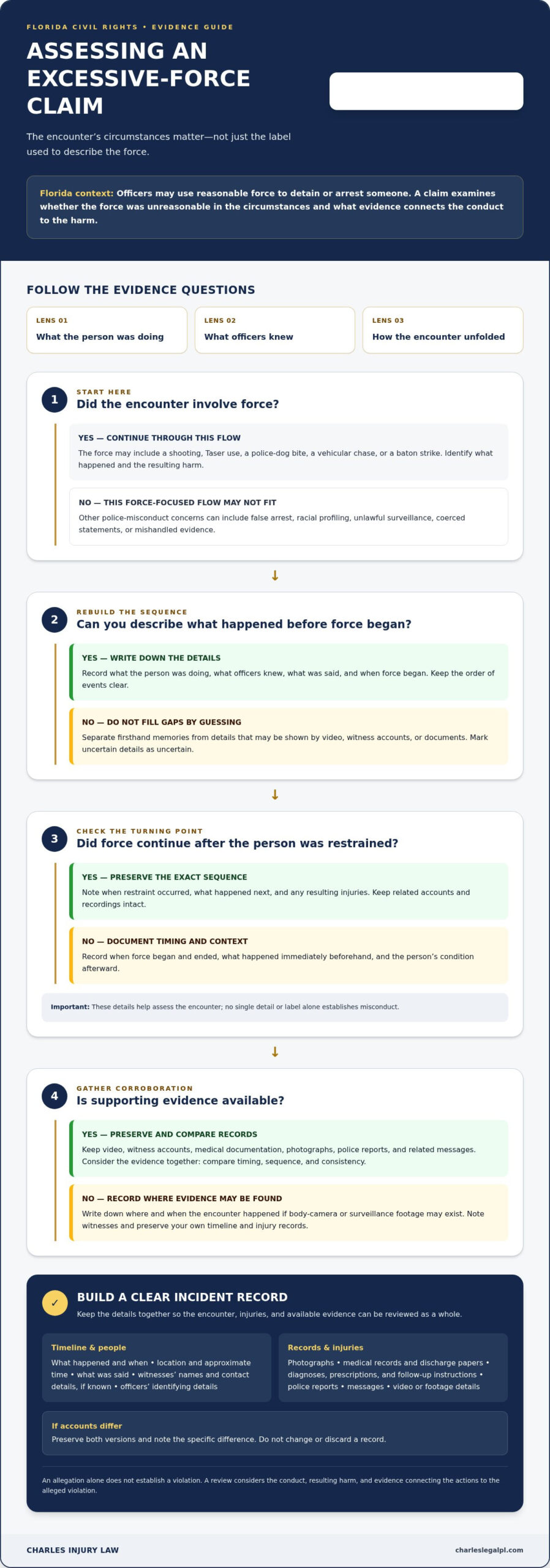
In Florida, law enforcement officers may use reasonable force to detain or arrest someone, but not unreasonable force. The circumstances matter: what the person was doing, what officers knew, and how the encounter unfolded.
Excessive Force Claims
Excessive-force claims examine force used during an encounter, including unwarranted shootings, Taser use, police-dog bites, vehicular chases, or baton strikes. A label alone does not establish misconduct. Assess the events leading up to the force and the resulting harm.
For example, compare a record of Taser deployment with witness accounts, video, and medical documentation. The sequence matters: when force began, what happened immediately beforehand, and whether officers continued after the person was restrained. These details help assess whether evidence supports an allegation of excessive force.
Police Brutality Cases
Police brutality cases may involve severe force or repeated actions during an encounter. A shooting, dog bite, or repeated baton strikes calls for close review of the officer’s actions and resulting injuries. An attorney can examine available evidence and assess whether it supports a civil-rights claim.
If you experience police brutality, preserve a useful record by writing down the timeline, identifying witnesses, and documenting injuries. Save photographs, medical records, police reports, and related messages. If body-camera or surveillance footage may exist, note where and when the encounter happened. These details can help identify relevant recordings.
Consider evidence together, not in isolation. A witness may describe an officer’s commands, while video shows when force began. Medical records can document injuries, and their timing and consistency also matter. If an account differs from a report, preserve both and note the specific difference instead of changing or discarding either record.
After treatment, keep copies of discharge papers, diagnoses, prescriptions, and follow-up instructions. Record witnesses’ names and contact details, if known, along with the location, approximate time, officers’ identifying details, and what was said. Do not guess when a detail is uncertain. Separate what you remember from what a video or document may show.
Police brutality claims can raise difficult questions about what force was reasonable in the circumstances. A police misconduct or brutality claim can involve reviewing the encounter, injuries, and supporting records. If you’re considering next steps, preserve the evidence and organize a clear timeline before discussing the incident with an attorney.
The firm states it has more than 100 years of experience representing clients affected by police misconduct, police brutality, and civil rights abuses.
Police shootings and wrongful death
A fatal police shooting can raise separate questions about criminal charges and civil accountability. For a family, the absence of an arrest or prosecution does not determine whether an officer’s conduct violated someone’s rights or caused a wrongful death.
No criminal charges are filed against officers involved in 99% of fatal shootings. That figure describes criminal charges, not every possible civil claim. Criminal proceedings and civil litigation serve different purposes. A civil case can examine the officer’s actions, the events leading to the shooting, and the harm suffered by the deceased person’s family.
Start by preserving evidence that may show the encounter’s timeline. Record the location, time, witnesses’ names, and any statements heard before or after the shooting. Save photographs, messages, medical records, and available police documents. If a witness has video, preserve the original file and note who recorded it. These steps help a law firm assess what evidence may clarify the circumstances.
An investigation into a shooting should examine more than the final moment. Relevant questions include what happened before force was used, what officers could see, and whether their account matches available video or witness statements. Avoid editing recordings or relying only on brief clips. Preserve complete files and note their source.
Taser use may also matter when an encounter ends in serious injury or death. Document when the Taser was used, what happened immediately before and afterward, and whether other force followed. For example, record a sequence involving a Taser, restraint, and medical emergency as separate events, rather than reducing it to one general description.
Keep civil and criminal questions distinct. A prosecutor’s decision about charges does not, by itself, resolve whether civil rights were violated. Likewise, a civil lawsuit does not determine criminal guilt. In a legal consultation, families can organize the timeline, records, witness information, and questions about potential claims. The evidence and alleged conduct guide the review.
After a death, relatives may need time to gather records while managing immediate responsibilities. A designated family contact can collect documents, list potential witnesses, and record when agencies provide information. Preserve written communications and note unanswered questions. An organized file helps prevent important details from being lost as the family considers next steps.
When police conduct may have caused a fatal injury, families can learn about wrongful-death claims involving government actors. Preserve relevant evidence and seek legal guidance about the facts and potential civil process.
Racial profiling
Racial profiling concerns whether race influenced law enforcement’s decision to stop, question, search, or use force against someone. A single encounter can be difficult to assess on its own. Compare officers’ stated account with the person’s account, witness observations, and available records. The issue is whether specific conduct, rather than a stereotype, explains the police action.
It also reports that Black people are 28% more likely than white people to be pulled over. Those figures describe disparities; they don’t prove why a particular stop or use of force occurred. An individual claim requires evidence about the encounter and the decisions surrounding it.
For a traffic stop, record the date, location, reason given, questions asked, and whether officers searched the vehicle. Note if the explanation changed during the encounter. If a passenger or bystander witnessed the stop, record their contact details and recollection. A documented pattern of stops, searches, or citations may also provide context.
Stereotyping may appear in an officer’s words, stated reasons, or treatment of people in similar circumstances. Note race-related remarks and whether officers described a specific act or relied on a broad assumption. Preserve messages, dispatch details, citations, and video in their original form. A timeline helps distinguish direct observations from later conclusions.
Police violence and racial disparities can overlap when an encounter escalates. Record the sequence: the initial stop, commands, any search, when force began, and what happened afterward. Medical records and photographs can document injuries, while witness accounts may add context. Keep dates and descriptions consistent across notes, reports, and discussions about the incident.
If you are seeking justice, focus on evidence tied to your encounter. A disparity alone does not establish unlawful discrimination. A civil-rights attorney can examine the stated reason for police action, recorded conduct, and whether comparable events provide context. Specific evidence is the foundation for evaluating an individual claim, not a broad statistic or unsupported accusation.
To prepare for legal review, organize records by event and date. Separate what you personally saw from what someone else reported. Include officers’ and witnesses’ names when available, and identify records that may still need preservation. This makes it easier to clarify what happened and where accounts or documents differ.
Municipal liability for policies and practices
A police-misconduct claim involving a government entity may require examining more than an officer’s actions. Under Florida law, key questions include what conduct caused the harm and whether an official policy or practice connects to it. Focus on the specific evidence, not simply on whether the encounter involved alleged misconduct.
That distinction matters: an officer’s alleged conduct and a government entity’s role are separate issues. A written directive, regulation, or ordinance may provide context if it relates to the events. The existence of a policy alone does not establish that it caused harm or that a government entity is responsible.
Build a record around the incident. Preserve reports, written directives mentioned in them, witness accounts, and available recordings. Note whether an officer said a particular procedure guided a decision. If records describe the event differently, keep each version and identify the specific difference. Do not edit original files or documents.
For example, if a report refers to a departmental directive, record its exact title and retain the report. Compare its description of the procedure with witness accounts and other records. This may clarify how the directive related to the incident. It does not, by itself, establish that the practice caused a constitutional or other legal violation.
For an incident involving a county agency, identify which agency employed the officers and which government entity issued the relevant policy or directive. Keep officers’ names, badge details, report numbers, and agency paperwork together. This helps distinguish an individual officer’s conduct from an alleged official practice connected to the event.
A focused review can ask: What rule or directive applied? Who issued it? What conduct followed? What evidence connects the practice to the harm? The answers may clarify whether the government entity’s role warrants further legal examination. Dated records describing specific encounters and decisions are more useful than broad claims about a recurring problem.
One incident may not reveal how a department operates. Preserve every document you receive, noting its source and date. If a report cites a directive, copy its exact title. If witnesses describe similar conduct, record each account separately and identify what each person observed firsthand. This gives a Florida attorney material to assess without blending distinct events together.
If officers’ conduct may connect to a government policy or practice, organize the records for review. A police-misconduct claim can involve examining the incident, the relevant directive, and the evidence linking them.
Personal Injury Attorney in Fort Lauderdale: Injuries suffered from Car Accidents
Personal Injury Attorney in Fort Lauderdale represents people injured by police misconduct or brutality. If an encounter with law enforcement caused an injury, the firm can help explain the civil claim and relevant records. Its injury practice also handles injuries from car, truck, semi, and tractor-trailer accidents, Uber and Lyft rideshare accidents, and pedestrian incidents involving walking, jogging, or bicycling.
Turn to Personal Injury Attorney in Fort Lauderdale when an injury from one of these incidents leaves you with questions about accountability. Contact the firm to discuss your situation and possible next steps.
Call Now: (954) 390-2228 Available 24 Hours a Day, 7 Days a Week
Take the Next Step Toward Accountability
Your next step is to turn a difficult encounter into a clear account of what happened. Note the central issue you want addressed: an officer’s conduct, a department practice, or both. A focused account can help a lawyer for police harassment identify the questions that need answers and the records that may help.
The details of each claim matter. Its potential strength depends on the conduct, available evidence, resulting harm, and connection between them. You do not need to resolve those questions before seeking legal guidance. Bring your concerns forward to get a clearer view of your options.
Contact Personal Injury Attorney in Fort Lauderdale to discuss your situation and possible next steps. Taking that first step can help you move forward with greater clarity and determination.
Frequently Asked Questions
What Is Police Misconduct?
Police misconduct is improper conduct by an officer that may violate a person’s rights or cause harm. Examples include falsifying a report, tampering with evidence, or threatening someone during an encounter. Context matters: disagreement with an officer alone does not establish misconduct. When documenting an incident, separate what you directly observed from what someone else told you, and keep original records intact.
What type of lawyer handles police harassment or misconduct cases?
A civil-rights attorney who handles police-misconduct cases can review potential claims involving harassment, brutality, or other alleged misconduct. Ask how the lawyer would assess the events, identify relevant records, and explain the legal process in Florida. Bringing a concise timeline and the documents you have can focus an initial discussion and clarify what information may still be needed.
How do I file a complaint against a police officer or department?
Prepare a clear account of the incident and submit it through the police agency’s complaint process. Include the date, location, people involved, and conduct you are reporting. Attach copies of relevant records, not originals, and retain your complaint and any acknowledgment. A complaint is separate from a civil lawsuit, so track both processes and their correspondence.
Can I sue police for harassment under federal civil rights law, such as 42 U.S.C. § 1983?
A civil claim may be possible, but this article addresses legal issues under Florida law, not federal statutory claims. For a potential Florida claim, organize the incident timeline, identify the officers and public agencies involved, and preserve records related to the alleged harm. These details help counsel assess legal options and filing deadlines before you decide how to proceed.
How much does a police misconduct lawyer cost, and do they work on contingency?
Charles Injury Law handles eligible injury matters on a contingency-fee basis: clients pay no attorney’s fees unless the firm recovers compensation. The written agreement explains how the arrangement applies to your case and how case expenses are handled. Review those terms before representation begins, and ask about anything you do not understand so you can make an informed decision.
What are the deadlines for suing police for harassment or misconduct?
Filing deadlines depend on the claim and applicable filing period; civil-rights lawsuit deadlines often range from one to three years. Record the incident date and seek legal guidance promptly, because delay can affect a claim.
Disclaimer
The information provided on this blog is for general informational purposes only and does not constitute legal advice. Viewing this content does not create an attorney-client relationship with the firm. You should not act or rely on any information contained herein without seeking legal advice from a qualified attorney regarding your individual situation.