



A Courtyard hotel’s name doesn’t determine who may be responsible for an injury. What matters is who controlled the area, what happened, and what the evidence shows. If you were hurt in a lobby, hallway, guest room, or another hotel area, a lawyer for injury at Courtyard can investigate whether negligence contributed to your injuries.
It’s understandable to worry that surveillance footage or incident records could disappear while medical bills mount and you miss work. Report the incident, photograph the hazard and your injuries when it’s safe, and keep copies of medical records and communications. When speaking with insurance representatives, stick to what you know and avoid guessing about fault. Details can matter.
Charles Injury Law helps injured people in Miami and in Fort Lauderdale understand how responsibility may be evaluated under Florida law. The firm investigates incidents, works to preserve relevant evidence, gathers records, and handles insurer communications while pursuing accountability. This article explains what to do next, which evidence may help clarify what happened, and how the firm can guide you through a claim on a contingency-fee basis.
Key Takeaways
- An injury at a Courtyard hotel doesn’t establish liability by itself. The circumstances and available evidence help clarify who may be responsible under Florida law.
- A lawyer for injury at Courtyard can investigate the incident, including who controlled the area and whether timing, notice, or maintenance records may matter.
- After an injury, prioritize medical care, record what happened, and photograph the scene and visible injuries when it’s safe and appropriate.
- An insurer’s disagreement doesn’t automatically end a claim. Disputed facts can be assessed through an evidence-based investigation.
- Charles Injury Law can help preserve evidence, gather medical records, handle insurer communications, and pursue negotiation or litigation without guaranteeing a particular result.
Injured at a Courtyard Hotel in Florida? Start With What Happened
Getting hurt during a hotel stay can be painful and disorienting. You may be dealing with an injury while trying to understand what went wrong. An injury at a Courtyard hotel does not, by itself, prove that anyone was legally responsible. A claim depends on the specific circumstances and evidence, assessed under Florida law.
Premises liability is the area of law that addresses injuries connected to conditions on property. In plain language, an important question is whether a party responsible for the relevant area may have failed to address a dangerous condition, and whether that failure contributed to the injury. The answer depends on the facts, not the hotel’s name alone.
An injury shows that someone was hurt; it does not, on its own, show who was responsible or why. That distinction matters when assessing what happened and identifying evidence that may help explain it. A lawyer for injury at Courtyard can examine these questions without assuming the outcome in advance.
Which Courtyard hotel incidents may raise premises-liability questions?
A wet floor in a lobby, an obstacle in a hallway, a pool-area incident, or an elevator injury may raise questions about the condition and circumstances involved. These are examples, not proof of negligence. Each situation calls for a fact-specific review: what the hazard was, where and when it occurred, and what information may show about it. General background about the Courtyard by Marriott brand does not establish who controlled a particular property or who may be accountable for an injury there.
Security-related injuries may also require a close look at the circumstances and available evidence. Charles Injury Law represents people with hotel injury and premises-liability matters, helping them understand whether the facts may support a property-related claim.
Who may be responsible for a hotel injury?
Responsibility must be evaluated using evidence about the location and the roles of the people or businesses involved. The hotel brand, property owner, manager, or a contractor should not automatically be treated as liable just because an injury happened on the premises. The relevant facts may help identify who had a role connected to the condition and whether that role matters under Florida law.
Your actions may also be part of the claim analysis. For example, what you could see, where you were walking, and what you knew about the condition may be relevant, depending on the circumstances. An insurer’s allegation of fault does not automatically decide the matter. Charles Injury Law investigates the incident and evaluates the evidence rather than relying on assumptions. For related information about personal injury representation in Florida, the firm’s practice-area page provides additional context.
How a Florida Lawyer Evaluates a Courtyard Hotel Injury Claim
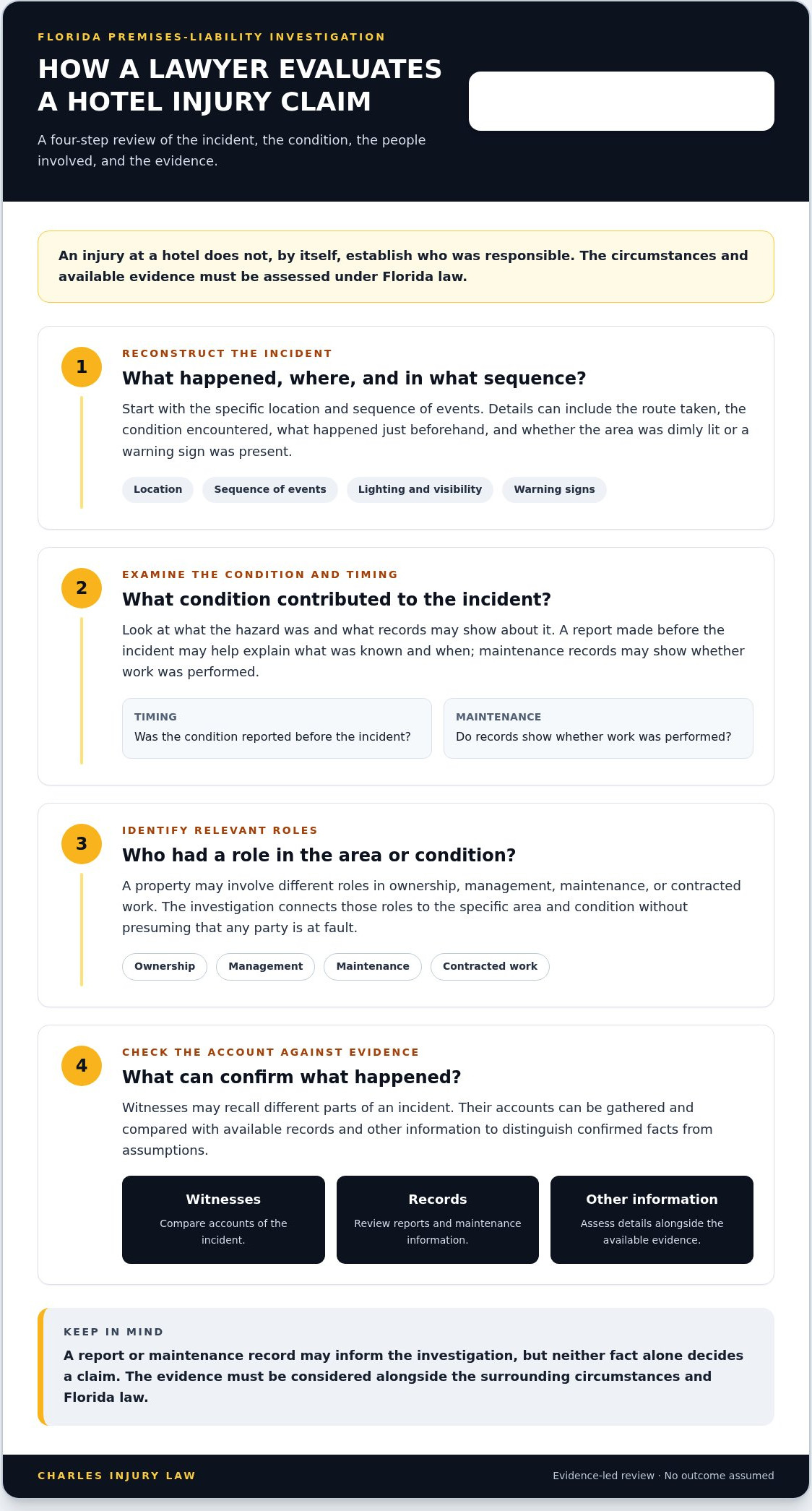
A careful investigation does more than identify where an injury happened. A lawyer for injury at Courtyard may organize the review around four questions: What happened? What condition contributed to the incident? Who had a role in the area? What evidence can confirm the account? These questions guide an investigation, but they are not a guarantee of a particular legal outcome.
Responsibility depends on evidence about the hazard, who handled it, and what the surrounding facts show. Timing can matter. A record that a condition was reported before an incident may help explain what was known and when. Maintenance records may show whether work was performed. Neither fact alone decides a claim. The records must be considered alongside other evidence and the requirements of Florida law.
What facts can help establish how the injury occurred?
The investigation starts with a precise account of the location and sequence of events. Was the area dimly lit? Was a warning sign present? What condition did you encounter, and what happened just beforehand? Details such as the route you took or whether the hazard was visible can help clarify conflicting accounts.
Witnesses may recall different parts of an incident, so their accounts should be gathered and compared with other available information. A claim that a staff member knew about a hazard is not the same as a verified record or firsthand account showing what was reported and when. The investigation should separate confirmed facts from assumptions about what hotel staff knew or did.
How can control of the area affect the investigation?
A hotel property may involve different roles in ownership, management, maintenance, or contracted work. The investigation should identify which roles relate to the specific area and condition without presuming that any party is at fault. Records concerning management or maintenance may help clarify who handled the area and what actions were documented.
The responsible parties and applicable legal rules depend on the individual facts. If an incident involves alleged criminal conduct by a third party, the legal analysis may raise different questions. The Florida statute addressing premises liability for third-party criminal acts may be relevant. Its applicability should be assessed under current Florida law, not assumed from the hotel setting alone.
Evidence can be incomplete or disputed. Charles Injury Law investigates incidents, reviews available records, and assesses how the facts fit Florida law. The firm represents people in hotel injury and premises-liability matters. A focused legal review can help identify the questions that need answers and the evidence that may help address them.
What Evidence Should You Preserve After a Courtyard Hotel Injury?
After an injury, focus on your health first. Evidence can help clarify what happened, but documentation should never delay urgent medical care or put you at risk. Once you’re safe, write down what you remember and preserve information that may help show the scene, the events, and the effect of the injury. Details can become harder to recall as time passes.
- Get medical care. Follow medical advice and keep records of visits, treatment, prescriptions, and recommended follow-up.
- Record the incident. Note the date, time, precise location, and your factual recollection while it’s fresh.
- Preserve what’s available. Save photos, messages, witness details, and any incident-report information you receive.
- Seek legal guidance. A lawyer for injury at Courtyard can help assess what evidence may be relevant and take steps to preserve available records.
Prompt documentation gives you a clear account to refer to later. It doesn’t mean evidence will necessarily disappear, but records and conditions can change, and memories can fade. Keep original files where possible, and note when and where each photo or message came from.
What should you document at the scene?
When it’s safe and appropriate, photograph the area from more than one angle, along with any visible injuries. Capture details that help show the setting, such as lighting, nearby warning signs, or the condition you encountered. Don’t enter an unsafe area or delay care to take pictures.
Write down what happened in your own words. Include where you were, what you noticed, and what occurred immediately before and after the incident. If witnesses are willing, save their names and contact information. Keep relevant texts, emails, and report details together. Avoid guessing about what caused the incident, changing records, or presenting assumptions about fault online as established facts.
For a fall involving a spill or another temporary hazard, the details of the condition and surrounding circumstances may matter. Florida slip-and-fall claim guidance can help explain why a clear, factual record may be useful when assessing a claim.
Why medical records and incident reports matter
Medical records can document your symptoms, treatment, and follow-up care over time. Tell your healthcare providers about the symptoms you’re experiencing and follow their guidance. Keep appointment information and related records in one place so you can refer to them as your care continues.
An incident report is one piece of information, not proof that either side is legally responsible. Its contents may help establish what was reported and when, but the report must be considered alongside other evidence. Charles Injury Law investigates hotel incidents, works to preserve relevant evidence, and gathers medical records. For guidance about documenting a Courtyard hotel injury, call Charles Injury Law.
Call Now: (954) 390-2228 Available 24 Hours a Day, 7 Days a Week
What Happens When the Hotel or an Insurer Disputes Your Injury Claim?
A hotel or insurer may question how an injury happened, whether a dangerous condition existed, or whether that condition caused the harm. A disagreement can feel discouraging, but it doesn’t automatically end a claim. The disputed issues need to be evaluated against the available evidence and Florida law.
A claim’s strength depends on the evidence, the applicable law, and the losses that can be documented. An insurer’s position is not the same as an independent assessment of the facts. Records, witness accounts, medical documentation, and other relevant information may help clarify what is supported and what remains contested. No single piece of evidence guarantees a particular result.
How should you handle questions from an insurer?
Be accurate and measured. If you don’t know or remember an answer, don’t guess. Keep copies of written communications and note what information you provided. Before signing a document, read it carefully and make sure you understand what it says. If a request involves disputed facts, detailed questions, or a proposed resolution, you can seek legal guidance before responding.
Not every request is improper, and no response guarantees success. But you don’t have to assess a complex dispute alone. A lawyer for injury at Courtyard can review the insurer’s position alongside the available evidence and help address communications about the claim.
Which losses may be considered in an injury claim?
The losses considered depend on the facts and supporting documentation. They may include medical expenses already incurred, reasonably supported future medical care, wages lost because of the injury, and loss of earning capacity. Keep bills, appointment records, wage information, and other documents that help show how the injury has affected your health and work.
Pain and suffering, emotional distress, or permanent disability may also be relevant when supported by the individual circumstances and evidence. These losses aren’t established simply by listing them. Medical information and other records may help explain their nature and impact, while the legal and factual analysis determines what may be considered in a particular claim.
Charles Injury Law communicates with insurers and evaluates current and potential future damages as part of its investigation. The firm can also help gather records and respond to disputed issues with evidence-based advocacy. Its Florida personal injury representation includes assessing the facts and documented losses without promising a particular outcome.
If the hotel or insurer is challenging your account, discuss your disputed injury claim with Charles Injury Law to understand what evidence may help address the disagreement.
How Charles Injury Law Helps After a Courtyard Hotel Injury in Florida
A hotel injury can leave you juggling medical appointments, missed work, questions about responsibility, and calls from an insurer. Charles Injury Law investigates the incident and pursues accountability while you focus on your recovery. The firm works to preserve relevant evidence, gather medical records, and communicate with insurers on your behalf.
The investigation can include examining how the incident occurred, identifying records that may clarify what happened, and evaluating documented losses. If the parties dispute responsibility or the value of a claim, the firm can negotiate and prepare for litigation when needed. Trial-ready advocacy does not guarantee compensation or a particular result. It means the case is handled with its evidence and potential next steps in mind.
What can you expect when Charles Injury Law handles your claim?
You’ll communicate directly with the attorney and receive personalized attention. Charles Injury Law represents injured people throughout Florida, reviewing medical care and income-related effects alongside other supported losses. The firm gathers relevant records, keeps you informed, and handles insurer communications with assertive advocacy. A lawyer for injury at Courtyard can help you understand how the facts and evidence may shape the claim.
When should you reach out to Charles Injury Law?
Consider seeking guidance promptly if your injuries are serious, responsibility is disputed, or an insurer’s questions or documents raise concerns. Early legal guidance can help you understand which records may matter and how to approach communications about contested issues. You don’t need to resolve every question before speaking with the firm.
People searching for a personal injury firm near me after a hotel injury may value direct communication and help navigating the claim process. Charles Injury Law represents people seeking attorneys for personal injuries, including hotel-related premises-liability matters. Representation is on a contingency-fee basis: you pay no attorney fees unless the firm recovers compensation. The firm can discuss the incident, explain its approach, and help you understand possible next steps without promising a particular outcome.
If you’re facing disputed facts or insurer pressure, contact Charles Injury Law to discuss your hotel injury claim. The firm can assess the available information, preserve relevant evidence, and pursue negotiation or litigation as the case requires.
Call Now: (954) 390-2228 Available 24 Hours a Day, 7 Days a Week
Take the Next Step Toward Accountability
You don’t have to decide on your own whether an injury at a Courtyard hotel may support a claim. A lawyer for injury at Courtyard can review the circumstances and help you understand possible next steps under Florida law. Prompt guidance can help you make informed choices about protecting your interests.
Charles Injury Law has recovered millions of dollars for injured clients, while recognizing that every case depends on its own facts and evidence. There’s no promise of a particular result. The firm can assess your situation and explain your options.
If you’re ready to discuss what happened, reach out to Charles Injury Law. A conversation can help turn uncertainty into a clearer path forward. You deserve support as you focus on healing and pursue accountability.
Call Now: (954) 390-2228 Available 24 Hours a Day, 7 Days a Week
Frequently Asked Questions
Can I sue a Courtyard hotel if I was injured on the property?
Possibly, but an injury on hotel property doesn’t automatically make the hotel legally responsible. A claim depends on what caused the injury, the parties’ roles, and whether evidence supports a basis for liability under Florida law. For example, a fall involving a floor hazard calls for a different factual review from an injury involving security. A lawyer can assess the circumstances and explain what options may be available.
What should I do immediately after an injury at a Courtyard hotel?
Get medical care first, especially if you have severe pain, a head injury, or trouble moving safely. Once you’re out of immediate danger, tell hotel staff what happened and ask how to obtain a copy of any incident report. Keep contact details for witnesses and save related messages or receipts. These practical records can help you recall the timeline and connect the incident with your stay.
How do I prove a hotel was responsible for my injury in Florida?
Proof depends on the type of incident and the available evidence. A lawyer for injury at Courtyard may examine photographs, witness accounts, reports, and records related to the area or condition. For a fall involving a temporary substance, Florida law may require evidence addressing whether the business knew or should have known about the condition. The specific legal requirements depend on the facts and applicable law.
Can I still bring a claim if I did not report the injury at the hotel?
Not reporting an injury at the hotel doesn’t automatically answer whether you can bring a claim. It may make documentation more challenging, but other information could help establish what happened, such as medical records, photographs, messages, or witness accounts. Write down what you remember while details are fresh, including why no report was made. A lawyer can review the circumstances and explain how the missing report may affect the case.
How much does a Florida hotel injury lawyer cost upfront?
Charles Injury Law handles injury cases on a contingency-fee basis. You pay no attorney fees unless the firm recovers compensation for you. This arrangement means attorney fees depend on a recovery, rather than requiring an upfront attorney-fee payment to begin representation. Read the fee agreement and ask the firm to explain its terms before deciding how to proceed.
What compensation may be available after a Courtyard hotel injury?
Depending on the evidence and case facts, a claim may seek documented medical expenses, future medical care, lost wages, or loss of earning capacity. Pain and suffering, emotional distress, or permanent disability may also be considered when supported by the circumstances. Compensation isn’t automatic, and no amount can be predicted from the hotel name or injury alone. Available damages depend on the facts and applicable Florida law.
Does Charles Injury Law handle hotel slip-and-fall cases in Florida?
Yes. Charles Injury Law represents people with hotel injury and slip-and-fall matters in Florida. The firm serves clients in Fort Lauderdale, in Miami, in West Palm Beach, in Boca Raton, in Delray Beach, in Boynton Beach, in Lake Worth, in Orlando, and in Tampa. Each matter receives an individual review, since the location, condition, and available evidence can shape how responsibility is assessed.
How quickly should I contact a lawyer after a hotel injury?
Consider speaking with a lawyer as soon as practical, especially if your injuries are significant, the facts are disputed, or you’re receiving insurer requests. Prompt guidance can help you understand what records to keep and what questions to ask before making decisions about a claim. Florida filing deadlines may apply, so don’t assume you have unlimited time. A lawyer can review the circumstances and explain relevant timing considerations.
Disclaimer
The information provided on this blog is for general informational purposes only and does not constitute legal advice. Viewing this content does not create an attorney-client relationship with the firm. You should not act or rely on any information contained herein without seeking legal advice from a qualified attorney regarding your individual situation.