



What if the hotel’s name matters less than what happened at the exact spot where you were hurt? If you need a lawyer for injury at Intercontinental Hotel in Miami, the key questions are what caused the hazard, who controlled the area, and what evidence shows about the responsible parties’ knowledge.
A hotel injury can leave you managing medical care, missed work, and insurance calls while trying to understand who may be accountable. Being hurt on hotel property doesn’t automatically establish a claim. Florida premises-liability cases turn on the specific facts, including the condition that caused the injury and how it was handled.
Start by getting medical attention, reporting the incident, and preserving relevant records and photos. Witness details, incident documentation, and available video may help clarify what happened, but evidence can become harder to obtain over time. Hotel guests in Fort Lauderdale, Miami, West Palm Beach, Boca Raton, Delray Beach, Boynton Beach, Lake Worth, Orlando, and Tampa face the same basic first step: record the exact location and circumstances. This article explains what to do, how an injury firm can investigate property control and preserve evidence, and when legal guidance may help you understand your options. Personal Injury Attorney in Fort Lauderdale can review the circumstances and explain possible next steps while you focus on recovery.
Key Takeaways
- An injury on hotel property doesn’t automatically establish legal responsibility. The hazard, incident circumstances, and injury evidence all matter.
- A lawyer for injury at Intercontinental Hotel can investigate which parties may have controlled or maintained the area without assuming who is responsible.
- After an incident, prioritize safety and medical care, document what happened, and keep a record of whom you notified at the hotel.
- Photos, witness information, incident records, and other evidence can help clarify how the injury occurred.
- Charles Injury Law can examine the facts, preserve evidence, communicate with insurers, and prepare a claim for possible resolution.
Injured at an InterContinental Hotel in Florida? Start With These Facts
An injury at a hotel can be painful, disorienting, and disruptive. It’s natural to want to know who is responsible, but the fact that an injury happened on hotel property doesn’t, by itself, establish legal liability. The specific hazard, how the incident unfolded, who controlled the area, and the nature of the resulting injury all matter.
A hotel premises-liability claim asks whether a party responsible for the property failed to address a dangerous condition and whether that failure caused someone’s injury. Answering that question requires evidence, not assumptions based on a hotel’s name or the location of the incident.
The relevant facts can differ across guest rooms, walkways, restaurants, and parking areas. A spill, a change in floor level, or another unsafe condition may each call for a different investigation. If you’re considering a lawyer for injury at Intercontinental Hotel in Miami, start by identifying exactly where and how the injury happened. A precise account helps guide the next questions.
Which hotel incidents may call for a premises-liability review?
A review may be appropriate after a slip and fall, trip and fall, or another injury involving a dangerous property condition. The circumstances matter. Investigators may examine what caused a person to slip, whether an obstruction or uneven surface contributed to a fall, and what happened before the injury. Negligent-security concerns may also warrant review when the facts raise questions about security practices. The injury alone doesn’t prove how an incident happened or who may be responsible.
Why the specific InterContinental property matters
A brand name doesn’t identify every entity connected to a particular property. Ownership, operation, management, and maintenance may involve different parties, and those roles shouldn’t be assumed without investigation. The InterContinental Hotels Group Overview provides background on the brand, but a claim turns on the specific property and incident, not general brand information.
Details such as the precise location, the condition that caused the injury, and who was responsible for the area can shape an initial inquiry. Charles Injury Law investigates those property-specific facts as part of its premises liability representation. The firm also represents injured people in Miami through its personal injury representation in Miami. Neither the hotel brand nor the injury location alone decides responsibility. The evidence must connect the condition, the parties’ roles, and the harm.
How Florida Premises-Liability Investigations Examine a Hotel Injury
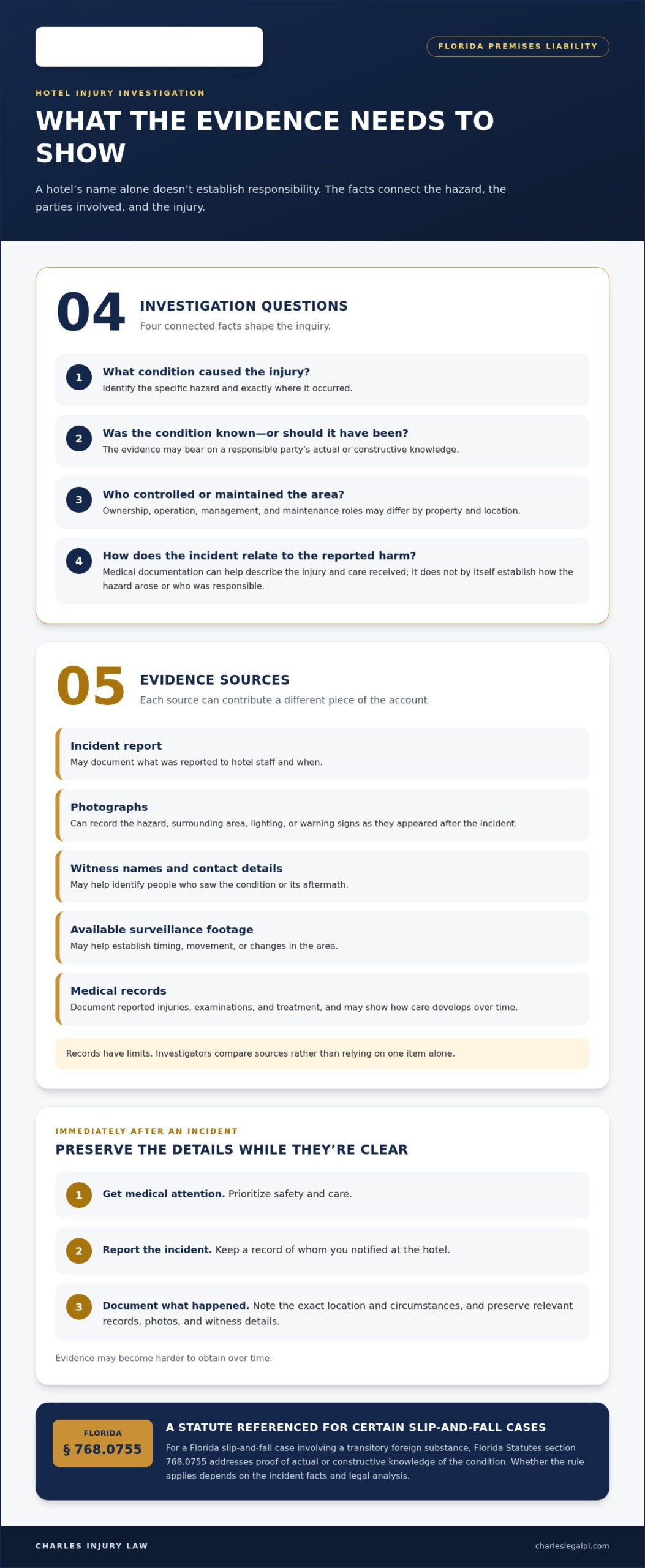
Once the incident location and circumstances are clear, the next question is what the available evidence can establish. Florida premises-liability analysis depends on the facts and applicable Florida law. An investigation examines the condition that caused the injury, whether a responsible party knew or should have known about it, who controlled the area, and how the incident relates to the reported harm.
Liability depends on evidence about the condition, responsibility for addressing it, and the resulting harm. A hotel’s brand alone doesn’t answer those questions. The aim is to trace the facts, not jump to a conclusion.
What evidence can help explain how the injury happened?
Different records can provide different pieces of the picture. An incident report may show what was reported to staff and when. Photographs can document the hazard, surrounding area, lighting, or warning signs as they appeared after the incident. Witness names and contact details may help identify people who saw the condition or its aftermath. Available surveillance footage may help establish timing, movement, or changes in the area. Each item has limits, so investigators compare sources rather than relying on one record alone.
Time and place matter. A wet patch documented shortly after a fall may raise different questions from a surface that had already been cleaned. The location can point to which records or personnel may be relevant. In a Florida slip-and-fall case involving a transitory foreign substance, Florida Statutes section 768.0755 addresses proof of actual or constructive knowledge of the condition. Whether that rule applies depends on the incident facts and legal analysis.
Medical records add another part of the account. They document injuries reported to medical providers, examinations, and treatment. Those records can help connect the incident to the care received, while follow-up documentation may show how symptoms or treatment develop. They don’t, by themselves, establish how the hazard arose or who was responsible.
How property roles can affect the investigation
Ownership, operation, and maintenance arrangements can differ from one property to another. The party responsible for a particular area or condition may not be the same entity that manages other parts of the property. Investigators can review relevant records, incident documentation, and information about the area’s upkeep to understand who had control and what responsibilities applied. Any conclusion should follow the evidence.
For example, records about a common walkway may point to different people or entities than records about a restaurant or parking area. The investigation should connect the specific location to the relevant control or maintenance arrangements, then compare that information with witness accounts, photographs, and available footage. Naming a potential party too early risks overlooking how the property actually operated.
A lawyer for injury at Intercontinental Hotel can help organize those questions and evaluate the evidence under Florida law. Charles Injury Law investigates property-specific facts in its premises-liability representation, including the hazard, notice, control, and injury documentation.
Who May Be Involved in an InterContinental Hotel Injury Claim?
An InterContinental name identifies a hotel brand, but it doesn’t answer who owned, operated, or maintained the specific property or area where an injury occurred. The relevant parties depend on the location, the hazard, and the available records. Naming the brand alone doesn’t resolve responsibility. Investigators need to understand the roles connected to the particular incident before drawing conclusions.
The categories below are starting points for investigation, not findings about any InterContinental property or any party’s legal responsibility.
| Possible category | What an investigation may examine |
|---|---|
| Hotel brand | Whether the brand had a role relevant to the property or incident. The name on signs or booking materials alone doesn’t establish control. |
| Property owner | Who owned the property or the area where the incident happened, based on relevant records. |
| Operator | Who managed or operated the hotel, or handled the activity connected to the incident. |
| Maintenance provider or staff | Who inspected, cleaned, repaired, or otherwise addressed the specific condition, if the records identify such a role. |
How investigators identify relevant property relationships
Investigators can compare incident documentation with property records and information about the area’s upkeep. Maintenance or inspection records may help show who handled a hazard, when it was addressed, or whether the condition was recorded. The aim is to establish relevant roles from evidence, not to assume that a particular company owned or controlled the property.
Consider a fall in a walkway. Records about who inspected or maintained that area may help identify which parties should be examined. An incident in a restaurant or parking area may involve different records and responsibilities. A lawyer for injury at Intercontinental Hotel can help assess how those details relate to possible responsibility, while keeping any conclusions tied to the evidence.
When a hotel injury also involves a fall or security concern
In a fall case, the precise condition and circumstances matter: what caused the fall, where it happened, and what the evidence shows about the hazard. Charles Injury Law represents injured people in slip and fall cases. If the incident raises questions about security practices, the inquiry may instead focus on the circumstances of the harm and the parties’ relevant roles. Neither a fall nor a security incident establishes fault by itself. The facts must be evaluated before responsibility can be assessed.
This careful approach avoids a common mistake: treating a familiar hotel name as proof of who should answer for an injury. The property relationships, records, and circumstances must be examined together. That review can help an injured guest understand which parties may be relevant to a potential claim.
What to Do After an Injury at an InterContinental Hotel
An unexpected injury can leave you shaken and unsure what to do next. Keep the priorities clear: get to safety, take care of your health, then preserve what you can about the incident. Don’t delay urgent medical care to take photos or speak with hotel staff. Evidence matters, but your immediate well-being comes first.
- Address immediate safety. Move away from an ongoing hazard if you can do so safely. If the area remains dangerous, alert hotel staff so they can respond.
- Seek medical attention. Get care promptly, especially if you’re seriously hurt or your symptoms are concerning. Follow the guidance of your medical providers.
- Report the incident. Tell hotel staff what happened and where. Note the date and time, whom you spoke with, and any report or reference details they provide.
- Document the scene when safe. Photograph the area and the condition involved. Include enough context to show where the hazard was, not just a close-up.
Document the incident and preserve useful details
As soon as you’re able, write down the date, approximate time, precise location, and what you recall about the condition. Keep the description factual. Don’t guess about who caused the hazard or how long it was there. If anyone witnessed the incident or its aftermath, save their names and contact details when available. Preserve copies of photographs, incident reports, and related messages or correspondence.
Keep original files when possible, and avoid editing photos in ways that could obscure what they show. Save relevant communications in one place. Details can blur after a stressful event, so a short, accurate note made while your memory is fresh may help you explain what happened later.
Track treatment and communicate carefully
Follow medical guidance and retain records related to your evaluation and treatment. Keep brief notes about symptoms, changes in daily activities, and work you’ve missed. These details can help show how the injury has affected you over time. Don’t minimize symptoms when speaking with medical providers, and don’t claim certainty about facts you don’t remember.
Hotel or insurance representatives may ask questions. Be truthful, but avoid speculation or agreeing to a description that doesn’t match your recollection. Before giving a detailed insurance statement or responding to requests about a claim, consider getting legal guidance. Charles Injury Law also handles Car Accidents. People searching for a personal injury firm near me, attorneys for personal injuries, attorneys personal injury, an injury lawyer near me, or a personal injury lawyer near me may also be looking for lawyers for auto accidents or auto accident lawyers near me.
If you’d like help reviewing the incident and possible next steps, contact Charles Injury Law about your hotel injury. Call Now: (954) 390-2228 Available 24 Hours a Day, 7 Days a Week
How a Florida Injury Lawyer Can Help After a Hotel Accident
After a hotel injury, you may be managing treatment, missed work, and questions from insurance representatives. Charles Injury Law can handle the legal investigation while helping you understand the choices ahead. The process starts with the incident facts, not assumptions about who is responsible or what a claim may be worth.
The firm evaluates the circumstances, investigates property-specific evidence, and identifies questions that need answers. This work can include preserving relevant records, gathering medical documentation, reviewing the parties’ roles, and communicating with insurers. If the evidence supports pursuing a claim, the firm can negotiate and prepare the matter for trial while working toward a resolution. The approach stays grounded in the facts and Florida law.
A complete assessment considers more than the immediate aftermath. Medical records and other available information can help evaluate the treatment received, current effects, and potential future damages. No result or case value can be promised in advance. The evidence, applicable law, and individual circumstances shape the options available. Charles Injury Law handles personal injury matters, including premises-liability claims involving hotel injuries.
What happens during a free consultation?
During a free consultation, an attorney reviews what happened, listens to your concerns, and answers your questions. Sharing details such as where the incident occurred, what you remember about the condition, and what medical care you’ve received can help frame the discussion. The conversation can clarify possible legal options and practical next steps. It won’t promise a particular outcome, claim value, or timeline.
Charles Injury Law has 15+ years of experience, has handled 1,000+ cases, and reports 98% client satisfaction. The firm represents clients on a contingency-fee basis, with no fees unless compensation is recovered. The representation agreement explains the fee arrangement and what it covers.
Take the next step with Charles Injury Law
You don’t have to sort through every issue alone. With direct attorney access, you can discuss the evidence, insurance communications, and questions about moving forward with the team handling your matter. A conversation can help bring the next steps into focus while you continue addressing your recovery.
To discuss an injury at an InterContinental Hotel with Charles Injury Law, call now: (954) 390-2228. Call Now: (954) 390-2228 Available 24 Hours a Day, 7 Days a Week.
Take a Clear Next Step Toward Recovery
You don’t have to determine on your own which party may be responsible or how to respond to an insurer. The next step can simply be getting a clearer view of your options based on what you remember and the available records. A lawyer for injury at Intercontinental Hotel can help assess the situation and explain what may come next, without promising a particular result.
Give yourself room to focus on your health while the legal questions are reviewed. If you’re ready to discuss your circumstances with Charles Injury Law, reach out to start a conversation about your hotel injury. Call Now: (954) 390-2228 Available 24 Hours a Day, 7 Days a Week.
Frequently Asked Questions
Can I sue an InterContinental Hotel if I was injured on the property?
You may have a claim, but it depends on the incident, supporting evidence, and applicable Florida law. The InterContinental name alone doesn’t establish which party, if any, is responsible. A lawyer for injury at Intercontinental Hotel can review where the incident occurred, what caused it, relevant records, and the parties connected to the property. That assessment can clarify possible legal options without guaranteeing that a claim will succeed.
What should I do immediately after getting hurt at an InterContinental Hotel?
Prioritize immediate safety and medical care. When practical, note the exact location and condition, take photos, report the incident to hotel staff, and keep related documents. Save witness contact details and messages about the event. Stick to what you remember rather than guessing about fault. These steps can help preserve useful information, but they don’t replace medical advice or determine whether the facts support a claim.
Who may be liable for an injury at an InterContinental Hotel?
Potentially relevant parties depend on the specific property, injury location, and available records. An investigation may examine the hotel brand, property owner, operator, or party responsible for maintenance, but none should be presumed liable without evidence. A lawyer can review property-related records and incident details under Florida law. For an injury in Miami or Fort Lauderdale, the location may help identify which property records and parties warrant examination.
What evidence should I keep after a hotel slip and fall?
Keep original photos showing the area and any visible condition, along with copies of incident reports, witness details, and communications with the property. Write down when and where the fall happened, and preserve relevant receipts or other records connected to the event. Retain medical documents and notes about symptoms or work missed. Don’t alter or discard potentially relevant materials; what matters most can vary with the facts.
How long do I have to file a hotel injury lawsuit in Florida?
For many Florida negligence claims, including premises-liability cases, the filing deadline is two years from the injury date for injuries occurring on or after March 24, 2023. Different dates or circumstances may affect which deadline applies, so don’t assume this general rule settles your situation. Missing an applicable deadline can bar a claim. Get legal guidance promptly to assess the incident date, parties, and potential filing requirements.
Do I pay attorney fees upfront for a Florida hotel injury case?
Charles Injury Law handles injury cases on a contingency-fee basis: No Fees Unless We Win. Clients owe no attorney fees unless the firm recovers compensation. The representation agreement explains the fee arrangement and what it covers. A free consultation gives you an opportunity to discuss the incident, ask questions, and understand possible options. No fee arrangement guarantees that compensation will be recovered.
What compensation may be available after a hotel injury in Florida?
Depending on the evidence and applicable Florida law, a claim may involve medical expenses, future medical care, lost wages, reduced earning capacity, pain and suffering, emotional distress, property damage, or permanent disability. Treatment records and employment documentation, for example, may help explain particular losses. Not every category applies to every case, and no amount should be assumed in advance. The injury, its effects, and proof of loss all matter.
Disclaimer
The information provided on this blog is for general informational purposes only and does not constitute legal advice. Viewing this content does not create an attorney-client relationship with the firm. You should not act or rely on any information contained herein without seeking legal advice from a qualified attorney regarding your individual situation.