

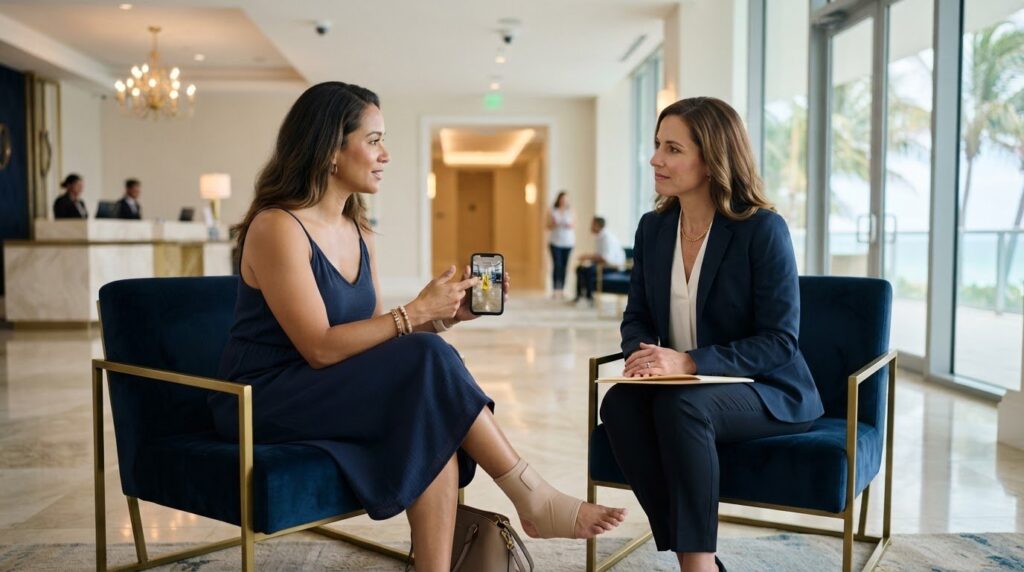

What if important evidence disappears before anyone investigates? If you were hurt at a JW Marriott or Ritz-Carlton in Florida, a lawyer for injury at JW Marriott & Ritz-Carlton can assess what happened and who may be responsible. A hotel isn’t automatically liable just because an injury occurred on its property. The circumstances and available evidence matter.
After a hotel injury, medical bills, missed work, and insurer questions can add stress while you’re trying to recover. Preserve what you can: photographs of the scene, details about the incident, witness names, and medical records may help explain what happened. Report the incident, seek appropriate medical care, and understand your options before giving an insurer a detailed statement.
Charles Injury Law represents people injured in Florida hotel incidents. Whether you’re looking for a personal injury firm near me, attorneys for personal injuries, attorneys personal injury, an injury lawyer near me, or a personal injury lawyer near me, useful guidance should address the facts of your situation. The firm also represents injured people seeking lawyers for auto accidents or auto accident lawyers near me. This article explains what evidence may matter and practical steps to consider after a hotel injury.
Key Takeaways
- Responsibility for a hotel injury depends on the incident and evidence, not simply where it happened.
- Property conditions, maintenance, warnings, and the hotel’s response may be relevant to an evaluation under Florida law.
- Prioritize medical care, report the incident, document what you remember, and keep related records.
- A lawyer for injury at JW Marriott & Ritz-Carlton can investigate the incident and help preserve evidence relevant to a potential claim.
- Charles Injury Law represents clients in Florida hotel injury matters and can assess documented losses and address insurer communications.
Injured at a JW Marriott or Ritz-Carlton in Florida? Start With the Incident
An unexpected injury during a hotel stay can mean pain, disrupted plans, and uncertainty about what happened. Whether a hotel may be responsible depends on the specific incident and evidence, not just the name on the property. A fall near a pool, an elevator incident, and harm involving security raise different questions. Start by documenting what happened, where it occurred, and the circumstances around it.
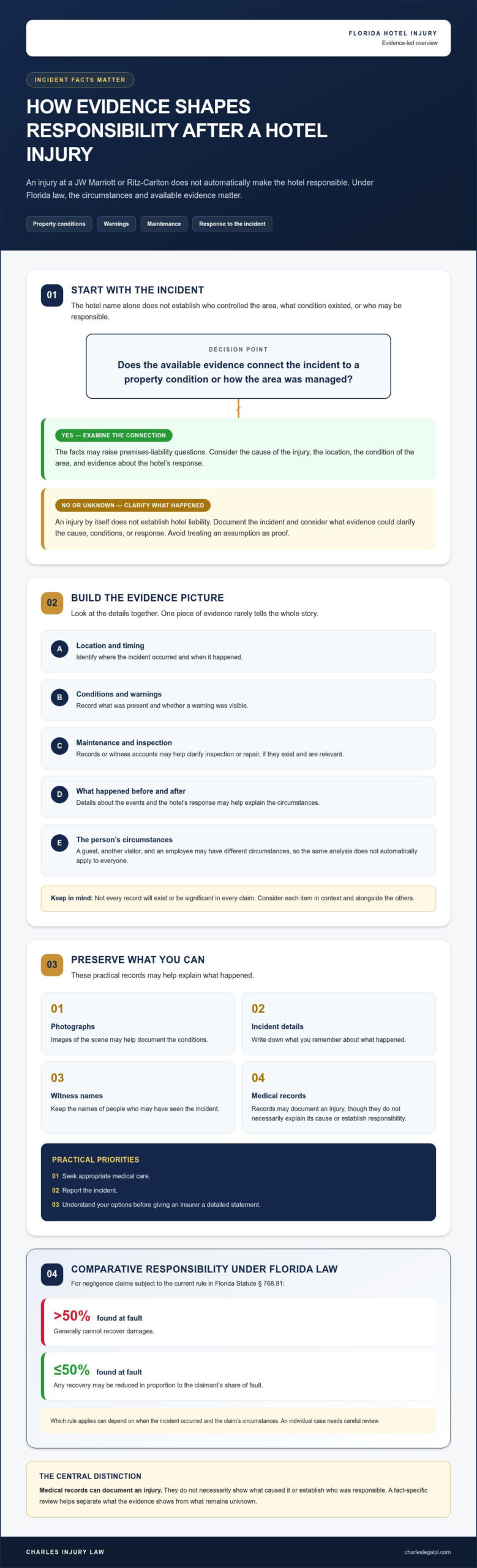
An injury alone does not establish hotel liability. Premises liability concerns injuries connected to a property’s condition or how it was managed. Under Florida law, an evaluation may consider the cause of the injury, the location, and evidence about the condition or the response to it. A guest, another visitor, and an employee may have different circumstances, so the same analysis does not automatically apply to everyone.
The Ritz-Carlton name belongs to The Ritz-Carlton Hotel Company, but brand background does not establish responsibility for a particular injury. The incident and evidence need to be examined. Charles Injury Law represents people in Florida premises-liability matters, including hotel injury claims. Its personal injury representation can include investigating the circumstances and assessing available evidence.
What kinds of hotel incidents may raise premises-liability questions?
Falls, swimming-pool injuries, elevator incidents, and security-related harm may raise premises-liability questions, but the setting and cause matter. A fall may involve a surface condition, while a pool injury may call for a different review of the surrounding circumstances. An elevator incident or security-related injury presents its own factual questions. These examples do not establish that either named hotel has a particular hazard or safety history.
Useful details include where the incident occurred, what the person encountered, and what happened before and afterward. That specific account is more useful than assumptions based on the type of hotel or the fact that an injury occurred there.
Does an injury automatically make a hotel responsible?
No. Florida law calls for a fact-specific assessment. An injury by itself does not establish whether a hotel may be legally responsible. Evidence about a property condition and the circumstances of the incident may be relevant, as may information about how the situation was handled. The applicable analysis can depend on the injured person’s circumstances, including whether they were a guest, another visitor, or an employee.
Keep the distinction clear: medical records may document an injury, but they do not necessarily explain what caused it or establish who was responsible. A lawyer for injury at JW Marriott & Ritz-Carlton can examine the available facts without treating an assumption as proof. The goal is to understand what the evidence shows, what remains unknown, and what may need further investigation.
How Florida Law May Apply to an Injury at a Luxury Hotel
A hotel injury claim turns on more than the seriousness of the injury. Florida law calls for a fact-specific assessment of the circumstances, including the injured person’s relationship to the property and what the evidence shows about the incident. A guest’s situation may differ from an employee’s, and a visitor’s access and activity may matter too.
Brand recognition does not replace evidence about the specific incident. The hotel name alone does not establish who controlled the area, what condition existed, or who may be responsible. A premises-liability claim depends on the facts and applicable Florida law, not assumptions about a brand.
Comparative responsibility may also affect a negligence claim. Under Florida Statute § 768.81, for negligence claims subject to the current rule, a claimant found more than 50% at fault generally cannot recover damages. If the claimant is 50% or less at fault, any recovery may be reduced in proportion to their share of fault. Which rule applies can depend on when the incident occurred and the claim’s circumstances, so an individual case needs careful review.
Which facts can affect a hotel injury claim?
Start with the location, timing, and cause of the incident. The condition of the area, any warning signs, and what happened before and after the injury can help create a clearer account. Depending on the case, relevant evidence may include inspection or maintenance records, witness accounts, and information about the hotel’s response. Not every record will exist or be significant in every claim.
- Location and timing: Identify the area and when the incident occurred.
- Conditions and warnings: Record what was present and whether a warning was visible.
- Maintenance and response: Look for records or witness accounts that may clarify inspection, repair, or what happened afterward.
One piece of evidence rarely tells the whole story. Consider each item in context and alongside the others.
Who may need to be investigated?
The hotel’s name does not identify the legally responsible party. Depending on the evidence, an investigation may need to clarify who controlled or maintained the area, or whether another entity’s conduct contributed to the event. Property operators, contractors, or other parties should be considered when the facts support examining their role. An evidence-focused investigation avoids unsupported accusations.
A lawyer for injury at JW Marriott & Ritz-Carlton can help assess which records, witnesses, and entities warrant further investigation. If questions about responsibility remain, contact Charles Injury Law to discuss the incident and get guidance based on the available facts.
What to Do After an Injury at a JW Marriott or Ritz-Carlton
Focus first on your health, then take practical steps to create a clear record of what happened. You do not need to prove fault at the scene, and an incident report does not decide responsibility by itself. Still, details can become harder to recall or locate over time. Preserve evidence promptly, but remember that no single action guarantees a recovery.
- Get appropriate medical care. Seek attention that fits your symptoms and follow your healthcare providers’ guidance. Tell them what happened and keep documents related to evaluation, treatment, and expenses.
- Report the incident. Notify hotel staff or management and describe the event as accurately as you can. Ask that the incident details be recorded and, if possible, how to obtain a copy. A report documents that information was provided; it does not prove who was at fault.
- Write down what you remember. Note the date, time, precise location, and a factual account while the details are clear. Include what you observed before and afterward, without guessing about the cause.
- Keep relevant materials. Save photographs, messages, receipts, report details, witness contact information, and medical or treatment records when available. Keep copies together so you can find them later.
If the incident involved a fall, photographs may help show the area and visible conditions, if taking them is safe and appropriate. Apply the same care when documenting an injury: photograph only what you are comfortable recording, and do not delay medical attention to gather evidence. Information about slip-and-fall injuries can help explain why the precise location and surrounding conditions may matter.
How can you document the incident and preserve evidence?
Make your notes specific. Record where you were, what you encountered, and what happened next. If it is safe, photograph the scene from useful angles and keep the original files when possible. Ask witnesses for their names and contact details, but do not pressure anyone to adopt your account. Retain copies of messages and other communications about the incident.
What should you do about medical care and insurer contact?
Keep appointment summaries, treatment instructions, bills, receipts, and other related records. If an insurer contacts you, stay factual and avoid guessing or minimizing your symptoms. Ask what information is requested and take time to understand the request. Consider seeking legal guidance before providing a detailed claim statement, while continuing to respond appropriately to legitimate communications.
A lawyer for injury at JW Marriott & Ritz-Carlton can help you understand which records may matter and how to preserve them. Charles Injury Law investigates hotel injury matters and addresses insurer communications. Call Now: (954) 390-2228 Available 24 Hours a Day, 7 Days a Week
Evidence, Damages, and Questions That Can Shape a Florida Hotel Claim
A well-supported claim connects the incident to the evidence and explains how the injury affected your life. No single photograph, report, or medical record proves every part of a case. The significance of each item depends on what it shows and how it fits with the rest of the available information.
Evidence may come from several sources:
- Photographs: Images of the location, visible conditions, warnings, and injuries may help show what was present at a particular time.
- Witness accounts: Accounts from people who saw the event or surrounding circumstances may help clarify what happened.
- Reports and communications: Incident reports, messages, and other communications may document what was reported and how the matter was handled.
- Medical and expense records: Treatment records, bills, receipts, and related documents may help describe the injury’s effects and associated expenses.
These materials serve different purposes. A photograph may show a condition, while a medical record may document treatment. Neither automatically establishes who was responsible. Charles Injury Law’s Florida personal injury representation includes investigating incidents, gathering records, and assessing available evidence.
Which records may help show the injury’s impact?
Medical records and treatment documentation can describe symptoms, care received, and a provider’s assessment. Expense records may show costs related to treatment. If an injury affects work, schedules, pay records, and other employment documents may help explain missed time or a possible effect on earning capacity. No single document establishes liability or determines a damages amount.
How can damages be assessed?
Depending on the facts and applicable Florida law, a claim may involve medical expenses, future care, lost wages, reduced earning capacity, pain, or emotional distress. These categories are not automatic; their relevance depends on the evidence and circumstances. Future care or work-related effects may require additional support. A case’s value cannot be reliably estimated from the hotel name or injury description alone.
Keep records organized for a case-specific review. Do not assume that bills or photographs guarantee compensation. The evidence must be considered as a whole, alongside questions about the incident and responsibility.
What if the incident involved a fall or security concern?
For a fall, evidence about the location and property conditions may help investigators understand what happened. For security-related harm, the incident and surrounding circumstances may raise different questions. Each matter calls for its own review; neither a fall nor a security incident alone proves a claim.
A lawyer for injury at JW Marriott & Ritz-Carlton can assess how the available evidence relates to potential responsibility and documented losses. If you need help evaluating records and claim questions, contact Charles Injury Law to discuss your situation.
How Charles Injury Law Helps After a Florida Hotel Injury
A hotel injury can leave you managing medical needs, missed work, and insurer questions. Charles Injury Law represents Florida premises-liability clients, including people injured in hotel incidents. The firm recognizes the person behind each claim and builds its work around the facts of that individual situation.
What happens when Charles Injury Law reviews an injury claim?
The firm investigates how the incident occurred, identifies evidence that may help explain it, and works to preserve relevant materials. This may include gathering available records, reviewing photographs and reports, and consulting experts when appropriate. The aim is to develop a clear, evidence-based account, not to assume who is responsible before examining the facts.
Charles Injury Law can gather medical records and other documentation to assess the injury’s effects. The firm evaluates current and potential future damages based on the information available. It also communicates with insurers and supports clients as claim questions arise. Negotiation or litigation may be considered as the case develops. The next steps depend on the circumstances, and no particular outcome can be promised.
Preparation can help identify unanswered questions, organize evidence, and ready a claim for meaningful review. Charles Injury Law gives each case individual attention and is prepared to pursue appropriate next steps when the evidence and circumstances call for them.
How can an injured guest take the next step?
You do not need to arrive with a complete file. Basic details can start a focused conversation: where and when the incident happened, what you recall, whether it was reported, and what treatment or communications followed. If you have photographs, incident information, medical records, or insurer correspondence, keep them available. Do not delay needed care or feel you must resolve every question before seeking guidance.
Clients communicate directly with the attorney and receive personalized attention. The firm is available 24 hours a day, 7 days a week. Representation is handled on a contingency-fee basis, which means clients pay no attorney fees unless Charles Injury Law recovers compensation. That arrangement does not guarantee a recovery, and the facts of each claim still matter.
If you were hurt at a JW Marriott or Ritz-Carlton, a lawyer for injury at JW Marriott & Ritz-Carlton can help you understand the investigation and claim process. Share what you know, ask your questions, and get case-specific guidance from Charles Injury Law.
Call Now: (954) 390-2228 Available 24 Hours a Day, 7 Days a Week
Take the Next Step With Confidence
You do not need to decide the future of a claim today. Start by getting a case-specific perspective on the questions that remain. A lawyer for injury at JW Marriott & Ritz-Carlton can help you understand what the available information may mean and which steps could make sense in your situation.
Before reaching out, consider what you want answered. You may be unsure whether a particular party had responsibility, whether more evidence should be preserved, or how an insurer’s request could affect your claim. It is okay if some details are missing. An initial conversation can help identify what matters next without assuming that an injury guarantees a legal recovery.
If you’re ready to discuss what happened, connect with Charles Injury Law. Call Now: (954) 390-2228 Available 24 Hours a Day, 7 Days a Week
You deserve clear guidance as you consider your options. Take the next step when you’re ready and move forward with support.
Frequently Asked Questions
Can I sue a hotel for an injury at a JW Marriott or Ritz-Carlton in Florida?
Possibly, if the facts and evidence support a claim under Florida law. The hotel’s name or the fact that you were injured there does not, by itself, establish legal responsibility. An assessment may consider what caused the injury, the circumstances surrounding it, and the roles of the parties involved. A lawyer for injury at JW Marriott & Ritz-Carlton can review the available information and explain potential options without promising a result.
What should I do if a hotel asks me to complete an incident report after an injury?
Give a factual account and do not guess about details you cannot recall. Before submitting the report, read it carefully and ask to correct anything that does not accurately reflect what you said. Keep a copy or note when and to whom you submitted it. The report can document that you reported an incident, but it does not decide whether anyone was legally responsible or prevent you from seeking legal guidance.
How can I prove that a hotel’s property condition caused my injury?
No single document proves causation in every case. Useful evidence may connect the condition to the event, such as photographs of the area, witness observations, or records describing what was present around the time of the injury. Medical documentation can help establish the nature and timing of an injury, but it may not explain the cause. A lawyer can assess how the evidence fits together under Florida law.
Can I bring a Florida hotel injury claim if I may have contributed to the accident?
Possibly. Under Florida’s modified comparative negligence rule, a person found more than 50% responsible generally cannot recover damages; if their share is 50% or less, damages may be reduced by that share. The rule generally applies to negligence claims arising on or after March 24, 2023. The incident date and facts matter, so uncertainty about your actions does not automatically end a potential claim.
What evidence should I preserve after an injury at a hotel?
Keep original photos and videos when possible, and avoid editing the files. Save relevant emails, texts, receipts, report-related paperwork, and documents about the visit. Write down what you remember while the details are fresh, and keep witness contact information if available. Store digital copies somewhere secure. If you’re concerned that relevant records may be lost, legal guidance can help you understand how to raise that concern appropriately.
How long do I have to bring a hotel injury claim under Florida law?
For many negligence injury claims arising on or after March 24, 2023, Florida’s filing deadline is two years from the injury; incidents before that date generally fall under the previous four-year period. Exceptions and other circumstances may affect a specific case. Do not rely on an estimate or wait until a deadline is close. A prompt review can help identify which deadline may apply to your situation.
Can I seek compensation for medical bills and lost wages after a hotel injury?
Potentially, if the evidence and applicable Florida law support a claim. Medical bills and treatment records may help document healthcare expenses, while employment or income documents can help show missed work and earnings. Other damages depend on the injury and its effects. Keep relevant records, but do not assume a particular document establishes liability or guarantees payment. Any recovery depends on the facts and legal analysis.
Do I pay attorney fees upfront when Charles Injury Law handles a hotel injury claim?
Charles Injury Law handles these claims on a contingency-fee basis, meaning clients pay no attorney fees unless the firm recovers compensation. The firm represents injured clients throughout Florida, including in Fort Lauderdale, in Miami, in West Palm Beach, in Boca Raton, in Delray Beach, in Boynton Beach, in Lake Worth, in Orlando, and in Tampa.
Disclaimer
The information provided on this blog is for general informational purposes only and does not constitute legal advice. Viewing this content does not create an attorney-client relationship with the firm. You should not act or rely on any information contained herein without seeking legal advice from a qualified attorney regarding your individual situation.