

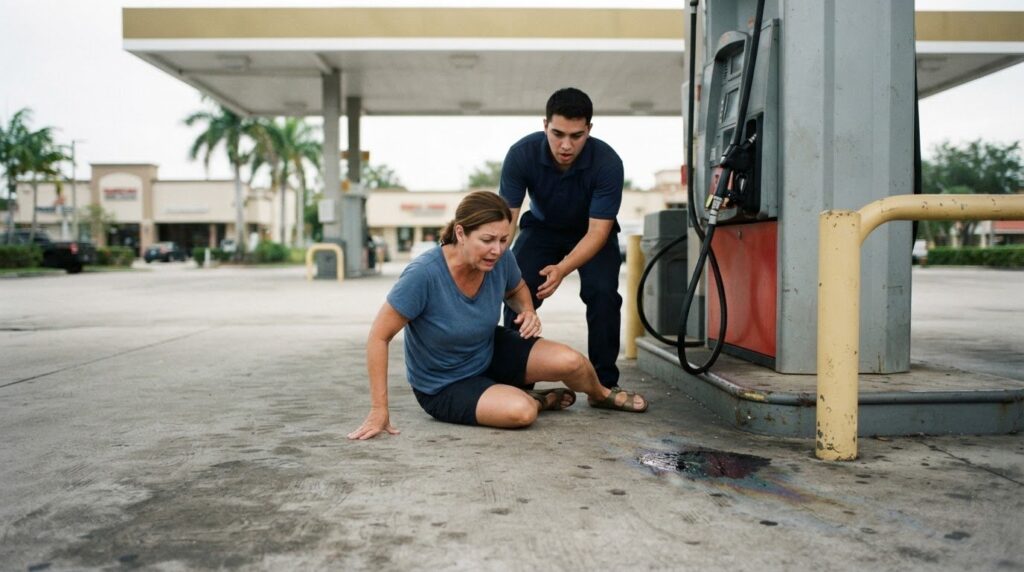

A gas station injury claim depends on more than the fact that you were hurt. In Florida, a slip-and-fall claim generally must be filed within four years. A lawyer for injury at gas station incidents can assess whether evidence of a dangerous condition, the station’s knowledge, and the resulting harm supports a premises-liability claim. Evidence such as a spill or surveillance footage can disappear quickly.
A slick floor, fuel or oil on pavement, cracked concrete, a defective pump, or inadequate security can turn an ordinary stop into a serious injury. If you’re looking for a personal injury firm near me, you may be weighing attorneys for personal injuries or attorneys’ personal injury services. It’s understandable to expect a business to address hazards that put customers at risk, but a claim depends on evidence connecting the condition to your injury and losses.
This guide covers common causes of gas station injuries in Miami and in Fort Lauderdale, the facts that can establish liability, and factors that may affect a slip-and-fall claim’s value. Whether you’re considering an injury lawyer near me, a personal injury lawyer near me, lawyers for auto accidents, or auto accident lawyers near me, you’ll also learn what steps to take after an incident and when legal help may protect important evidence.
Key Takeaways
- Gas station spills, leaking fuel or oil, uneven pavement, and defective equipment can create hazards that lead to serious injuries.
- A claim may depend on whether a dangerous condition existed, the station knew or should have known about it, and the hazard caused injury and losses.
- Photograph the hazard and scene, report the incident to station staff, and seek medical attention to document your injuries.
- The value of a slip-and-fall claim can depend on medical expenses, lost income, pain and suffering, and how the evidence supports your case.
- Florida generally allows four years to file a slip-and-fall injury claim. For help with a commercial slip-and-fall case, call: Call Now: (954) 390-2228 Available 24 Hours a Day, 7 Days a Week
Gas Station Slip-and-Fall Claims in Florida
A gas station or convenience store may face premises-liability responsibility when a dangerous condition causes a visitor’s injury. In Florida, a slip-and-fall claim focuses on the hazard, the business’s knowledge of it, and the steps taken to address or warn about it.
Property Owner Duties
Premises liability concerns injuries caused by unsafe property conditions. At a gas station, the key questions include whether a dangerous condition existed and whether the owner knew or should have known about it. For example, a spill left on a store floor may support a negligence claim if the station failed to address or warn about the hazard within a reasonable time.
Florida generally allows four years to file a slip-and-fall injury claim. It is important to assess the incident promptly, while details about the condition and the station’s response can still be gathered.
Potentially Responsible Parties
Responsibility depends on who controlled the area and could address the hazard. The property owner, gas station operator, landlord, or a contractor may be relevant if evidence connects that party’s role to the unsafe condition. A spill near a pump and a floor hazard inside the convenience store, for example, may involve different areas and responsibilities.
The owner, operator, landlord, or contractor may be considered if their control, work, or conduct relates to the hazard. Evidence, rather than a party’s title alone, guides the liability analysis.
Investigating and Proving Liability
A focused investigation connects the condition to the injury. Record where the fall happened, what the surface looked like, and whether warning signs were present. Photos or video can show the hazard and surrounding area. Because surveillance footage may be overwritten, preserving relevant evidence early matters. An incident report and witness accounts may also help establish what happened.
When choosing a gas station injury lawyer, look for a firm that handles Premise Liability and can explain how it assesses notice, evidence, and damages. A discussion of the facts of your fall can help you understand the legal process and your options.
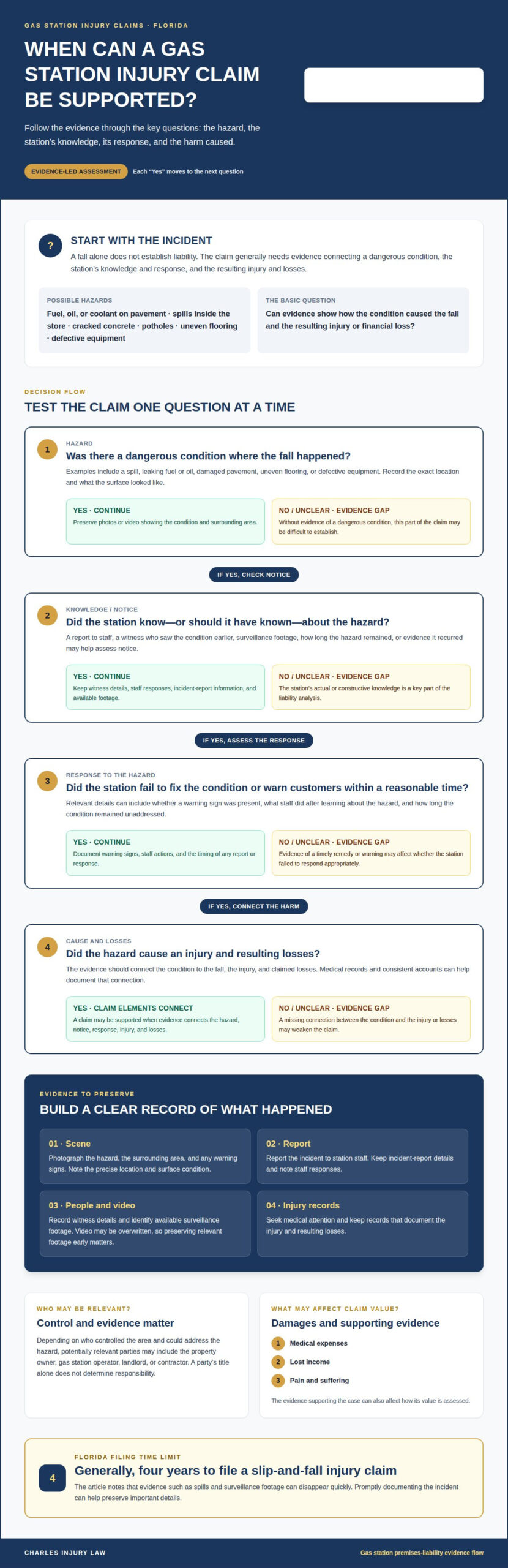
A claim generally needs evidence of a dangerous condition, the station’s actual or constructive knowledge, its failure to remedy the hazard or warn customers within a reasonable time, and resulting injury and financial loss. Records, photographs, and consistent accounts can help support these connections during settlement discussions.
Shared Liability and Comparative Negligence
Florida claims may also involve questions about each party’s role in the accident. The station may argue that the injured person contributed to the fall, while the injured person may point to the hazard, lack of warning, or delayed response. Evidence about visibility, the route taken, and the floor’s condition can help clarify the competing accounts.
Shared fault does not erase the need to prove negligence. A careful review separates the station’s conduct from claims about the injured person’s actions and considers how each may affect liability and potential recovery. Learn more about personal injury representation and how a claim may be assessed.
Slip-and-fall hazards at gas stations and convenience stores
A fall may begin with a small spill, a leaking pump, or uneven pavement. Where the hazard occurred and how long it remained can shape the evidence and liability analysis.
Fuel-Area Hazards
At the pumps, fuel, oil, or coolant on pavement can make a walking surface slippery. Cracked concrete and deep potholes create separate tripping hazards near vehicles and pump islands. Someone may fall while walking between a car and a pump or stumble over broken pavement while leaving the fueling area. The location and condition of the surface matter.
For a useful record, note the precise spot, the material or defect, and any nearby warning sign. Photographs can preserve how the area looked after the fall, including the spill’s spread or the pavement’s damage. Witness details and staff responses may also help show whether someone noticed the hazard before the incident. That evidence can clarify how the fall was caused.
Convenience-Store Fall Hazards
Inside a convenience store, liquid on the floor can cause a slip and fall. A customer might encounter a wet patch near a drink cooler or along the route to the counter. Uneven flooring can also catch a customer’s foot. In each case, the condition’s exact location helps explain whether it affected an ordinary path through the store.
Consider what evidence may establish when the spill or defect appeared and whether staff knew about it. A customer’s report to an employee, a witness who saw the spill earlier, or available surveillance footage may help show actual notice. The condition’s duration or repeated presence may also matter when assessing whether the business should have discovered it. Video may be overwritten, so prompt preservation can be important.
Notice is central to a fall case. If a store learned about a spill but left it unaddressed, that response may support an argument that it failed to act within a reasonable time. If no one saw the hazard beforehand, evidence about how long it remained and whether it recurred may help assess constructive notice. The facts guide that analysis.
A person injured by a dangerous condition may be entitled to damages if the evidence supports the required elements of a claim. The hazard alone does not establish liability; the evidence must connect the condition, the business’s knowledge and response, and the injury. For help understanding a slip-and-fall claim, consider discussing the incident and available evidence with an attorney.
What Are the Causes of Gas Station Injuries in Florida?
A gas station injury may involve faulty equipment, a fall, or a security failure. For example, a defective gas nozzle can cause a gasoline burn. Falls can also result in serious injuries, including traumatic brain injury. Identifying the incident’s cause helps clarify what happened and what evidence may matter.
Equipment failures create risks beyond ordinary walking hazards. A defective nozzle can expose a customer to gasoline and cause a burn. The details matter: which pump was involved, what failed, and how the incident unfolded. If equipment contributed to an injury, photographs of the pump and nozzle, witness accounts, and incident records may help preserve the facts.
Falls are another source of gas station injuries. A person may slip or trip and suffer injuries that require medical care. A fall can cause a traumatic brain injury or other harm that affects daily activities. A physician’s examination can document the injuries, while treatment records can establish when care began.
Security failures can also contribute to injury. Poor or absent lighting may create security concerns at night, while inadequate security can contribute to stabbings and thefts. If a criminal attack occurs, call 911 immediately and seek prompt medical attention, even if injuries seem minor. Report the incident to station staff when it’s safe to do so.
Each incident calls for a different record of events. After a nozzle-related burn, identify the pump and equipment involved. After a fall, note the location and condition that contributed to it. After an attack, record where and when it occurred and report the incident. These details can help distinguish equipment failure, a fall hazard, and a security issue.
Medical documentation matters in each situation. See a physician or go to an emergency room to have injuries assessed and recorded. Keep records describing the diagnosis, treatment, and effects on everyday activities. Pain and suffering may also be relevant when evaluating personal injury compensation, alongside documented physical harm and financial losses.
Gas station injuries can have different causes, and the evidence should reflect the event. A faulty nozzle calls for attention to the equipment; an attack at night raises questions about security and lighting. Prompt medical care and a clear incident report help document what happened. An attorney can assess whether the facts support a claim and explain possible next steps.
What Is Your Slip and Fall Case Worth?
There is no single figure that fits every Florida gas station fall claim. Evidence of injury, financial loss, and effects on daily life helps shape a damages assessment.
Economic and Non-Economic Damages
Economic losses can be documented through medical bills and proof of missed work. Non-economic harm includes pain and suffering and the effect an injury has on ordinary activities. Treatment records and a clear account of how an injury limits daily routines, for example, can help explain impacts that a receipt cannot show.
Organize records by date. Medical bills, payment statements, and wage documents can help show financial losses. Notes about symptoms and changes to daily tasks provide context for pain and suffering. These materials connect the injury to specific losses rather than relying on a broad estimate.
Expert Evidence and Injury Damages
Medical records provide a timeline of examinations, diagnoses, and treatment. A healthcare professional’s explanation may clarify how the injury affects movement or daily activities. Evidence should relate to the fall injury and treatment received. Detailed records can distinguish documented effects from unsupported assumptions.
Surveillance footage may show the fall, the conditions beforehand, or the injured person’s movements afterward. Because footage can be overwritten, preserving relevant video promptly may matter. Photographs, incident records, and witness accounts can add context to medical and financial documents when damages are assessed.
A property owner may challenge whether the fall caused a claimed injury or loss. Consistent records can help address that challenge. Treatment records created after the incident can show when symptoms were reported, while wage documents can identify missed work. A settlement assessment considers the available evidence and the losses it supports, not simply the amount requested.
Loss of consortium concerns a family relationship, not the injured person’s medical bills or lost income. It is a separate legal issue under Florida law, so it should not be added to the injured person’s damages calculation without considering its distinct basis. A family’s account of changed responsibilities may explain the injury’s broader impact, but it does not replace proof of the injured person’s losses.
To organize a damages assessment, gather treatment records, bills, wage documents, and notes about daily limitations. Preserve incident evidence, including available surveillance, as soon as possible. A law firm can evaluate how these materials support economic losses and pain and suffering. The central question is what the evidence establishes about the injury, its consequences, and the connection between them.
Elements of a gas station injury claim
A strong claim connects a dangerous condition to the station’s conduct, your injury, and resulting losses. Each link needs evidence. A wet floor, for example, matters legally when the available proof also shows notice, an inadequate response, and harm caused by the fall.
First, establish that a dangerous condition existed. Evidence might include photographs of a spill, a witness account, or video showing the floor before the fall. Describe the hazard’s precise location and appearance. A report that says only “I slipped” gives less useful detail than one identifying liquid near a particular entrance.
Next, show that the station knew or should have known about the condition. An employee’s earlier report may support actual notice. Evidence that a spill remained or appeared repeatedly may help show constructive notice. Timing matters: a hazard discovered moments before a fall raises a different question from one left unaddressed after staff received a warning.
The claim must also address the station’s response. Did staff clean the spill, block access, or warn customers? A warning sign placed away from a wet patch, for example, may not alert people approaching from another direction. Evidence should show what steps were taken, where they occurred, and whether they addressed the dangerous area.
Finally, connect the condition to an injury and financial loss. Medical records can document treatment after the incident, while wage records can show lost wages. If symptoms began after the fall and appear in treatment records, that timeline may support causation. The claim should distinguish losses tied to this accident from unrelated medical issues or missed work.
- Condition: Photograph the hazard and its location before it changes, if safe.
- Notice: Record who saw or reported the condition and when.
- Response: Document warnings, cleanup, barriers, or the lack of them.
- Harm: Preserve medical, expense, and wage records linked to the fall.
These elements work together. A spill alone does not prove negligence; a documented warning followed by no cleanup may strengthen the evidence of notice and response. If the station disputes how the fall happened, witness accounts, incident records, and available footage may help clarify the competing accounts. The goal is a supported account, not assumptions about what the property owner knew.
You deserve an evaluation grounded in the evidence, not guesswork. If you were hurt at a gas station, discuss the facts and available records to understand how they may support a claim.
Personal Injury Attorney in Fort Lauderdale
Personal Injury Attorney in Fort Lauderdale can help injured people assess whether evidence supports a Florida premises-liability claim. If you were hurt at a gas station, the firm can review the hazard, available records, and resulting losses, then explain possible next steps. That support may be useful when the station disputes what happened or who was responsible.
Charles Injury Law also handles Car Accidents, Truck Accidents, Uber & Lyft Rideshare Accidents, and Pedestrian Accidents. Each claim depends on its own facts and evidence. Contact the firm to discuss your injury and the circumstances of the incident.
Call Now: (954) 390-2228 Available 24 Hours a Day, 7 Days a Week
Take the Next Step Toward Accountability
Your next decision can shape how you approach a claim. A lawyer for injury at gas station incidents can assess the available evidence, identify unresolved questions, and explain your options. Charles Injury Law offers direct attorney access and prepares cases for trial, helping you consider next steps based on the facts.
Before discussing the incident, gather any records you already have and note questions about your next steps. You do not need to resolve every detail alone. A free consultation can help you understand your situation and decide what action makes sense for your circumstances.
Contact Personal Injury Attorney in Fort Lauderdale to discuss your situation.
Take the process one step at a time. A thoughtful conversation can help you move forward with greater clarity.
Frequently Asked Questions
Can I Sue If I Was Partially At Fault For The Accident?
Partial responsibility does not automatically prevent a Florida injury claim. The circumstances and available evidence still matter. For example, a gas station may argue that a customer did not notice a visible hazard, while the customer may point to missing warnings or the station’s response. An attorney can assess how the evidence addresses those competing accounts and explain possible options.
How Long Does A Settlement Take?
Settlement timing varies. Some claims settle in months, while others take longer. The investigation, disputed responsibility, completeness of medical records, and insurance negotiations can affect the pace. A claim may need additional documentation before its losses can be evaluated. Ask your attorney what steps remain and what is causing delays; those answers provide a clearer picture than relying on a standard timeline.
What Factors Affect The Settlement Amount?
Evidence about responsibility and the documented effects of the injury shape settlement discussions. Relevant factors may include medical expenses, missed work, ongoing care, pain, and changes to everyday activities. Records showing consistent treatment and wage loss, for example, can clarify the impact of an injury. Disputed evidence or gaps in documentation may complicate negotiations. No single factor determines every claim’s value.
What Is Premises Liability?
Premise Liability concerns legal responsibility for injuries connected to dangerous property conditions. At a gas station, a claim may focus on whether a hazard existed, whether the business knew or should have discovered it, and whether its response was reasonable. A customer’s fall near a pump, for instance, may prompt questions about the surface, warnings, and prior reports of the condition.
What Types Of Injuries At Gas Stations May Qualify For A Personal Injury Claim?
Injuries involving falls, burns from defective gas nozzles, or criminal attacks may support a personal injury claim when evidence connects the harm to another party’s negligence. Examples include a fall-related head injury, a burn caused by malfunctioning equipment, or an injury during an attack involving alleged security failures. The cause, injury records, and circumstances all matter.
What Must I Prove In A Gas Station Slip-And-Fall Or Premises Liability Case?
A claim generally needs evidence that a dangerous condition existed, the business knew or should have known about it, and it failed to address or warn about the condition within a reasonable time. You must also connect the condition to your injury and resulting losses. Records of a reported spill, the station’s response, and subsequent medical care may help establish those links.
What Evidence Should I Collect After Being Injured At A Gas Station?
If it’s safe, photograph the hazard, its location, nearby warnings, and the surrounding area. Note the time and where the incident occurred, and get witness names and contact details. Report what happened to staff and request an incident report. Keep medical and wage records. Ask that relevant surveillance footage be preserved, since it may be overwritten.
What Should I Do Immediately After A Gas Station Injury?
First, move away from immediate danger and seek medical attention. If a criminal attack caused the injury, call 911. Report the incident to station staff and request an incident report. Photograph the scene if it’s safe, and keep any records you receive. Before signing releases or giving the station’s insurer a recorded statement, seek legal advice about your rights.
This information is general and isn’t legal advice. Every case is different; contact an attorney to discuss your specific circumstances.
Disclaimer
The information provided on this blog is for general informational purposes only and does not constitute legal advice. Viewing this content does not create an attorney-client relationship with the firm. You should not act or rely on any information contained herein without seeking legal advice from a qualified attorney regarding your individual situation.