



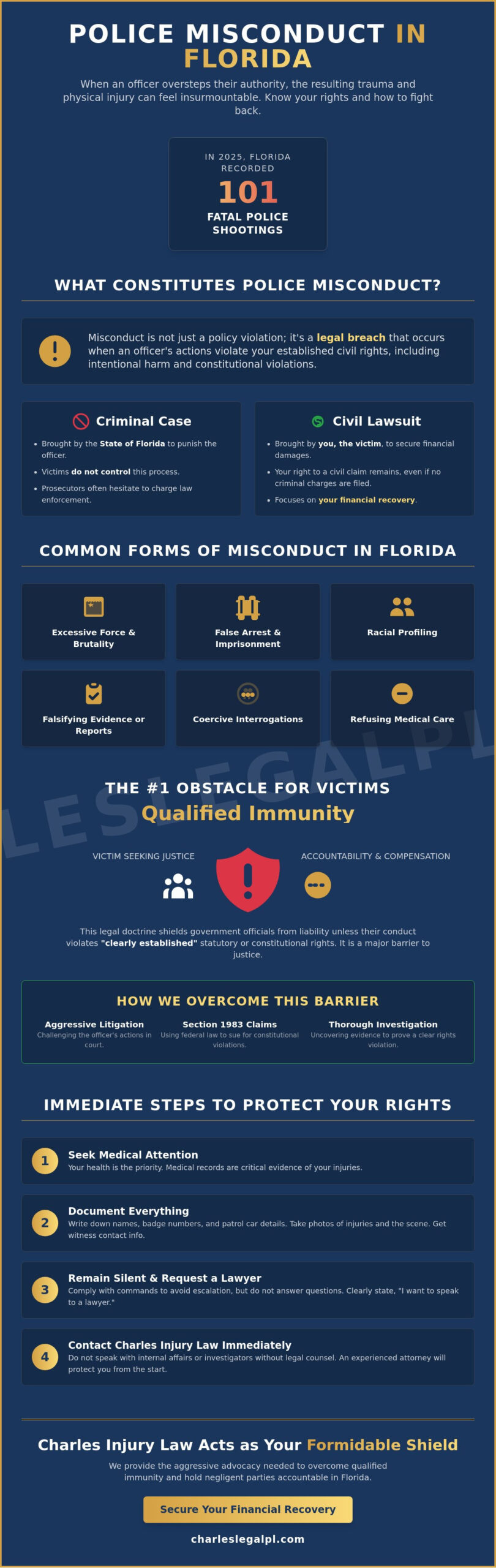
In 2025, Florida recorded 101 fatal police shootings, a statistic that highlights a sobering reality for residents in Miami and in Fort Lauderdale. You expect law enforcement to protect you, not to become the source of your trauma. When an officer oversteps, the resulting physical injury and fear of authority can feel insurmountable. It’s natural to feel confused by complex immunity rules that often shield the wrongdoer from accountability.
You deserve to know exactly what is police misconduct in Florida and how you can fight back. Charles Injury Law acts as your formidable shield against state power. This legal guide breaks down the 2024 changes to civilian oversight, the 180 day internal investigation deadlines, and the path to securing financial compensation. If the police violated your civil rights, then we’re ready to lead the mission for your recovery. We provide the aggressive advocacy needed to overcome qualified immunity and hold negligent parties accountable in Florida.
Key Takeaways
- Identify exactly what is police misconduct in Florida by recognizing specific actions that violate your established civil rights.
- Recognize the signs of excessive force and false imprisonment in Florida to validate your experience and build a case for restitution.
- Learn why qualified immunity is the primary obstacle for victims and how aggressive litigation can overcome this legal barrier.
- Discover the immediate steps you must take in Miami or in Fort Lauderdale to document evidence and preserve your right to sue.
- Understand how Charles Injury Law acts as a formidable shield to hold law enforcement accountable and secure your financial recovery.
Defining Police Misconduct in Florida: A Legal Perspective
Law enforcement officers carry a badge and a gun, but they don’t carry the right to ignore your civil rights. If an officer uses their authority to cause you harm, then you’ve experienced a betrayal of public trust. Understanding what is police misconduct in Florida is essential for anyone seeking accountability after a traumatic encounter. Misconduct isn’t just a policy violation; it’s a legal breach that occurs when an officer’s actions cross into the territory of civil rights violations. This includes intentional torts like battery and constitutional violations that strip away your dignity and safety.
Police misconduct can take many forms, including racial profiling, falsifying reports, or refusing to provide medical care to a detainee. While the Florida Department of Law Enforcement (FDLE) sets the baseline for professional compliance, these standards are frequently ignored on the streets of Miami and in Fort Lauderdale. Misconduct also extends to procedural abuses. This involves planting evidence, coercive interrogations, or failing to complete internal investigations within the 180 day deadline required by Florida law. Since July 1, 2024, new state laws have limited civilian oversight, making it even more critical to have an aggressive legal advocate who knows how to navigate these restricted systems.
The Difference Between Criminal and Civil Misconduct in Florida
The legal system treats criminal and civil cases as two separate tracks. The State of Florida brings criminal charges to punish an officer for breaking the law. Victims do not control this process, and prosecutors often hesitate to charge their own colleagues. Civil lawsuits are different. These are brought by you, the victim, to secure financial damages for the harm you suffered. If the state fails to file charges, then your right to a civil claim remains intact. Charles Injury Law focuses on the civil side because our mission is your financial recovery. We hold officers and departments accountable when the criminal justice system fails to act. You can learn more about how we handle these cases on our police misconduct or brutality page.
Constitutional Violations and Section 1983 Claims
Federal law provides a powerful tool for victims through Section 1983 claims. This law allows you to sue government officials who violate your constitutional rights. The Fourth Amendment is often the focal point, as it protects you from unreasonable searches and seizures in Florida. If an officer stops you without probable cause or uses excessive force, they’ve violated this amendment. The Fourteenth Amendment also plays a critical role by ensuring due process and equal protection under the law. We use these federal protections to build a case that forces local agencies in Miami or in Fort Lauderdale to pay for their negligence. If the police violated your rights, then we provide the professional force needed to secure your restitution.
Common Types of Law Enforcement Misconduct in Florida
Abuse of power isn’t always a headline-grabbing event. It often happens in the quiet moments of a traffic stop or during a routine detainment. Understanding what is police misconduct in Florida requires looking past the flashy headlines and into the specific ways officers abuse their power every day. While the Florida Statutes on police misconduct investigations provide certain protections for officers, they do not grant a license to ignore your civil rights. Misconduct is a spectrum that includes malicious prosecution, the falsification of evidence, and sexual harassment by officers on duty. If an officer fails to protect you while you are in their custody, then they may also be liable for negligent security.
The “blue code of silence” often makes it difficult to uncover these violations. Officers are frequently hesitant to report the misconduct of their colleagues, which leaves victims feeling isolated. Charles Injury Law breaks through this barrier. We investigate every detail to ensure that no procedural abuse or intentional tort goes unpunished. If you feel your rights were stripped away, then reaching out to a dedicated legal advocate is your first step toward justice.
Excessive Force and Brutality in South Florida
Police brutality is perhaps the most visible form of misconduct. In 2025, Florida saw 101 fatal police shootings, proving that the stakes are incredibly high. Courts use an “objectively reasonable” standard to judge force. If an officer uses more force than a reasonable person would in that same situation, then it’s a violation. We see victims suffering from broken bones, Taser burns, and traumatic brain injuries after encounters in Fort Lauderdale or in Miami. In the most tragic cases, this violence leads to wrongful death. We fight to hold these officers accountable for the physical and emotional wreckage they leave behind.
False Imprisonment and Illegal Detainment
Your freedom is not a suggestion. A “stop and frisk” in Miami can quickly turn into an illegal detention if the officer lacks reasonable suspicion. Under Florida law, an arrest requires probable cause. If an officer arrests you based on a hunch or personal bias, then they’ve committed false imprisonment. This isn’t just a mistake; it’s a compensable injury. We examine dashcam footage and arrest reports to prove when an officer bypassed the law to take your liberty. We don’t accept excuses for illegal detainment, and we ensure the responsible parties pay for their overreach.
Qualified Immunity: The #1 Obstacle for Victims in Florida
Qualified immunity is a legal wall that stops many civil rights lawsuits before they ever reach a jury. If you want to understand what is police misconduct in Florida, then you must first understand the defenses that officers use to avoid accountability. This doctrine protects government officials from liability unless their conduct violates “clearly established” statutory or constitutional rights. In simple terms, a court must have already ruled that a nearly identical act was illegal for your case to move forward. Florida courts apply this standard strictly. It places a heavy burden on the victim to prove the officer knew their actions were unconstitutional. Charles Injury Law specializes in dismantling this defense. We don’t just accept that an officer is immune. We hunt for the specific legal precedents and evidence required to pierce this shield and secure your financial recovery.
A Florida Atlantic University study examined data from 241 law enforcement agencies to identify the prevalence and nature of these abuses. This research shows that misconduct isn’t just an isolated incident; it’s a recurring issue across the state. If an officer’s actions were clearly unconstitutional, then that immunity should vanish. We use this data and deep legal research to build a case that officers cannot hide from. We provide the aggressive advocacy needed to turn the tide in your favor.
Bypassing Immunity with Direct Evidence
Objective proof is the most effective way to beat a claim of immunity. Body camera and dash camera footage in Miami or in Fort Lauderdale provide an unfiltered look at the truth. If the video contradicts the officer’s sworn statement, then the “clearly established” argument becomes much stronger. Eyewitness testimony in Palm Beach or in Boca Raton also provides critical context that police reports often omit. We also look for patterns of misconduct within a specific Florida agency. If an officer has a history of similar complaints, then it becomes harder for them to claim they didn’t know their actions were wrong. We leave no stone unturned when gathering this vital evidence.
Suing the Municipality vs. the Individual Officer
Sometimes the officer isn’t the only one at fault. If a city in Florida fails to train its staff or ignores a history of abuse, then the municipality itself may be liable. This is known as a Monell claim. It requires proving that a specific policy or custom led to the misconduct. You must also be aware of sovereign immunity caps on damages. In March 2026, the Florida Legislature passed a bill to increase these limits to $350,000 per person and $500,000 per incident. These changes take effect on October 1, 2026. If your claim involves systemic failure, then we’ll hold the entire department accountable to maximize your restitution.
Steps to Take if You Experience Misconduct in Florida
The moments following a police encounter are critical for your physical safety and your legal rights. If you believe you are a victim, then you must act with precision to preserve evidence. Knowing what is police misconduct in Florida is only the first step; you must also build a foundation for your future claim. Law enforcement agencies in Miami and in Fort Lauderdale often rely on the chaos of an incident to obscure the facts. You can take control by following these steps immediately.
- Seek medical care: Visit an emergency room or urgent care in Fort Lauderdale or in Miami right away. Physical injuries like bruising, Taser marks, or fractures fade quickly.
- Capture visual evidence: Take high-resolution photos of your injuries, damaged property, and the location where the incident occurred.
- Identify the officers: Record names, badge numbers, and patrol car numbers. If an officer refuses to provide this, then note their physical description.
- Secure witness data: Get the names and phone numbers of anyone who saw the event. Do not wait for the police to interview them.
- Stay silent: Contact Charles Injury Law before you speak with any internal affairs investigators or provide a recorded statement.
If you have been injured by authority, then you need an advocate who acts as a formidable shield. Contact Charles Injury Law today to begin your mission for accountability.
The Importance of Medical Records
Medical documentation serves as the backbone of any injury claim in Florida. When you see a doctor, you must be explicit about the cause of your trauma. Mentioning that an officer caused your injury creates a contemporaneous record that is difficult for the defense to dispute later. These records link the officer’s specific actions directly to your physical or mental suffering. Without this proof, the state may argue that your injuries were pre-existing or unrelated to the encounter. We use these professional evaluations to demand superlative financial restitution for your pain.
Filing a Formal Complaint vs. a Civil Lawsuit
You should understand the difference between an internal investigation and a civil lawsuit. Florida law requires that internal investigations into misconduct be completed within 180 days of the agency receiving notice. However, these investigations are handled by the police themselves. Since July 1, 2024, most independent civilian oversight boards in major Florida cities have been dissolved. This means the police are often grading their own papers. An internal finding of guilt rarely results in money for the victim.
A civil lawsuit is your path to financial compensation. You must be aware of strict deadlines. For civil rights and negligence claims in Florida, the statute of limitations is generally two years. If your case involves malicious prosecution, then you have four years from the date the criminal case is resolved in your favor. If you miss these windows, then your right to sue is gone forever. We handle the litigation so you can focus on your recovery.
How Charles Injury Law Fights for Misconduct Victims in Florida
If the power of the state was used to crush your rights, then you need a professional force in your corner. Charles Injury Law acts as a formidable shield for individuals who have suffered at the hands of those sworn to protect them. We don’t just look at the surface level of your incident. Our team launches an aggressive investigation into officer personnel files and prior complaints in Miami and in Fort Lauderdale. We hunt for patterns of abuse that the department wants to keep hidden. When you are trying to determine what is police misconduct in Florida, our firm provides the clarity and the combatative energy required to win. We handle the high-stakes conflict with the city or county while you focus on your physical and emotional recovery.
Many firms only focus on the most violent cases. We recognize that false imprisonment and negligent security while in custody are equally devastating violations. If an officer’s negligence led to your injury, then we are ready to litigate. We provide trial-ready representation designed to secure superlative outcomes. Our mission is simple: we secure the financial restitution you deserve. We understand that defining what is police misconduct in Florida involves recognizing that your civil rights are non-negotiable. We are ready to act now.
Our Combatative Approach to Opposing Entities
We do not back down against large law enforcement agencies in Florida. These entities have deep pockets and legal teams, but we have the expertise to neutralize their advantage. We utilize expert witnesses in police tactics and forensics to dismantle their defenses. These professionals testify on the objectively reasonable standard and highlight exactly where procedures were ignored. If the police claim they followed protocol, then we use evidence to prove otherwise. Our Police Misconduct or Brutality services are built on a foundation of assertive energy and technical precision.
Securing Compensation for Your Damages
Your path to recovery should not be a bureaucratic journey. We fight for a settlement that covers your medical bills, lost wages, and the deep emotional distress caused by authority figures. In cases where an officer acted with intentional malice in Florida, we seek punitive damages to punish the wrongdoer and prevent future abuse. If you were a victim of misconduct in Florida, contact Charles Injury Law for a free consultation. We are the expert advocate you need to turn a traumatic event into a mission for justice.
Reclaim Your Rights and Secure Your Restitution
Police overreach can leave you feeling powerless, but the law provides a path to accountability. Understanding exactly what is police misconduct in Florida is the first step toward reclaiming your dignity. You now know the critical importance of medical documentation and the strict timelines governing civil rights litigation. If an officer in Miami or in Fort Lauderdale violated your constitutional protections, then you don’t have to face the system alone. Charles Injury Law stands as your dedicated ally against state negligence.
Our firm provides aggressive trial-ready representation built on localized knowledge of law enforcement agencies in Miami and in Fort Lauderdale. We utilize specialized expertise in Section 1983 civil rights claims to dismantle the shield of qualified immunity. We handle the heavy lifting of litigation so you can focus on healing from your injuries. If you are ready to demand justice, then we are ready to lead the mission for your superlative financial recovery.
Fight back against police misconduct in Florida; Contact Charles Injury Law today for a free evaluation. Your voice deserves to be heard, and your rights deserve to be protected.
Frequently Asked Questions
Can I sue a police officer in Florida for excessive force?
Yes, you can sue a police officer in Florida for excessive force when their actions violate the “objectively reasonable” standard. This is a primary example of what is police misconduct in Florida. If an officer’s violence caused you physical injury, then you have the right to seek financial restitution through a civil rights lawsuit. Charles Injury Law provides the aggressive advocacy needed to overcome qualified immunity and force accountability for your trauma.
What is the statute of limitations for police misconduct in Florida?
The statute of limitations for most police misconduct claims in Florida is two years from the date of the incident. This applies to civil rights violations and negligence claims. If your case involves malicious prosecution, then you have four years from the date the criminal charges were resolved in your favor. Missing these deadlines will permanently bar you from seeking compensation; therefore, you must act with urgency.
Do I need body camera footage to win a misconduct case?
You do not strictly need body camera footage to win, although it is a powerful piece of evidence. Misconduct cases can also be proven through eyewitness testimony, medical records, and forensic analysis of the scene. If an officer failed to activate their camera in Miami or in Fort Lauderdale, then we investigate why that policy was ignored. We use every available resource to build a trial-ready case for our clients.
Can I be compensated for false arrest in Florida?
You can absolutely be compensated for false arrest and false imprisonment in Florida. If an officer detained you without probable cause, then they have violated your Fourth Amendment rights. Compensation can cover your emotional distress, lost wages, and any physical harm suffered during the illegal detainment. Charles Injury Law acts as a shield for victims of these procedural abuses to ensure the state pays for its overreach.
What should I do if the police department denies my misconduct claim?
If the police department denies your internal complaint, then you should proceed with a civil lawsuit. Internal affairs investigations are conducted by the agencies themselves and rarely result in victim compensation. A denial by the department does not prevent you from filing a claim in court. We handle the conflict with the municipality while you focus on recovery, ensuring your rights are protected by an expert advocate.
How much is a police misconduct settlement worth in Florida?
Settlement values vary based on the severity of your injuries and the nature of the violation. In Florida, sovereign immunity laws currently cap damages at $200,000 per person, but these limits increase to $350,000 for incidents occurring after October 1, 2026. If the misconduct was intentional or malicious, then you may also be eligible for punitive damages. We fight for superlative outcomes to maximize your financial recovery.
Can I sue the police if I was not arrested but was injured?
Yes, you can sue for injuries even if the encounter did not result in an arrest. Excessive force is a violation of your rights regardless of whether you were taken into custody. If an officer’s actions caused you harm during a “stop and frisk” or a traffic stop in Boca Raton or in Palm Beach, then you have a valid claim. Understanding what is police misconduct in Florida means knowing that any unauthorized violence is a compensable injury.
Does Charles Injury Law handle police brutality cases in Miami?
Charles Injury Law actively handles police brutality and misconduct cases in Miami and throughout South Florida. We are a dedicated ally for those injured by authority figures. Our firm brings specialized expertise in Section 1983 claims and a confrontational spirit to every case. If you need an aggressive advocate in Miami or in Fort Lauderdale, then we are ready to lead your mission for justice.
Disclaimer
The information provided on this blog is for general informational purposes only and does not constitute legal advice. Viewing this content does not create an attorney-client relationship with the firm. You should not act or rely on any information contained herein without seeking legal advice from a qualified attorney regarding your individual situation.