



In Florida, a medical lien isn’t a final bill; it’s an aggressive opening offer designed to strip away your hard-earned recovery. You’ve spent months recovering from a traumatic accident, only to face relentless collection calls and health insurance companies demanding a massive cut of your check. It’s frustrating to feel like your settlement is disappearing before you even see it. Understanding liens on a personal injury settlement in Florida is the first step toward protecting your financial future. If you want to maximize your take-home recovery, you need a strategy to counter these aggressive demands.
We agree that you shouldn’t have to choose between paying medical bills and rebuilding your life. This guide will teach you how to shield your compensation from lienholders and leverage Florida law to reduce the amount you owe. You’ll learn about the “super liens” held by Medicare, the impact of the 2023 tort reform on your claim, and how a personal injury firm near me can act as your formidable shield. We’re going to dive into the “Made Whole” doctrine and explain why Charles Injury Law fights to ensure you aren’t left with nothing while insurance companies profit. You deserve a recovery that actually lands in your bank account.
Key Takeaways
- A Florida medical lien is a mandatory debt that attaches to your recovery proceeds before you receive a settlement check.
- Hospitals in Fort Lauderdale and Miami often utilize local ordinances to file aggressive liens that can significantly drain your final compensation.
- The “Made Whole” Doctrine serves as a vital legal shield in Florida, preventing insurers from taking reimbursement if you haven’t been fully compensated for your damages.
- Gaining a clear understanding of liens on a personal injury settlement in Florida empowers you to audit medical bills for “upcoding” and negotiate for a lower payoff amount.
- Charles Injury Law acts as your professional shield, fighting to reduce the amount owed to lienholders and maximizing your final take-home recovery.
What is a Lien on a Personal Injury Settlement in Florida?
A lien is a direct attack on your financial recovery. It is a legal claim or “security interest” placed on your settlement proceeds by a third party, such as a hospital or an insurance company. A Florida medical lien is a mandatory debt that attaches to your recovery before you receive a check. These entities have the legal right to intercept your funds to reimburse themselves for costs they paid for your care. Gaining a clear understanding of liens on a personal injury settlement in Florida is the only way to protect your money from being drained by aggressive collectors.
If you don’t resolve these claims properly, the consequences are severe. You could face “double damages” or long-term financial liability even after your case is closed. To get a broader grasp of What is a Lien?, think of it as a cloud over your compensation that prevents you from truly owning your settlement until the debt is satisfied. If you are pursuing a personal injury claim, understanding liens on a personal injury settlement in Florida is essential for calculating your final take-home pay.
Why Liens Exist in Personal Injury
Most liens are fueled by the “Right of Subrogation.” This is a legal doctrine that allows an insurer to “step into your shoes” to recover money they paid out for your injuries. If a health insurance company pays for your emergency room visit in Miami, they believe they are entitled to a piece of your settlement from the at-fault driver. While this feels like an unfair grab, these liens do allow you to receive immediate, life-saving care without paying out-of-pocket during your recovery. Charles Injury Law acts as your professional shield during this process. We manage these aggressive claims and fight to keep the money in your pocket while you focus on healing.
Statutory vs. Contractual Liens
Not all liens are created equal. You must know the difference to gain leverage during negotiations. Florida law identifies two primary categories:
- Statutory Liens: These are claims created by Florida law or federal statutes. Examples include hospital liens in Fort Lauderdale or Medicare and Medicaid “super liens.” These are often the most difficult to reduce because they are backed by the government.
- Contractual Liens: These claims are based on the specific language in your private health insurance policy. If your plan is governed by federal ERISA laws, the insurer may fight even harder to take your money.
Knowing which type of lien you face determines how much leverage we have. We audit every claim to ensure it is valid. If a hospital in Boca Raton attempts to charge you for treatment unrelated to your accident, we move to strike that claim immediately. We don’t accept their first offer. We fight for a superlative outcome for you.
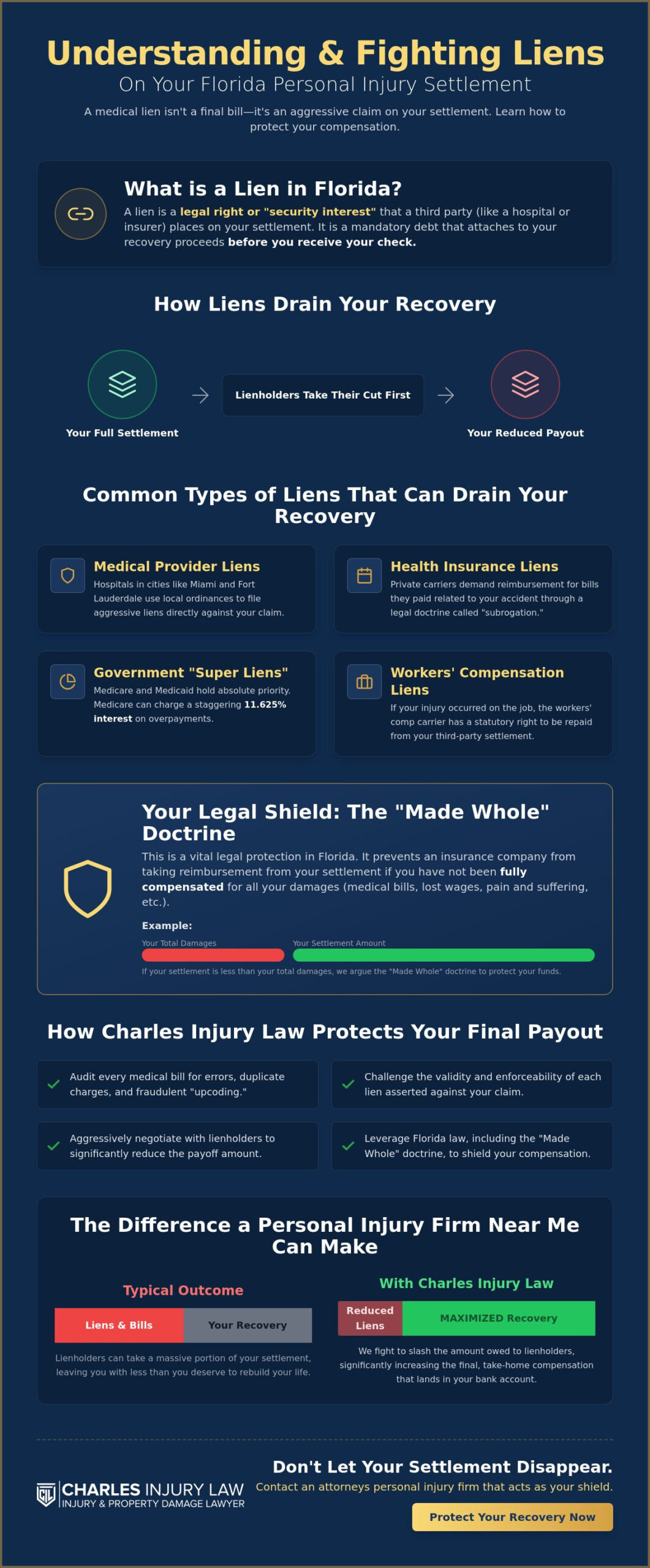
Common Types of Liens That Can Drain Your Recovery
Lienholders are not your friends. They are financial entities looking to secure their slice of your recovery before you even see a dime. When you are understanding liens on a personal injury settlement in Florida, you must recognize who has the most power to deplete your funds. Knowing What is a Lien is the first step toward defending your settlement from these four common threats.
- Medical Provider Liens: Hospitals in Miami and Fort Lauderdale utilize specific local ordinances that allow them to file liens directly against your claim. These are high-priority debts.
- Health Insurance Liens: If you were in a car accident in Boca Raton, your private carrier likely paid your initial bills. They will demand every cent back through subrogation.
- Government Liens: Medicare and Medicaid hold “super lien” status. They have absolute priority under federal and Florida law. As of January 2026, the interest rate for Medicare overpayments is a staggering 11.625%.
- Workers’ Compensation Liens: If your injury happened on the job, the workers’ comp carrier has a statutory right to be paid back from any third-party settlement you receive.
If you are struggling with aggressive calls from insurers or hospitals, contact our team today for a professional case review.
ERISA Liens: The Most Aggressive Claims
Self-funded employer plans, known as ERISA plans, are the most dangerous to your settlement. These plans use “Federal Preemption” to bypass many Florida state consumer protections. If your plan is a true self-funded ERISA plan, then the insurer may claim they are entitled to 100% of their payments, regardless of how much you actually recover. Charles Injury Law is the personal injury firm near me that identifies these plans early. We audit the plan documents to find weaknesses in their recovery language before they can surprise you at the closing table.
Letters of Protection (LOPs)
A Letter of Protection is a contractual lien between you, your attorneys for personal injuries, and a medical provider. This document allows you to receive top-tier treatment with $0 down. While LOPs provide immediate access to care, they must be managed with extreme care. Expert auto accident lawyers near me monitor these bills to ensure providers aren’t overcharging. If a medical bill is inflated, we negotiate it down to protect your final payout. We fight to ensure your recovery serves your future, not a hospital’s bottom line.
Legal Protections: The ‘Made Whole’ Doctrine in Florida
Insurance companies often try to skip to the front of the line. They want their money back the moment a settlement is reached. However, understanding liens on a personal injury settlement in Florida requires knowing your rights as a victim. The “Made Whole” Doctrine is your most powerful weapon. This essential Florida rule states that an insurer is not entitled to subrogation or reimbursement until the injured party has been fully compensated for all their damages. If your settlement doesn’t cover the full extent of your losses, the insurer shouldn’t get a full refund. We use this doctrine to stop unfair insurance grabs in Miami and Fort Lauderdale.
Another critical shield is the “Common Fund” Doctrine. This rule prevents insurance companies from getting a “free ride” on your legal efforts. If your auto accident lawyers near me successfully secure a settlement that benefits the lienholder, that lienholder must pay their fair share of the legal fees and costs. They cannot take a 100% reimbursement while you pay 100% of the attorney’s fees. This effectively reduces the amount you owe them, keeping more money in your bank account.
When the Made Whole Doctrine Applies
Calculating “full compensation” is a complex battle. It isn’t just about your medical bills. It includes your pain and suffering, lost wages, and future medical needs. Insurers will aggressively argue that you have been made whole just because you accepted a settlement check. We push back with hard data and expert testimony. Under Florida case law, if a $100,000 policy limit is all that’s available but your total damages are $500,000, you are clearly not “made whole.” In these scenarios, Charles Injury Law fights to eliminate or drastically reduce the lien.
Equitable Distribution in Florida
When settlement funds are limited, Florida courts apply the principle of equitable distribution. This process balances your rights against the rights of the lienholder. Instead of the insurer taking everything, the court may order a “pro-rata” reduction. This means the lienholder only receives a small percentage of the funds based on the total value of the case versus the actual recovery. You need a personal injury firm near me that understands these specific Florida statutes. We don’t just accept the lienholder’s demands. We force them to accept a fair share so you can focus on your recovery with financial security.
How to Negotiate and Reduce Liens on Your Settlement
Every lien is a negotiable claim. It is not an inevitable tax on your success. If an insurance company sends a “final payoff” amount, don’t believe them. It is an aggressive opening bid. Understanding liens on a personal injury settlement in Florida allows you to treat these demands as what they truly are: negotiable debts. We fight to minimize these claims so you can maximize your final take-home recovery. If you don’t challenge these numbers, you are leaving your own money on the table. We refuse to let that happen.
Before you agree to any distribution, you must see the “net” recovery. This is the actual amount that lands in your bank account after all debts are settled. We audit every bill to identify “upcoding” or charges for treatment unrelated to your accident in Miami. If a provider tries to inflate their bill, we move to strike the overage. You deserve a superlative outcome that prioritizes your needs over an insurer’s profit margins.
Step 1: Verification and Auditing
We start by demanding a detailed itemization of every single charge from the lienholder. Hospitals in Fort Lauderdale often make billing errors that favor their bottom line. We cross-reference your medical records with these statements to find discrepancies. Verifying the lien’s legal validity is the first step in building a formidable defense for your personal injury settlement. If a lienholder cannot prove a charge is directly related to your accident, we demand its removal. Our personal injury firm near me doesn’t let a single cent go unvetted.
Step 2: The Demand for Reduction
Once we have the facts, we draft a formal “Lien Reduction Request.” This document utilizes Florida‘s equitable principles to force a lower settlement. We highlight the risks the lienholder faces if the case proceeds to trial. Charles Injury Law uses our trial-readiness as a hammer in these negotiations. Lienholders know that if they are too greedy, they risk getting nothing in a long courtroom battle. They would rather take a guaranteed, reduced amount now than fight attorneys for personal injuries who are ready for war. If they see we are prepared to litigate, they usually fold. Contact us today to start your lien defense.
Understanding liens on a personal injury settlement in Florida is about more than math; it is about your survival. We also utilize the “Hardship” argument for clients facing significant financial distress. If your recovery is small and your needs are great, we use your financial reality to force a deeper reduction. Your injury lawyer near me must be a protective champion for your check. We ensure your settlement serves your future, not a billion-dollar insurance company.
How Charles Injury Law Protects Your Final Payout
Charles Injury Law doesn’t just win cases. We protect the money you’ve already won. Winning a high-stakes settlement is only half the battle. Understanding liens on a personal injury settlement in Florida is the other half. If we don’t aggressively fight the lienholders, your compensation disappears into their pockets. We act as a formidable shield for the injured. Our firm treats the legal process as a mission for financial restitution, not a bureaucratic journey. We are dedicated allies in your fight for justice.
Our advocacy is a calculated blend. We are combative toward lienholders and deeply comforting to clients. We pursue accountability from every entity trying to drain your recovery. Our trial-ready reputation in Fort Lauderdale makes insurers think twice about being greedy. They know we are ready for the courtroom. This leverage forces them to lower their demands. If we don’t secure a recovery for you, then you owe us nothing in fees or costs. This clear path removes the cognitive load for you during a time of physical pain and distress.
Maximum Recovery, Minimum Stress
We handle all communication with aggressive bill collectors in Palm Beach. You shouldn’t have to deal with harassment while recovering from your injuries. Our commitment to your case remains until the check is in your hand. The “Shield” stays up throughout the entire negotiation process. For more on our specific process regarding Car Accidents, explore our dedicated practice area. We ensure your legal journey leads to a successful outcome, not a bureaucratic dead end. We fight to maximize your net recovery while you focus on your health.
Contact a Personal Injury Lawyer in Florida Today
Don’t let a settlement turn into a disbursement nightmare. Get expert help now. We serve victims in Miami, Boca Raton, and across South Florida. Our auto accident lawyers near me maintain a rhythm of perpetual readiness. The first few hours and days after an incident are critical. We move quickly from identifying your problem to offering an immediate solution. This “always-on” cadence ensures your rights are protected from the start. Secure your free consultation with Charles Injury Law today. We are the personal injury lawyer near me that fights for your superlative outcome. You deserve an expert advocate who treats you like an individual, not a file number.
Secure Your Financial Future Today
If you want a protective champion who handles the conflict while you recover, we are ready to fight. Charles Injury Law provides trial-ready representation with a clear promise. If we don’t win your case, you owe us nothing in fees or costs. We are aggressive negotiators who refuse to let major insurers bully our clients. You’ve suffered enough; don’t let aggressive lienholders take what you’ve earned.
Fight for the maximum take-home recovery. Contact Charles Injury Law today.
Frequently Asked Questions
Can a medical lien take my entire personal injury settlement?
No, a medical lienholder generally cannot take your entire settlement if you are represented by a skilled advocate. Florida law and the “Made Whole” doctrine exist to ensure that victims aren’t left with nothing while insurers profit. We negotiate aggressively to reduce these claims, ensuring that your net recovery remains the priority. If a lienholder demands an unreasonable amount, we use legal leverage to force a fair reduction.
What happens if I ignore a lien on my car accident case in Florida?
Does my health insurance have a right to my settlement money?
Private health insurance companies usually have a contractual right to reimbursement through subrogation. However, this right is not absolute. Understanding liens on a personal injury settlement in Florida allows us to challenge these demands if your policy doesn’t meet specific legal criteria. We audit their payments to ensure they only recover funds directly related to your accident injuries, not unrelated previous care.
What is a Letter of Protection (LOP) and should I sign one?
A Letter of Protection is a legal contract that allows you to receive medical treatment now with $0 down. You agree to pay the provider from your future settlement proceeds. It’s a powerful tool for getting immediate care from top specialists in Miami or Boca Raton. We review every LOP before you sign to ensure the provider’s billing practices are fair and won’t consume your entire recovery later.
How long does it take to resolve liens after a settlement is reached?
Resolving liens typically takes between 30 and 90 days after your settlement is finalized. Private insurance companies often move faster, while government entities like Medicare or Medicaid can take much longer due to federal bureaucracy. As of 2026, the statutory interest rates on certain government overpayments make it critical to resolve these quickly. We maintain constant pressure on these agencies to speed up the process so you get your check faster.
Can a lawyer help me reduce the amount I owe to a hospital in Fort Lauderdale?
Yes, we aggressively negotiate with hospitals in Fort Lauderdale to slash their lien amounts. Many hospitals use local ordinances to claim high payoff amounts, but these numbers are rarely final. We audit their itemized statements for “upcoding” and inflated charges. Our personal injury firm near me uses trial-readiness as leverage to force hospitals to accept a significantly reduced payment, keeping more money in your pocket.
What is the ‘Made Whole’ doctrine in Florida law?
The “Made Whole” doctrine is a consumer protection rule that prevents insurers from taking your money if you haven’t been fully compensated for your losses. If your settlement is limited by insurance policy caps and doesn’t cover your total pain and suffering, the insurer’s right to reimbursement may be eliminated. This is a complex area of understanding liens on a personal injury settlement in Florida that requires an expert advocate to argue successfully in court.
Who gets paid first from a personal injury settlement?
Generally, attorney fees and litigation costs are paid first from the gross settlement. Next, statutory liens, such as those from Medicare or hospitals with local lien laws, must be satisfied. Finally, any remaining contractual liens or medical bills are paid before the net proceeds are distributed to you. Charles Injury Law fights at every stage of this distribution to minimize what others take and maximize what you keep.
Disclaimer
The information provided on this blog is for general informational purposes only and does not constitute legal advice. Viewing this content does not create an attorney-client relationship with the firm. You should not act or rely on any information contained herein without seeking legal advice from a qualified attorney regarding your individual situation.