

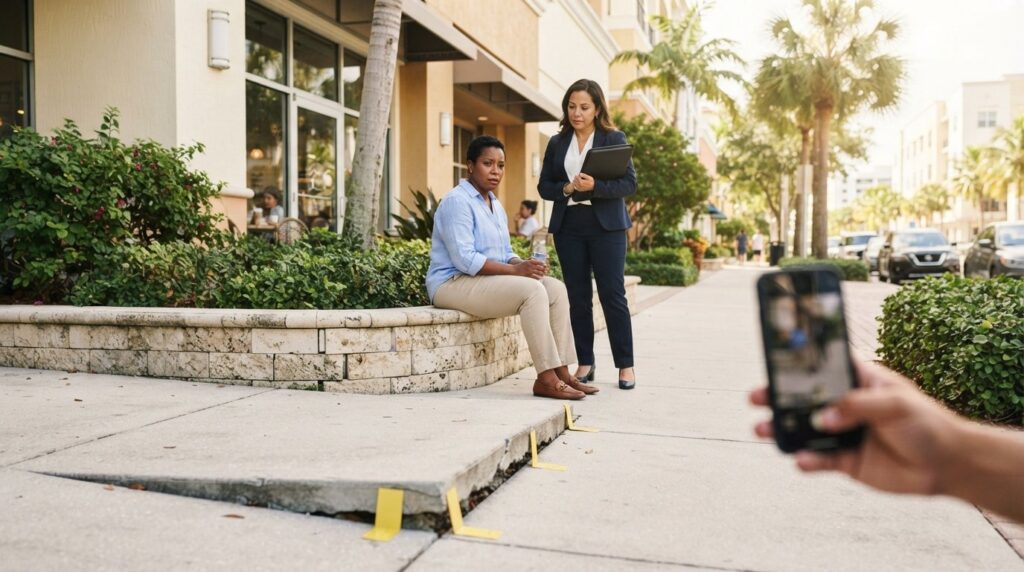

Property owners and commercial insurers want you to believe that tripping over cracked concrete is entirely your fault. It isn’t. When neglected curbs or hazardous slab shifts cause debilitating fractures and joint tears, partnering with a relentless uneven pavement trip and fall attorney in Florida is the decisive move to take control. If a negligent entity left an unsafe hazard in your path, they must be held fully accountable for the damage left behind.
Facing painful physical recovery alongside mounting medical debt is exhausting, especially while insurance adjusters actively work to minimize your claim. You already know the process is stacked against unrepresented victims. This 2026 guide explains how to establish fault under Florida law, overcome aggressive comparative negligence defenses, and secure complete financial compensation for your hospital bills and lost wages. We examine strict notice deadlines for municipal walkways and highlight how to select a trial-ready personal injury lawyer near me to protect your future.
Key Takeaways
- Learn how to differentiate actionable sidewalk defects exceeding statutory thresholds from trivial walkway irregularities under Florida law.
- Discover what separates high-volume settlement mills from a dedicated uneven pavement trip and fall attorney who prepares every premises liability claim for trial.
- Find out how Florida’s modified comparative negligence framework impacts your compensation if commercial insurance adjusters argue the tripping hazard was open and obvious.
- Understand the full spectrum of recoverable financial damages, including immediate emergency care, projected physical therapies, and diminished earning capacity.
- See how immediate evidence preservation stops commercial property owners or municipalities from concealing hazardous concrete defects before you file a claim.
Evaluating Liability: When Does Uneven Pavement Justify Hiring an Attorney?
A sidewalk crack is rarely just an unfortunate blemish. When property managers ignore deteriorating concrete, walking surfaces turn into sudden, bone-breaking hazards. Under established premises liability principles, commercial property owners and operators must keep their walkways in a reasonably safe condition for invited guests. If they fail in that fundamental duty, you have every right to pursue accountability.
Insurance carriers immediately attempt to dismiss structural pavement flaws as trivial inconveniences. Hiring a dedicated uneven pavement trip and fall attorney stops that narrative cold. When you retain a personal injury firm near me immediately after an incident, our team moves swiftly to secure critical physical measurements before negligent maintenance crews patch the scene to hide their culpability.
Dangerous Walkway Conditions vs. Trivial Sidewalk Defects
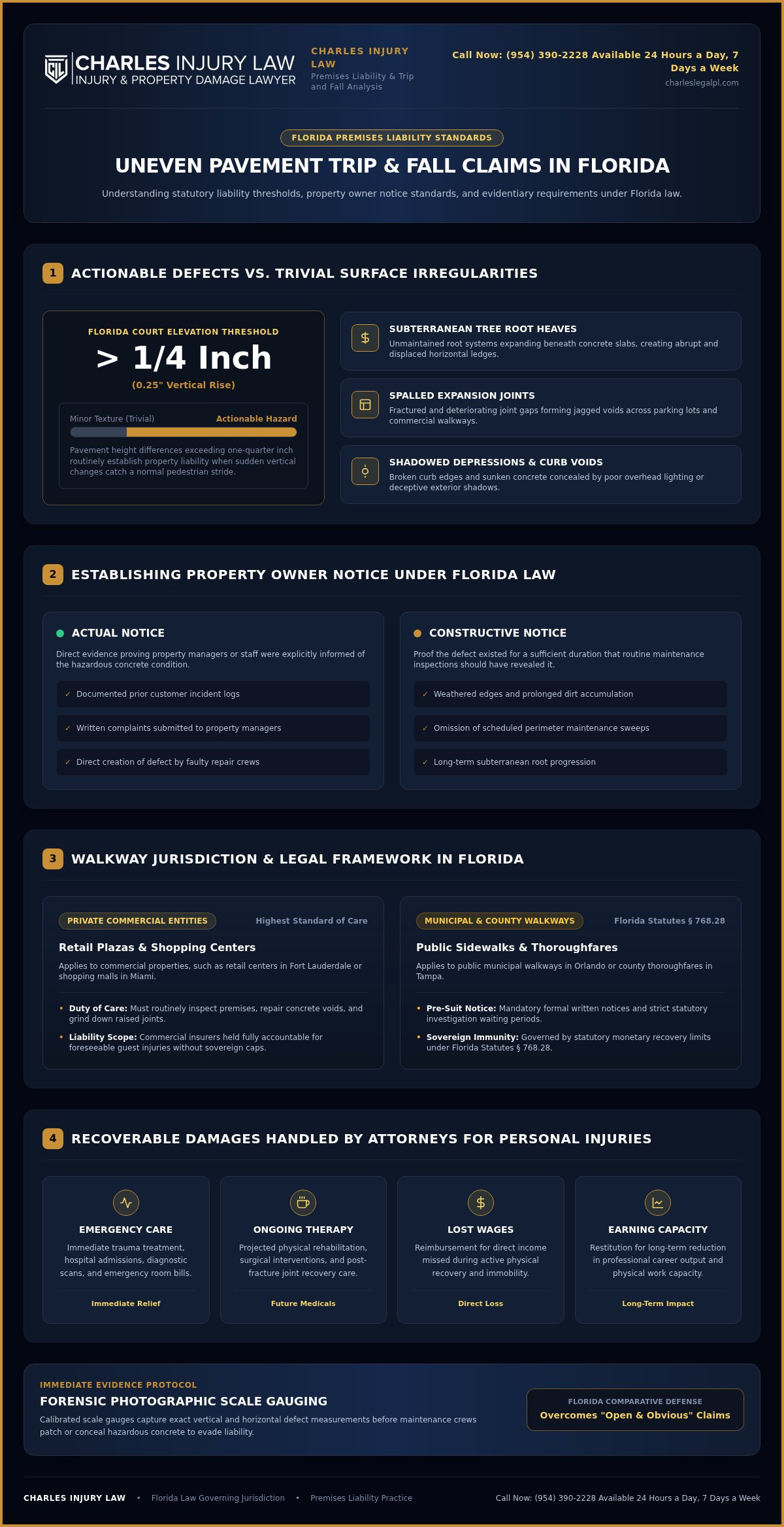
Florida courts distinguish between minor surface textures and actionable tripping defects. Pavement elevation changes exceeding one-quarter inch routinely establish liability, especially where sudden vertical rises catch the human foot during normal stride. Common dangerous conditions include:
- Abrupt concrete slabs displaced by unmaintained subterranean tree root heaves.
- Spalled, fractured expansion joints creating jagged, uneven voids in parking lots.
- Depressions and broken curbs disguised by shadows or poor overhead exterior illumination.
If defective concrete contributed to your injuries, securing experienced trip and fall accident representation ensures those physical dimensions are forensically recorded using calibrated photographic scale gauges.
Actual vs. Constructive Notice Under Florida Law
Proving liability requires showing that the property owner either created the hazard, possessed actual knowledge of it, or had constructive notice. Constructive notice means the defect existed long enough that regular maintenance inspections should have revealed it. Weathered edges, dirt accumulation inside cracked concrete, and past customer incident logs demonstrate persistent neglect. If management failed to conduct routine perimeter sweeps, Florida courts will hold them liable for foreseeable harm.
Private Commercial Owners vs. Government Entities in Florida
Liability rules shift dramatically depending on walkway ownership. Private commercial retail plazas in Fort Lauderdale or shopping centers in Miami owe visitors the highest standard of care. They must routinely inspect and grind down raised joints. In contrast, claims against municipal entities involving public sidewalks in Orlando or county thoroughfares in Tampa require navigating Florida statutory sovereign immunity caps under Florida Statutes § 768.28. These claims mandate strict written pre-suit notices and formal investigation windows before a lawsuit can even be initiated.
Essential Criteria for Selecting an Uneven Pavement Trip and Fall Attorney
Hiring the right legal representation directly impacts the final recovery for your physical trauma. Commercial insurers track law firms. They know which billboard operations settle cheaply and which trial attorneys force full payouts. Choosing a skilled uneven pavement trip and fall attorney in Florida ensures you aren’t shortchanged by insurers looking to minimize their own financial exposure.
When searching for a personal injury lawyer near me, you need an advocate who investigates promptly and litigates fearlessly. Your recovery requires counsel willing to take claims directly before a jury if the defense refuses a fair settlement.
Trial Experience vs. High-Volume Settlement Mill Practices
Settlement mills rely on rapid case turnover. They process files quickly, push clients into discounted pre-suit payouts, and rarely step foot inside a courtroom. That strategy leaves injured walkers carrying the bill for future surgeries. In contrast, dedicated trial advocates prepare every pavement lawsuit for court from day one. If your tripping incident intersects with a vehicular right-of-way, seasoned pedestrian accident representation and counsel trusted as lawyers for auto accidents gives you the multi-disciplinary edge needed to counter aggressive defenses under Florida Statute § 768.81.
Resources for Immediate Investigation and Evidence Preservation
Defective concrete disappears quickly once claims are threatened. High-caliber attorneys deploy rapid-response protocols to lock down critical physical proof before maintenance crews make repairs. Essential benchmarks include:
- Dispatching investigators to record precise pavement elevation differentials.
- Issuing formal spoliation letters to preserve nearby exterior surveillance video.
- Retaining safety engineers to evaluate building code compliance and walkway slip-resistance.
Contingency Fee Agreements and Direct Attorney Accessibility
Financial anxiety should never block justice. A trial-ready firm works on a strict contingency fee basis: if you don’t recover compensation, you pay no legal fees. Direct attorney access is just as vital. When you call your legal team, you should speak directly with your dedicated lawyer, not an unvetted case assistant. Transparent communication builds winning trial strategies from day one. If you suffered injuries on poorly maintained commercial property in West Palm Beach or in Boca Raton, you can contact our team today to evaluate your legal options.
Proving Fault and Overcoming Comparative Negligence Under Florida Law
The moment you trip over an unlevel slab, insurance companies begin building a defense designed to pin the incident on you. Under Florida law, commercial insurers relentlessly claim that pedestrians should have seen the crack or watched their feet. Defeating these tactics requires immediate action from an uneven pavement trip and fall attorney who understands how to counter hostile adjusters. Retaining dedicated attorneys for personal injuries shields you from manipulative inquiries and preserves your statutory right to compensation.
Florida Modified Comparative Negligence Standard
Florida enforces a strict modified comparative fault framework under Florida Statutes § 768.81. If an injured party is found to be 51% or more at fault for their own accident, they are completely barred from recovering damages. Insurers routinely weaponize this rule to deny valid claims, arguing that phone use, footwear, or daylight makes you predominantly responsible. By applying the principles of the legal comparative negligence doctrine, counsel proves that the commercial property owner bears primary liability for failing to maintain safe pedestrian paths. To explore related defense tactics, review our overview of slip and fall liability.
Dismantling the ‘Open and Obvious’ Doctrine
Property owners frequently assert the open and obvious doctrine. They argue that visible pavement cracks require no warning because any observant walker would have avoided them. This defense fails when analyzed under Florida premises liability standards. Commercial store displays, exterior signage, vehicular traffic, and glaring sunlight naturally pull a pedestrian’s attention away from the ground. Uniform concrete discoloration, cast shadows from awnings, and dim lighting can easily camouflage an abrupt vertical displacement.
Evidentiary Documentation That Establishes Clear Property Neglect
Defeating defense arguments demands decisive physical proof gathered immediately after the fall. Winning claims rely on concrete documentation:
- Calibrated photographs capturing measuring tape placed against the elevation gap to establish height differentials.
- Surveillance camera footage showing the walking path, lighting levels, and the mechanics of the stumble.
- Eyewitness statements confirming that the unlevel joint was difficult to spot before the fall.
- Emergency medical records linking fractures or soft-tissue damage directly to the sudden impact.
If you sustained severe trauma on cracked walkways in Delray Beach or in Boynton Beach, partnering with an uneven pavement trip and fall attorney ensures this vital evidence is documented before property managers alter the scene.
Calculating Full Restitution: Damages Handled by Attorneys for Personal Injuries
A sudden trip over broken concrete can permanently disrupt your health and financial stability. Online settlement calculators generate arbitrary numbers that overlook the actual lifelong costs of orthopedic trauma. Working with experienced attorneys personal injury ensures every bill, lost hour of work, and ongoing physical limitation is calculated with forensic precision under Florida law. Comprehensive premises liability claims demand an aggressive accounting of your full financial losses.
Commercial insurers fight to devalue claims by downplaying long-term physical therapy and future surgical interventions. A dedicated uneven pavement trip and fall attorney collaborates with medical providers and economic analysts to demand complete restitution from every liable party.
Direct Medical Costs and Future Rehabilitation Care
Tripping hazards routinely cause catastrophic fractures to hips, wrists, knees, and facial bones. Complete economic restitution covers your immediate medical intervention and your future medical path:
- Emergency medical transportation and acute trauma stabilization.
- Orthopedic surgeries, hardware implantation, and hospital stays.
- Extensive physical therapy and vocational rehabilitation regimens.
- Projected costs for corrective procedures, injections, and in-home mobility aids.
Income Disruption and Loss of Earning Capacity
Severe physical injuries force workers away from their jobs for weeks or months. Economic damages replace your missing income through verifiable payroll records, tax filings, and corporate documentation. When joint damage or traumatic head injuries prevent you from returning to your prior profession, forensic economic specialists calculate your diminished earning capacity over your entire remaining working life. If you can no longer perform high-demand tasks, negligent property managers must bridge that financial shortfall.
Non-Economic Restitution for Pain and Suffering
Physical injuries inflict emotional and lifestyle tolls that medical invoices cannot fully capture. Florida courts permit recovery for non-economic harm, including acute physical pain, sleep disruption, depression, and the fear of falling again. Chronic stiffness in the joints robs you of your favorite hobbies and daily independence. An uneven pavement trip and fall attorney builds a compelling narrative using medical witness statements and family testimony to ensure insurers pay for every dimension of your suffering.
If you or someone close to you suffered severe harm on broken pavement in Lake Worth or in Tampa, do not let an insurer dictate the value of your recovery. Schedule a confidential case review today to evaluate your complete damages.
Securing Representation: Why Injured Walkers Turn to Charles Injury Law
Suffering a sudden fall leaves you dealing with serious physical pain and mounting stress. When commercial insurance carriers attempt to shift the blame onto you, Charles Injury Law acts as your formidable shield. Retaining an uneven pavement trip and fall attorney from our firm ensures that negligent commercial property managers, corporate retailers, and municipalities face aggressive accountability under Florida law.
Our firm has secured millions of dollars for injured individuals throughout Florida. We believe that if you were injured by dangerous property conditions, you should never bear the financial cost of another party’s neglect. We fight to secure the maximum compensation possible for your injuries, lost income, and long-term rehabilitation.
Aggressive Advocacy Backed by Courtroom Readiness
Charles Injury Law treats every premises liability claim as if it will be presented to a jury. When insurance companies realize that your legal counsel is fully prepared to take a lawsuit to verdict in Florida courts, their settlement postures shift substantially. Our extensive litigation experience also spans motor vehicle collisions, making our firm a proven choice whether you need counsel for pedestrian incidents or trusted auto accident lawyers near me. We bring that same relentless courtroom readiness directly to complex sidewalk defect claims.
Compassionate, Personalized Client Service 24/7
Unlike massive billboard practices that delegate cases to non-attorney support staff, our firm delivers dedicated, direct communication with your lawyer. You work directly with your legal counsel rather than being shuffled between case managers. Severe trip injuries happen without warning, which is why our team remains accessible 24 hours a day, 7 days a week. We take over all hostile insurer communications, allowing you to focus on your medical recovery. Explore our wide array of civil advocacy options through our comprehensive personal injury services.
Taking Immediate Action to Protect Your Claim
Commercial property owners frequently grind down raised concrete edges or patch hazardous slabs within hours of an incident report to conceal safety violations. Securing representation immediately allows us to subpoena maintenance logs, acquire municipal work orders, and safeguard your rights. If you need a relentless injury lawyer near me in Fort Lauderdale, in Miami, or in Tampa, our team operates under a strict contingency fee agreement: you pay zero legal fees unless we secure financial compensation for your claim.
Call Now: (954) 390-2228 Available 24 Hours a Day, 7 Days a Week
Take Decisive Action to Secure Your Walkway Injury Restitution
Recovering from a traumatic fall shouldn’t come with the added burden of fighting hostile insurance adjusters. Securing immediate physical measurements, overcoming Florida’s 51% comparative negligence bar, and calculating the full extent of your long-term medical damages are vital steps toward justice. Retaining a relentless uneven pavement trip and fall attorney ensures your rights remain protected while you focus entirely on healing.
Charles Injury Law has recovered millions of dollars for injured victims throughout Florida. You’ll work directly with a dedicated lawyer who prepares every claim for court, backed by a clear contingency fee guarantee: if we don’t win compensation, you don’t pay legal fees. Don’t let negligent property managers conceal hazardous walking surfaces or shift the blame for your injuries. Contact Charles Injury Law today to discuss your case and begin pursuing the financial recovery you deserve.
Call Now: (954) 390-2228 Available 24 Hours a Day, 7 Days a Week
Frequently Asked Questions
What constitutes actionable uneven pavement under Florida premises liability law?
Actionable uneven pavement under Florida law generally involves vertical elevation differences exceeding one-quarter of an inch between adjoining concrete slabs. Under Florida premises liability principles, changes between one-quarter and one-half inch require beveling, while greater displacements demand transition ramps. When property managers fail to repair these abrupt shifts, root heaves, or broken expansion joints, the walkway becomes an unreasonable hazard rather than a normal surface imperfection.
Who is legally responsible if I trip on a broken sidewalk in Florida?
Liability falls on the commercial entity, private property owner, or government body responsible for maintaining the walkway. In private plazas across commercial districts in Miami or in Orlando, retail landlords or business operators bear direct duty of care. For public sidewalks, municipal or county entities are liable under Florida Statutes § 768.28, which involves statutory sovereign immunity damages caps and strict formal notice procedures before initiating litigation.
Can I recover compensation if the property owner claims the uneven pavement was open and obvious?
Yes, you can still recover financial compensation even if the property owner raises the open and obvious doctrine. Florida courts recognize that while an elevation defect might appear visible in hindsight, exterior lighting, shadows, store signage, and retail distractions can easily camouflage ground-level hazards. An uneven pavement trip and fall attorney proves that the property owner’s duty to maintain a reasonably safe walking environment remains regardless of defense blame-shifting.
How long do I have to file an uneven pavement lawsuit under Florida law?
Under Florida Statutes § 95.11(4)(a), you have two years from the date of the fall to file a personal injury lawsuit against private commercial property owners. For claims against government agencies maintaining public sidewalks in Florida, you must deliver formal written pre-suit notice within three years under Florida Statutes § 768.28, followed by a mandatory 180-day administrative investigation period before filing suit. Missing these strict deadlines bars recovery permanently.
What should I do immediately after falling on broken concrete or an uneven sidewalk?
Seek emergency medical care immediately to diagnose and document your physical injuries. Next, take clear photographs of the exact pavement defect, using a ruler, coin, or key to show the elevation differential before the owner repairs it. Report the incident directly to store management or municipal authorities, obtain an official written incident report, collect witness contact details, and avoid providing recorded statements to insurance adjusters.
How much does it cost to hire an uneven pavement trip and fall attorney?
Hiring an uneven pavement trip and fall attorney at Charles Injury Law involves zero upfront expenses. We represent injured clients on a strict contingency fee agreement, meaning our firm covers all investigative, forensic, and court filing expenses during your case. If we don’t recover compensation for your medical bills and lost wages, you owe no attorney fees whatsoever.
What damages can an injury lawyer near me recover for a sidewalk trip and fall?
An injury lawyer near me can recover economic and non-economic damages to provide complete financial restitution. This includes reimbursement for emergency trauma transport, surgeries, physical therapy, prescription medication, and projected future medical care. Additionally, our attorneys pursue full compensation for missed paychecks, diminished earning capacity, physical pain, emotional anguish, and loss of life enjoyment caused by debilitating orthopedic injuries.
Disclaimer
The information provided on this blog is for general informational purposes only and does not constitute legal advice. Viewing this content does not create an attorney-client relationship with the firm. You should not act or rely on any information contained herein without seeking legal advice from a qualified attorney regarding your individual situation.