


Can an insurer’s silence or low settlement offer give you grounds to sue? If you’re asking what constitutes a bad faith insurance claim in Florida, the answer depends on more than frustrating service. Delays, poor communication, and pressure to accept less than your claim may be worth can raise concerns, but they don’t automatically prove bad faith.
You’re entitled to expect your insurer to handle your claim fairly. Florida law provides a potential civil remedy when an insurer fails to act in good faith, but specific legal standards and procedural steps apply. The insurer’s conduct, the type of claim, and the available evidence all matter.
This guide explains potential warning signs, the difference between first-party and third-party claims, and the role of a Civil Remedy Notice before a statutory bad faith lawsuit. If an accident-related dispute is part of your situation, you may also be looking for legal help with injuries or insurance issues. Personal Injury Attorney in Fort Lauderdale fights for the injured and stands up to insurance companies.
Key Takeaways
- Learn what constitutes a bad faith insurance claim in Florida, and why poor service or a claim dispute alone may not meet the legal standard.
- Identify whether the issue involves your own insurer or another driver’s liability insurer, since first-party and third-party claims follow different paths.
- Recognize warning signs such as unexplained delays, weak investigations, unsupported denials, and claim-related communication failures.
- Understand how a Civil Remedy Notice and the insurer’s 60-day cure period can affect the next steps in a statutory bad faith claim.
- Charles Injury Law handles denied insurance claims on a contingency fee basis. Call Now: (954) 390-2228 Available 24 Hours a Day, 7 Days a Week
Defining Insurance Bad Faith Under Florida Law
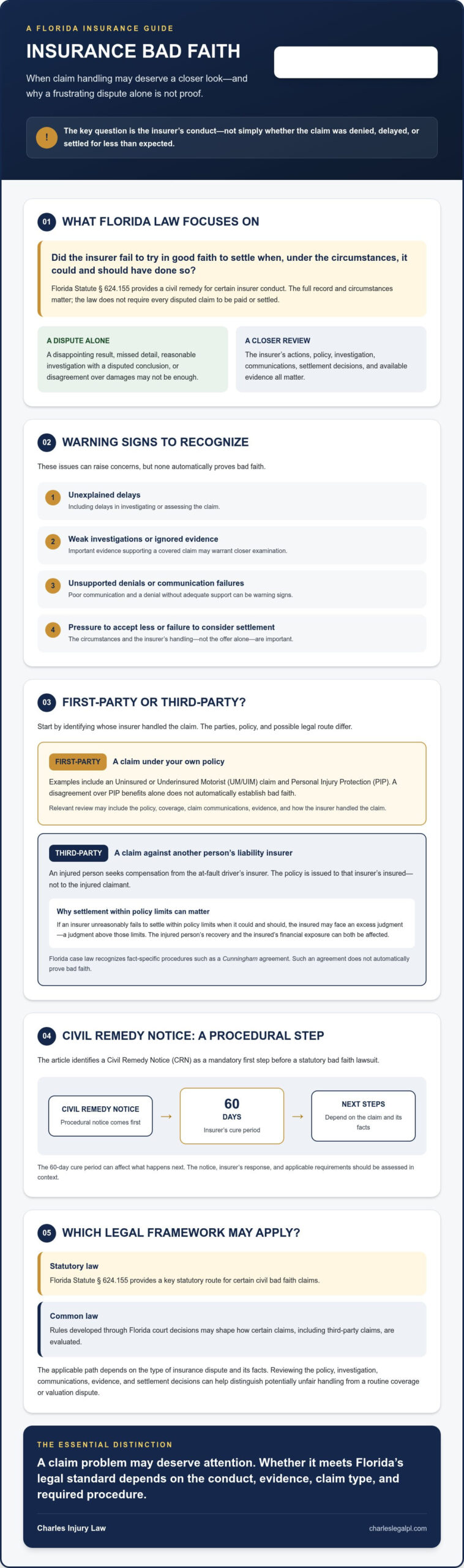
Insurers must handle claims in good faith, but a disappointing outcome alone doesn’t establish bad faith. Florida law considers the insurer’s conduct and the circumstances surrounding the claim. A missed detail, a reasonable investigation that reaches a disputed conclusion, or a disagreement over the value of damages may not be enough. The question is whether the insurer failed to meet its legal obligations.
The implied covenant of good faith and fair dealing describes the expectation that parties will act honestly and not undermine the benefits of their agreement. In insurance disputes, the principle helps explain why an insurer must fairly assess a claim rather than put its own interests ahead of its obligations.
The Statutory Basis: Florida Statute § 624.155
Florida Statute § 624.155 provides a civil remedy for certain insurer conduct, including failing to attempt in good faith to settle a claim when, under the circumstances, the insurer could and should have done so. The law sets a legal standard. It doesn’t guarantee that every disputed claim must be paid or settled.
In practical terms, an insurer’s fiduciary-like duty means it must evaluate and handle a claim honestly and fairly, while recognizing that this description doesn’t automatically make an insurer a fiduciary in every legal sense.
For example, if an insurer ignores important evidence supporting a covered claim or refuses to consider a reasonable settlement opportunity, its handling may warrant closer legal review. The full record matters, including the policy, investigation, communications, and settlement decisions.
Common Law vs. Statutory Bad Faith in Florida
Common law refers to legal rules developed through Florida court decisions. Statutory law is enacted by the Legislature. Florida Statute § 624.155 is a key statutory route for pursuing a civil bad faith claim, while Florida case law may also shape how certain claims, including third-party claims, are evaluated. The applicable path depends on the type of insurance dispute and its facts.
A personal injury firm in Florida can assess which legal framework may apply, what evidence supports the claim, and whether required procedural steps have been met. That review can help distinguish potentially unfair claim handling from a routine coverage or valuation dispute. Charles Injury Law fights for the injured and stands up to insurance companies.
Call Now: (954) 390-2228 Available 24 Hours a Day, 7 Days a Week
First-Party vs. Third-Party Bad Faith Claims in Florida
Start by identifying whose insurer handled the claim. A first-party dispute involves your own insurance company. A third-party dispute involves another person’s insurer, usually after that person caused an accident. The distinction matters because the policy, the parties’ relationship, and the legal route for challenging claim handling differ.
First-Party Claims: When Your Own Insurer Fails You
A first-party claim arises when you seek benefits under your own policy. After a crash, that might include an Uninsured or Underinsured Motorist (UM/UIM) claim if the at-fault driver lacks adequate coverage. Personal Injury Protection (PIP) is also a type of first-party coverage, although a disagreement over PIP benefits alone doesn’t automatically establish bad faith.
Your insurer must assess a covered claim fairly under the policy and applicable Florida law. If it disregards relevant evidence, unreasonably delays its investigation, or refuses to consider a reasonable resolution, the handling may deserve closer review. Policy language and the claim record are critical. An attorney can review the coverage, communications, and evidence to assess whether the dispute concerns benefits, claim handling, or both.
Third-Party Claims: Protecting the At-Fault Driver and the Victim
In a third-party claim, an injured person seeks compensation from the at-fault driver’s liability insurer. The insurer’s policy is issued to its insured, not to the injured claimant. If the insurer unreasonably fails to settle a claim within policy limits when it could and should do so, the insured may face an excess judgment, meaning a judgment above those limits. The injured person’s recovery and the insured’s financial exposure can both be affected.
Florida case law recognizes procedures such as a Cunningham agreement, which may help resolve issues between an injured claimant and an insured while the insurer’s obligations remain disputed. These agreements are fact-specific and don’t automatically prove bad faith. A lawyer should assess the proposed terms and their consequences before anyone agrees.
For an accident-related claim, the facts surrounding fault and damages matter alongside the insurer’s settlement conduct. Learn more about car accident claims and how liability issues can shape a dispute.
What constitutes a bad faith insurance claim in Florida depends in part on whether you’re dealing with your own insurer or the at-fault party’s insurer. Charles Injury Law can review the claim path, policy, and handling record to help identify potential next steps.
Tactical Red Flags: What Constitutes Bad Faith in Florida?
A slow response or low offer can be frustrating, but neither proves bad faith by itself. Concern grows when the insurer’s conduct suggests it isn’t making a fair, informed effort to evaluate and resolve the claim. When considering what constitutes a bad faith insurance claim in Florida, look for patterns and evidence, not just an unsatisfying outcome.
- Unexplained delays: The insurer doesn’t acknowledge claim communications or provide meaningful updates despite reasonable follow-up.
- Weak investigation: The insurer denies the claim without addressing relevant records, photographs, witness accounts, or other available evidence.
- Unclear denial: The insurer doesn’t explain how the policy language and facts support its decision.
- Unsupported low offer: The insurer proposes a settlement that appears disconnected from documented losses and doesn’t explain its valuation.
Unreasonable Delays and Communication Failures
Florida law doesn’t establish one universal response timeline for every type of insurance claim. Applicable deadlines and what counts as reasonable can depend on the claim, policy, and circumstances. Repeatedly unanswered messages or prolonged silence after requested documents are submitted may be warning signs, but a delay alone doesn’t establish bad faith. An adjuster’s silence may leave you feeling pressured to give up, though it doesn’t prove that wearing you down was the insurer’s intent.
Keep a clear record. Save emails and letters, note the dates and substance of phone calls, identify who you spoke with, and track which documents you sent and when. This timeline can help a lawyer assess whether the insurer responded appropriately or left important evidence unaddressed.
Misrepresenting Policy Provisions or Facts
In West Palm Beach or Miami, as elsewhere in Florida, the location doesn’t change the need to assess the specific policy, investigation, and claim record. A “take it or leave it” offer can warrant careful review, especially if the insurer gives no clear basis for the amount or pressures you to accept quickly. But a firm deadline or disputed valuation, on its own, doesn’t prove bad faith. Don’t sign a release or accept a settlement before you understand which claims it resolves.
Save the offer, denial, policy, and supporting evidence. If the insurer’s explanations shift or conflict with the records, those inconsistencies may help a lawyer evaluate the claim. Call Now: (954) 390-2228 Available 24 Hours a Day, 7 Days a Week
The Civil Remedy Notice: Your Mandatory First Step in Florida
A Civil Remedy Notice (CRN) is a formal notice filed with the Florida Department of Financial Services. For a statutory bad faith claim under Florida Statute § 624.155, filing a valid CRN is generally a required step before bringing suit. It gives the insurer notice of the alleged violations and an opportunity to address them. A CRN isn’t simply a complaint letter, and filing one doesn’t automatically prove bad faith.
The notice must use the required form and provide specific information, including the policy and claim details, the statutory provisions allegedly violated, the facts supporting the allegations, and relevant individuals involved. It should explain what the insurer allegedly did or failed to do. Missing or vague information can jeopardize the process, so confirm current filing requirements with the Florida Department of Financial Services and seek legal guidance before submitting a notice.
The 60-Day Cure Period Explained
After a CRN is filed, the insurer generally has 60 days to cure the alleged violation. A cure means the insurer takes the action required to resolve the issue identified in the notice. This is the insurer’s statutory opportunity to correct the alleged violation and avoid a bad faith lawsuit. If the insurer resolves the issue within the cure period, a statutory bad faith lawsuit is barred under the rule described in Florida law. The notice creates a defined window for response, but it doesn’t guarantee payment or settlement.
There are important distinctions. For example, Florida Statute § 624.1551 sets an additional prerequisite for a first-party property insurance bad faith lawsuit: the insured must first prove a breach of contract in court and obtain a final judgment against the insurer. A CRN doesn’t replace that requirement. The right sequence depends on the kind of claim and the governing law.
Strategic Filing of the CRN
Timing matters. Filing too early, before the claim record supports specific allegations, may weaken the notice. Waiting without assessing deadlines can create different risks. A lawyer can review the policy, evidence, insurer communications, and claim status to determine whether a statutory bad faith claim may be ready for a CRN and what the notice should address.
Charles Injury Law can assess the insurer’s conduct and use a properly prepared CRN as part of a broader strategy to press for accountability. For more information about challenging a denial, read this denied insurance claim lawyer guide. If you’re considering a CRN, contact Charles Injury Law to discuss your claim.
Call Now: (954) 390-2228 Available 24 Hours a Day, 7 Days a Week
Why You Need a Personal Injury Firm in Florida to Fight Bad Faith
An insurer has claims professionals and legal resources on its side. You shouldn’t have to challenge its decisions alone while also managing an injury claim. Charles Injury Law represents people confronting denied claims and insurance disputes in Florida, with direct communication and trial-ready advocacy. If negotiations don’t resolve a supported claim, the firm can prepare to litigate.
Aggressive Advocacy Against Insurance Tactics
“Delay, deny, defend” may describe a claimant’s experience, but the phrase isn’t proof of bad faith. A lawyer can examine the insurer’s investigation, communications, policy interpretation, and settlement decisions, then challenge unsupported positions with evidence. If a crash happened in Miami or Orlando, preserve available photos, messages, medical records, repair documents, and witness details. A clear record can help assess the dispute and protect important evidence.
When choosing representation, focus on finding a firm that understands both the injury and the insurer’s conduct. Charles Injury Law is available 24 hours a day, 7 days a week.
Understanding Recovery and Fees
Bad faith damages aren’t automatic, and punitive damages aren’t guaranteed. Potential recovery depends on the legal claim, proof of harm, and applicable Florida law. Keep the bad faith dispute distinct from damages in the underlying personal injury case. Medical records and wage documentation may support claimed injury losses, including future medical needs or lost income, but those items aren’t automatically damages in a separate bad faith action.
Charles Injury Law works on a contingency-fee basis. The attorney’s fee depends on recovery under the terms of the representation agreement. Ask how case costs are handled. Before accepting a settlement or signing a release, understand which claims and losses it covers. That decision may affect your options.
If you’re trying to determine what constitutes a bad faith insurance claim in Florida, a review of the policy, claim history, and supporting evidence can help clarify whether the insurer’s conduct may support legal action. Charles Injury Law fights for the injured and stands up to insurance companies.
Call Now: (954) 390-2228 Available 24 Hours a Day, 7 Days a Week
Take the Next Step Toward Holding the Insurer Accountable
Knowing what constitutes a bad faith insurance claim in Florida can help you distinguish a frustrating claim dispute from conduct that may violate Florida law. The insurer’s actions, the evidence, and whether the claim is first-party or third-party all matter. For statutory claims, the Civil Remedy Notice and its cure period can also shape your next steps.
Don’t assume that silence, a denial, or a low offer proves bad faith. Preserve your policy, claim letters, messages, and supporting records. Then have the handling reviewed before deciding how to proceed.
The firm has recovered millions of dollars, prepares cases for trial, and is available 24/7 to people throughout Florida, including Fort Lauderdale, Miami, West Palm Beach, Boca Raton, Delray Beach, Boynton Beach, Lake Worth, Orlando, and Tampa. If you’re concerned about how an insurer handled your claim, contact Charles Injury Law to discuss your situation.
Call Now: (954) 390-2228 Available 24 Hours a Day, 7 Days a Week. You don’t have to face the insurer alone. A review of your claim can help you understand your options and decide how to move forward.
Frequently Asked Questions
What is the statute of limitations for a bad faith claim in Florida?
Florida statutory bad faith claims generally carry a five-year limitations period, but the deadline depends on the claim type and when the claim accrued. The Civil Remedy Notice process and other prerequisites can affect timing, so don’t assume you have five years to act. For first-party property claims, Florida law also requires the insured to prove breach of contract and obtain a final judgment against the insurer before filing suit. Prompt legal review can clarify your deadline.
Can I file a bad faith claim if my insurance company paid the claim but took too long?
Possibly, but late payment alone doesn’t establish bad faith. Key issues include whether the insurer’s delay was unreasonable under the circumstances, whether it failed to act in good faith, and whether the applicable legal prerequisites were met. Keep records of when you submitted information, followed up, and received payment. The policy and claim history matter. An attorney can assess whether the delay may support a claim or reflects a dispute that was eventually resolved.
Do I need a personal injury lawyer near me to file a Civil Remedy Notice in Florida?
No. Florida law doesn’t generally require you to hire a lawyer to submit a CRN, but the notice must meet Florida Department of Financial Services filing requirements. It should identify the policy and claim, specific provisions allegedly violated, supporting facts, and relevant individuals. An inaccurate or vague filing can jeopardize the process. Charles Injury Law represents clients in Fort Lauderdale, Miami, West Palm Beach, Boca Raton, Delray Beach, Boynton Beach, Lake Worth, Orlando, and Tampa.
What kind of damages can I recover in a Florida bad faith insurance lawsuit?
A successful bad faith lawsuit may allow recovery for damages caused by the insurer’s conduct, subject to applicable Florida law and evidence. In some cases, punitive damages may be available, but they aren’t automatic and require additional legal support. Recoverable damages depend on the type of claim and proven harm. Don’t assume every loss from an accident belongs in a separate bad faith case. The underlying injury claim and insurance dispute may involve different damages.
Is a low settlement offer considered bad faith under Florida law?
Not by itself. An insurer may dispute the value of a claim, and a low offer alone doesn’t prove bad faith. The offer may raise concern if the insurer ignored important evidence, failed to explain its valuation, or rejected a reasonable opportunity to settle when it could and should have done so. Preserve the offer and the insurer’s explanation. The policy, claim records, and full settlement history help determine whether the conduct may violate Florida law.
How long does a bad faith insurance case typically take to resolve in Florida?
There’s no reliable single timeline for every Florida bad faith case. The time depends on the claim type, evidence, required steps such as a Civil Remedy Notice, and whether the insurer resolves the dispute or litigation follows. A CRN generally gives the insurer a 60-day cure period, but that isn’t a prediction of how long the entire case will take. A lawyer can review the circumstances and explain the procedural steps that may apply.
What happens if my insurance company “cures” the bad faith within 60 days?
If the insurer cures the alleged violation within the 60-day period after the CRN is filed, a statutory bad faith lawsuit is generally barred under Florida law. A cure means the insurer takes the action needed to address the violation identified in the notice. Whether its response qualifies depends on the allegations and circumstances. Keep the insurer’s response and related records, and have them reviewed before concluding that the dispute is over.
Can I sue for bad faith if I was partially at fault for the accident in Florida?
Partial fault doesn’t automatically prevent a bad faith claim, but it may affect the underlying injury case and the insurer’s evaluation. Under Florida’s modified comparative negligence rule, a person found more than 50% at fault generally can’t recover damages for their own injuries. Florida law also allows a claimant’s conduct to be considered in evaluating insurer bad faith. The evidence about fault, the insurer’s handling, and the type of claim all matter.
Disclaimer
The information provided on this blog is for general informational purposes only and does not constitute legal advice. Viewing this content does not create an attorney-client relationship with the firm. You should not act or rely on any information contained herein without seeking legal advice from a qualified attorney regarding your individual situation.