



A personal injury deposition is not a casual conversation; it is a strategic battlefield where insurance defense lawyers hope you’ll make a mistake. If you walk into that room without a plan, you risk your entire financial recovery. It’s natural to feel anxious about being under oath or confused by complex legal terminology. You want to ensure your testimony supports a maximum settlement, but the fear of trick questions is real. We understand that pressure. You deserve to know exactly what happens during a personal injury deposition in Florida so you can face the opposition with total confidence.
Charles Injury Law acts as your protective champion throughout this high-stakes process. We provide the aggressive advocacy needed to shut down defense tactics while offering the reassuring expertise you need to stay calm. This article previews the specific stages of a Florida deposition, from the initial oath to the final cross-examination. You’ll learn the essential “rules of the game” for cases in Fort Lauderdale, Miami, Palm Beach, and Boca Raton. If you follow our proven strategies, then you can protect your right to the superlative outcome your family needs. Let’s prepare you to win.
Key Takeaways
- Understand why your sworn statement is a critical part of the Florida discovery process. This testimony carries the same legal weight as speaking in front of a judge.
- Identify the roles of the court reporter and videographer. Knowing exactly who is in the room helps you stay focused on your recovery mission.
- Discover what happens during a personal injury deposition to prepare for specific questions about your life before and after the accident.
- Learn the essential rules for giving testimony, including why you should never guess or rush your answers. Silence is often your strongest tool.
- See how Charles Injury Law prepares you through rigorous mock sessions. We act as your shield against aggressive defense lawyers in Fort Lauderdale.
Understanding the Personal Injury Deposition: Your Statement Under Oath
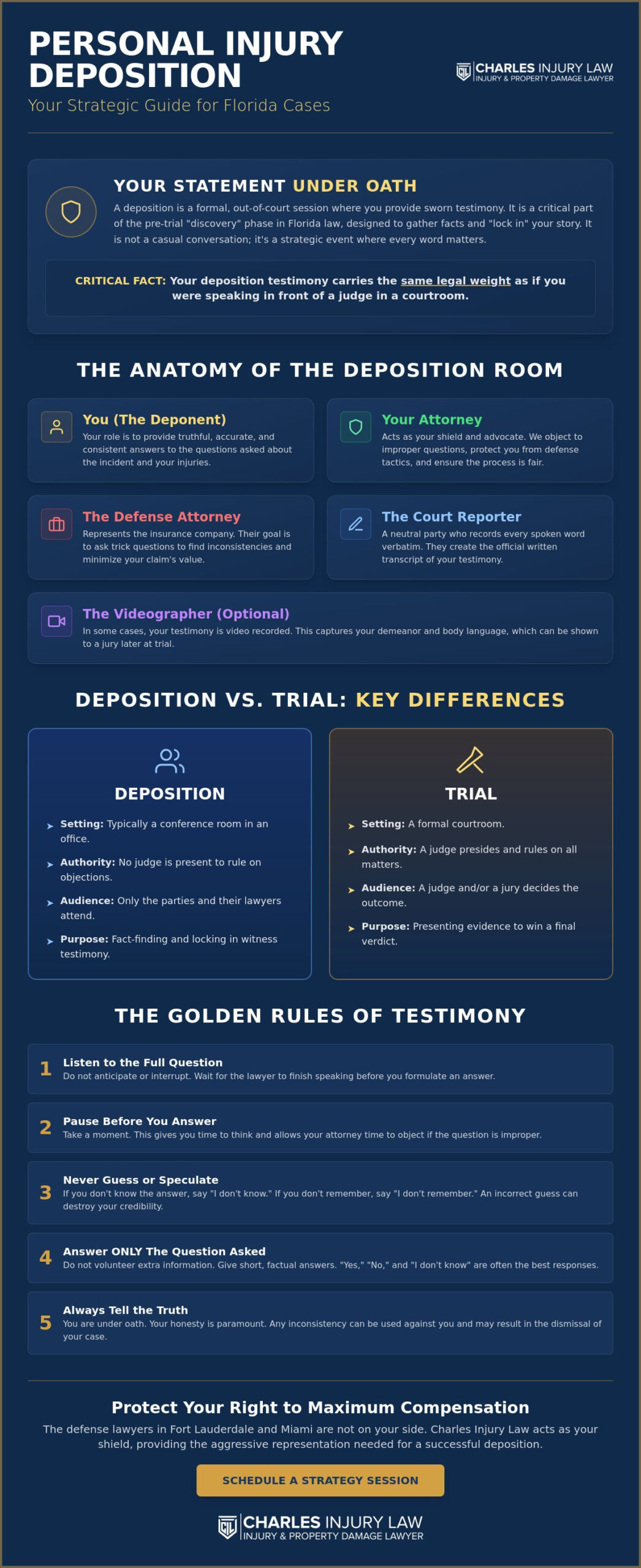
A deposition is a formal, out-of-court session where you provide testimony under oath. In the Florida legal system, it is a critical component of the discovery process. If you are pursuing a personal injury claim, then you must treat this session with the same gravity as a trial. Insurance companies in Miami and Fort Lauderdale do not view this as a friendly chat. They view it as an opportunity to “lock in” your story. If your testimony at trial differs from your deposition, the defense will use the transcript to destroy your credibility. Understanding what happens during a personal injury deposition is your first line of defense against these tactics.
The “under oath” status is the most serious aspect of the day. A court reporter will ask you to raise your right hand and swear to tell the truth. From that moment on, your words carry the weight of law. This procedure is standard for a Deposition in United States law; it ensures that all parties have a recorded, truthful account of the facts. If you provide inaccurate information, it can lead to the dismissal of your case or even legal penalties. Your testimony directly impacts the settlement value of your claim. A strong, consistent performance forces the insurance company to take your demands seriously.
The Purpose of Discovery in Florida Law
Florida litigation follows a “no surprises” rule. This means both sides are entitled to know the evidence and testimony the other side possesses. Lawyers in Fort Lauderdale use depositions to narrow the issues and identify which facts are truly in dispute. Discovery is the fact-finding phase that precedes a potential trial. By uncovering the details of the accident and your injuries early, Charles Injury Law can build a stronger case for maximum compensation. If the facts are clear and undeniable, then the insurance company is more likely to settle before a trial begins.
Deposition vs. Trial: Key Differences You Must Know
The most striking difference between a deposition and a trial is the setting. You will likely sit in a conference room rather than a courtroom. There is no judge present to rule on objections or maintain order. Instead, attorneys from both sides ask questions while a court reporter creates a permanent, written transcript of everything said. Although the atmosphere may feel less formal, the stakes are identical. Charles Injury Law uses these transcripts to prevent defense flip-flopping. If a witness or a defense representative tries to change their story later, we use their sworn words to hold them accountable. This ensures the truth remains the focus of your mission for financial restitution.
The Anatomy of the Deposition Room: Who Attends and Why
Your team includes your advocate from Charles Injury Law. We sit beside you as your shield. Across the table, you will find the defense counsel. Their singular goal is to minimize the insurance company’s payout. Between you sits the court reporter. They record your sworn out-of-court testimony word for word. In high-stakes cases, a videographer may also be present. They capture your facial expressions and body language, which can be played back to a jury later. If you feel overwhelmed by the environment, then contact our team for a strategy session to regain your footing.
The Role of the Court Reporter and the Transcript
The court reporter is the most important person for the official record. They use a stenotype machine to capture every syllable. If you say “um,” “ah,” or “uh-huh,” it goes into the permanent transcript. You must provide clear, verbal answers. Nodding your head or gesturing does not work for the written record. This transcript becomes a legal document used to verify your story. If your trial testimony conflicts with this record, the defense will use it as a weapon to damage your credibility and your case.
Virtual Depositions: Navigating Zoom Proceedings in 2026
In 2026, many Florida depositions occur via Zoom or other remote platforms. Florida Rule of Civil Procedure 1.330 governs these proceedings, ensuring they hold the same weight as in-person sessions. You must maintain “digital credibility” by choosing a quiet, professional background and ensuring a stable connection. Technical glitches can happen, but your focus must remain on the questions. We represent many clients who have suffered Injuries suffered from Car Accidents through these virtual formats. If your deposition is remote, we ensure the technology works for you, not against you. Charles Injury Law handles the logistics so you can focus entirely on your testimony.
Common Question Categories: What Defense Attorneys in Miami and Fort Lauderdale Ask
Defense lawyers follow a calculated playbook designed to trip you up. They often start with basic background questions to lower your guard. If you understand what happens during a personal injury deposition, then you know these “easy” questions are actually data-mining missions. They ask about your residence, employment history, and past legal involvements to find any thread they can pull to unravel your credibility. They want to see if you are a “professional plaintiff” or if you have a history of being unreliable under oath.
The mechanics of the accident are the next focus. Expect aggressive questioning regarding speed, distance, and visibility. If you were involved in a collision, the defense will ask exactly where you were looking the split second before impact. They want you to commit to specific numbers that they can later challenge with expert accident reconstructionists. Because this is sworn out-of-court testimony, you must be careful not to guess. If you don’t know an exact distance, it’s better to say so than to provide a false measurement that destroys your case later.
The Trap of Pre-Existing Conditions
Defense lawyers in Fort Lauderdale frequently dig into your medical history from the last ten years. They are hunting for any previous injury that they can blame for your current pain. This tactic is a staple in Premise Liability Claims where back or neck issues are common. You must disclose prior injuries, but you don’t need to volunteer extra information. Charles Injury Law helps you frame these answers so the defense cannot unfairly devalue your current suffering by tying it to a resolved issue from years ago.
Describing the Impact on Your Life
When you describe your current limitations, avoid absolute terms like “always” or “never.” If you claim you can “never” walk your dog, but an insurance investigator films you doing it once, your entire claim is at risk. Instead, use specific, descriptive examples of your daily struggles. Florida law allows for the recovery of non-economic damages such as pain, suffering, and loss of enjoyment of life, which means your ability to articulate the specific changes in your daily routine is a major factor in determining your final compensation. We ensure you’re prepared to speak clearly about how your life has changed since the accident.
Strategic Rules for Giving Testimony: Protecting Your Claim
A deposition is a tactical exercise. If you treat it like a friendly chat, you’ve already lost. Your goal is to provide accurate information without giving the defense any extra ammunition. Knowing what happens during a personal injury deposition means understanding that the defense is looking for inconsistencies. You must follow a specific set of rules to protect your case and your future financial recovery. These rules aren’t just suggestions; they are the foundation of a successful testimony.
- Listen to the entire question: Don’t anticipate the end of a sentence. Wait until the lawyer finishes speaking before you even think about your response.
- Never guess: If you aren’t 100% sure of a fact, “I don’t know” or “I don’t recall” is a powerful and legally sound answer. Guessing creates traps that you can’t escape later.
- Keep it short: Stick to “Yes,” “No,” or “I don’t recall” whenever possible. The more you talk, the more opportunities the defense has to twist your words.
- Wait for the objection: If your attorney starts speaking, stop immediately. Your lawyer is your shield; let them do their job before you say another word.
- Control your emotions: Anger is a gift to the defense. If they can make you lose your cool, they can make you look unreliable or combative to a jury.
Your testimony is the most critical evidence in your case. If you provide clear, concise, and honest answers, then the insurance company has fewer ways to devalue your claim. We prepare every client to handle the pressure of these high-stakes sessions in Miami and Fort Lauderdale. If you want a team that acts as a formidable shield, then schedule your deposition preparation today.
Handling Objections from Your Attorney
During the proceedings, you will hear your lawyer say things like “Objection: Form.” This is a signal that the question is flawed, vague, or misleading. In many Florida depositions, you may still have to answer after the objection is noted for the record. However, if Charles Injury Law instructs you not to answer, you must remain silent. We intervene the moment questioning becomes abusive or crosses legal boundaries. Our presence ensures that the defense plays by the rules and respects your rights throughout the entire process.
The Danger of Volunteering Information
Victims often feel the need to explain themselves or fill uncomfortable silences. This is a massive mistake. In Florida depositions, the “Less is More” philosophy is your best friend. The defense attorney will often wait after you finish speaking, hoping you’ll keep talking to fill the void. Don’t fall for it. Answer the question and then stop. This rule is especially critical in high-stakes litigation, such as Wrongful Death Cases, where every detail is scrutinized for liability. If you provide a concise answer, you limit the defense’s ability to build a counter-narrative against you.
Why Aggressive Representation is Mandatory for a Successful Deposition
Walking into a deposition alone is a recipe for disaster. Insurance companies hire high-priced defense firms to find ways to deny your claim. They want to see if you will crack under pressure. If you don’t have a seasoned advocate by your side, then you are at their mercy. Charles Injury Law acts as your formidable shield. We don’t just attend the session; we control the environment. Our team ensures that what happens during a personal injury deposition works in your favor, not the insurance company’s pocketbook.
Preparation is the difference between a low-ball offer and a superlative settlement. We conduct rigorous mock depositions with our clients. We simulate the aggressive questioning styles used by defense lawyers in Miami and Fort Lauderdale. This process removes the fear of the unknown. If you know the questions before they are asked, then you can provide confident, accurate testimony. We neutralize the opposition by making sure you are the most prepared person in the room. This preparation ensures the official record accurately reflects the true severity of your injuries and the impact on your life.
The Charles Injury Law Advantage
Our commitment to trial-ready representation sets us apart in South Florida. We never let our clients walk into a deposition unprepared or intimidated. We take a confrontational spirit toward the defense while providing a sense of deep security for you. Our goal is to protect your right to maximum financial restitution at every stage of the Personal Injury Overview process. We handle the conflict so you can focus on your recovery. If the defense sees that we are ready for trial, they are much more likely to offer a fair settlement.
Securing Your Future After the Deposition
The mission doesn’t end when the court reporter stops typing. After the session, we meticulously review the transcript for any errors or opportunities. We use your strong testimony as a hammer in settlement negotiations. A successful deposition victory often forces insurance companies to pay what you deserve rather than risking a trial in front of a Florida jury. We turn your words into leverage for your future. If you are ready to secure the compensation you need, then contact Charles Injury Law for a consultation. We are ready to fight for you in Fort Lauderdale, Miami, Palm Beach, and Boca Raton.
Take Control of Your Legal Mission Today
Don’t let the insurance company’s defense team dictate the terms of your recovery. You now understand exactly what happens during a personal injury deposition and why your silence is often your greatest weapon. By following the rules of brevity and waiting for our objections, you neutralize their aggressive tactics. We provide trial-ready representation focused on maximum compensation. Our expertise in Florida insurance litigation ensures you are never a target, but a force to be reckoned with. We provide personalized preparation for every client in Miami, in Fort Lauderdale, in Palm Beach, and in Boca Raton.
If you want a protective champion to shield you from defense traps, then you need our team by your side. Your path to financial restitution starts with confidence and ends with accountability. We handle the conflict while you focus on your health. You deserve a superlative outcome for your family. We are ready to stand as your shield. Secure Aggressive Advocacy for Your Injury Claim
Frequently Asked Questions
Can I change my answers after the deposition is over?
You can technically change your answers through an errata sheet within 30 days of receiving the transcript. However, this is a risky move. The defense will use any significant changes to attack your credibility at trial. If you change a “yes” to a “no,” the insurance company will highlight the contradiction to the jury. It’s much safer to provide accurate testimony the first time under our guidance.
How long does a typical personal injury deposition last in Florida?
Most depositions last between two and six hours. Florida Rule of Civil Procedure 1.310 does not set a strict time limit for all cases, but the court can intervene if the questioning becomes unreasonable. Complex cases in Miami involving multiple parties often take longer. We fight to keep the process efficient and protect you from unnecessary, grueling sessions that serve no legal purpose.
What should I wear to my personal injury deposition in Fort Lauderdale?
You should wear clean, professional business casual attire to your deposition in Fort Lauderdale. You want to project a reliable and serious image to the defense attorney and the videographer. Avoid flashy jewelry or overly casual clothing like t-shirts or flip-flops. If the jury later watches a video of your testimony, your appearance should command respect and support your mission for financial restitution.
Can the other side use my deposition against me at trial?
Yes, the defense will use your transcript to impeach your testimony if your story changes at trial. Under Florida Rule of Civil Procedure 1.330, your testimony can be read to the jury to show a contradiction. This is why understanding what happens during a personal injury deposition is vital. If you remain consistent and honest, then the defense loses this powerful weapon against your claim.
Is my spouse or family allowed to sit in the room during my deposition?
Your family members are generally not allowed to sit in the room during your testimony. If they are potential witnesses in the case, the rule of witness sequestration usually excludes them to prevent their testimony from being influenced. Even if they aren’t witnesses, defense lawyers in Boca Raton often object to their presence to maintain a formal environment. Charles Injury Law remains by your side as your sole legal shield.
What happens if I truly don’t remember a detail about the accident?
If you truly don’t remember a detail, you must state “I don’t recall” or “I don’t know.” You are under oath to tell the truth, and “I don’t know” is a truthful answer. Never guess about speeds or distances. If you guess and are proven wrong by evidence, your credibility is destroyed. Charles Injury Law ensures you feel confident in being honest about the limits of your memory.
Will there be a judge present to settle disputes during the questioning?
There is no judge present during a deposition in Florida. The court reporter records the testimony, and your attorney makes objections for the record. If a serious dispute arises that we cannot resolve, then we may have to pause the proceedings to seek a ruling from a judge later. This is why having an aggressive advocate from Charles Injury Law is mandatory to prevent defense overreach and abuse.
Can I take a break if I feel overwhelmed or in pain?
You have the right to request a break at any time. If you are in physical pain or feel overwhelmed by what happens during a personal injury deposition, then you should ask for a rest. You must finish answering any pending question before the break starts. We monitor your well-being throughout the session to ensure the defense does not push you beyond your physical or mental limits.
Disclaimer
The information provided on this blog is for general informational purposes only and does not constitute legal advice. Viewing this content does not create an attorney-client relationship with the firm. You should not act or rely on any information contained herein without seeking legal advice from a qualified attorney regarding your individual situation.