



The insurance adjuster calling you after a crash in Miami isn’t checking on your health. They are a professional negotiator hunting for an excuse to slash your payout. Knowing what not to say to a car insurance adjuster is the only way to prevent your words from being used against you. It’s exhausting to fight for your recovery while an insurance company treats your injury like a line item on a spreadsheet.
You deserve a formidable shield. At Charles Injury Law, we see how easily honest people are exploited by “friendly” questions. We’ll teach you the specific phrases that destroy injury claims and how to protect your right to maximum compensation in Florida. Your financial future depends on a strategic, limited communication plan that accounts for 2026 insurance market shifts.
This guide provides a clear list of forbidden phrases and explains why silence is often your best strategy. We’ll walk through Florida’s no-fault PIP rules and the mandatory 14-day medical treatment window. You will gain the confidence to handle the first phone call and ensure the insurance company’s profit margin doesn’t come at your expense.
Key Takeaways
- Recognize that a sympathetic adjuster is a professional negotiator using rapport to identify red flags and devalue your claim.
- Master the specific list of forbidden phrases and learn what not to say to a car insurance adjuster to avoid accidental admissions of fault.
- Protect your right to maximum compensation by avoiding the “I’m fine” trap before you have received a full medical evaluation in Florida.
- Learn a two-step verification strategy to handle calls in Fort Lauderdale while providing only the bare minimum of required information.
- Understand how trial-ready representation from Charles Injury Law serves as a formidable shield against the profit motives of insurance companies.
The Trap: Why Insurance Adjusters in Florida Are Not Your Friends
The person on the other end of the phone sounds concerned. They ask how you’re feeling. They might even offer a quick check to cover your immediate costs. This is a performance. An insurance claims adjuster is a highly trained professional whose primary job is to protect the company’s bottom line. In Florida, where insurance litigation remains at record highs in 2026, these adjusters are under intense pressure to minimize payouts. Knowing what not to say to a car insurance adjuster is your first line of defense against their tactics.
Insurance companies in Florida train their staff to identify “red flag” statements that can be used to deny or devalue a claim. They use a sympathetic tone as a professional tool to lower your guard. If they can get you to speak casually, you are more likely to make an admission that hurts your case. Their goal during that first call isn’t to help you recover; it’s to gather evidence that reduces their liability. They are looking for any reason to pay you less than you deserve.
In Florida, your Personal Injury Protection (PIP) coverage is supposed to be “no-fault.” However, your own insurer can still become an adversary. They might challenge the necessity of your medical treatment or question if you met the 14-day rule for initial care. They hunt for statements that allow them to cap your benefits at $2,500 instead of the full $10,000. Understanding what not to say to a car insurance adjuster applies to your own company just as much as the at-fault party’s insurer.
The Role of the Adjuster in Miami and Fort Lauderdale
Florida follows comparative negligence rules. If an adjuster can trick you into admitting even a small percentage of fault, they can slash your settlement proportionally. Local adjusters in Miami and Fort Lauderdale are specifically looking for admissions to close files quickly. They compare your verbal statements against the police report to find any inconsistency they can exploit. They are professional negotiators, and you should treat every interaction with that reality in mind.
The Danger of Voluntary Information
You have no legal obligation to provide a detailed narrative or a recorded statement immediately after car accidents in Florida. Small talk is a trap. If you mention you were “running a bit late” or “didn’t see the other car until the last second,” they will use those words to build a case against you. Charles Injury Law acts as a formidable shield between you and these tactical inquiries. We handle the conflict so you can focus on your physical recovery. If you are represented by us, we manage all communication to ensure your rights are protected.
The ‘No-Say’ List: 5 Critical Phrases That Kill Claims in Florida
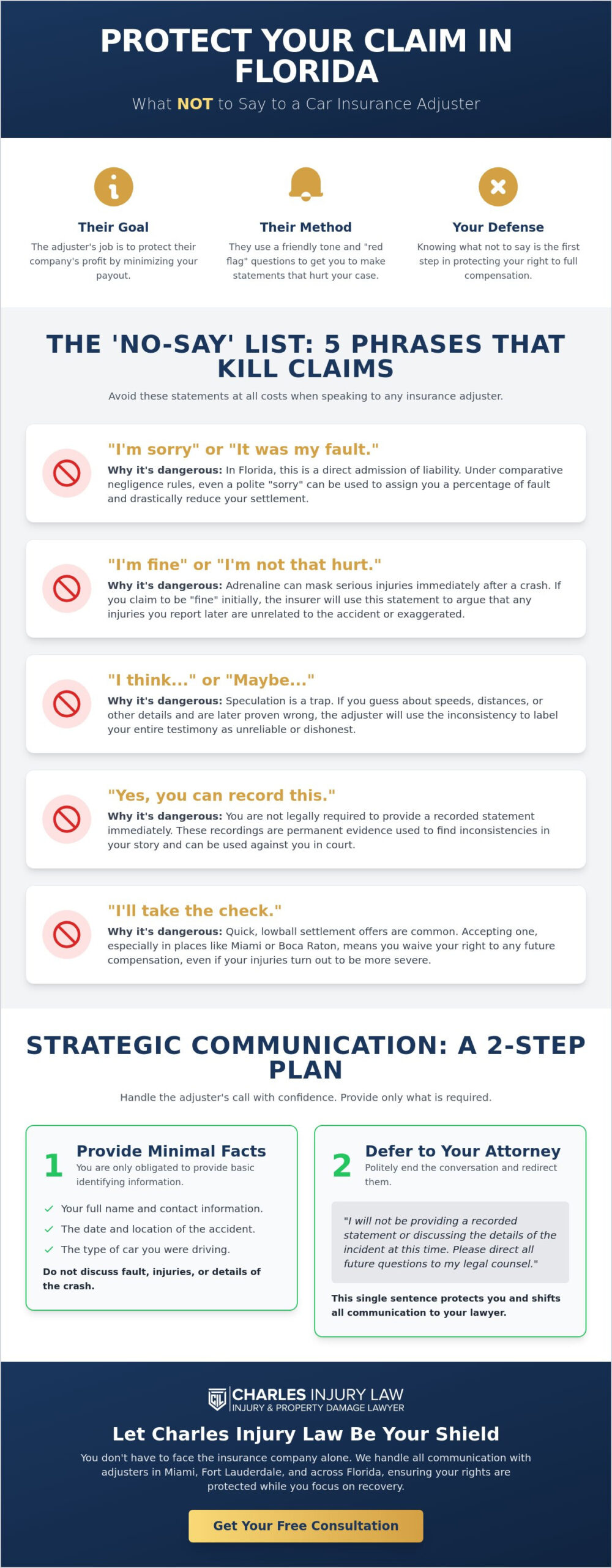
Words are weapons in the hands of a profit-driven insurance company. In 2026, Florida insurers are more aggressive than ever in their attempts to devalue personal injury claims. A single slip of the tongue can cost you thousands of dollars. You must memorize what not to say to a car insurance adjuster before you pick up the phone. These five phrases are the most common tools adjusters use to dismantle your case.
- “I’m sorry” or “It was my fault”: Never apologize. Even a polite “sorry” is legally recorded as an admission of liability.
- “I’m fine” or “I’m not that hurt”: Adrenaline hides pain. If you minimize your injuries on day one, you cannot easily claim they are severe on day ten.
- “I think…” or “Maybe…”: Speculation is a trap. If you guess your speed or the distance of the other car and you are wrong, the adjuster will label you as dishonest.
- “Yes, you can record this”: You are not legally required to provide a recorded statement immediately. These recordings are permanent and used to impeach your testimony later.
- “I’ll take the check”: Quick settlement offers in Boca Raton are designed to make you waive your right to future compensation. Once you cash that check, your claim is dead.
While government resources explain your rights when you file a claim, they rarely highlight how a single sentence can void those protections. If you have already spoken to an adjuster, it is critical to speak with a professional advocate who can mitigate the damage and protect your interests.
Why ‘I’m Sorry’ is a Legal Disaster in Florida
Florida uses a comparative fault system. If an adjuster can use your apology to pin even 10% of the blame on you, your total compensation is slashed by that same 10%. Being polite is not the same as being responsible. Do not discuss your feelings about the crash. Stick to the objective facts of what happened without adding emotional context that an insurer will weaponize against you.
The ‘I’m Fine’ Trap: Hidden Injuries and Delayed Symptoms
Delayed symptoms like whiplash or internal trauma often take days to manifest. Under Florida Statute § 627.736, you only have 14 days to seek medical treatment to qualify for PIP benefits. If you tell an adjuster “I’m okay” before seeing a doctor, you give them a reason to deny your claim later. Additionally, without a determination of an “Emergency Medical Condition,” your PIP medical benefits are capped at $2,500 instead of $10,000. Always secure a medical evaluation before discussing your health with anyone from an insurance company.
Recorded Statements vs. Fact-Based Reporting: The Insurance Trap
The recorded statement is a minefield designed to destroy your credibility. Adjusters use leading questions to force you into a narrative that benefits the insurance company. They might ask, “You didn’t see the other car until the impact, right?” If you agree, they have just “proven” you weren’t paying attention. This is a primary reason why knowing what not to say to a car insurance adjuster is vital for your financial survival. They aren’t looking for the truth. They are looking for a contradiction.
In Fort Lauderdale, adjusters will meticulously compare your recorded words against the official police report. Any minor discrepancy in speed, distance, or timing becomes a “gotcha” moment used to label you as unreliable. These recordings are permanent. If your case moves into litigation years from now, defense attorneys will use these early statements to impeach your testimony. While some general guides explain how to make a car insurance claim, they often fail to warn you that you have the legal right to refuse a recorded statement to the at-fault driver’s insurance company.
Tactics Adjusters Use to Get a Statement
Expect high-pressure lines like, “We just need this to move the claim forward.” This is a lie. The claim can move forward without a recorded statement from you. Adjusters often adopt a friendly, casual persona to make you feel like you’re just “telling your story” to a helpful neighbor. If they ask for a statement, decline firmly. Tell them your legal counsel will provide all necessary facts in writing. This protects you from the stress of a rapid-fire interrogation while you are still in physical pain.
The Better Alternative: Written, Attorney-Reviewed Facts
Written statements are safer because they allow for precision. At Charles Injury Law, we act as a formidable barrier between you and these tactical inquiries. We draft fact-based communications that address the requirements of Florida law without providing the “filler” information adjusters use to slash payouts. If we handle your car accident claim, we ensure every word is calculated for maximum impact. We prepare every case as if it is going to court. This aggressive advocacy prevents insurance defense attorneys from twisting your words. Our goal is a superlative outcome where the facts speak for themselves, not a distorted recording.
Strategic Communication: How to Handle the Call in Boca Raton
The phone will ring sooner than you expect. You might still be in the hospital or recovering at home in Boca Raton when an adjuster calls. This is not a social visit. It is a data collection mission. To protect your claim, you must approach this call with a tactical mindset. Your goal is to provide the bare minimum while redirecting the conversation toward your legal representative. This is the practical application of knowing what not to say to a car insurance adjuster during a live interaction.
Follow these five steps to maintain control of the conversation:
- Step 1: Verify the identity of the caller and the claim number. Ask for their full name, the insurance company they represent, and their direct phone extension.
- Step 2: Provide only basic identifying information. Give your name, address, and phone number. Do not provide your Social Security number or employment details at this stage.
- Step 3: Refuse to discuss injuries, fault, or the mechanics of the crash. Refer back to the “I’m fine” trap discussed earlier. Simply state that the investigation is ongoing.
- Step 4: Politely inform the adjuster that all further communication should go through your attorney. This establishes a professional barrier immediately.
- Step 5: Hang up and document the call details. Write down the date, time, and exactly what was said.
A Simple Script for Victims in Miami
Adjusters in Miami often lead with “How are you feeling today?” It sounds like a polite greeting, but it is a trap. If you say “good” or “better,” they will log it as evidence that you aren’t truly injured. Instead, say: “I am still undergoing medical evaluation and am not prepared to discuss my health.” When they ask you to tell the story in your own words, use the power of the phrase: “I am not prepared to discuss the details of the incident at this time.” This is not being uncooperative. It is being strategic. Stick to this script to avoid accidental admissions.
When to Stop Talking and Start Protecting Your Claim
Red flags appear when an adjuster becomes aggressive or manipulative. If they suggest you don’t need a lawyer or pressure you to sign a medical release form, the conversation must end. A medical release allows them to dig through your entire history to find pre-existing conditions to blame for your current pain. Never sign anything without legal review. The most effective way to stop the pressure is to say: “Please contact my lawyer at Charles Injury Law.” If you feel overwhelmed by these tactical calls, contact our team immediately to take over all communications on your behalf. We act as your shield so you can focus on your physical recovery.
Let Charles Injury Law Be Your Shield Against Insurers
Insurance companies are massive corporations with nearly unlimited resources. Their adjusters are trained to protect corporate profits by devaluing your pain. You need a professional force that is equally formidable. At Charles Injury Law, we provide trial-ready representation for every client. We prepare every case as if it is going to court in Florida. This aggressive stance signals to insurers that we will not accept lowball offers. Knowing what not to say to a car insurance adjuster is only half the battle. The other half is having an advocate who ensures the insurance company hears only the facts that support your recovery.
Our focus is on securing the full value of your medical bills, lost wages, and physical suffering. We understand the specific tactics used by insurers operating in Fort Lauderdale and in Palm Beach. These companies often use 2026 market data to justify reduced payouts. We counter their data with the reality of your injuries and the governing Florida statutes. Our advocacy is risk-free for you. If we don’t win your case, you don’t pay. This contingency fee structure removes the financial burden from your shoulders so you can focus entirely on your health.
Professional Advocacy for Injuries in Florida
The moment you hire us, we become your shield. We handle every phone call, email, and negotiation. You will never have to worry about what not to say to a car insurance adjuster again because they will no longer be allowed to contact you directly. Our team has extensive experience managing complex claims involving car accidents and truck accidents in South Florida. We know how to document the evidence that adjusters try to ignore. This level of professional advocacy prevents insurers from utilizing the “friendly adjuster” myth to exploit your vulnerability.
Take Action Before the Adjuster Calls Again
Early legal intervention is the most critical factor in successful personal injury cases. Evidence can disappear and memories can fade. Most importantly, adjusters will continue to call until they get the statement they want. Do not give them that opportunity. We offer a clear path to legal representation that starts with a free consultation. We will review the facts of your accident and explain how we can protect your right to superlative financial restitution. Protect your claim; contact Charles Injury Law now.
Secure Your Financial Future Today
Your words have value. In the aftermath of a crash in Florida, the insurance company is actively working to devalue your claim. You now understand what not to say to a car insurance adjuster to avoid their most common traps. From refusing recorded statements to avoiding apologies, your silence is a powerful tool. However, strategic silence is only the beginning of a successful recovery.
Charles Injury Law provides the aggressive advocacy you need to face Florida’s largest insurers. We offer trial-ready representation designed to secure maximum compensation for your medical bills and pain. Our contingency fee structure means there are no fees unless we win your case. We act as your formidable shield so you can focus on healing while we handle the conflict.
Stop the adjusters from twisting your words; schedule your free consultation with Charles Injury Law today. You deserve a dedicated ally who fights for the superlative outcome your case requires. We are ready to stand by your side.
Frequently Asked Questions
Do I have to talk to the other driver’s insurance adjuster in Florida?
No. You are under no legal obligation to speak with the at-fault party’s insurance company. While you must cooperate with your own insurer to receive PIP benefits, the other driver’s adjuster is looking for evidence to use against you. Redirect them to your legal counsel immediately to protect your claim. This prevents them from using your own words to deny you the compensation you deserve.
What happens if I already gave a recorded statement to the insurance company?
We can still work to mitigate the damage. If you’ve already shared information, Charles Injury Law will review the recording to identify any twisted context or leading questions. We then build a strategy to clarify those statements through fact-based reporting and medical evidence. Don’t assume your case is over. Instead, seek professional intervention now to ensure your rights remain protected throughout the litigation process.
Is it okay to tell the adjuster I am ‘fine’ if I don’t feel pain yet?
No. Never tell an adjuster you are fine or uninjured. Adrenaline often masks serious trauma like internal bleeding or soft tissue damage that may not appear for several days. If you make this statement, the insurer will use it to deny that your later symptoms were caused by the crash. Simply state that you are still undergoing medical evaluation and have not reached a final diagnosis.
Can an insurance adjuster deny my claim if I refuse to answer some questions?
An adjuster for the other driver cannot deny your claim solely for refusing to give a recorded statement. However, your own insurance company requires cooperation for PIP coverage. If you are unsure what not to say to a car insurance adjuster during these mandatory calls, let your attorney handle the communication. We ensure you fulfill your policy duties without compromising your right to full financial restitution.
Should I sign the medical authorization form the insurance company sent me?
Do not sign any medical release forms without a lawyer’s review. These forms often give the insurance company unlimited access to your entire medical history. They will search for old injuries to claim your current pain is a pre-existing condition. We provide a limited release that only covers treatment directly related to your accident in Miami or Fort Lauderdale. This prevents invasive searches into your private history.
How do I tell an insurance adjuster I have a lawyer at Charles Injury Law?
State clearly that you are represented by counsel and provide our contact information. You can say, “I am represented by Charles Injury Law. Please direct all future inquiries and correspondence to my attorney.” Once you provide this notice, the adjuster is legally prohibited from contacting you directly. This move stops the harassment and protects your words from being twisted by professional negotiators.
What is the most common trick insurance adjusters use in Florida?
The most common trick is the “friendly check” or the immediate lowball settlement offer. Adjusters offer a small sum of money early on to convince you to sign a liability release. If you accept this check, you waive your right to pursue further compensation for future surgeries or lost wages. This is a primary reason why knowing what not to say to a car insurance adjuster is so critical during those first 48 hours.
Will hiring a lawyer make the insurance company angry and hurt my claim?
No. Hiring a lawyer shows the insurance company that you are serious about your recovery. Insurers actually prefer dealing with unrepresented victims because they are easier to manipulate with low offers. When you hire a professional force, the adjuster knows they can’t use standard delay tactics. It levels the playing field and forces them to treat your claim with the accountability and urgency it deserves.
Disclaimer
The information provided on this blog is for general informational purposes only and does not constitute legal advice. Viewing this content does not create an attorney-client relationship with the firm. You should not act or rely on any information contained herein without seeking legal advice from a qualified attorney regarding your individual situation.