

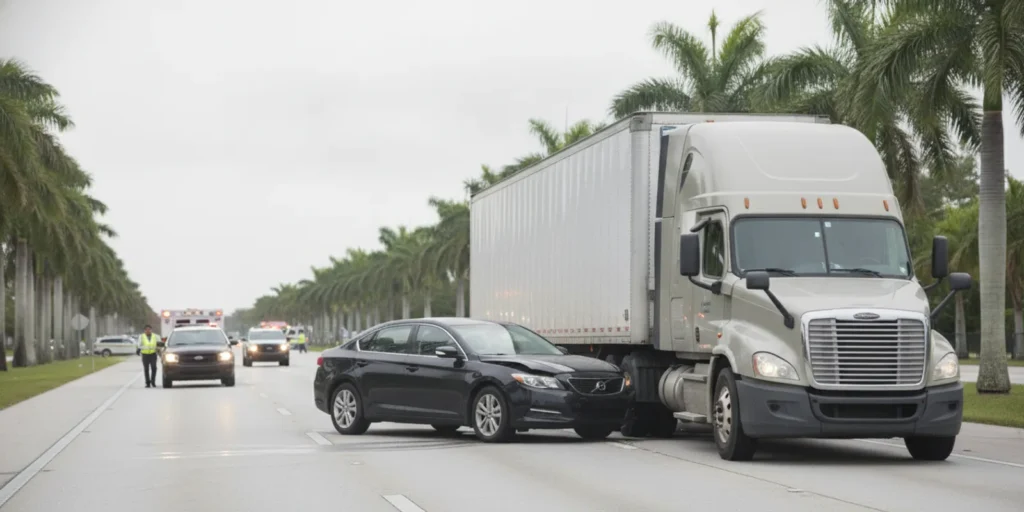
If you are wondering what to do after a truck accident in Florida, begin with safety and medical needs. A collision involving a commercial vehicle can leave people shaken and unsure what to handle first. Work through the steps below only when it is safe. You do not need to investigate the crash from a dangerous location or solve every insurance question at the scene.
What should you do first at the scene?
Check whether you or anyone else appears to need urgent help. If someone is seriously hurt, trapped, in danger, or reporting alarming symptoms, call 911 and follow the dispatcher’s instructions. Do not move an injured person unless an immediate hazard makes moving them necessary. If there is fire, leaking material, traffic exposure, or another danger, move to a safer place if you can do so without putting yourself at risk.
If vehicles can be moved safely and are creating a hazard, follow law enforcement or dispatcher guidance. Do not stand in a traffic lane to inspect damage, take photographs, or exchange information. On a busy road, wait for a safe place and let responders manage the scene. Your immediate safety matters more than collecting evidence, identifying a company, or getting a complete account of what happened.
Try to stay calm and communicate clearly. If you are able, note the time and general location. Avoid arguing about what happened or making guesses about fault. You can provide factual information to responders without trying to decide the legal or insurance consequences at the scene. If you are too shaken, hurt, or confused to answer a question, say so.
Think in terms of priorities rather than a rigid checklist: get away from immediate danger, request help, and follow emergency instructions. The order of later tasks can wait. You may be unable to gather details because of your injuries or because responders need the area clear. That does not mean you did anything wrong; a person’s safety comes before preserving a perfect record.
When should you get medical care?
Seek emergency help for urgent symptoms, including trouble breathing, severe bleeding, loss of consciousness, confusion, intense pain, or a suspected serious injury. A person may feel overwhelmed after a crash and may not be able to assess every injury immediately. If you are uncertain about a symptom, contact a qualified medical professional for guidance rather than relying on an online article.
Even if you do not think you are badly hurt, consider getting an appropriate medical assessment. Some symptoms can become noticeable later, and a clinician can evaluate your condition and explain what follow-up may be appropriate. Do not delay emergency care to take pictures, speak with an insurer, complete a form, or wait for a truck company representative.
Tell the medical provider, as accurately as you can, what happened and what you are experiencing. Mention symptoms even if they seem minor or come and go. For example, explain where discomfort is located, when you first noticed it, whether it has changed, and what makes it better or worse, if you know. Do not minimize a symptom simply because you are focused on other people or because it seemed manageable at the scene.
Follow the provider’s instructions and keep copies of discharge papers, visit summaries, referrals, prescriptions, and appointment information. If your symptoms change or worsen, contact a medical professional promptly. If you are given follow-up directions, write down the next step and how to arrange it. This is a way to stay organized, not a substitute for medical guidance.
Keep a simple record of care as it occurs. Write down the dates of appointments, the provider’s name, questions you need to ask, and any instructions you want to remember. If you cannot keep the notes yourself, ask someone you trust to help organize them. Keep the record factual and private. It is not a medical record and does not determine what an insurance claim may cover.
How should you report a Florida truck crash?
Call 911 when anyone may be injured, there is an immediate safety concern, or emergency response is needed. For a non-emergency situation, contact the appropriate law enforcement agency and ask how to report the collision. Reporting requirements and procedures can depend on the circumstances, so do not assume that an informal exchange of information is enough in every situation.
When speaking with an officer, give truthful, direct answers based on what you observed. If you do not know or remember something, say so instead of filling in gaps. It can help to distinguish what you personally saw from what you learned afterward. Avoid presenting another person’s statement as your own observation. If you later remember an additional detail, note when you remembered it rather than changing your original account without explanation.
Ask how to obtain the crash report and make a note of any report or incident number, the responding agency, and the officer’s name or identification details if available. A report may not be ready immediately, and procedures for requesting one can vary. Keep a note to follow up through the appropriate agency rather than repeatedly contacting people at the scene or relying on an informal copy from someone else.
A crash report records information collected by law enforcement, but it may not answer every question about how a collision occurred or who may be responsible. Do not treat an initial report, a driver’s comment, or an insurer’s early view as a final legal conclusion. The facts, available records, and applicable rules may need to be reviewed together. Keep your copy and note any factual error you believe you see; do not assume that an error can be corrected in a particular way without checking with the agency.
What information should you exchange and write down?
When it is safe, exchange basic identifying and insurance information with the other driver. Avoid blocking traffic or approaching a vehicle or person if the situation feels unsafe. If a company representative arrives, you can note their name, role, company, and contact details, but you do not have to resolve a complicated dispute at the roadside. Responders may direct people to exchange information in a particular way; follow their directions.
For a truck collision, useful details to record if visible and safe include:
- The truck driver’s name and contact information, and the driver’s license details if exchanged.
- The trucking or motor carrier company name and its contact details.
- The truck’s license plate, unit number, and any visible fleet identification.
- Trailer identification, if there is a separate trailer and its number is readable from a safe position.
- Insurance information provided by the driver or company representative.
- The make, color, and plate number of other vehicles involved.
- The crash location, direction of travel, date, approximate time, weather, and road conditions.
Keep observations separate from assumptions. You might write, “white tractor, blue lettering on the trailer, heading north,” if that is what you saw. If you are uncertain about the carrier name or a number, mark it as uncertain rather than completing it from memory. A few accurate details can be more useful than a long list containing guesses.
Do not climb onto or enter a commercial vehicle, open cargo areas, handle freight, or put yourself near moving traffic to obtain a number. If a detail is inaccessible or unclear, leave it for responders or another safe opportunity. A partial record is better than creating a new risk. Do not follow a truck that leaves the scene or try to stop it; share your observations with law enforcement.
What photographs and notes may help explain the scene?
Only take photographs or video if you can do so from a safe location and without interfering with emergency response. Capture the overall scene first, then details that may help identify the vehicles, roadway, and visible damage. For example, you might photograph vehicle positions, damage from more than one angle, skid or debris patterns, nearby traffic controls, weather conditions, and any visible road hazard. If responders ask you to move or stop recording, follow their instructions.
It can help to take a few wide views before close-ups. A wide view may show how vehicles relate to each other and to lanes, intersections, or nearby landmarks; a close-up can show a specific area of visible damage or a vehicle marking. Do not walk around the scene to get a better angle if doing so places you near traffic, unstable vehicles, spilled material, or emergency activity. There is no photograph worth risking another injury.
Keep the images in their original form when possible. Avoid editing, cropping, or adding filters to the only copy. Back them up somewhere secure and make a brief note about when and where they were taken. If someone sends you an image, save the original message or note who provided it and when. Do not present someone else’s photograph as one you took yourself.
Do not post sensitive images, medical information, or accusations on social media. Public posts can be difficult to contextualize and may not be appropriate while facts are still being gathered. Avoid deleting relevant messages or images after the collision. If you have a question about what to share with an insurer or another person, get advice based on the particular request rather than assuming every image should be posted or sent.
Write down what you remember as soon as you can, while recognizing that stress can affect recall. Separate what you personally saw from what another person told you. Note the direction each vehicle was traveling, where you were, what you noticed before impact, what happened immediately afterward, and any changes in weather or traffic. If you are unsure about a detail, mark it as uncertain rather than treating a guess as a fact.
A useful note is specific but does not need to sound formal. For instance, record, “I was stopped in the right lane near the intersection; I heard a sound and then saw the truck beside my car,” if that accurately reflects your memory. Do not improve the story to make it sound more certain. If you remember more later, add a dated note instead of silently rewriting your first account.
Keep a copy of any messages, emails, or documents you receive about the crash. Save them with dates and do not alter the original. An organized record can make later conversations easier, but it does not prove fault by itself or guarantee a particular claim result.
How can you identify witnesses and preserve their observations?
If people saw the crash and are willing to speak, ask for their names and a reliable way to contact them. A short note about where each person was positioned and what they said they observed may help you remember who is who. Do not pressure anyone to adopt your interpretation, rehearse a statement, or sign something at the scene. Let the witness describe events in their own words.
There may also be people who arrived shortly after the collision, such as nearby workers or other drivers. Note their information only if it is safe and respectful to do so. If a witness prefers to provide information to law enforcement, allow them to do that. You can tell the responding officer that someone may have seen the event and share contact information when available.
Do not assume every person nearby saw the impact itself. A witness may have noticed the vehicles only before or after the collision, seen a traffic signal, or heard a sound. That can still be worth noting accurately, but describe the limits of what the person said. Avoid telling witnesses what you think they should remember or asking them to confirm your version.
If someone gives you contact information, check that you have copied it correctly if circumstances permit. Record a neutral identifier such as “person in the silver sedan behind us,” along with where they were positioned and when you spoke. Do not share a witness’s private details publicly. If they later ask to communicate through law enforcement or another appropriate channel, respect that preference.
What truck-specific details should you keep in mind?
A commercial truck may involve a driver, motor carrier, vehicle owner, maintenance provider, cargo-related company, or other parties. The presence of a company name on a truck does not, by itself, establish who is legally responsible. The roles and facts can vary from one collision to another. A person involved in a crash should not try to decide responsibility solely from a logo, the truck’s route, or an early explanation.
Record visible identifying information if it is safe: the carrier’s name, truck and trailer numbers, license plates, and any markings identifying the vehicle. If the truck has left the scene, write down whatever you remember about its appearance, direction, and company markings. Do not follow the truck or attempt to stop it. Share your observations with law enforcement.
Details can be easy to confuse when a tractor and trailer have separate identifiers or when more than one company name appears on a vehicle. If you see multiple names, numbers, or logos, note where each appeared instead of deciding which one matters. A company name on a trailer might not tell you every entity involved in the trip. A photograph taken safely or a careful written description may preserve the distinction.
Some records about a commercial vehicle or its operation may be held by a company or another organization rather than by an injured person. It can be useful to write down what you saw and preserve documents already in your possession. Do not try to access a company’s systems, contact employees in a confrontational way, or assume that a record exists or will be kept for a particular period. A lawyer can review what information may be relevant and what steps are appropriate in a specific matter.
For more about the types of issues that can arise in these cases, see the firm’s truck accident representation page. Its descriptions are general and do not determine the facts or outcome of any particular collision.
What should you do during the first day or two?
Once immediate needs are addressed, make a short list of unfinished tasks rather than trying to remember everything at once. The list might include confirming how to request a report, saving photographs, arranging follow-up care recommended by a provider, locating insurance information, and recording a claim number if you receive one. Add the person or organization you need to contact and a date to check back. Do not postpone medical attention or follow-up care in order to complete administrative tasks.
Keep the list flexible. You may not have the energy or information to complete every item immediately. Ask someone you trust to help with practical tasks if you want assistance, but share only the information needed for that task. For example, a family member might help collect receipts or scan a document while you focus on care. You remain free to wait until you have appropriate guidance before answering a request that you do not understand.
Save important materials in one secure place, whether that is a paper folder or a private digital folder. Use descriptive names and dates, such as “crash scene photos – October 13” or “clinic visit summary.” Keep original files and messages when possible. If you make a working copy or a summary, label it as such so it is not confused with the original source.
Consider making a basic timeline that distinguishes confirmed facts from questions. A timeline could include the approximate crash time, when you called for help, when you received medical care, and when a person or insurer contacted you. Put “approximate” beside a time you are not sure of. The purpose is to help you remember the sequence, not to create an official account or decide what the sequence means legally.
How should you handle insurance calls and forms?
Insurance policies, coverage, and claim procedures differ. You may need to notify an insurer, but the timing, method, and information requested can depend on the policy and circumstances. Review documents you have and consider asking a qualified professional about questions you do not understand. Do not assume that a rule applying to one person or policy applies to yours.
When speaking with an insurer or other company representative, be accurate and avoid speculation. If you do not know an answer, say that you do not know. You can ask who is calling, which company they represent, what claim they are discussing, and whether they can send a request in writing. You can also ask what information they need and how it will be used, then take time to understand the request rather than guessing under pressure.
Before signing a release, accepting a settlement, or providing a recorded statement, consider getting advice about the specific request and its possible effect. This article does not tell you whether to accept or refuse any particular request. Do not sign a document you have not read or do not understand simply because someone says it is routine. Ask for a copy of any document and keep a record of when it was provided.
Keep a record of calls, including the date, time, caller’s name, organization, claim number, and a short summary of what was discussed. Write down any requested action and its stated due date, but do not treat a caller’s date as a complete explanation of your legal rights. If you are unsure whether a call is genuine, use contact information from your own policy or other verified documents to check rather than sharing sensitive information with an unknown caller.
Save letters, claim forms, estimates, and other communications. If you send documents, keep a copy and note when and how you sent them. Do not submit information that you know is inaccurate, and do not alter records. If a form asks for a detail you do not know, ask the organization how to handle the blank or explain that you need to verify it; do not invent an answer to finish quickly.
How can you organize expenses and daily effects?
Keep receipts and records related to the collision and your care. Depending on the situation, these might include medical bills, pharmacy receipts, transportation costs to appointments, repair estimates, towing or storage records, and documents about missed work. Keep these categories separate and record the date and reason for each expense. Whether any item is relevant or recoverable depends on the facts, insurance terms, and applicable law.
A simple log can make the records easier to understand. Include the date, what the expense was for, the amount shown on the receipt, and where the supporting document is saved. If another person paid, note that accurately. Do not estimate an amount and present it as a receipt-backed total. If you cannot find a receipt, note what you remember and mark it as an estimate instead of treating it as confirmed.
You can also keep a brief daily note about symptoms and how they affect ordinary activities. Stick to concrete observations, such as difficulty completing a usual task or a change in sleep, rather than trying to diagnose yourself. Share health concerns with a medical provider. A personal journal is not a medical record and does not establish a legal claim, but it may help you remember details when discussing your experience.
For example, a useful entry might say that you needed help carrying groceries on a certain day or that you attended a scheduled appointment. Avoid conclusions about medical cause or long-term effects unless a qualified provider has explained them. Keep the notes private and factual. If the condition changes, continue to seek appropriate medical guidance rather than using a journal to decide whether care is necessary.
What records and potential evidence should you preserve?
Keep materials that may relate to the collision in their original form where possible. These can include photographs, video, texts, emails, call logs, medical paperwork, police information, repair records, insurance letters, and receipts. If a document arrives in the mail, keep the envelope when it helps show when it was received. If you have a digital message, do not rely only on a screenshot if the original conversation can also be preserved.
Make a simple inventory with a description, date received or created, and storage location. For example: “phone photo of rear passenger-side damage, taken after the scene was safe, saved in original camera folder.” You do not need elaborate software. The aim is to find a record later without changing it or confusing it with a copy, draft, or personal summary.
Keep relevant items together but protect private information. Use a device password and limit access to people who need to help you. Avoid sending your entire collection to an unknown person who contacts you. If a legitimate representative requests records, confirm who they are and clarify what they need before sharing. If you are uncertain about a request, seek matter-specific guidance.
Do not alter, destroy, or discard relevant records just because they seem unimportant at first. A routine text about a tow, repair, or appointment may later help explain dates or sequence. On the other hand, do not assume every item proves anything by itself. Preserving a record keeps it available for appropriate review; it does not establish liability, damages, or coverage.
How can you keep vehicle and repair information organized?
If a vehicle was damaged, keep the documents you receive about towing, storage, inspection, and repair together. Save estimates, invoices, photographs, and messages from a repair facility or insurer. Note who prepared each estimate and when you received it. A repair document describes the work or damage it addresses; by itself, it does not establish how the collision happened or resolve an insurance question.
Before discarding damaged parts, personal property, or other items connected to the crash, consider whether someone may need to inspect them and ask an appropriate professional what to do. Do not put yourself in danger to retrieve anything from a vehicle or roadside. If an item has to be moved or disposed of for safety or practical reasons, make a factual note of what happened and keep available photographs or paperwork without altering the originals.
Keep transportation-related costs separate from repair records. For example, save a receipt for a tow or alternate transportation and note the date and purpose. If you receive more than one estimate or a document is corrected, keep each version and note which is the latest rather than deleting earlier copies. Whether a repair, expense, or property item is relevant to a particular claim depends on the circumstances, insurance terms, and applicable law.
What mistakes can make the next steps harder?
- Taking risks for evidence. Do not walk into traffic, approach a dangerous vehicle, or delay urgent care to collect photographs or details.
- Guessing about facts. Avoid filling in missing details when talking with police, medical providers, or insurers. Correct information is more useful than a confident guess.
- Throwing away records. Keep relevant messages, bills, photos, repair documents, and claim correspondence in an organized place.
- Posting conclusions publicly. Avoid sharing accusations, private medical information, or detailed speculation online.
- Assuming a deadline. Do not rely on a general online article to calculate a legal deadline. The rules can depend on the claim and other facts, and a deadline may affect available options.
- Assuming the first explanation is final. Early statements about fault, coverage, or responsibility may be incomplete. Preserve information and seek a matter-specific review where appropriate.
- Mixing fact with inference. Label what you personally observed, what someone else reported, and what you are unsure about. This makes later review less confusing.
- Trying to obtain restricted information yourself. Do not access a company’s records or systems or confront staff to demand materials. Preserve what you have and ask an appropriate professional about next steps.
When may a lawyer review be helpful?
A case review may help you understand what information is available, what questions remain, and whether further investigation may be appropriate. Truck collisions can involve several people or organizations and records that an injured person may not control. A review is not a promise that a claim will be accepted, that a particular party is responsible, or that compensation will be obtained.
Charles Injury Law describes its injury work as involving investigation, insurer communication, and trial preparation when needed. Those are general descriptions of the firm’s approach, not a guarantee about staffing, timing, or outcome in a particular matter. If you are considering an inquiry, you can use the firm’s personal injury frequently asked questions for general information and contact the firm to discuss your situation.
An initial conversation can be used to identify what you know and what questions you still have. You may want to have the crash date and location, names or company details you collected, any report number, and a short description of your current concern available. Do not delay urgent care or attempt to create a complete file before making an inquiry. If a detail is unknown, say that it is unknown.
Before sharing sensitive details, ask who will receive the information and how the inquiry is handled. A consultation or web inquiry does not by itself create an attorney-client relationship; representation generally requires a written agreement, and the firm must confirm whether it can take a particular matter. A free initial case review is an opportunity to discuss the circumstances, not a promise of representation or a particular result.
Contact the firm to discuss a case review
Frequently asked questions
Should I move my vehicle after a truck crash?
Prioritize safety and follow instructions from emergency responders or law enforcement. If the vehicle creates a hazard and can be moved safely, instructions may differ by situation. Do not put yourself in traffic to move or inspect a vehicle. If you are unsure what to do, ask responders or the dispatcher rather than taking a risk to preserve the scene.
What if I feel fine immediately after the collision?
Pay attention to your condition and contact a medical professional if symptoms develop or you have concerns. Seek emergency assistance for urgent symptoms. A person’s initial impression does not replace a medical assessment, and an online guide cannot evaluate an injury. Do not let the need to document the crash take priority over a health concern.
Do I need to know who caused the crash before contacting an insurer?
You do not need to decide fault at the scene. Provide accurate information when required and avoid speculation. Responsibility and coverage depend on the facts and applicable rules, so an early opinion should not be treated as a final determination. If a question asks you to assign blame and you are not sure, explain what you observed rather than guessing.
How long do I have to take legal action in Florida?
There is no single deadline that can safely be stated for every truck collision from the information in this article. Time limits may depend on the type of claim, parties, and circumstances, and laws can change. Ask a Florida attorney to review the specific facts promptly rather than relying on a general guide or assuming that an insurance discussion changes a legal deadline.
Does contacting a law firm make it my lawyer?
No. An inquiry or consultation does not by itself create an attorney-client relationship. Representation generally requires a written agreement, and the firm must confirm whether it can take a particular matter. Ask for clarification if you are uncertain about whether representation has begun.
These steps are general information, not legal advice, and do not determine fault, insurance coverage, eligibility, deadlines, damages, or the value of a claim. Laws and circumstances vary, so speak with a Florida attorney about your situation; an inquiry does not create an attorney-client relationship, and past results do not guarantee future outcomes.