

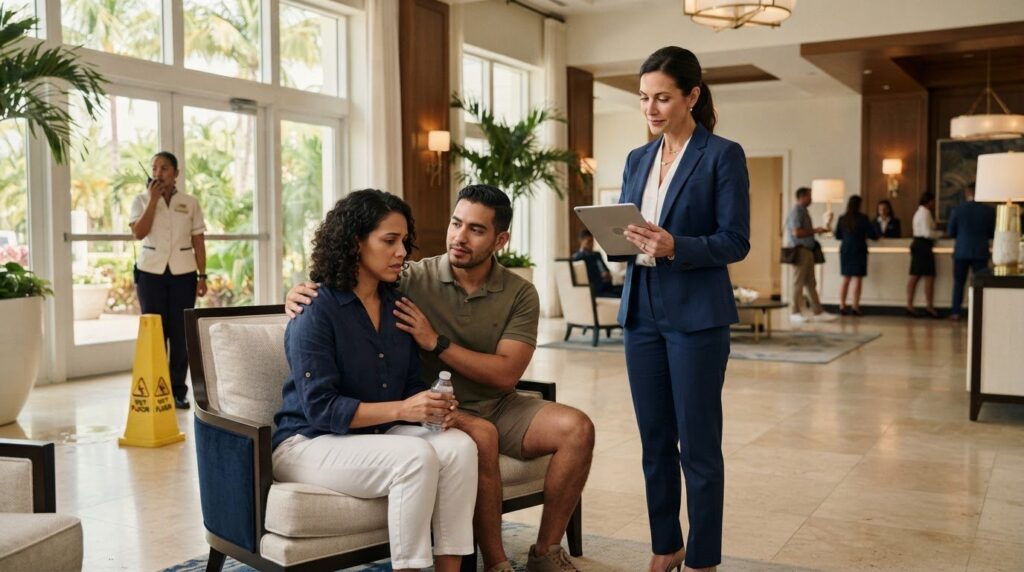

The name on a Wyndham hotel sign doesn’t automatically identify who may be responsible for an injury. A dangerous condition could involve the property owner, operator, or another party. A lawyer for injury at Wyndham should begin with the facts of the specific property and incident, not assumptions based on the brand.
If you were hurt at a Wyndham property, you may be dealing with medical bills, time away from work, and questions from an insurer. People searching for help may use terms such as personal injury firm near me, personal injury lawyer near me, injury lawyer near me, attorneys for personal injuries, or attorneys personal injury. Car-crash claims may call for lawyers for auto accidents or auto accident lawyers near me, while a hotel injury calls for a close look at the property, hazard, and incident details.
This article covers practical steps after a hotel accident, how a claim may be evaluated under Florida law, and what evidence can help explain what happened. Charles Injury Law investigates hotel injury cases, works to preserve relevant evidence, assesses losses, and communicates with insurers. The firm represents injured people throughout Florida, including Fort Lauderdale, Miami, West Palm Beach, Boca Raton, Delray Beach, Boynton Beach, Lake Worth, Orlando, and Tampa.
Key Takeaways
- An injury at a Wyndham property doesn’t by itself establish liability. Ownership, management, and control details can help identify potentially responsible parties.
- A Florida claim may turn on evidence about the hazard, who controlled the area, whether the condition was known, and how it caused the injury.
- Put safety and medical care first. When it’s safe, document relevant details and report the incident to property staff.
- A lawyer for injury at Wyndham can investigate the property-specific facts, gather records, assess losses, and handle insurer communications.
- Charles Injury Law represents injured people throughout Florida and prepares cases for trial when needed.
Injured at a Wyndham Property in Florida? Start With the Facts
An injury at a hotel is serious, but the injury alone doesn’t establish who is legally responsible. The circumstances matter: where it happened, what condition caused it, who managed or controlled the area, and what information is available. A Wyndham brand on the building doesn’t answer those questions. A lawyer for injury at Wyndham can investigate the specific property and incident before drawing conclusions about a claim.
Hotel incidents can include falls on wet floors, injuries from uneven or obstructed walkways, pool-area hazards, malfunctioning elevators, or harm connected to a security concern. The injured person might be a registered guest, a visitor, or someone else on the premises. Their status and reason for being there may be relevant, but they don’t determine responsibility by themselves. The circumstances need to be examined together.
What counts as an injury at a Wyndham property?
Premises liability broadly concerns injuries connected to conditions or hazards on property. For general background, Premises liability describes the concept, but it isn’t a substitute for evaluating a particular claim under Florida law. A wet lobby floor, an unsafe walkway, a pool-area hazard, or inadequate security may raise different questions. The incident circumstances and available evidence shape the legal evaluation, including how the injury occurred and who had responsibility for the area.
A guest’s account, an incident report, photographs, witness recollections, and property records may each help clarify what happened. No single detail automatically proves liability. A careful review looks at the full picture rather than treating every hotel accident as the same kind of case.
Who may be connected to a hotel injury claim?
A hotel property may involve separate entities or people responsible for ownership, management, daily operation, maintenance, or insurance. Those roles can differ from one property to another. The presence of a Wyndham brand doesn’t, by itself, show that Wyndham Hotels & Resorts owns or controls a particular location. The relevant parties must be identified through property-specific information, not assumptions.
An investigation can help establish who controlled the area, which records may relate to the incident, and where those records may be held. This can include reviewing maintenance responsibilities, the property’s management structure, and available incident documentation. If you need a personal injury claim review for a hotel incident in Florida, the focus should be on the facts tied to that property and event. Charles Injury Law investigates premises-related injuries and works to identify the parties and evidence relevant to each claim.
Start with what you know: the location within the property, the time and circumstances, the condition involved, and anyone who witnessed the event. Those details help move the question from “Who might be responsible?” to a fact-based investigation.
How Florida Law Evaluates a Hotel Injury Claim
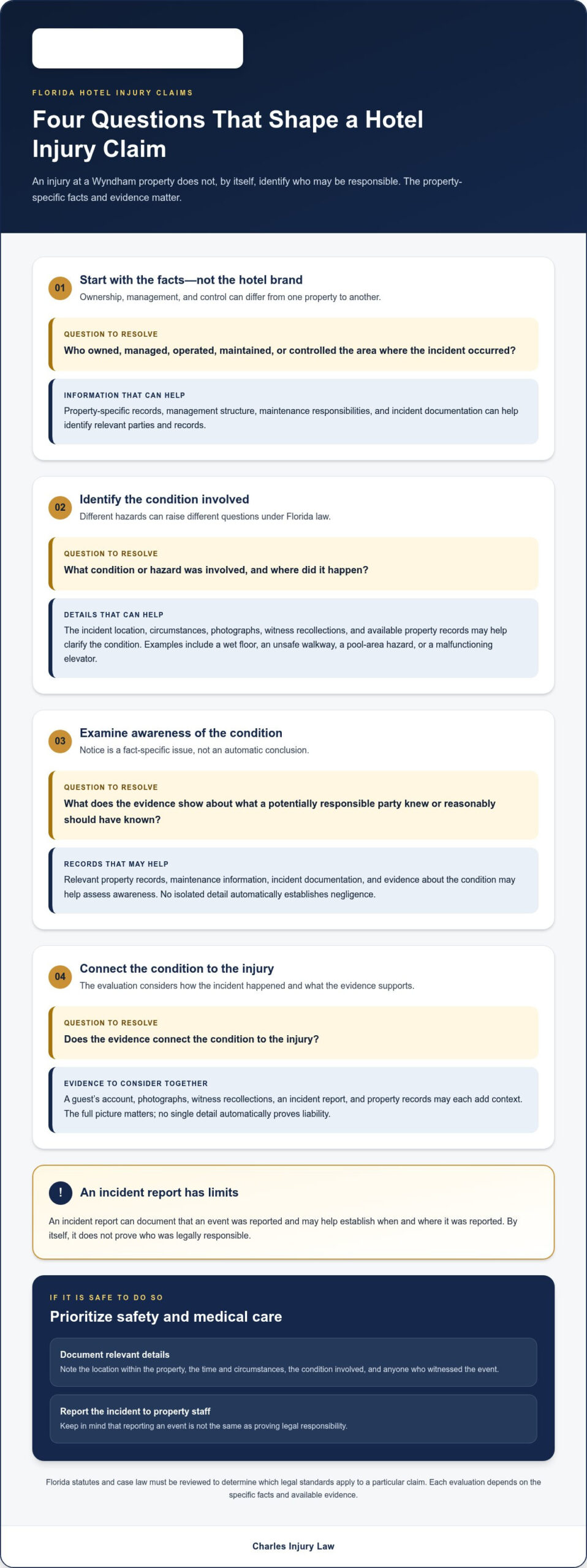
A hotel injury claim isn’t decided by the seriousness of the injury alone, and a Wyndham brand doesn’t establish responsibility. The evaluation asks what condition caused harm, who had control over the relevant area, what the evidence shows about awareness of the condition, and whether that condition caused the injury. Each question depends on the specific facts.
Florida statutes and case law must be reviewed to determine the legal standards that apply to a particular claim. The Florida Statutes Chapter 768 includes provisions addressing negligence and civil liability, but a statute’s application depends on the facts and current law. A careful review should also consider relevant Florida case law rather than treating every hotel incident as governed by one rule.
An incident report documents that an event was reported; by itself, it doesn’t prove who was legally responsible. It may help establish when and where an injury was reported. Other evidence may be needed to evaluate the condition, control, notice, and causation. Those are separate questions from whether someone was injured.
How property control and notice can matter
Control can help identify which person or entity was responsible for the area where an incident occurred. A hotel may have different arrangements for management, maintenance, and operations, so the relevant responsibilities and records need to be investigated. Notice is another fact-specific issue. Depending on the claim and the condition involved, the analysis may examine what a potentially responsible party knew or reasonably should have known. No isolated detail, such as a spill or a maintenance record, automatically establishes negligence.
For example, a report of a wet floor may identify a hazard, but the broader investigation may need to clarify how long the condition existed, who managed the space, and whether the evidence connects the hazard to the injury. A premises liability claim calls for an evidence-based assessment, not an assumption based on the hotel’s name.
Which losses may be considered in a Florida claim?
If liability is supported, the damages evaluation looks at losses connected to the injury. Depending on the evidence and circumstances, these may include medical expenses already incurred, anticipated future care, lost wages, and reduced ability to earn income. Pain and suffering, emotional distress, or permanent disability may also be relevant when supported by the individual’s situation and applicable law.
Medical records, bills, work documentation, and information about future treatment can help explain the injury’s impact. A diagnosis alone doesn’t determine a claim’s value. The nature of the injury, recovery, effects on daily activities, and strength of supporting records all matter. A lawyer for injury at Wyndham can assess liability evidence and documented losses without promising a particular result.
If you’re unsure how the facts may fit Florida law, discuss your hotel injury claim with Charles Injury Law.
Evidence That Can Strengthen a Wyndham Injury Investigation
Useful evidence helps reconstruct what happened, but it doesn’t automatically establish negligence or identify the responsible party. A photograph may show a condition, for example, but further investigation may be needed to determine when it appeared, who controlled the area, and whether it caused the injury. Document what you can safely preserve, then let the full record guide the analysis.
Don’t put yourself at risk to take pictures, approach a hazard, or retrieve an item. Get to a safe place and seek medical care first. If collecting evidence isn’t safe or practical, leave it alone. Your well-being comes before documentation.
What to document after the incident
As soon as you’re able, make a factual record while details are fresh. Avoid guessing or adding conclusions. Note:
- The date, approximate time, and specific location within the property, such as a lobby entrance, walkway, or pool area.
- What you recall happening, including the condition involved and what you observed before and after the injury.
- Visible conditions and injuries in photographs, but only if taking them is safe and practical.
- Witness names and contact details, if they’re willing to provide them.
- Relevant messages, receipts, or other records that help establish your presence or the sequence of events.
Keep original files where possible, and avoid editing images in ways that alter what they show. A brief note about when and where a photograph was taken can help explain its context later. Prompt documentation matters because conditions can be changed, cleaned, repaired, or otherwise become difficult to observe. Memories can also fade.
Why hotel records and medical documentation may matter
Incident reports, maintenance records, and available surveillance footage may help investigators understand how an event unfolded or how an area was managed. Their existence, retention, and contents can vary. Don’t assume a particular record or video exists, or that it will prove fault. Its value depends on what it shows and how it connects to the specific incident.
Medical records can document reported symptoms, examinations, diagnoses, and treatment over time. Tell healthcare providers accurately when and how symptoms began, and follow appropriate medical guidance. Those records may help connect treatment to the event, but they don’t decide legal responsibility on their own.
A hotel injury investigation may also examine whether evidence points to a potentially applicable safety statute. The University of Miami School of Law discusses negligence per se in Florida law, a concept that may arise in some legal analyses. Whether it applies depends on the law and case-specific facts, not merely on the presence of a hazard.
Charles Injury Law investigates property-related claims by gathering and assessing available evidence. Its premises liability representation can help connect records, witness accounts, and medical documentation to the questions raised by an injury. A lawyer for injury at Wyndham can pursue relevant evidence without treating any single document as automatic proof of fault.
Contact Charles Injury Law about a hotel injury claim.
What to Do After an Injury at a Wyndham Hotel
Take things one step at a time. Your immediate safety and medical needs come first. Once you’re safe, make a clear record of what happened, notify property staff, and keep documents connected to your treatment and expenses. These practical steps can help protect your health and preserve useful details while a claim is evaluated.
First steps: safety, care, and incident documentation
- Move to safety and seek care. If you need urgent medical attention, seek emergency assistance. Don’t return to a hazardous area to gather evidence or continue an activity that could worsen an injury. Follow medical guidance and keep paperwork from each visit.
- Report the incident to property staff. Describe where and when it happened, what you experienced, and any condition you observed. Stick to what you know. Don’t guess about the cause or accept pressure to speculate about fault. Ask whether staff will prepare an incident report and request a copy when available.
- Preserve details if it’s safe. Take photographs of the area and visible injuries only when practical and safe. Record the approximate time and location, note witness names and contact details, and keep relevant messages or receipts. Don’t put yourself at risk to collect proof.
- Track the effect on your health and work. Keep treatment records, receipts, bills, and notes about missed work or duties you can’t perform. Save information as it becomes available, including follow-up care instructions and communications about work absences.
Keep a useful record, not a theory
Write down a factual account while the sequence is still clear. Separate what you personally saw from what someone else told you. If you slipped, for example, record where you were walking and what you noticed, without guessing how long a condition had been there. This helps keep your account precise and consistent.
If your incident involved a fall, the Florida slip and fall guide offers additional context. Preserve the original photographs and paperwork where possible. A thorough record can help an investigation, but no single note or image guarantees a particular conclusion.
Be deliberate with insurance communications
An insurer may ask for details, a recorded statement, or a signed release. Before agreeing, make sure you understand what you’re being asked to provide or authorize. Don’t sign documents you don’t understand. A lawyer for injury at Wyndham can review the circumstances, investigate the claim, and communicate with insurers on your behalf. Charles Injury Law works to gather relevant records and assess the evidence without assuming who is responsible.
If you need guidance on next steps, talk with Charles Injury Law about your hotel injury.
How Charles Injury Law Can Help With a Wyndham Injury Claim
A hotel injury claim can involve more than describing what happened. Key questions include which parties had relevant responsibilities, what the available records show, and how the injury affected your health, work, and daily life. Charles Injury Law investigates the facts before drawing conclusions, then builds a claim around evidence rather than assumptions about a hotel brand.
From investigation to negotiation or trial
The process begins with reviewing the incident and identifying potentially relevant evidence. Charles Injury Law works to preserve available records, gather medical documentation, and determine what other information may help explain how the injury occurred. Depending on the case, expert opinions may help assess particular issues, such as the nature of an injury or the condition involved. Their role depends on the evidence and questions the claim presents.
Medical records and other documentation also help assess damages. The review may consider treatment to date, anticipated future care, lost income, and the injury’s impact on everyday activities. No two claims are identical, and an evaluation is based on the individual’s circumstances and supporting evidence. A lawyer for injury at Wyndham can also handle communications with insurers, helping present the claim with relevant facts and records rather than unsupported assumptions.
Charles Injury Law represents injured people throughout Florida and prepares cases for trial when needed. The firm negotiates with insurers and pursues fair compensation, while recognizing that no particular settlement or result can be promised. If a case requires litigation, preparation matters: the evidence, medical records, and damages assessment must support the position being advanced.
Accessible representation for injured people
You deserve clear communication and personal attention while you focus on recovery. Charles Injury Law provides direct communication with the attorney and keeps clients informed as the investigation and claim develop. The firm is available 24 hours a day, 7 days a week.
Concerns about upfront attorney fees shouldn’t prevent you from understanding your options. Charles Injury Law handles injury claims on a contingency-fee basis, meaning clients pay no attorney fees unless the firm recovers compensation. The claim still depends on its facts, evidence, and applicable law.
If you were injured at a Wyndham property, Charles Injury Law can investigate the circumstances, assess your losses, and address insurer communications. Learn more about discussing your claim.
Take the Next Step Toward Accountability
The next step isn’t to decide who’s at fault on your own. It’s to have the circumstances reviewed carefully while your focus stays on healing. A lawyer for injury at Wyndham can help you understand what the available evidence may show and what options you may have under Florida law.
Charles Injury Law has recovered millions of dollars for injured clients. Past results don’t guarantee a future outcome, and every claim depends on its own facts. The firm handles injury claims on a contingency-fee basis, so clients pay no attorney fees unless compensation is recovered.
You don’t have to face insurer pressure or unanswered questions alone. Speak with Charles Injury Law about your situation. Call Now: (954) 390-2228 Available 24 Hours a Day, 7 Days a Week. Your recovery comes first; a careful review can help you understand the next steps.
Frequently Asked Questions
Can I sue after being injured at a Wyndham hotel in Florida?
A claim may be possible if evidence supports negligence by a legally responsible party, but an injury alone doesn’t establish liability. The property’s ownership, management, and control arrangements, along with the incident details, may need investigation. A lawyer for injury at Wyndham can review those facts and explain possible options under Florida law. Charles Injury Law represents clients in Fort Lauderdale, Miami, West Palm Beach, Boca Raton, Delray Beach, Boynton Beach, Lake Worth, Orlando, and Tampa.
Who is responsible for an injury at a Wyndham property?
Responsibility depends on the specific property and incident. A brand, owner, operator, manager, or maintenance provider may have different roles, and the brand name alone doesn’t show who controlled the area where someone was hurt. Relevant agreements, records, and property details may help clarify those roles. A Florida lawyer can investigate the relationships and evidence before identifying any potentially responsible party. Don’t assume every Wyndham property has the same ownership structure.
What should I do immediately after a hotel injury in Florida?
First, get to safety and seek appropriate medical care. Don’t delay urgent treatment to gather evidence. Once you’re able, report what happened to property staff and keep a copy of any paperwork they provide. Tell medical providers when symptoms began and what you’re experiencing. Save appointment summaries, pharmacy receipts, and communications about missed work. Describe only what you know firsthand, and seek Florida legal advice for questions specific to your circumstances.
Can I make a claim if I slipped and fell at a Wyndham hotel?
You may be able to make a claim, but a fall alone doesn’t establish legal responsibility. The evaluation may consider what caused the fall, who controlled the area, what the relevant party knew or should have known, and whether the condition caused the injury. For example, a witness account may help clarify what the floor or walkway looked like before the fall. These issues must be assessed under current Florida law and the particular evidence.
What compensation may be available after a hotel injury in Florida?
Depending on the evidence and applicable law, damages may include medical expenses, future care, lost wages, loss of earning capacity, pain and suffering, emotional distress, or permanent disability. Records showing missed shifts, ongoing rehabilitation, or limitations on everyday activities may help document the injury’s effects. The available categories and amount depend on individual circumstances. No settlement average can reliably predict the value of a specific claim, and compensation isn’t guaranteed.
How much does it cost to hire Charles Injury Law for an injury claim?
Charles Injury Law uses a contingency-fee arrangement: clients pay no attorney fees unless the firm recovers compensation. The fee agreement explains the terms that apply to the representation. Read it carefully and ask about anything that’s unclear, including how the fee is calculated and what the agreement covers. Don’t assume other case expenses are handled the same way as attorney fees; review the agreement for those terms.
How long do I have to file a Florida hotel injury claim?
The filing deadline depends on the claim type and its facts, and missing an applicable deadline may affect your legal rights. Don’t rely on a general estimate to decide how much time remains. A Florida attorney can review when the claim arose and assess which deadline may apply under current law. Seek advice promptly, since contacting a lawyer doesn’t itself pause or extend a filing deadline.
Disclaimer
The information provided on this blog is for general informational purposes only and does not constitute legal advice. Viewing this content does not create an attorney-client relationship with the firm. You should not act or rely on any information contained herein without seeking legal advice from a qualified attorney regarding your individual situation.