



Suing your own insurer after a crash is never an act of betrayal. It is holding a corporate carrier to the contractual promises written into your policy. When an irresponsible driver hits you, medical bills mount immediately, yet carriers routinely respond with insultingly low settlement offers. If you are asking whether suing your own insurance for uninsured motorist coverage in Florida is legally permissible, the clear answer is yes. You bought this coverage to shield yourself, not to absorb financial devastation alone.
It’s completely natural to worry that filing a claim might cause your rates to skyrocket, or to feel overwhelmed by complex terms like stacked coverage. In this guide, you’ll learn how to take legal action against your insurer for uninsured motorist benefits under Florida law and secure the full compensation you deserve for your injuries and pain. We preview the bad-faith insurance statutes, critical filing deadlines, and the aggressive litigation approach Charles Injury Law uses to protect your future.
Key Takeaways
- Understand your contractual rights when suing your own insurance for uninsured motorist coverage in Florida, ensuring you pursue every dollar owed under your policy.
- Discover how stacked versus non-stacked policy limits establish your maximum recovery ceiling after an accident with an uninsured driver.
- Master the legal progression required to hold insurers accountable, from serving a formal demand package to filing a civil complaint in court.
- Identify bad-faith insurance practices and comparative negligence defenses that adjusters use to devalue legitimate claims.
- Learn why securing aggressive trial representation under a contingency model guarantees relentless advocacy without upfront legal fees.
Uninsured Motorist Coverage: When to Sue in Florida
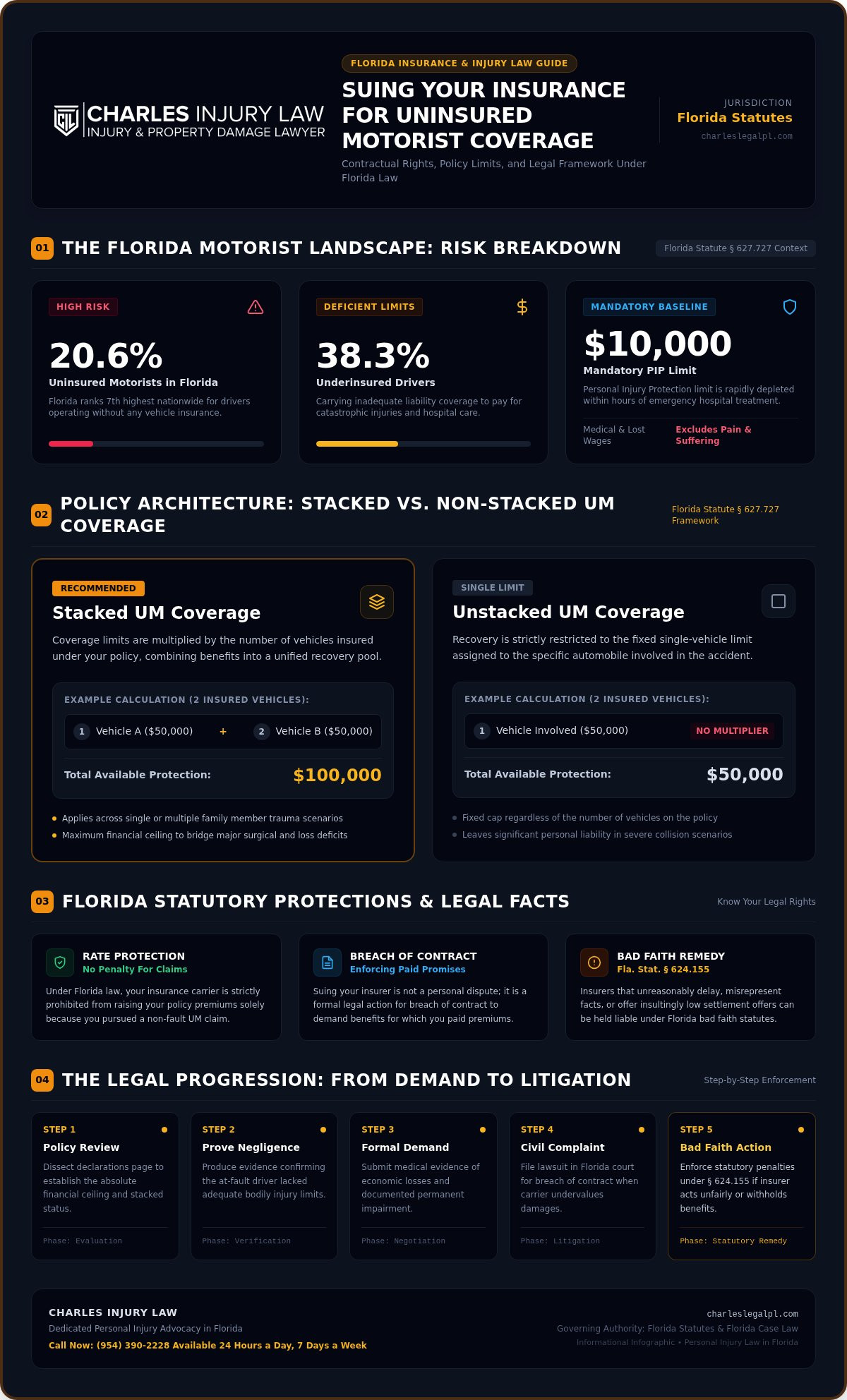
Uninsured motorist (UM) and underinsured motorist (UIM) coverage acts as an essential financial safety net under Florida Statute § 627.727. This provision protects you if an at-fault driver carries no bodily injury liability insurance or lacks adequate limits to cover catastrophic harm. Drivers in Florida encounter staggering risks on local roadways: roughly 20.6% of motorists operate without any insurance, ranking the state seventh-highest nationwide, while an estimated 38.3% are underinsured. When a negligent driver lacks coverage, your own policy must step into the breach.
Initiating legal action against your insurer is not a hostile confrontation; it is a direct action for breach of contract. You paid regular, hard-earned premiums for financial protection. If the carrier fails to disburse benefits that align with your covered losses, suing your own insurance for uninsured motorist coverage in Florida enforces the binding terms of that legal agreement.
The Role of UM Coverage in Florida After Severe Accidents
Mandatory Personal Injury Protection (PIP) in Florida provides only $10,000 for medical costs and lost wages. In severe collisions, hospital emergency care depletes that statutory threshold in hours. Because Florida does not require motorists to buy bodily injury liability insurance, hit-and-run drivers or underinsured motorists frequently leave victims with substantial uncompensated losses. A robust UM policy bridges this gap, funding long-term physical therapy, surgical procedures, and pain and suffering damages that PIP never touches.
Contractual Rights: Why Filing a Lawsuit Against Your Insurer Is Justified
Many injured policyholders hesitate to litigate, fearing rate increases or policy cancellation. Under Florida law, your insurer cannot raise your premiums solely because you pursued a non-fault UM claim. The moment you file a high-value claim, the carrier shifts from a service provider into an adversarial corporate entity focused on protecting profit margins. Claims adjusters frequently misrepresent facts or exploit delays, actions that can border on actionable insurance bad faith under Florida Statute § 624.155.
You do not have to fight these aggressive corporate defense teams alone. Enlisting seasoned lawyers for auto accidents shields your recovery, forcing claims departments to evaluate your injuries fairly. When an insurer undervalues your damages, filing a formal civil lawsuit becomes the ultimate legal mechanism to compel compliance. If you need immediate, battle-tested advocacy, Charles Injury Law is ready to intervene. Call Now: (954) 390-2228 Available 24 Hours a Day, 7 Days a Week.
Evaluating Your UM Policy: Key Criteria Before Demanding Compensation in Florida
Before demanding a payout or suing your own insurance for uninsured motorist coverage in Florida, you must dissect your policy documents. Your declarations page establishes the absolute recovery ceiling available from your carrier. You cannot collect compensation beyond these established limits, making a detailed policy review critical. Additionally, you must produce concrete evidence showing that the at-fault motorist lacked bodily injury liability coverage entirely or carried limits far below your accumulated damages.
Stacked vs. Unstacked Uninsured Motorist Policies in Florida
Under Florida Statute § 627.727, carriers must offer both stacked and non-stacked options. The structure you chose dictates your total financial recovery:
- Stacked Coverage: This format multiplies your available coverage limits by the number of vehicles insured on your policy. For example, if you insure two vehicles at $50,000 per person, you possess $100,000 in total protection for a single incident.
- Unstacked Coverage: This selection limits your recovery strictly to the single-vehicle limit attached to the automobile involved in the accident. The financial cap remains fixed, regardless of how many cars you own.
Opting for stacked coverage offers indispensable protection, especially when multiple family members suffer trauma in a single collision in Florida.
Proving the Full Extent of Economic and Non-Economic Losses
Capturing the full value of your policy requires presenting undeniable evidence of your physical and financial harm. Under Florida law, obtaining non-economic damages for pain, suffering, and mental distress requires clinical documentation proving a permanent impairment within a reasonable degree of medical probability. To justify a maximum policy payout, your file must substantiate every loss:
- Emergency medical invoices, hospitalization bills, and detailed estimates for future surgical interventions.
- Verifiable payroll documentation, tax records, and vocational evaluations establishing reduced earning capacity.
- Objective diagnostic scans, such as MRIs and CT imaging, documenting spinal trauma, fractures, or permanent nerve damage.
Insurance adjusters look for treatment delays to devalue your claim. Before moving forward with suing your own insurance for uninsured motorist coverage in Florida, discuss your claim with a dedicated injury lawyer near me at Charles Injury Law. If your carrier refuses to honor its obligations, you can request a comprehensive case evaluation to demand the financial restitution you deserve.
How to Sue Your Own Insurance for Uninsured Motorist Coverage in Florida
Holding your insurer accountable requires a disciplined legal strategy. Insurance carriers possess substantial resources and seasoned legal defense panels. Navigating this process demands procedural precision at every stage. When claims adjusters refuse to negotiate fairly, suing your own insurance for uninsured motorist coverage in Florida transforms your dispute from an administrative deadlock into a formal legal challenge in civil court.
Step 1 to 3: Evidence Gathering, Demand Letter, and the Civil Remedy Notice
A successful lawsuit begins long before you set foot in a courtroom. Your legal team initiates the dispute through three critical actions:
- Evidence Preservation: Immediately secure the official Florida traffic crash report, scene photography, vehicle black box data, and comprehensive medical diagnosis records.
- The Formal Policy Demand: Your counsel compiles an unassailable demand package detailing negligence, verified medical expenditures, and policy limits, demanding full financial tender within a specific timeframe.
- Filing the Civil Remedy Notice (CRN): Under Florida Statute § 624.155, your attorney submits a formal CRN to the Florida Department of Financial Services. This statutory notice outlines the insurer’s unfair claim settlement practices and triggers a mandatory 60-day cure window. If the carrier refuses to pay within 60 days, it opens itself to first-party bad faith liability beyond policy limits.
Step 4 to 5: Filing the Lawsuit and Navigating Court Proceedings
If the carrier lets the 60-day cure window lapse without tendering policy limits, litigation moves directly to the local circuit court in Florida. Your lawyers draft and serve a formal summons and complaint for breach of contract.
During the discovery phase, your legal team compels the insurer to produce internal claim notes, underwriting guidelines, and adjuster communications. Depositions are conducted under oath to pin down the adjuster’s reasoning for underpaying your claim. If settlement negotiations during mediation fail, your counsel presents the case before a civil jury. For a deeper look at the dispute process, review our guide on how to fight a denied insurance claim in Florida. Having experienced attorneys for personal injuries on your side ensures your insurer takes your demand seriously from day one.
Overcoming Common Insurance Defense Tactics and Bad Faith in Florida
The moment you submit an uninsured motorist claim, your insurer’s financial priority shifts. Instead of protecting you, the company steps into the shoes of the negligent driver. Defense adjusters deploy calculated strategies designed to diminish claim value or eliminate liability entirely. When negotiations stall due to bad-faith obstruction, suing your own insurance for uninsured motorist coverage in Florida strips the carrier of its leverage and demands judicial accountability.
Deceptive Adjuster Tactics: Lowball Offers, Delays, and Blame-Shifting
Carriers rely on well-worn playbooks to reduce payouts to injured policyholders. Recognizing these maneuvers early protects your recovery:
- Predatory Early Settlements: Adjusters push rapid, lowball offers before you reach maximum medical improvement, hoping you waive future claims.
- Manufactured Delays: Claims departments repeatedly demand redundant paperwork or claim missing documentation to prolong processing until financial desperation sets in.
- Pre-Existing Condition Allegations: Insurers comb through past medical history to argue that spinal disc bulges or joint trauma stem from prior degeneration rather than the crash.
- Comparative Fault Accusations: Under Florida comparative negligence law, proving a victim is more than 50 percent liable bars all financial recovery. Adjusters routinely twist accident details to inflate your percentage of fault.
Florida Bad Faith Law: Holding Insurers Financially Accountable
Florida Statute § 624.155 requires insurance companies to treat policyholders fairly, investigate claims thoroughly, and settle claims promptly when liability is clear. When an insurer engages in intentional stalling or unreasonable settlement refusals, it commits statutory bad faith. In successful bad faith actions under Florida law, courts can hold the insurer liable for judgment amounts that exceed the stated policy coverage limits.
Trial-ready litigation shatters these defense strategies. When you retain seasoned attorneys for personal injuries, the insurer knows lowball tactics will fail in court. Charles Injury Law builds airtight cases that compel compliance from reluctant carriers. If your provider is delaying, discounting, or denying your valid claim, contact our team today to assert your rights. Suing your own insurance for uninsured motorist coverage in Florida can be the only way to compel fair payment.
Why Retaining Charles Injury Law Maximizes Your Uninsured Motorist Settlement in Florida
When auto insurers discover that an injured claimant has unyielding courtroom representation, the dynamic shifts immediately. Suing your own insurance for uninsured motorist coverage in Florida requires an assertive strategy backed by extensive litigation experience. Charles Injury Law serves as your formidable shield against corporate insurance tactics. We demand every dollar your policy provides, giving you direct communication with your legal team instead of treating you like a file number.
Relentless Representation Across South Florida and Statewide
Our trial-ready approach forces insurance compliance. We have recovered millions of dollars for injured clients in Florida by preparing every claim as if it will go before a civil jury. Whether your collision occurred in Fort Lauderdale, in Miami, or in West Palm Beach, we deliver relentless advocacy against powerful insurance carriers. We also protect injured drivers in Boca Raton, in Orlando, and in Tampa. If a carrier refuses to negotiate in good faith, we initiate formal civil proceedings in Florida without hesitation.
No Financial Risk: Our Contingency Fee Commitment
Mounting medical debt after a serious motor vehicle collision creates immense emotional strain. You should not have to gamble your personal savings to enforce an insurance policy you already paid for. Charles Injury Law handles every first-party uninsured motorist claim on a contingency fee model. If we do not secure financial restitution on your behalf, you pay zero attorney fees. There are no upfront retainers and no out-of-pocket costs to begin your case.
If you are considering suing your own insurance for uninsured motorist coverage in Florida, do not face corporate defense adjusters alone. Aligning your recovery with a trusted personal injury firm near me levels the playing field and maximizes your financial recovery. Take decisive action now to protect your financial future.
Call Now: (954) 390-2228 Available 24 Hours a Day, 7 Days a Week.
Demand the Full Settlement Value of Your Policy Today
You purchased uninsured motorist protection to safeguard your health and financial stability. When carriers attempt to devalue legitimate claims or deploy bad-faith delay tactics, suing your own insurance for uninsured motorist coverage in Florida enforces the contractual protection you paid for. Taking formal legal action ensures you don’t shoulder catastrophic medical bills, ongoing physical rehabilitation expenses, and lost income alone.
With millions recovered for injured clients in Florida, Charles Injury Law provides aggressive advocacy that levels the playing field against stubborn insurance companies. We operate strictly on a contingency fee basis, providing trial-ready representation with zero fees unless your case is won. Our dedicated legal team remains available 24 hours a day, 7 days a week for immediate consultation. Demand the compensation you paid for by contacting Charles Injury Law today and protect your financial future.
Frequently Asked Questions
Can my auto insurer cancel my policy or raise my rates for filing a UM claim in Florida?
Under Florida law, your insurance company cannot cancel your policy or increase your premiums simply for filing a non-fault uninsured motorist claim. You purchased this coverage specifically to protect against motorists who drive without liability insurance. If you were not primarily at fault for the crash in Florida, your carrier cannot legally penalize you for demanding the benefits outlined in your policy contract.
How long do I have to file an uninsured motorist lawsuit against my insurer in Florida?
Following tort reform in Florida, lawsuits for motor vehicle accidents occurring on or after March 24, 2023, must be filed within two years from the collision date. While contract claims against carriers often carried longer deadlines, the underlying fault claim dictates strict action. If you are considering suing your own insurance for uninsured motorist coverage in Florida, secure legal representation immediately to avoid missing statutory deadlines.
What is the purpose of filing a Civil Remedy Notice against an auto insurer in Florida?
A Civil Remedy Notice (CRN) serves as a formal statutory notice filed with the Florida Department of Financial Services under Florida Statute § 624.155. It officially informs your insurer that it is acting in bad faith by delaying, undervaluing, or refusing a legitimate claim. This filing starts a mandatory 60-day clock, giving the carrier one final window to pay your policy limits before facing extra-contractual damages in court.
Can I recover pain and suffering damages through my UM coverage in Florida?
Yes, you can recover non-economic damages like pain, suffering, and emotional trauma through your UM policy in Florida. However, Florida law requires clinical documentation establishing a permanent injury within a reasonable degree of medical probability. Objective evidence, such as MRI diagnostics, surgical evaluations, and ongoing therapy records, is essential to validate that your physical limitations justify compensation beyond ordinary economic losses like medical bills and lost wages.
What happens if my medical damages exceed my policy limits in Florida?
If your damages exceed your policy limit, your recovery is generally capped at the coverage ceiling you purchased, unless you have stacked coverage across multiple vehicles. However, if your insurer acted in bad faith by unreasonably refusing a timely, fair settlement demand within your policy limits, you may pursue an extra-contractual claim under Florida law. This legal step can hold the insurance company accountable for the total verdict amount.
Do I have to pay upfront attorney fees to sue my insurance company for UM benefits in Florida?
No, you do not pay any upfront retainers or out-of-pocket costs. Charles Injury Law handles first-party UM claims on a strict contingency fee model. If our litigators do not secure financial compensation on your behalf, you owe zero legal fees. Suing your own insurance for uninsured motorist coverage in Florida comes with zero financial risk to you. We fight aggressively so you can focus entirely on your physical recovery.
Can I sue both the uninsured driver and my own insurance company in Florida?
Yes, Florida law allows you to file a lawsuit naming both the at-fault driver and your UM carrier as co-defendants. Suing the negligent driver establishes fault and damages in civil court, while joining your insurer ensures that your policy pays out if the at-fault party has no assets. Skilled auto accident lawyers near me in Florida manage these dual claims simultaneously to maximize your total recovery.
Disclaimer
The information provided on this blog is for general informational purposes only and does not constitute legal advice. Viewing this content does not create an attorney-client relationship with the firm. You should not act or rely on any information contained herein without seeking legal advice from a qualified attorney regarding your individual situation.