



Insurance carriers don’t back down from polite negotiations; they respond to relentless courtroom pressure. If an auto insurer drags out your claim or offers an insulting settlement that won’t cover your medical bills, the financial burden falls squarely on you. You shouldn’t have to suffer while carriers protect their bottom line. Hiring a fierce bad faith insurance lawyer in Fort Lauderdale immediately shifts the leverage back to your side when a carrier violates Florida law.
You already know that taking on a multi-billion-dollar insurer feels like an unfair fight against endless red tape. In this 2026 guide, you will discover how to evaluate and select the right legal advocate when insurers wrongfully delay, undervalue, or deny valid claims in Florida. We examine the exact conduct that constitutes statutory bad faith, outline objective criteria to secure trial-ready counsel, and reveal how decisive legal action helps you recover maximum compensation for your losses.
Key Takeaways
- Learn how to distinguish between standard valuation disputes and unlawful carrier misconduct under Florida statutes.
- Discover the critical criteria for choosing a bad faith insurance lawyer in Fort Lauderdale who prioritizes courtroom trial readiness over quick, discounted settlements.
- Understand the tactical legal differences between first-party auto claims and third-party liability disputes in Florida.
- Uncover the mandatory procedural steps for filing a formal Civil Remedy Notice to trigger strict insurer deadlines.
- Find out how direct legal representation protects your rights and pursues full financial restitution for your unpaid medical losses.
Recognizing Bad Faith: When an Insurer Violates Florida Law
Insurance policies are binding legal contracts. When you pay your premiums, the carrier assumes an obligation to handle claims fairly and promptly. Florida law strictly defines how carriers must administer these claims. An honest disagreement over vehicle damage or injury valuation is common. Misconduct occurs when an insurer deliberately ignores evidence, delays payouts without cause, or denies valid coverage to protect corporate profits. When an auto carrier acts in this manner, retaining a bad faith insurance lawyer in Fort Lauderdale levels the playing field.
Under Florida Statute § 624.155, policyholders have a statutory remedy when an insurer fails to settle claims in good faith when it could and should have done so. While Florida tort reform under House Bill 837 established that mere negligence does not constitute bad faith, deliberate stonewalling crosses the line into statutory liability. Insurers must act with promptness, not calculated hesitation.
Common Signs of Bad Faith Claims Handling
Carriers use subtle tactics to exhaust claimants and force undervalued settlements. Watch for these specific indicators of misconduct:
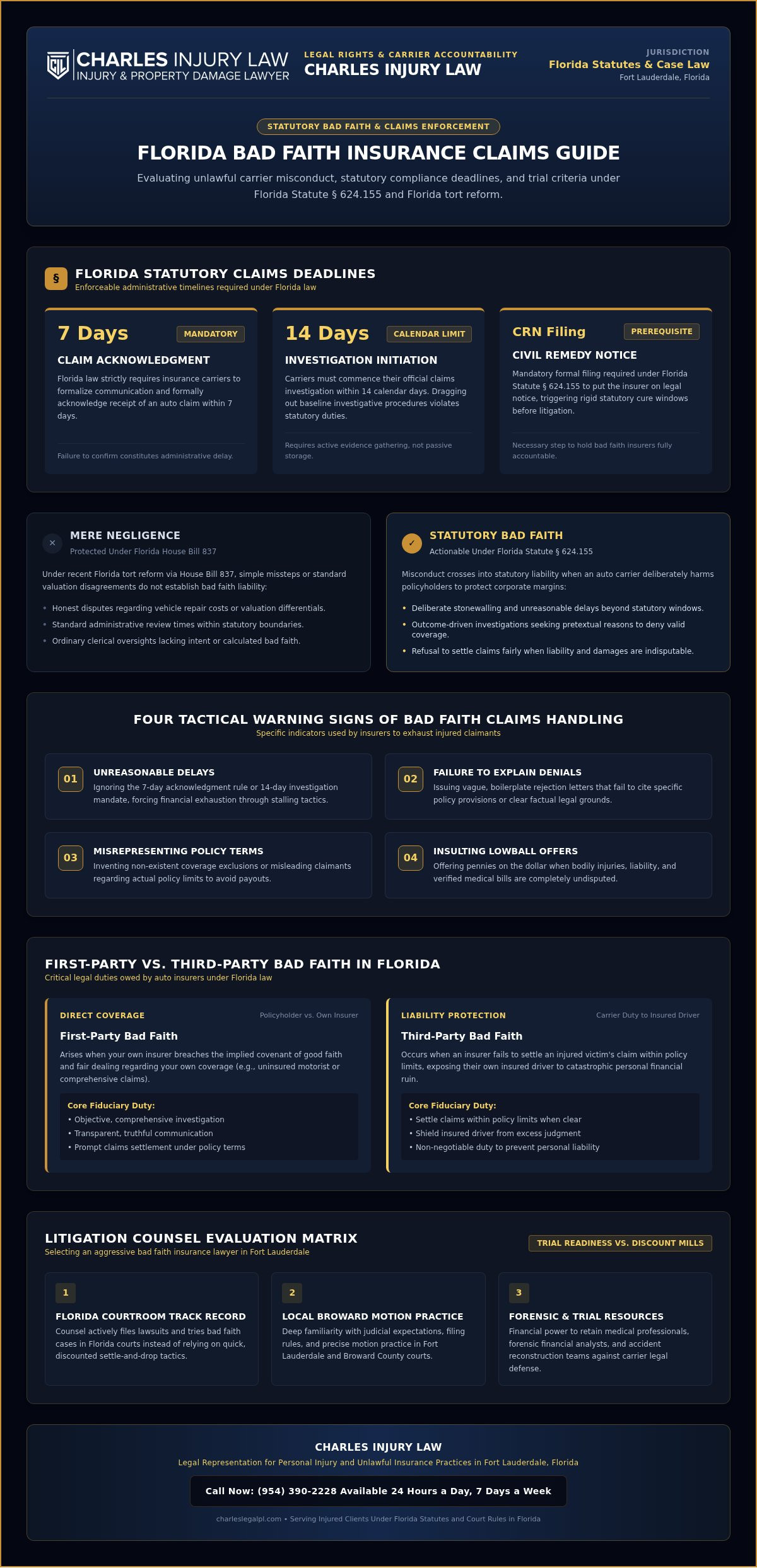
- Unreasonable delays: Florida law requires insurers to acknowledge a claim within 7 days and begin investigating within 14 calendar days. Dragging out basic tasks violates administrative requirements.
- Failure to explain denials: Issuing vague rejection letters without factual or legal citations under the policy is unlawful.
- Misrepresenting policy terms: Carriers cannot invent coverage exclusions or deceive you about policy limits.
- Lowball settlement offers: Offering pennies on the dollar when liability and medical bills are completely undisputed proves wrongful conduct.
Duties Insurers Owe to Policyholders in Florida
Florida courts hold carriers to strict fiduciary standards. Every policy includes an implied covenant of good faith and fair dealing, requiring insurers to treat policyholders with honesty and transparent communication. This duty requires an objective, comprehensive investigation rather than an outcome-driven search for reasons to deny coverage.
In third-party liability disputes, insurers carry a non-negotiable obligation to shield their insured drivers from financial ruin. If an injured party presents clear evidence of damages exceeding policy limits, the carrier must attempt a timely settlement. Refusing a reasonable demand exposes the driver to an excess judgment, triggering direct bad faith liability against the carrier under Florida law. A determined bad faith insurance lawyer in Fort Lauderdale builds the evidentiary record required to hold these companies accountable.
How to Choose a Bad Faith Insurance Lawyer in Fort Lauderdale
Insurance companies know which law firms take cases to trial and which ones accept quick, discounted settlements. Selecting the right bad faith insurance lawyer in Fort Lauderdale requires looking past marketing slogans to evaluate courtroom capability. You need a dedicated shield against carrier stall tactics, not a settlement mill that treats your claim like an assembly line. When searching for a personal injury lawyer near me, use an objective framework to vet your litigation counsel.
Essential Qualifications for Litigation Counsel
Litigating bad faith claims under Florida law demands specialized trial resources. Assess these core capabilities before hiring counsel:
- Courtroom track record: Confirm the attorney actively files lawsuits and tries cases in Florida courts rather than relying solely on demand letters.
- Local court familiarity: Judicial expectations in Fort Lauderdale and Broward County require precise motion practice and strict adherence to local filing rules.
- Resource depth: Your firm must possess the financial power to retain forensic financial analysts, medical professionals, and accident reconstruction teams to counter well-funded insurance legal teams.
Client Communication and Accessibility Standards
A major case requires close collaboration. You should speak directly with attorneys personal injury rather than getting passed between administrative case managers. Constant accessibility matters when adjusters use high-pressure tactics or issue sudden claim deadlines.
Reliable firms provide round-the-clock responsiveness so you never face critical decisions alone. Your lawyer should explain every procedural milestone under Florida statutes with complete clarity. If an auto insurer acts unfairly, you can contact a responsive legal team to protect your legal rights before critical statutory deadlines expire.
Contingency Fee Protections for Policyholders
Fearing litigation expenses often prevents policyholders from standing up to corporate carriers. Florida rules allow policyholders to eliminate upfront legal expenses through contingency fee agreements. Under this model, attorney fees align entirely with maximizing your financial recovery. You owe zero attorney fees unless the firm recovers compensation for your injuries and damages. This structure gives every driver an equal shot at justice against corporate misconduct, regardless of their financial circumstances.
First-Party vs. Third-Party Bad Faith: Critical Legal Differences
Bad faith claims in Florida fall into two distinct legal frameworks: first-party actions and third-party actions. Each category involves different legal duties, procedural hurdles, and avenues for financial recovery. Confusing these two paths jeopardizes your ability to secure compensation. A skilled bad faith insurance lawyer in Fort Lauderdale identifies the precise mechanism required to hold an insurer accountable for underhanded claim practices.
The distinction centers on whose insurance company committed the violation. The remedies available depend entirely on that relationship under Florida law.
First-Party Claims: Fighting Your Own Insurance Company
A first-party dispute arises when your own auto insurer fails to fulfill its contractual promises. These cases typically involve uninsured or underinsured motorist (UM/UIM) coverage, collision repair costs, or comprehensive benefits. When you pay premiums for UM protection, your insurer steps into the shoes of the uninsured driver who hit you.
Too often, your carrier treats you like an adversary instead of a loyal customer. They contest medical treatments, dispute obvious diagnostic scans, or delay payouts for months. In Florida, first-party bad faith claims are strictly statutory under Florida Statute § 624.155. A dedicated personal injury firm near me forces insurers to account for these delays, especially when fighting denied claims after catastrophic car crashes.
Third-Party Claims: When an At-Fault Insurer Refuses Settlement
Third-party bad faith involves the at-fault driver’s insurance carrier. When a reckless driver causes an accident resulting in life-altering physical harm, their insurance company has an obligation to settle the claim within policy limits. If the insurer refuses a reasonable settlement demand despite clear liability and catastrophic damages, they act in bad faith against their own policyholder.
When lawyers for auto accidents take that underlying injury case to trial, a jury may return a verdict far exceeding the insurance policy limits. Under Florida common law and statutory frameworks, that carrier can become directly responsible for paying the entire excess judgment. Seasoned auto accident lawyers near me leverage this dynamic to force full accountability. Connecting third-party liability to severe crashes handled by a car accident attorney ensures that recalcitrant carriers cannot walk away from the catastrophic losses their insured drivers caused.
Whether litigating first-party UM denials or third-party excess exposures, partnering with an aggressive bad faith insurance lawyer in Fort Lauderdale transforms standard claim disputes into high-stakes accountability proceedings.
The Bad Faith Litigation Process in Florida: Step-by-Step
Holding a recalcitrant insurance carrier accountable requires precision. You cannot simply file a lawsuit claiming unfair treatment; Florida law establishes strict procedural hurdles before a bad faith claim can enter a courtroom. Navigating these statutory mandates demands immediate action and detailed evidence gathering. Retaining a dedicated bad faith insurance lawyer in Fort Lauderdale ensures you meet every statutory deadline while exposing the carrier’s misconduct.
The litigation path moves through distinct, mandatory phases designed to establish carrier culpability under governing Florida statutes.
Filing a Florida Civil Remedy Notice (CRN)
Before filing a statutory bad faith lawsuit, Florida Statute § 624.155 requires submitting a formal Civil Remedy Notice to the Florida Department of Financial Services. This document must clearly identify the specific statutory sections violated and cite the exact policy language at issue. Once filed, the insurer receives a mandatory 60-day cure period. If the carrier pays the claim damages or resolves the underlying violation within those 60 days, the bad faith lawsuit is barred under Florida law.
Entering Discovery and Deposing Claims Adjusters
If the insurer fails to cure the violation, litigation moves into formal discovery. Counsel demands the carrier’s internal claim files, supervisor logs, and claims-handling guidelines. Adjusters and claims managers face rigorous depositions under oath. This process uncovers hidden company incentives, premature claim denials, and calculated internal delays that favor corporate revenue over honest claims administration.
Securing Maximum Restitution at Settlement or Trial
Trial preparation drives the final recovery phase. Counsel compiles all financial losses, including past surgeries, ongoing medical therapy, future earning capacity losses, and non-economic damages such as pain and suffering. If the carrier refuses a fair resolution, counsel presents this comprehensive evidence before a jury in Broward County civil court to demand full restitution. If your carrier refuses to honor its obligations, schedule a consultation with Charles Injury Law to launch your formal bad faith claim.
Stand Up to Insurers: Partner with Charles Injury Law
Insurance carriers rely on delays and intimidation to protect corporate profits. Charles Injury Law serves as an aggressive shield for injured policyholders facing bad faith claim practices. With millions of dollars recovered for injured clients in Florida, the firm brings proven courtroom resolve to every battle against national insurance corporations. When an insurer violates your trust and undervalues your valid claim, retaining a relentless bad faith insurance lawyer in Fort Lauderdale ensures your rights remain fiercely protected.
Relentless Advocacy Backed by Trial Readiness
We prepare every insurance dispute as if it is proceeding directly before a jury. This trial-ready posture eliminates the leverage adjusters seek when floating lowball settlement offers. Carriers operating in Miami, in Fort Lauderdale, and in Tampa know our reputation for refusing discounted payouts. If an auto insurer stonewalls your claim, decisive courtroom preparation forces them to take your case seriously.
Direct Attorney Communication and Client Commitment
Clients work directly with dedicated litigation counsel from day one. You don’t have to navigate confusing bureaucratic layers or talk solely to administrative case managers. Every client receives personal attention, transparent case updates, and compassionate guidance. Whether handling complex auto accident disputes or catastrophic collisions represented by truck accident lawyers, our attorneys for personal injuries stand firmly by your side.
Begin Your Risk-Free Case Evaluation Today
You don’t have to carry the financial burden of medical debt while an insurer stalls. Our contingency fee model requires zero upfront legal expenses. You owe nothing unless we recover financial compensation for your losses. Take decisive action against bad faith tactics. Contact Our Office to evaluate your insurance denial in Fort Lauderdale.
Call Now: (954) 390-2228 Available 24 Hours a Day, 7 Days a Week
Take Control of Your Claim and Demand Full Justice
Insurance companies bank on your exhaustion. When adjusters create unwarranted delays, misrepresent policy coverages, or extend lowball settlement offers, you don’t have to accept their terms. Florida statutes give policyholders formidable tools to fight back. By strictly enforcing procedural timelines and filing formal statutory notices, you strip away an insurer’s leverage and hold them accountable for bad faith practices.
Securing full compensation requires courtroom resolve and decisive action. Charles Injury Law stands as your uncompromising shield against deceptive carrier tactics. With millions of dollars recovered for injured clients in Florida, our firm delivers trial-ready representation with zero upfront costs. You pay no attorney fees unless we recover compensation for you, and you always maintain direct communication with your legal counsel. When an insurer refuses to honor your policy, choosing a fearless bad faith insurance lawyer in Fort Lauderdale restores balance to your fight.
Fight back against unfair insurer delays with Charles Injury Law: Call Now: (954) 390-2228 Available 24 Hours a Day, 7 Days a Week
Frequently Asked Questions
What qualifies as insurance bad faith under Florida law?
Under Florida Statute § 624.155, insurance bad faith occurs when an insurer fails to settle a claim in good faith when it could and should have done so had it acted fairly and honestly toward its insured. Misrepresenting policy terms, failing to conduct prompt investigations, or delaying payments without valid cause qualify. Under Florida law, mere negligence is not bad faith; the insurer’s actions must show deliberate stonewalling or reckless claims handling.
Can I sue my insurance company for denying my auto accident claim in Fort Lauderdale?
Yes, you can sue your auto insurer if they wrongfully denied your claim in bad faith. Before filing a bad faith lawsuit, Florida law requires filing a formal Civil Remedy Notice with the Florida Department of Financial Services. A bad faith insurance lawyer in Fort Lauderdale will review your policy, demonstrate that your crash damages met all coverage criteria, and prove the carrier lacked lawful justification to reject your valid claim.
How much does it cost to hire a bad faith insurance lawyer in Fort Lauderdale?
Hiring a bad faith insurance lawyer in Fort Lauderdale costs nothing upfront because representation operates on a contingency fee basis. Under this legal fee model, you don’t pay out-of-pocket retainers or hourly rates. Your litigation counsel only collects attorney fees if they recover financial compensation for your losses through a negotiated settlement or courtroom verdict. If your legal team recovers no money, you owe zero attorney fees.
What is a Civil Remedy Notice in Florida insurance litigation?
A Civil Remedy Notice is a mandatory statutory filing submitted to the Florida Department of Financial Services before pursuing a bad faith lawsuit against an insurer. This document details the exact statutory provisions violated and the factual basis of the dispute. Under Florida Statute § 624.155, the insurer has a 60-day cure period to pay the damages. If the carrier fails to cure the violation, litigation proceeds in Florida courts.
How long does an insurance company have to respond to a claim in Florida?
Florida law requires auto insurance companies to acknowledge receipt of a claim within 7 calendar days. Insurers must also begin their factual investigation within 14 calendar days of receiving notice. In most cases, insurers have 60 days to pay or deny the claim. Failing to comply with these statutory deadlines without reasonable justification provides strong evidence of unlawful delay tactics under Florida insurance regulations.
What happens if an insurer fails to settle an injury claim within policy limits?
When an insurer refuses a timely settlement demand within policy limits despite clear liability, the carrier exposes itself to third-party bad faith liability. If the injured victim proceeds to trial and obtains a verdict exceeding those policy caps, the insurer can be held liable for paying the full judgment. The carrier cannot avoid responsibility when its unreasonable refusal to settle exposed its insured driver to personal financial ruin.
Can I recover compensation beyond my original policy limits in a bad faith lawsuit?
Yes, successful bad faith litigation under Florida law allows policyholders and claimants to recover damages that exceed the stated limits of the original policy. In third-party claims, the insurer may be forced to pay the full excess judgment awarded by a jury. In first-party claims, statutory damages can include unpaid claim benefits, court costs, attorney fees, and economic losses resulting directly from the carrier’s unlawful refusal to pay.
Disclaimer
The information provided on this blog is for general informational purposes only and does not constitute legal advice. Viewing this content does not create an attorney-client relationship with the firm. You should not act or rely on any information contained herein without seeking legal advice from a qualified attorney regarding your individual situation.