

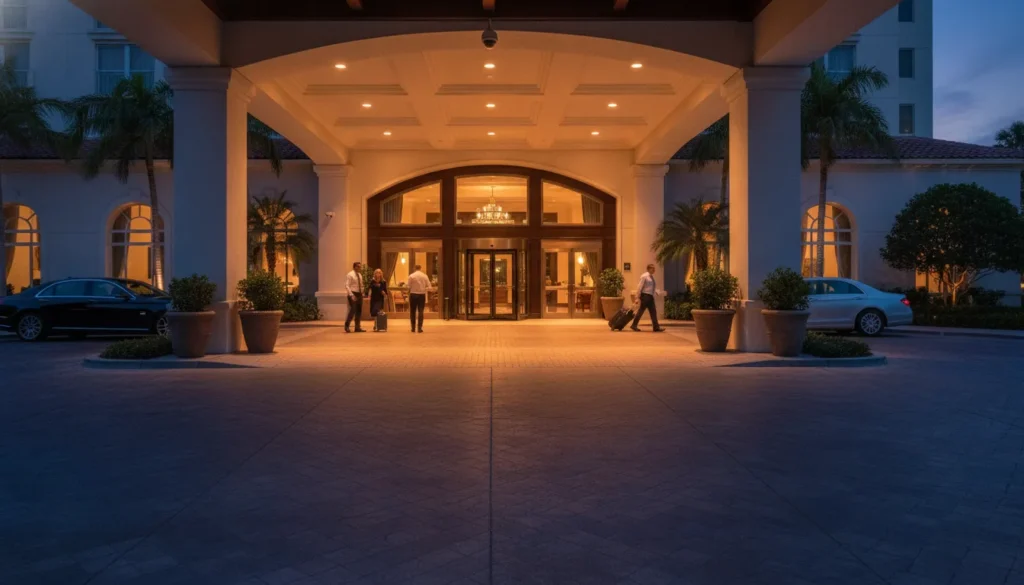
A hotel negligent security claim asks whether a hotel failed to use reasonable security after a known risk of crime, and whether that failure contributed to a guest’s injury. An assault, robbery, or shooting at a hotel does not, by itself, prove the hotel is responsible. Charles Injury Law reviews these questions for people hurt at hotels in Fort Lauderdale, Miami, and nearby South Florida counties. The first step is a free case review.
Call (786) 525-8784 to request a free case review
The review looks at where the incident happened, what the hotel controlled, and what records still exist. It is not a promise that a claim will be accepted or that any amount will be recovered.
What a hotel claim is really about
A hotel negligent security claim is a premises claim aimed at the hotel’s security choices, not only at the person who committed the crime. Florida hotels invite guests to stay, park, dine, and use hallways, elevators, and lobbies. That invitation can create a duty to take reasonable steps for lawful visitors. It does not make the hotel an insurer of every guest.
The practical question is narrower. Did the hotel know, or should it have known, about a risk in that part of the property? Did it fail to respond in a reasonable way? Did that failure contribute to the injury? If the answer to any of those is no, the incident can still be a crime without being a hotel claim.
Hotels also split control in ways an apartment or a store often does not. One company may own the building, another may operate the brand, and a vendor may staff the garage or the door. A restaurant, spa, or parking operator may control only part of the site. Liability depends on who owned, operated, or maintained the specific place where the harm occurred. Our negligent security page explains the broader Florida claim. This article stays on hotel conditions and the records that matter after a hotel incident.
Charles Injury Law is an attorney-led South Florida practice. Steve Charles, Esq. is the founder, and the firm describes its work as investigation, insurer negotiation, and trial preparation, with direct attorney access during the case. Those are the firm’s stated methods. They are not a guaranteed staffing level, response time, or result.
Hotel negligent security claim factors
Hotel claims often turn on a few conditions the guest can still describe, and that records may confirm. None of these conditions proves liability on its own. Each one is a fact that has to be tied to the risk and to how the harm happened.
| Hotel condition | What to note | Why it may matter |
|---|---|---|
| Lighting. | Note a dark garage, stairwell, side path, or porte-cochere. Also note whether the outage looked recent or longstanding. | Poor light can show a maintenance failure at the place the incident happened. |
| Access controls. | Note propped doors, broken gates, bad key cards, or visitors reaching guest floors without a check. | The path of entry has to match the broken control. A different entrance may not count. |
| Surveillance. | Note camera locations, whether they were recording, and who monitored them. | A camera that was off or never watched is different from one that missed the angle. |
| Prior incidents. | Note earlier assaults, robberies, threats, or trespass complaints on or near that part of the property. | Prior similar events are one way to examine foreseeability. They still have to be proven. |
| Staff response. | Note what was reported, to whom, and what staff or a guard did next. | An ignored complaint can matter more than a policy that was never triggered. |
Lighting is a common hotel fact because garages, stairwells, and side entrances fail in specific spots. A burned-out fixture over the space where someone was robbed is not the same as a dark lot on the other side of the building. Photos should show the location, the time of day, and nearby working lights, not only a close-up of one bulb.
Access control is just as specific. A broken garage gate matters if the attacker used that gate. It may not matter if the person walked through the staffed lobby. Key-card records, elevator logs, and front-desk visitor notes can show whether a guest floor was actually restricted. A propped side door is useful only if it was the route used, and if the hotel had notice that it stayed open.
Cameras cut both ways. Working footage can show entry, a warning to staff, or a guard leaving a post. Missing footage can also be a fact, if the system was supposed to cover that door and was down, overwritten, or pointed away. Prior incidents are the other half of foreseeability. One crime, standing alone, is a weak basis for saying the hotel should have predicted it. A pattern of similar events, police calls, or guest complaints about the same entrance is a different record. Even then, the pattern has to relate to the kind of harm and the part of the property involved.
Unsafe conditions that are not crimes, such as a wet lobby floor or a broken step, belong with premise liability rather than with a security claim. A hotel stay can involve both, but they are not the same case.
Reporting the incident and keeping records
What a guest reports, and how fast, often decides whether a hotel claim can be investigated at all. Hotel video systems commonly overwrite on a short cycle. A delay of days can leave no footage of the entrance, the elevator, or the garage. The same is true of key-card logs and radio traffic if nobody asks that they be kept.
- Report the crime to police when it is safe, and keep the report number.
- Tell hotel staff the place and time, and ask for an incident report.
- Write down staff names, lighting, open doors or gates, cameras, and any guard you saw.
- Ask, in writing if you can, that video and access logs for that time window be kept.
A police report is a start, not the whole file. Your own short account fills gaps the report often misses.
Preservation should be specific. A useful request names the date, the time window, and the entrance or floor. It should also list the records: camera footage, door and key-card logs, garage-gate logs, elevator access, alarm alerts, visitor notes, and staff dispatch. A general “save everything” note is easier to ignore. Do not assume the hotel will hold footage because you mentioned the incident at the desk.
Other records still matter after the video is gone. Medical records connect the injury to the event. Photos of injuries, torn clothing, and the scene help if they are dated. Witness names and phone numbers are easy to lose once other guests check out. Room keys, parking tickets, and ride receipts can place you on the property. None of this proves the hotel was negligent. It keeps the facts available for a later review.
Florida law sets a deadline for filing suit, and missing it can end a claim. Section 95.11 of the Florida Statutes states that an action founded on negligence must be commenced within two years. Wrongful-death timing, tolling, and which defendant is which are separate questions. The Florida Senate’s current text of section 95.11 is the place to read the limitation categories. Do not treat this article as a deadline calculation for your case. Attorney review is required before anyone relies on a filing date, a foreseeability theory, or a damages theory.
What an incident does not prove
Crime on hotel property is not automatic liability. The person who attacked or robbed a guest may be responsible for an intentional act even when the hotel is not. A negligent security claim against the hotel still needs a connection between a security failure and the harm. If the failure did not contribute to what happened, the claim against the hotel can fail while the criminal case proceeds.
Insurers and hotel operators often say the crime was not foreseeable, that security was reasonable for that property, or that a third party caused the harm. Those arguments are tested with evidence, not with the fact that a guest was hurt. A conviction is not required to ask the question, and an arrest does not answer it.
Damages, if a claim is proven, depend on the injury and the proof. Medical bills, lost income, and the effect of the injury are case-specific. This article does not estimate a value, and a free review is not a finding that those losses are recoverable. Past results do not predict a future outcome. Fee terms for injury work are recovery-dependent and matter-specific. The firm does not publish a universal percentage, and a review does not mean a case is accepted.
South Florida hotel claims also raise ordinary local facts. Charles Injury Law serves Fort Lauderdale and Miami as priority markets and describes coverage in Broward, Miami-Dade, Palm Beach, and Monroe counties. Documented offices are in Lauderdale Lakes and Miami, not a separate Fort Lauderdale city office. A hotel’s county can affect where a case is filed and which police agency has the report. It does not change the need to connect security conditions to the injury.
How Charles Injury Law reviews a hotel inquiry
A hotel inquiry starts with the incident, not with a conclusion. The firm asks where on the property it happened, whether police were called, what the guest told hotel staff, and what visible conditions stood out: lights, doors, gates, cameras, or a guard post. If records may still exist, preservation is discussed early because footage and access logs are the first things to disappear.
From there, the work follows the sequence the firm describes on other injury matters. Look at the facts. Gather what can still be gathered. Deal with the insurer when there is a claim to present. Prepare for litigation only if the matter is accepted and that step becomes necessary. Direct attorney access means the guest is not handed off to an anonymous call center. It does not mean a particular lawyer is assigned before a written engagement, or that every hotel incident will be taken.
Use the contact page to request a free case review, or call (786) 525-8784. The site also lists a Broward office line, (954) 390-2228, and a Miami office line, (305) 747-7457. Calling or submitting the form does not create an attorney-client relationship. That relationship begins only with a signed written agreement, unless the firm confirms otherwise in writing. Do not send medical records, photos of injuries, or other sensitive details through the public form before that relationship exists.
If you are reading this from Broward or Miami-Dade, the Broward County and Miami-Dade County pages describe the service areas. They are not a statement that every hotel matter in those counties is accepted.
Ask for a qualified free case review
FAQ
Does an assault at a hotel prove the hotel was negligent?
No. An assault, robbery, or shooting shows that a crime happened. A hotel negligent security claim still requires a duty, a reasonable basis to anticipate the risk, a security failure, and a link between that failure and the injury.
What hotel records should be preserved first?
Name the date, time, and location, then ask that camera footage, key-card and door logs, garage-gate logs, elevator records, alarm alerts, and the hotel incident report be kept. Many video systems overwrite quickly.
Should I report the crime to the hotel and the police?
Yes, when it is safe to do so. A police report number and a hotel incident report create a timeline. Your own notes about lighting, entry, cameras, and staff names fill gaps those reports often miss.
How is this different from a slip or trip at a hotel?
A fall on a wet floor or a broken step is usually a condition case about maintenance and warnings. A hotel negligent security claim is about foreseeable crime and the security measures used, or not used, for that risk.
Will Charles Injury Law take every hotel case?
No. A free case review is an inquiry. The firm does not guarantee that a claim will be accepted, that a deadline still applies, or that any recovery will follow. Engagement requires a written agreement.
A careful next step
If you were hurt at a hotel, write down the place and time while you remember them. Get a police report number if you can. Ask the hotel to keep the footage and access logs. Then request a review so someone can tell you whether those facts support a claim. General information on this page is not legal advice. Using the site or calling does not create an attorney-client relationship.