

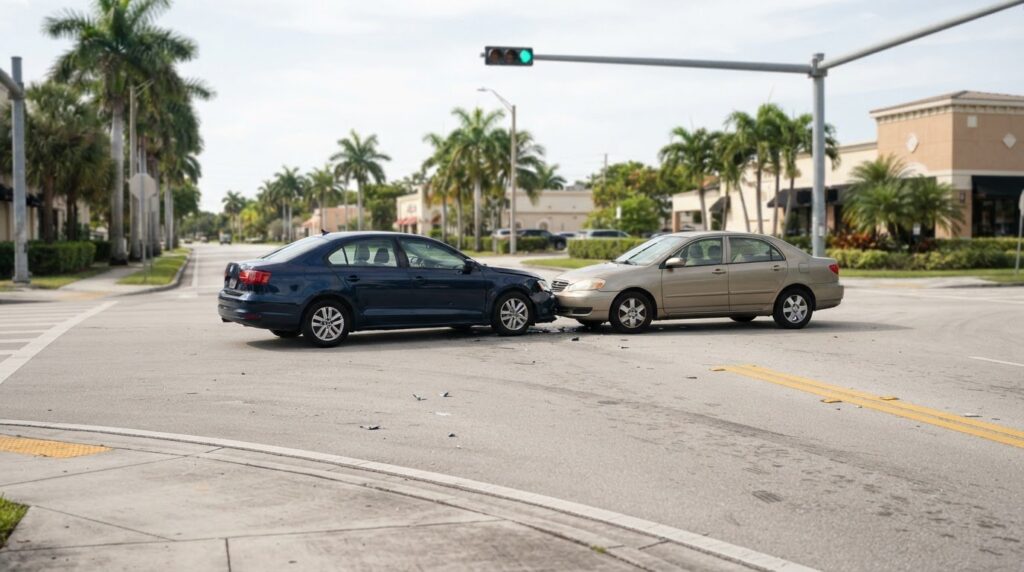

A left turn doesn’t automatically make one driver solely responsible. To determine who is at fault in a left-turn accident in Florida, start with the turning driver’s duty to yield to oncoming traffic. The other driver’s actions and the available evidence can affect how responsibility is shared.
It’s understandable to assume the turning driver is always at fault. But a driver going straight may also contribute by speeding, disobeying a traffic signal, or making an unexpected move. A green light alone doesn’t resolve every dispute about right of way.
Florida’s left-turn rules are only part of the picture. Signals, witness accounts, vehicle damage, and other evidence can affect a fault determination. Shared fault may also affect an injury claim, so it helps to understand what the evidence can show after a crash.
Key Takeaways
- A left-turning driver generally must yield to oncoming traffic, but the signal, timing, and circumstances can affect responsibility.
- Traffic footage, vehicle damage, witness accounts, and crash-scene details can help clarify what happened.
- Florida’s comparative-fault rules can reduce an injured person’s recovery based on their share of responsibility.
- Speeding, signal violations, and other unsafe actions by the oncoming driver may shift or share fault.
- Florida PIP coverage generally pays 80% of medical bills and 60% of lost wages, up to $10,000, according to the Florida Legislature.
Who Is at Fault in a Left-Turn Accident in Florida?
Fault depends on right of way, each driver’s conduct, and the evidence. A left turn can make the turning driver responsible, but it doesn’t automatically resolve every claim.
Oncoming Driver Fault
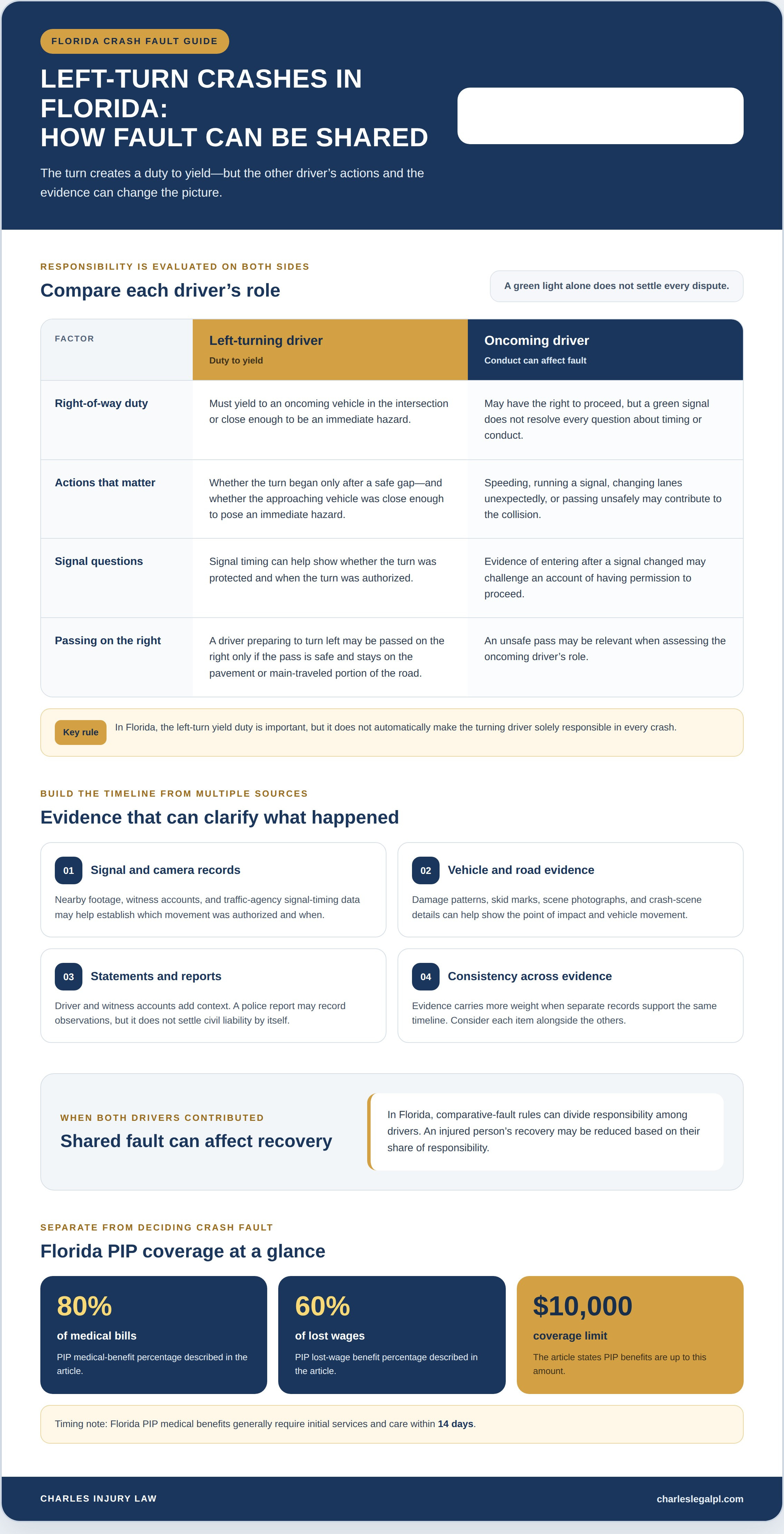
An oncoming driver may share fault by speeding, running a signal, changing lanes unexpectedly, or passing unsafely. These actions matter because they can affect whether the turning driver had a reasonable chance to judge the gap. Florida Statute Section 316.084 allows passing a vehicle making or about to make a left turn on the right only when the pass is safe and stays on the pavement or main-traveled portion of the road.
Green-Light Evidence
Signal evidence can help show which driver had permission to proceed and whether the turn was protected. Witness accounts, nearby camera footage, and signal-timing data from the traffic agency may help resolve a dispute about a green light or arrow. For example, video showing a vehicle entering after its signal changed may challenge a driver’s account, while signal timing may clarify when each movement was authorized.
The Turning Driver’s Yield Duty
Florida Statute 316.122 requires a driver turning left to yield to oncoming vehicles in the intersection or close enough to be an immediate hazard. That duty matters, but it doesn’t make the turning driver automatically at fault in every collision. Investigators must also consider the other driver’s speed, signal compliance, and lane use. A turn made after a safe gap may be evaluated differently if an oncoming driver approached far above a reasonable speed.
Other evidence can help test each account. Vehicle damage, skid marks, scene photographs, and driver statements may show where impact occurred and how the vehicles moved. A police report can record observations, but Florida Statute Section 316.066 limits the use at trial of certain crash-report statements made for completing the report. The report is one piece of evidence, not the entire liability decision.
For reporting, notify law enforcement and your insurer promptly, and preserve the crash details. For a Florida negligence claim based on a crash after March 24, 2023, Section 95.11 sets a two-year filing limit. Claims involving a Florida government agency may have separate notice rules under Section 768.28, so those deadlines can differ.
After a left-turn crash, move to safety if possible, exchange identifying and insurance information, and document the scene. Seek medical care promptly, even if injuries seem minor; Florida PIP medical benefits generally require initial services and care within 14 days.
According to the Florida Legislature, Florida personal injury protection coverage pays 80% of medical bills and 60% of lost wages, up to $10,000. The lost-wage benefit is 60%.
Evidence used to determine fault
Evidence helps reconstruct what each driver did before impact, not just where the vehicles ended up. Details carry more weight when separate records support the same account.
Evidence for Establishing Liability
Liability evidence connects a driver’s conduct to the collision and resulting harm. A vehicle’s damage pattern, for example, may help an accident reconstruction expert assess whether an oncoming driver was traveling far above the speed limit. That analysis may matter when the turning driver says a gap appeared safe, but the other driver’s speed could have reduced the time to react.
Evidence is strongest when it forms a consistent timeline. A camera view may show where a vehicle entered the intersection, while physical damage can help assess the reported point of impact. Driver statements add context, but conflicts with physical evidence may weaken an account. Consider each item alongside the others, rather than treating any one piece as a complete answer.
Police Reports and Fault
A Florida crash report may record an officer’s observations and details about the collision. It can point to issues that need closer investigation, but it doesn’t settle civil liability on its own. In Shaver v. Carpenter, a Florida appellate court ordered a new trial after evidentiary errors that included an investigating trooper’s opinion about which driver violated the right-of-way.
Florida Statute Section 316.066 also limits the use at trial of certain crash-report statements made to complete the report, subject to the statute’s terms. That distinction matters: the report may contain useful observations, while some statements within it may face limits as trial evidence. A careful review separates those categories instead of assuming every sentence has equal weight.
Preserve original photos and videos, note where each item came from, and record who provided it. If nearby business footage may show the intersection, act promptly because recordings may not remain available indefinitely. Keep copies of repair records and photographs that show vehicle damage as repairs progress.
When accounts conflict, ask whether independent evidence supports each driver’s description of the timing, lane position, and movement. A witness who saw the signal may address a different issue from one who heard the impact but couldn’t see the traffic light. Separating what each person observed helps keep uncertain details from being presented as established facts.
If conflicting accounts leave liability unclear, get help reviewing the crash evidence and identifying which records may clarify what happened.
Shared fault and comparative negligence
Florida law can assign responsibility to more than one driver after a left-turn crash. The percentages assigned to each party can directly affect an injured person’s recovery.
Florida Modified Comparative Negligence
Florida Statute §768.81 applies modified comparative negligence to covered negligence actions, allowing fault to be divided among responsible parties. The rule matters when both drivers’ conduct contributed to a collision. For example, a driver turning left may have failed to yield, while an oncoming driver may have been speeding. Evidence about each action helps determine each party’s share.
Comparative Fault and Recovery Limits
Under Florida’s rule, an injured person found more than 50% responsible for their own harm generally cannot recover damages in a covered negligence action. A person assigned 50% fault or less may still recover, with damages reduced by their percentage. That threshold makes the difference between 50% and 51% responsibility legally important, even when the crash circumstances appear similar.
Comparative Negligence and Damages
Comparative negligence reduces recoverable damages according to the injured person’s share of fault. For example, if a driver has $100,000 in damages and receives a 30% fault allocation, the general calculation leaves $70,000 before other applicable considerations. The example shows why both the damage evidence and the fault percentage matter; proving losses alone doesn’t establish the amount recoverable.
Fault allocation depends on each driver’s conduct, not simply on which vehicle was turning. Investigators may assess whether the turning driver could lawfully proceed, whether the oncoming driver obeyed signals, and how both vehicles moved before impact. If one driver had a green arrow and the other entered against a signal, those facts may affect how responsibility is divided.
A police report may document observations, but the assessment also depends on other evidence. A witness account, signal timing, or vehicle damage, for instance, may support or challenge a driver’s description. When accounts conflict, these details can help establish whether someone failed to yield or acted negligently in another way.
An assigned percentage doesn’t mean every part of a driver’s account is false. A driver may have followed some traffic rules but still contributed to the crash through another action. Florida’s comparative-fault analysis weighs conduct connected to the collision and applies the resulting percentage to damages.
Circumstances that can shift or share fault
If a driver speeds through an intersection or passes during a left turn, that conduct may shift or share responsibility. The turning driver may still be at fault for failing to yield, while the other driver’s unsafe maneuver may also contribute. Investigators examine how each action affected the collision, not just which vehicle was turning.
Speed matters because it can affect the time available to judge oncoming traffic and avoid impact. A driver turning left may have judged a gap based on a normal approach speed, while the oncoming driver was traveling far above the speed limit. In that situation, speed evidence may support an argument that the oncoming driver contributed to the crash. Vehicle damage and reconstruction analysis may help assess the speed involved.
A red-light violation can also affect the fault analysis. If a driver enters against a signal while another driver makes a lawful turn, the violation may support shared or shifted responsibility. A stop-sign violation can matter for the same reason: the right to proceed depends on traffic conditions and whether the required yield occurred. Compare both drivers’ statements with signal records and witness accounts.
Passing creates a separate danger. Florida Statute Section 316.084 allows a driver to pass a vehicle making or about to make a left turn on the right only when the pass is safe and stays on the pavement or main-traveled portion of the roadway. If a passing driver cuts around the turning vehicle using an unsafe path, that conduct can contribute to the impact. The precise path, lane position, and point of collision help explain what happened.
Other conduct may matter too. An unexpected lane change, distraction, reckless driving, or impairment may help explain why a driver failed to respond to a turning vehicle. Driving without headlights at night may also affect whether an oncoming vehicle was visible. Context matters: a witness who saw the vehicle move may support a different part of the account than someone who only heard the crash.
A sudden obstacle can change the analysis. If a person or animal abruptly enters a turning driver’s path and forces hard braking, that event may explain why the vehicle stopped or moved unexpectedly. Investigators may consider the obstacle’s location, the driver’s reaction, and the vehicles’ positions afterward. A sudden event doesn’t erase earlier conduct, but it may clarify the sequence leading to impact.
For an injured person seeking to recover damages, shared fault makes the conduct of every involved driver relevant. Florida’s comparative-fault rule can reduce recovery according to the injured person’s assigned responsibility, and a person found more than 50% responsible generally cannot recover in covered negligence actions. The strongest assessment connects each alleged violation or unsafe act to the crash and resulting harm.
Florida left-turn right-of-way rules
Florida’s right-of-way rules depend on the signal, the intersection, and each vehicle’s position. Understanding those rules can help you assess whether a turn was permitted and what details to preserve in the crash record.
Florida Statute 316.122 requires a driver turning left to yield to oncoming vehicles within the intersection or close enough to pose an immediate hazard. A solid green signal does not remove that duty. The driver must wait until oncoming traffic clears or a safe gap allows the turn. The rule focuses on the actual hazard, not simply whether the turning driver entered first.
A circular green signal permits a left turn, but Florida Statute 316.075 still requires the driver to yield to vehicles and pedestrians lawfully within the intersection or adjacent crosswalk. A green left-turn arrow gives the turning driver the right of way. Even then, the driver must watch for pedestrians, cyclists, or vehicles entering unlawfully. Those details can matter if an injured person’s account conflicts with another driver’s version.
At a stop sign or an uncontrolled intersection, a driver turning left must yield to traffic going straight and vehicles already in the intersection. Florida Statute § 316.123 requires a driver facing a stop sign to stop and yield to vehicles in the intersection or close enough to pose a hazard. At a four-way stop, the first driver to arrive goes first. If vehicles arrive together, the positions and movements shown in the record help explain who proceeded lawfully.
A flashing yellow arrow allows a left turn only after yielding to oncoming vehicles and pedestrians. Florida Statute § 316.151 also governs lane position: the turning driver must approach in the extreme left-hand lane lawfully available and leave in a lane lawfully available to that traffic. A turn from another lane can complicate fault, even if the signal allowed the turn.
Florida Statute Section 316.155 requires a driver to signal continuously for at least 100 feet before turning when another vehicle may be affected. Florida Statute § 316.075 generally prohibits turning left on red, except from a one-way street onto another one-way street unless a sign prohibits it. These rules help clarify whether the turn itself complied with Florida law; they do not replace an assessment of the other driver’s conduct.
For a driver or injured passenger, the practical questions are whether the signal authorized the turn, whether the driver had to yield, and whether the turn followed the proper lane. An attorney can assess how those rules apply to the crash record. Discuss the right-of-way evidence with an attorney.
Personal Injury Attorney in Fort Lauderdale
Charles Injury Law is a personal injury firm near me helping injured people in Fort Lauderdale understand how disputed fault may affect a claim. The firm represents people hurt in car, truck, and rideshare accidents. For conflicting accounts or questions about responsibility, the firm can review your situation and explain the issues.
People looking for an injury lawyer near me, a personal injury lawyer near me, lawyers for auto accidents, auto accident lawyers near me, attorneys for personal injuries, or attorneys personal injury can contact Personal Injury Attorney in Fort Lauderdale to discuss an accident injury claim.
Take the Next Step Toward Accountability
Understanding who is at fault in a left-turn accident in Florida is only part of protecting your interests. A claim should also reflect the crash’s full impact, including how injuries affect daily life and what evidence supports your account. Keep relevant records organized, and don’t let a dispute about fault obscure the harm you suffered.
Charles Injury Law represents people injured in car accidents, truck and tractor-trailer accidents, and Uber and Lyft rideshare accidents in Fort Lauderdale and throughout Florida, including Miami, West Palm Beach, Boca Raton, Delray Beach, Boynton Beach, Lake Worth, Orlando, and Tampa. If accounts conflict or responsibility is unclear, the firm can review the circumstances and explain your options. Each case depends on its facts.
Contact Personal Injury Attorney in Fort Lauderdale to discuss your crash and the next steps. You deserve a clear way forward while you focus on healing.
Frequently Asked Questions
Does a Green Arrow Give the Turning Driver Priority?
Yes. A green left-turn arrow gives the turning driver the right of way for that turn. In a later dispute, the arrow’s existence and timing may help distinguish a protected turn from one made on a circular green signal. That distinction can matter when accounts conflict. A signal phase alone doesn’t establish every detail, such as when a vehicle entered or whether another road user was already present.
Is the Left-Turning Driver Always at Fault?
No. A left turn does not automatically establish that the turning driver caused the crash. In Gonzalez v. Rose, 752 So. 2d 39 (Fla. 3d DCA 2000), a jury found the turning driver negligent after the parties disputed the signal. The case illustrates why a driver’s responsibility is assessed from the evidence and circumstances, rather than assigned solely from the direction of the turn.
What If Both Drivers Share the Blame?
Florida law can assign responsibility to more than one party, and an injured person’s assigned share affects recovery. The procedural history of Shaver v. Carpenter, No. 2D13-117 (Fla. 2d DCA Nov. 26, 2014), offers a caution: the jury initially assigned 95% of fault to the turning driver and 5% to the motorcyclist, but the appellate court ordered a new trial because of evidentiary errors. A jury’s allocation can be challenged when trial evidence was mishandled.
Does the Driver Going Straight Always Have the Right-of-Way?
No. Going straight does not create an unconditional right to proceed through every intersection. The signal and whether the driver entered lawfully still matter. Florida Bar Model Instruction No. 4 explains that violating a traffic statute is evidence of negligence, but not conclusive evidence. That means a traffic violation can support a fault argument, while the surrounding facts remain relevant to how responsibility is assessed.
Does the Police Report Determine Who Was at Fault?
No. A report is a record of the crash, not a final civil judgment on liability. Florida Statute Section 316.066 limits the use at trial of certain statements made to complete a crash report, subject to the statute’s terms. This distinction matters if a driver’s account appears in the report: its presence there does not automatically make that statement admissible as trial evidence or establish the other driver’s fault.
How Common Are Crashes Like This, and What Do the Numbers Show?
The Florida Department of Health dashboard lists 38,338 motor-vehicle traffic crashes in 2024. That figure shows the volume of reported crashes, but it does not identify how many involved left turns. A broad crash total cannot establish the frequency of this specific collision pattern. For a particular crash, the circumstances and evidence matter more than statewide totals.
How Do Traffic Lights Change Who Is at Fault?
A traffic light can establish which movements were authorized, but a disputed signal phase may require more than either driver’s recollection. In Gonzalez v. Rose, the parties disputed the signal, and the jury still found the turning driver negligent. The case illustrates that a disagreement about the signal doesn’t resolve liability by itself. Consider the evidence alongside the drivers’ actions and the circumstances of the collision.
What Florida law governs a driver making a left turn?
Florida Statute 316.122 governs a left-turning driver’s duty to yield to oncoming vehicles that are within the intersection or close enough to be an immediate hazard. The statute provides the central right-of-way rule for this maneuver. Florida Bar Model Instruction No. 4 adds an important evidentiary distinction: a statutory violation is evidence of negligence, but it does not conclusively establish negligence by itself.
Disclaimer
The information provided on this blog is for general informational purposes only and does not constitute legal advice. Viewing this content does not create an attorney-client relationship with the firm. You should not act or rely on any information contained herein without seeking legal advice from a qualified attorney regarding your individual situation.