



What if the insurance policy you signed in January 2026 leaves you personally exposed by July? Florida is undergoing a massive legal overhaul on July 1, 2026; the state is shifting from a no-fault system to a tort-based model. You likely feel certain about your current coverage, but the elimination of Personal Injury Protection (PIP) means the stakes for property damage liability have never been higher. If you’re involved in a collision in Fort Lauderdale or Miami, relying on outdated information could lead to a devastating lawsuit against your personal assets.
We understand the anxiety of facing repair costs that exceed state minimums. You deserve a clear path to recovery. This guide ensures you understand the new 2026 insurance requirements and how to protect your bank account if a driver’s policy falls short. You’ll learn the critical steps to take after an accident in Broward County to guarantee you receive maximum compensation. We’ll explain the new $10,000 minimums and show you how to win when insurance companies try to pay less.
Key Takeaways
- Learn how property damage liability covers more than just car repairs, including structural damage to fences and buildings in Miami-Dade County.
- Discover the “Loss of Use” clause that forces insurance companies to pay for your rental vehicle while your car is being fixed.
- Understand the $10,000 Florida minimum requirements and how the July 2026 legal shift impacts your financial responsibility.
- Shield your personal assets and wages from seizure if repair costs after a collision exceed your insurance policy limits.
- See how Charles Injury Law acts as your shield against insurance adjusters to secure the maximum compensation you deserve.
What Is Property Damage Liability and How Does It Work in Florida?
Property damage liability is your first line of defense when an accident occurs. It is a mandatory coverage under Florida law designed specifically to protect other drivers from the financial fallout of your mistakes. If you collide with another vehicle in Miami or Boca Raton, this policy pays for the repairs or replacement of the victim’s property. It functions as a financial shield for your assets. Without it, you are personally on the hook for every dollar of damage you cause.
Understanding What Is Property Damage is critical for every driver in Florida. While most people associate it with car accidents, the coverage extends far beyond just vehicles. It includes stationary objects such as fences, mailboxes, and even commercial buildings. If you lose control of your vehicle in Palm Beach County and strike a storefront, your property damage liability coverage is what pays for the structural repairs. However, you must remember one vital distinction: this coverage never pays for your own repairs. If you want your own vehicle fixed after a crash, you need collision coverage. PDL is strictly for the damage you inflict on others.
The Role of PDL in Florida’s No-Fault System
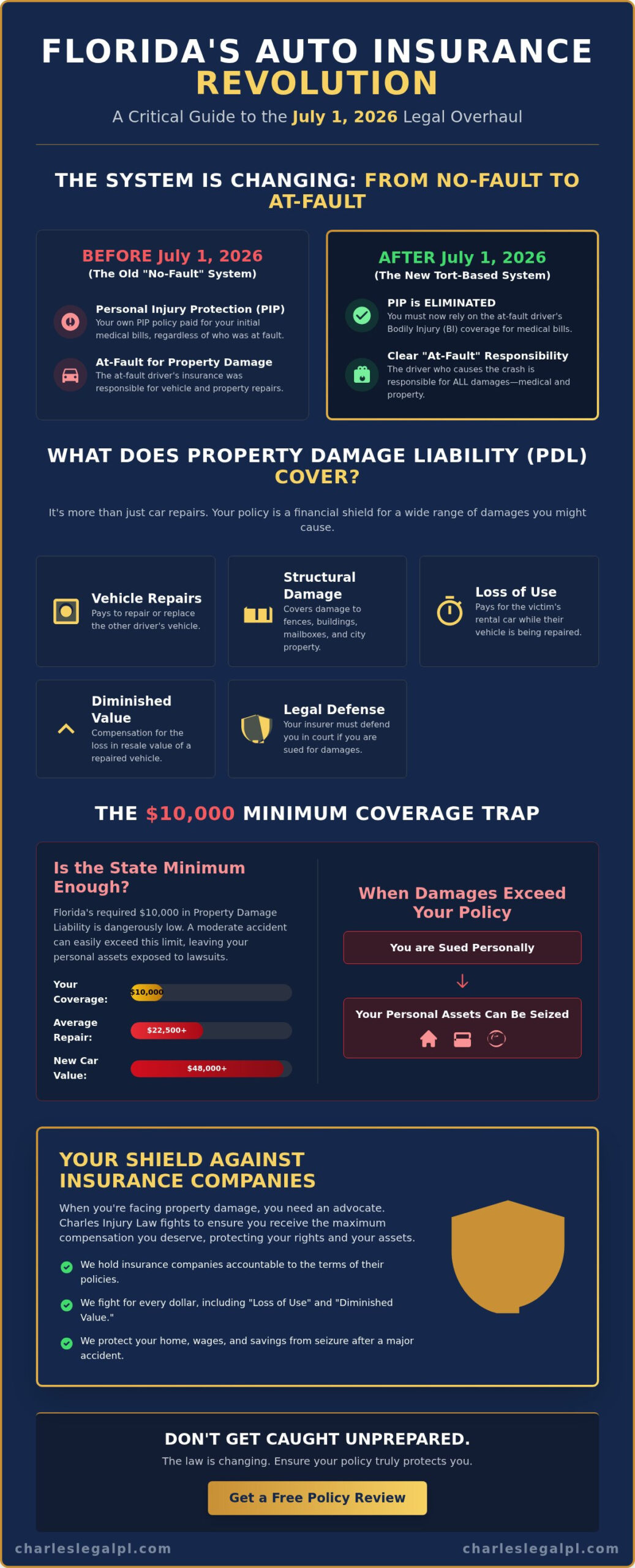
Florida operates under a “no-fault” system, but this label is often misleading. It only applies to medical expenses through Personal Injury Protection (PIP). When it comes to vehicle damage, Florida is an “at-fault” state. This means your PIP pays your medical bills regardless of who caused the wreck, but the at-fault driver’s property damage liability pays for your car. This split system often causes massive confusion for victims in Broward County. They expect their own insurance to handle everything, only to face delays when the other driver’s carrier drags its feet. We fight these delays to ensure you get paid fast.
Who Is Covered Under Your PDL Policy?
Your policy generally follows the vehicle, not just the driver. This is known as “permissive use.” If you lend your car to a friend in Fort Lauderdale and they cause a crash, your PDL coverage typically pays for the damage they cause. It is a high-stakes responsibility. You must list all household members on your policy to avoid a denied claim. If an unlisted resident driver causes an accident in Miami-Dade County, the insurance company may fight to deny coverage entirely. We don’t let them win that fight. We hold them to the terms of the policy to secure maximum results for our clients.
What Does Property Damage Liability Cover After a Collision?
Property damage liability does more than pay for a dented fender. It acts as a broad safety net for your bank account. This coverage pays for the full scope of financial loss you inflict on another party during a crash. It covers the obvious repair costs for their vehicle, but it also extends to “Loss of Use.” If you cause a wreck in Boca Raton, the victim still needs to get to work. Your policy pays for their rental vehicle while their car sits in the shop. For owners of luxury vehicles in Miami, we also push for “Diminished Value” settlements. A repaired high-end car is worth significantly less than one with a clean history. Your policy must cover that loss in value.
One of the most powerful benefits of this coverage is the legal shield it provides. If a victim sues you personally for the damage, your insurance company is generally required to pay for your legal defense. This protection is vital for keeping your personal savings intact. However, these benefits are limited by your policy cap. Many drivers realize too late that they only carry the bare minimum coverage requirements. If you’re worried your current policy won’t protect your home or savings, you should reach out for a professional policy review.
Beyond the Bumper: Non-Vehicle Property Damage
Accidents in Broward County often involve more than just two cars. If you swerve to avoid a collision and strike a storefront, a residential wall, or expensive landscaping, your property damage liability kicks in. It also covers damage to city property like traffic lights, signs, or guardrails. These costs escalate instantly. This is a major factor in truck accidents, where the sheer size of the vehicle can level a small building or destroy expensive city infrastructure in seconds.
Rideshare Complications: Uber and Lyft PDL
Rideshare drivers operate under a complex web of shifting liability. Uber and Lyft accidents are governed by a “period” system. If your app is off, your personal insurance is on the hook. If you’re logged in but haven’t accepted a rider, a limited corporate policy applies. Once you accept a trip or have a passenger in the car, the corporate policy limits increase significantly. Navigating which policy takes precedence is a battle. We know how to fight corporate adjusters to ensure the right policy pays out for the damage.
Florida Financial Responsibility Laws: Minimum Coverage Requirements
Florida law is clear. Every driver must carry a minimum of $10,000 in property damage liability and $10,000 in Personal Injury Protection (PIP) until June 30, 2026. After July 1, 2026, the state moves to a mandatory tort system, but the $10,000 PDL requirement remains a baseline for most. The Florida Department of Highway Safety and Motor Vehicles (FLHSMV) tracks your compliance with surgical precision. If your insurance carrier reports a lapse, the state will suspend your license and registration immediately. You’ll face reinstatement fees of $150 for a first offense, jumping to $500 for subsequent violations within a three-year period. This system ensures that every vehicle on our roads has at least some level of financial backing for the damage they cause.
Driving with only the minimum coverage is a gamble you will eventually lose. We see it every day in Fort Lauderdale. A driver with a $10,000 limit rear-ends a modern vehicle and discovers the repair bill is $25,000. The insurance company pays their $10,000 and walks away. You are left to face the remaining $15,000 alone. This is not just a legal technicality; it is a direct threat to your home, your savings, and your future. If you carry the minimum, you are essentially self-insuring for any serious wreck.
Why the $10,000 Minimum Is Dangerous in 2026
In Miami-Dade County and Boca Raton, the roads are packed with high-end luxury vehicles and electric cars. A minor fender bender on a high-tech bumper can cost $12,000 in sensors and calibration alone. If you cause a total loss on a vehicle worth $50,000, your $10,000 check is a drop in the bucket. The victim’s insurance company will pay their client and then sue you personally to recover the difference. We act as your shield in these high-stakes negotiations, but having higher limits is the only way to truly secure your assets.
The Interplay Between PDL and Bodily Injury (BI) Liability
While property damage liability is mandatory, many Florida drivers currently skip Bodily Injury coverage. This creates a dangerous landscape for victims. You might have your car fixed via the other driver’s PDL but remain buried in medical debt because they had no BI policy. Starting July 1, 2026, new laws mandate $25,000 in BI per person, but the transition period will be chaotic for many. Understanding how these coverages overlap is essential for your protection. Explore our personal injury overview to understand how we secure maximum compensation when coverage is thin.
When Property Damage Exceeds Insurance Limits: Protecting Your Assets
Many Florida drivers mistakenly believe their insurance policy acts as a total legal shield. This is a dangerous misconception. If you cause $45,000 in damage to a high-end electric vehicle in Boca Raton but only carry a $10,000 property damage liability limit, you remain legally responsible for the $35,000 deficit. An insurance policy limit is not a “cap” on what you can be sued for in a court of law. When the damages exceed your policy, your personal assets are suddenly on the line.
Victims and their insurance carriers have the right to pursue you personally for the balance. They can target your bank accounts, garnish your future wages, or place liens on non-exempt property to satisfy the debt. For high-net-worth individuals in Palm Beach County, an umbrella policy is a critical secondary layer of defense that sits above your standard auto coverage. Without this extra protection, a single moment of distraction on the road can wipe out years of financial growth. If you are currently facing a claim that exceeds your policy limits, contact us immediately to protect your financial future.
Subrogation: When Insurance Companies Fight Each Other
Subrogation is the legal process where an insurance company pays their client’s repair bill and then “steps into their shoes” to sue the at-fault driver for reimbursement. If you’re the victim of an underinsured driver in Miami, your own Uninsured Motorist (UM) property damage coverage becomes your primary lifeline. This coverage allows your insurer to fix your car immediately while their legal team handles the aggressive pursuit of the negligent party. We ensure your insurer doesn’t use subrogation as an excuse to delay your payout or offer a lowball settlement.
Legal Remedies for Victims with Unpaid Property Damage
Securing justice requires more than just filing a claim; it requires a trial-ready strategy. When insurance limits are too low to cover the wreckage, we file lawsuits to obtain a formal judgment against the negligent party. Enforcing these judgments in Florida courts requires a deep understanding of asset discovery and collection laws. Car accidents involving significant property damage require aggressive litigation to ensure you aren’t left paying for someone else’s negligence. We hunt for every available asset to make sure you receive the maximum compensation allowed by law.
How Charles Injury Law Fights for Your Maximum Compensation
Steve Louis-Charles acts as a calculated force against insurance companies. When an adjuster calls you with a “final offer” just days after a wreck, they are protecting their corporate interests, not yours. Our firm serves as a formidable shield for the injured. We don’t just process claims; we engage in high-stakes litigation to ensure your property damage liability settlement reflects the true cost of your loss. If an insurer refuses to pay the full value of your claim, we prepare for court. Our trial-ready mindset changes the dynamic of every negotiation from the first phone call.
While some firms avoid the courtroom to save on costs, we embrace it. This reputation for aggressive advocacy helps us secure results that protect your personal assets. Whether you are dealing with a totaled vehicle or the profound loss of a loved one in a wrongful death case, our mission is maximum compensation. Our “No Win, No Fee” promise removes the financial barrier to expert representation. If we don’t recover money for you, you don’t owe us a dime. This directness allows you to focus on healing while we handle the conflict.
Aggressive Advocacy Against Denied Claims
Insurance carriers frequently use biased software to undervalue vehicles or deny valid property damage liability claims. We dismantle these automated tactics by hiring independent appraisers and structural experts to prove the actual extent of the damage. We hold insurers to the strict standards of Florida law. If a company acts in bad faith or attempts to hide behind fine print, we are ready to strike back with the full weight of our legal expertise. We don’t let corporate adjusters dictate the value of your recovery.
Take Action: Schedule Your Free Consultation Today
The moments following a crash are the most critical for your legal recovery. We are available 24/7 for victims in Broward County and Miami-Dade County. You deserve an ally who is focused on justice and driven by results. We provide the expert slingshot you need to take down the Goliaths of the insurance industry. Call Charles Injury Law now to protect your rights. We fight for clients in Miami, Boca Raton, and Fort Lauderdale with a relentless spirit.
Secure Your Financial Future Today
The legal landscape in Florida is shifting fast. On July 1, 2026, the transition to an at-fault tort system makes your property damage liability limits more vital than ever before. You’ve seen how $10,000 minimums fail to protect your personal bank account from the high-value repair costs common in Miami-Dade County. You also know that insurance companies use aggressive software to slash your payout. Don’t let them win. We are trial-ready and available 24/7 to act as your shield during this period of legal transition. We understand the pressure of mounting bills and the fear of personal lawsuits.
Our firm is Focused on Justice. Driven by Results. We fight to secure the maximum compensation you deserve, ensuring no insurance giant treats you like a statistic. If you’ve been involved in a collision in Fort Lauderdale or Boca Raton, the first 48 hours are the most critical for your claim. Take the first step toward financial recovery and peace of mind now. Contact Charles Injury Law for a Free Case Evaluation. We’re ready to stand in your corner and win big for you.
Frequently Asked Questions
Is property damage liability required in Florida?
Yes, property damage liability is mandatory for every driver in Florida. You must maintain at least $10,000 in coverage to legally operate a vehicle on state roads. The Florida Department of Highway Safety and Motor Vehicles tracks this through real-time electronic reporting. If your coverage lapses for even one day, you face an immediate driver license suspension and a $150 reinstatement fee for a first offense.
What happens if I hit a car and the damage is more than my insurance limit?
You become personally liable for any repair costs that exceed your policy limits. If you cause $25,000 in damage but only carry the $10,000 minimum, you owe the remaining $15,000 out of your own pocket. The victim or their insurer can seek a court judgment to garnish your wages or seize funds from your bank accounts. This financial exposure is why minimum policies are extremely risky.
Does property damage liability cover my own car repairs?
No, this coverage never pays for your own vehicle repairs or replacement. It is strictly a third-party coverage designed to pay for the damage you inflict on others. To protect your own car in a collision, you must purchase optional collision insurance. Without collision coverage, you will be forced to pay for your own repairs if you are found at fault for the accident.
Can someone sue me personally for property damage after a Florida car accident?
Yes, any individual or insurance company can sue you personally if your coverage is insufficient to pay for the total loss. Florida is not a no-fault state for property damage; it is an at-fault system. A lawsuit can lead to a legal judgment that stays on your record for up to 20 years. We fight to prevent these judgments and shield your assets from aggressive collection efforts.
How much property damage liability coverage should I actually carry?
Most legal experts recommend carrying at least $50,000 to $100,000 in coverage given the high cost of modern vehicles. The average price of a new car in 2024 exceeded $47,000, meaning a $10,000 limit is mathematically inadequate for a total loss. Increasing your limits is a cost-effective way to protect your home and savings from being targeted in a post-accident lawsuit in Miami or Boca Raton.
What is the difference between property damage liability and collision insurance?
Property damage liability pays for the other person’s car or property when you are at fault. Collision insurance pays for your own car repairs regardless of who caused the accident. While PDL is required by Florida law, collision insurance is optional unless required by your auto lender. Having both ensures that every vehicle involved in a wreck can be repaired without causing personal financial ruin.
Does PDL cover me if I am driving an Uber or Lyft in Miami?
Your personal policy likely excludes coverage while you are logged into a rideshare app in Miami. Uber and Lyft provide their own property damage liability policies, but the limits change based on whether you have a passenger. If the app is on but you haven’t accepted a ride, coverage is often limited. Once a trip is active, the corporate policy typically increases to $1 million for liability.
How do I file a property damage claim against another driver in Florida?
You must contact the at-fault driver’s insurance carrier to open a claim and schedule a vehicle inspection. Provide the police report number and any photos taken at the scene in Broward County. If the insurer delays the process or offers a lowball settlement, we step in to negotiate. We ensure the adjuster accounts for every dollar of damage, including rental car costs and diminished value settlements. If your injuries occurred on someone else’s property rather than on the road, an experienced slip and fall lawyer can help you pursue maximum compensation against negligent property owners in Florida. Similarly, if you or a loved one was attacked by an animal during a walk through a Boca Raton park or neighborhood, working with an experienced dog bite lawyer near me can help you recover maximum compensation for medical bills, scarring, and trauma caused by someone else’s negligent pet ownership.
Disclaimer
The information provided on this blog is for general informational purposes only and does not constitute legal advice. Viewing this content does not create an attorney-client relationship with the firm. You should not act or rely on any information contained herein without seeking legal advice from a qualified attorney regarding your individual situation.