



Insurance companies aren’t your allies; they’re billion-dollar corporations designed to protect their bottom line, not your recovery. If you’ve been injured in an accident, understanding how to file a personal injury claim in Florida is the only way to ensure you aren’t silenced by a lowball settlement offer. You’re likely feeling the weight of mounting medical bills and the frustration of Florida’s complex “No-Fault” insurance system. It’s a high-stakes battle, and the insurance adjusters are already moving to minimize your pain.
Charles Injury Law stands as your protective champion during this crisis. We’ll help you master the legal complexities so you can focus on healing while we handle the conflict. If you follow this 2026 guide, then you’ll have the exact steps to secure the superlative outcomes you deserve. We’ll preview the critical 14-day medical rule, explain the strict two-year statute of limitations, and show you how to maximize your settlement value against even the most aggressive opposition.
Key Takeaways
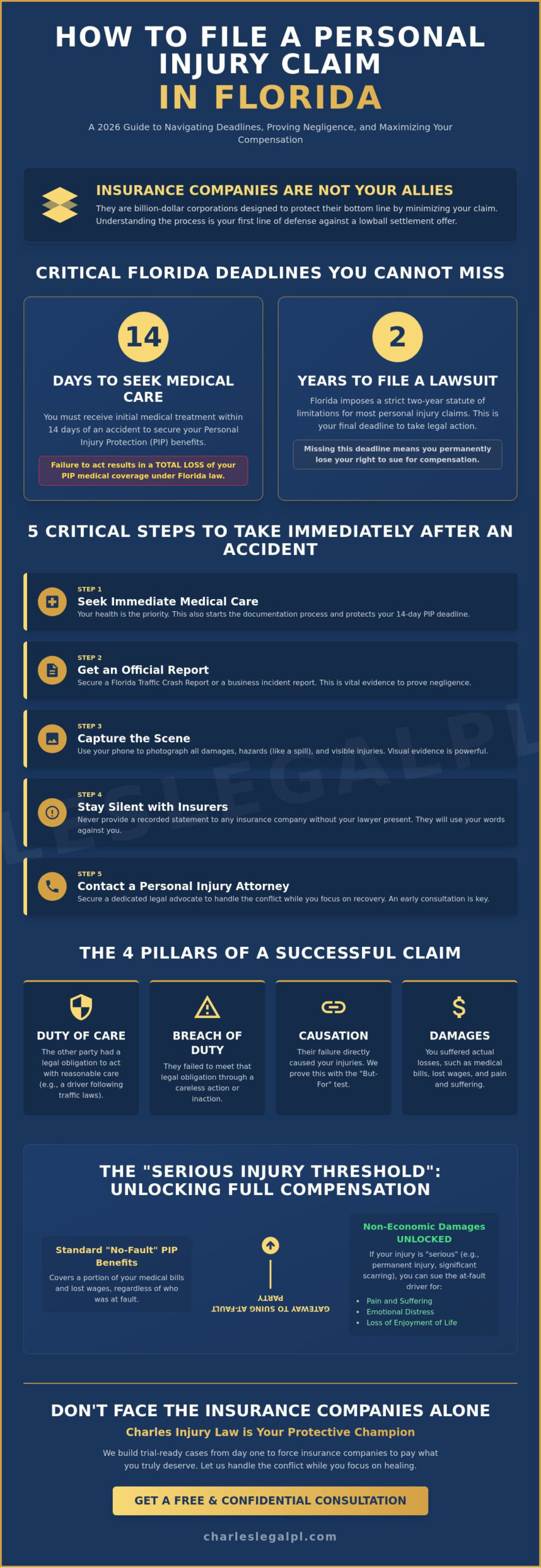
- Seek medical attention within 14 days to secure your PIP benefits. If you fail to act quickly, then you may suffer a total loss of medical coverage under Florida law.
- Learn the precise process for how to file a personal injury claim in Florida. This guide provides a clear timeline to help you navigate the strict two-year statute of limitations.
- Identify if your injuries meet the serious injury threshold. This legal gateway is the only way to recover non-economic damages like pain and suffering from an at-fault driver.
- Force insurance companies to pay what you deserve by using a trial-ready strategy. Charles Injury Law acts as your protective champion; ensuring your case is never undervalued.
- Secure official documentation immediately; such as a Florida Traffic Crash Report. This evidence is vital for proving negligence in Miami, in Palm Beach, or in Boca Raton.
The Legal Foundation: What Qualifies as a Personal Injury Claim in Florida?
A personal injury claim is not a simple request for help. It is a legal battle for accountability. You file a claim when you suffer physical or emotional harm due to the negligence of another party. If another person fails to act with reasonable care, then they are legally responsible for your recovery. Understanding What is a Personal Injury Claim? provides the base for your legal journey. Most victims in Miami or in Fort Lauderdale don’t realize that intent is irrelevant. You don’t have to prove they meant to hurt you. You only have to prove they were careless.
Learning how to file a personal injury claim in Florida starts with identifying the four pillars of negligence. These are the legal benchmarks that Charles Injury Law uses to build your case. If any pillar is missing, the insurance company will use that weakness to deny your compensation. The pillars include:
- Duty of Care: The defendant had a legal obligation to act safely.
- Breach of Duty: The defendant failed to meet that obligation.
- Causation: This failure directly caused your injury.
- Damages: You suffered actual losses, such as medical bills or pain and suffering.
Common claims in Florida involve injuries from car accidents, slip and fall accidents, and general premises liability. Regardless of the scenario, the mission is the same: securing financial restitution for your losses.
Establishing a Duty of Care under Florida Law
A duty of care exists when the law recognizes a relationship between you and the defendant. Drivers in Florida owe a duty to others on the road to follow traffic laws and stay alert. Florida property owners have a legal obligation to maintain their premises in a reasonably safe condition for all lawful visitors. If a business in Boca Raton or in Palm Beach ignores a spill or a broken stair, then they have breached this duty. Florida statutes use the standard of “reasonable care” to measure this obligation. It asks what a prudent person would have done in the same situation.
Proving Causation and Tangible Damages
5 Critical Steps to Take Immediately After an Accident in Florida
The first 72 hours after an incident are a legal war zone. If you don’t act with precision, then you risk losing your right to financial restitution. Knowing how to file a personal injury claim in Florida requires more than just filling out forms. It requires a strategic defense of your rights from the moment the impact occurs. You are the target of aggressive insurance adjusters who want to settle your case for pennies. You must build a protective shield around your claim immediately by following these five steps.
- Step 1: Seek Medical Care. You have exactly 14 days to see a doctor or you lose your insurance benefits.
- Step 2: Get the Report. Secure a Florida Traffic Crash Report or a formal incident report if the injury happened in a business.
- Step 3: Capture the Scene. Use your phone to take high-resolution photos of all damages, hazards, and visible injuries.
- Step 4: Stay Silent. Never provide a recorded statement to an insurance company without your lawyer present.
- Step 5: Call Charles Injury Law. Secure a dedicated ally to handle the conflict while you recover.
Navigating the 14-Day Rule for Medical Treatment
Florida law is strict regarding Personal Injury Protection (PIP). If you wait longer than 14 days to seek initial medical treatment, then your insurer will deny your PIP coverage entirely. This is a non-negotiable deadline. Under Florida’s No-Fault Insurance System, your own insurance pays for 80% of your medical bills up to $10,000. However, you only access the full $10,000 if a physician diagnoses you with an Emergency Medical Condition (EMC). Without an EMC diagnosis, your benefits are capped at $2,500. Early medical records are the bedrock of your claim. They prevent insurers from arguing that your pain is unrelated to the accident.
The Art of Evidence Collection at the Scene
Evidence disappears fast. If you are physically able, you must document everything in Miami or in Boca Raton before the scene is cleared. Take wide-angle shots of the entire area and close-ups of specific vehicle damage or property defects. Collect the names and phone numbers of any witnesses. Do not rely on the police to gather every detail. Most importantly, never admit fault or apologize. A simple “I’m sorry” can be twisted into a confession of liability by a defense attorney. Learn more about evidence in car accidents to ensure your documentation is trial-ready. If you have questions about the evidence you’ve already gathered, you should reach out to our team for immediate guidance.
Understanding the Florida No-Fault System and the Serious Injury Threshold
Florida operates under a no-fault insurance system. This means your first line of financial defense is your own Personal Injury Protection (PIP) coverage. Regardless of who caused the accident in Miami or in Fort Lauderdale, your insurer pays for 80% of medical bills and 60% of lost wages. This coverage is capped at $10,000. For many victims, this amount is exhausted within hours of arriving at the hospital. If your losses exceed this limit, then you must understand how to file a personal injury claim in Florida to seek additional restitution from the at-fault party.
You cannot sue for non-economic damages like pain and suffering unless your injuries meet the “serious injury threshold.” The Florida Statutes define this threshold strictly. To step outside the no-fault system, your injury must involve at least one of the following criteria:
- Significant and permanent loss of an important bodily function.
- Permanent injury within a reasonable degree of medical probability.
- Significant and permanent scarring or disfigurement.
- Death.
Charles Injury Law acts as your protective champion to prove these criteria. We utilize medical experts to document the permanent nature of your harm. If we can’t prove you meet this threshold, then the insurance company will successfully block your claim for pain and suffering.
Bypassing PIP: Pursuing a Liability Claim
When PIP isn’t enough, you must target the at-fault driver’s Bodily Injury (BI) liability coverage. This is a critical step in the process of how to file a personal injury claim in Florida for those with catastrophic injuries. Many drivers in Palm Beach or in Boca Raton carry BI limits that far exceed the standard PIP cap. Navigating this transition requires a deep understanding of Understanding Florida’s No-Fault status. We fight to ensure the at-fault party’s insurance pays for the medical debt that PIP leaves behind.
Comparative Fault: Protecting Your Percentage of Recovery
Florida’s 2023 tort reform significantly changed the landscape of negligence cases. We now operate under a modified comparative negligence system. If you are found to be more than 50% at fault for an accident, then you are legally barred from recovering any damages. If your fault is 50% or less, your compensation is reduced by your percentage of blame. Insurance adjusters will aggressively try to shift the blame onto you to save their company money. We combat these tactics with immediate evidence and assertive advocacy to protect your financial outcome.
The Procedural Journey: From Demand Letter to Filing a Lawsuit
Winning a case isn’t just about the facts; it’s about the process. Once your medical treatment reaches a stable point, the real legal maneuvering begins. This phase is where most victims fail because they don’t understand the tactical requirements of how to file a personal injury claim in Florida. You aren’t just asking for a check. You are demanding accountability from a billion-dollar insurance carrier that wants to pay you nothing. If you want a superlative outcome, then you must follow a strict procedural path that leaves no room for error.
The Power of a Comprehensive Demand Package
Your first major strike is the demand letter. We don’t send a simple note. Charles Injury Law drafts a comprehensive settlement package that forces the insurer to see the risk of going to trial. This is a vital part of how to file a personal injury claim in Florida for maximum value. A professional demand package often leads to higher settlements in Fort Lauderdale or in Miami. This package typically includes:
- Detailed medical chronologies and all associated bills.
- Verification of lost wages and loss of future earning capacity.
- Irrefutable evidence of the defendant’s negligence and liability.
If the insurance company refuses to negotiate fairly, then we move to the next stage of combat. You can learn more about how to fight a denied insurance claim to see how we handle stubborn adjusters. Timing is also critical. Under Florida law, specifically since the 2023 tort reform, you generally have only two years from the date of the accident to file your lawsuit. If the two-year window closes, then your right to recover is gone forever.
Discovery, Depositions, and Mandatory Mediation
Once we file a formal complaint in the appropriate Florida circuit court, we enter the discovery phase. This is an aggressive exchange of evidence. We take sworn testimony from the defendant and witnesses during depositions. This process exposes the truth and weakens the insurance company’s defense. Florida law also requires mandatory mediation in almost every personal injury case. This is a formal meeting where both sides attempt to settle before trial. Because of our trial-ready reputation, 90% of Florida personal injury cases are resolved during these phases without ever seeing a jury. If you’re ready to start this journey, you should contact our legal team today for a strategic review of your case.
Securing Maximum Compensation with Charles Injury Law
Charles Injury Law is your Protective Champion. We act as a formidable shield for the injured. Knowing how to file a personal injury claim in Florida is only half the battle; having the right advocate is the other. Our voice is combative toward insurance companies. It is deeply comforting to you. We pursue accountability with a confrontational spirit. This approach ensures superlative outcomes. If you are recovering from a crash, then we handle the conflict. You focus on healing. We handle the litigation. We prepare every case as if it is going to a jury in Florida. Most firms settle for the first offer. We don’t. We are trial-ready from day one. This assertive energy defines our firm.
Our commitment is entirely risk-free. If we don’t secure a financial recovery for you, then you pay us nothing. This directness removes the cognitive load from your shoulders. We serve clients across South Florida, including in Miami, in Fort Lauderdale, and in Boca Raton. We understand the specific local challenges of South Florida roads. We know how to navigate the legal landscape to protect your interests. Our mission is to secure the restitution you need to move forward. We provide the expert advocacy required to succeed against larger adversaries. We are small enough to care personally but experienced enough to win.
Aggressive Advocacy Against Insurance Tactics
Insurance carriers are billion-dollar entities. They use stall tactics to wear you down. They make lowball offers to save money. We counter these moves with immediate authority. We know how to file a personal injury claim in Florida that stands up to scrutiny. Our team works to uncover every available insurance policy. This includes secondary layers of coverage that other firms might miss. We maximize your recovery by being more prepared than the opposition. We utilize technical terms regarding liability and litigation to establish professional credibility. This ensures the insurance company knows we are serious. Explore our personal injury practice areas to see the breadth of our expertise.
Start Your Recovery Today with a Free Consultation
Your initial case evaluation is straightforward and professional. We remove the legal jargon. We explain the path to financial restitution clearly. You gain immediate peace of mind. A professional force is now handling your conflict. We take the weight of the insurance company off your back. Our communication rhythm is rapid and urgent. We are perpetually ready to act on your behalf. If you are ready to take a stand, then we are ready to fight for you. Contact Charles Injury Law today for a free case evaluation. We are available to help you secure the justice you deserve.
Take Command of Your Legal Recovery
You now possess the roadmap to navigate Florida’s complex legal system. Remember that the 14-day medical rule and the strict two-year statute of limitations are non-negotiable. If you fail to meet these deadlines, then your right to restitution disappears. Understanding how to file a personal injury claim in Florida is your first step toward holding negligent parties accountable. You don’t have to face aggressive insurance adjusters alone. Charles Injury Law acts as your formidable shield; ensuring your voice is heard and your damages are fully valued.
Our firm provides trial-ready representation focused on maximum compensation for victims in Miami, in Fort Lauderdale, and in Boca Raton. We operate on a no-win, no-fee guarantee. This means you pay nothing unless we win your case. We are the expert advocate you need to succeed against larger adversaries. Don’t let a lowball offer define your future. You deserve a dedicated ally who fights for the superlative outcomes you need to recover.
Secure Your Maximum Recovery; Contact Charles Injury Law Today
Frequently Asked Questions
How long do I have to file a personal injury claim in Florida?
You have exactly two years from the date of your injury to file a negligence-based lawsuit in Florida. This strict deadline was established by legislation that took effect on March 24, 2023. If you fail to file within this two-year window, then you lose your legal right to seek financial restitution forever.
What is the 14-day rule for Florida car accidents?
The 14-day rule requires you to seek initial medical treatment within 14 days of an accident to preserve your Personal Injury Protection (PIP) benefits. If you wait longer than 14 days, then your insurance company will deny your claim for medical bills and lost wages. This rule is a non-negotiable requirement under Florida law.
Can I still file a claim if the accident was partially my fault?
You can recover damages as long as you are 50% or less at fault for the incident. Florida follows a modified comparative negligence system. If you are found to be more than 50% responsible for the accident, then you are legally barred from recovering any compensation from other parties.
How much does it cost to hire a personal injury lawyer in Florida?
Hiring Charles Injury Law involves no upfront costs because we work on a contingency fee basis. We only receive payment if we successfully secure a financial recovery for you. This risk-free structure ensures that you can pursue accountability without worrying about immediate legal expenses while you recover.
What is the ‘Serious Injury Threshold’ under Florida law?
The serious injury threshold is a legal gateway that allows you to sue for non-economic damages like pain and suffering. To meet this threshold, your injury must involve significant and permanent loss of a bodily function, permanent scarring, or disfigurement. Proving this is a critical part of how to file a personal injury claim in Florida.
Do I have to go to court to win my personal injury case?
Most personal injury cases in Miami or in Fort Lauderdale are resolved through settlement negotiations or mandatory mediation. You don’t necessarily have to go to trial to win. However, we prepare every case as if it is going to a jury to force the insurance company to offer a superlative settlement.
What damages can I recover in a Florida personal injury claim?
You can recover economic damages for medical bills and lost wages, as well as non-economic damages for pain and suffering. Understanding how to file a personal injury claim in Florida ensures you document every loss. We fight to uncover every available insurance policy to maximize the total value of your financial restitution.
How long does a typical personal injury case take to settle in Florida?
The timeline for a settlement varies from a few months to over a year depending on your medical treatment. We wait until you reach Maximum Medical Improvement (MMI) before finalizing a claim. This ensures we don’t settle for less than what you need to cover your long-term medical care and future lost earnings.
Disclaimer
The information provided on this blog is for general informational purposes only and does not constitute legal advice. Viewing this content does not create an attorney-client relationship with the firm. You should not act or rely on any information contained herein without seeking legal advice from a qualified attorney regarding your individual situation.