



What if a single percentage point was the only thing standing between you and the settlement you need to recover? If you’re dealing with the aftermath of an accident in Florida, you’re likely facing aggressive insurance adjusters who want you to admit fault. It is a high-stakes game where being 51% responsible means you get zero compensation. This Florida comparative negligence law explained will clarify how the 2023 legal shifts impact your specific case in 2026.
You deserve to know the truth about your recovery. We understand the fear of walking away empty-handed after a serious injury in Miami or Palm Beach. Charles Injury Law acts as your shield against these corporate tactics. You will learn exactly how the 51% bar rule works and why the right legal strategy is critical to your financial restitution. We’ll preview the math behind potential settlements and show you how we fight to keep the “at-fault” label off your shoulders. This article breaks down the governing Florida statutes so you can move forward with confidence.
Key Takeaways
- Florida now uses a 51% bar rule, meaning if you are found more than 50% at fault for your own injuries, you are legally barred from recovering any damages.
- Discover how your settlement is calculated and why every percentage point of fault assigned to you by an insurance company directly reduces your final compensation.
- This Florida comparative negligence law explained guide details the massive 2023 tort reform shift that transformed how personal injury cases are litigated in Florida.
- Learn why aggressive legal advocacy in Miami and Fort Lauderdale is the only way to counter insurance companies trying to push you over the 51% fault limit.
- See how Charles Injury Law acts as your shield, utilizing evidence like “Black Box” data to prove the negligence of others and secure your financial restitution.
Florida Comparative Negligence Law Explained: The New 51% Bar Rule
Florida comparative negligence law explained is the legal framework used to distribute fault among parties after an incident. It dictates how much you can recover based on your role in the accident. For decades, Florida allowed victims to recover damages even if they were mostly responsible. That era ended on March 24, 2023. Governor Ron DeSantis signed House Bill 837, which fundamentally changed how Florida law handles negligence claims. This shift moved the state from a “pure” system to a “modified” system for most personal injury cases. If you are injured in Florida today, the rules are much harsher. You’re now fighting against a system designed to protect the bottom lines of massive insurance corporations.
The ‘Greater Than 50%’ Recovery Bar in Florida
The 51% bar acts as a legal cliff where your right to financial compensation completely vanishes. Under the current comparative negligence standard, being 50.1% at fault is legally identical to being 100% at fault. If a jury decides you are slightly more than half responsible, you receive zero dollars. This “all or nothing” threshold is a weapon for defense attorneys. It applies to nearly every negligence action, including car accidents in Florida. If you don’t have an advocate to keep your fault percentage low, you risk losing everything. The law isn’t about fairness anymore; it’s about reaching a specific mathematical threshold to deny liability.
Why Fault Distribution is the New Legal Battleground
Liability is no longer just a factor in your settlement; it’s the gatekeeper of your entire claim. Insurance adjusters in Miami and Fort Lauderdale aren’t looking to help you. They’re hunting for any reason to push your fault percentage over that 51% mark. They often use recorded statements to trick victims into admitting minor distractions or errors. If they succeed, your claim dies instantly. At Charles Injury Law, we treat fault distribution as a high-stakes battle that begins the moment you call us. We gather the evidence needed to lock in the other party’s negligence before they can rewrite the narrative. We act as a shield, ensuring that the blame stays where it belongs: on the person who caused your injuries.
This new legal landscape creates a massive incentive for insurance companies to be more aggressive than ever. They know that if they can shift just enough blame, they can avoid paying for your medical bills and lost wages entirely. Protecting your recovery in 2026 requires more than just filing paperwork. It requires a confrontational spirit and an expert understanding of Florida statutes. If you want to secure a superlative outcome, you must win the fight over fault percentages.
Pure vs. Modified Negligence: Understanding the 2023 Tort Reform in Florida
Having the Florida comparative negligence law explained is the first step to securing your future after a sudden injury. Before the 2023 reform, Florida was a pure comparative negligence state. This meant the courtroom doors were open to everyone regardless of their level of fault. If a jury found you 90% at fault for an accident, you could still recover 10% of your damages. It was a system rooted in partial accountability. Today, that safety net is gone for most cases of personal injury in Florida. The law has moved from a sliding scale of justice to a rigid barrier that favors large corporations.
The shift to a modified standard is one of the most significant pivots in Florida legal history. Understanding Pure vs. Modified Negligence is essential for anyone injured after March 24, 2023. This Florida comparative negligence law explained guide clarifies why the legislation was a strategic move to protect insurance companies from high-value payouts. It effectively ended the era of shared responsibility for most accidents. However, there is one major exception you must know. Florida law still applies the pure comparative negligence standard to medical negligence cases. In those specific instances, you can still recover damages even if you are more than 50% responsible.
The Legacy of Pure Comparative Negligence
Florida followed the pure standard for 50 years, from 1973 to 2023. This legacy was built on the idea that every negligent party should pay their fair share. In cities like Fort Lauderdale, that same 90% at-fault victim who once received compensation now walks away with nothing. This change represents a massive win for insurers who no longer have to pay for their portion of the blame if the victim is slightly more responsible.
How the 2023 Law Impacts 2026 Accident Claims
For claims filed in 2026, the date of your incident determines your legal path. Most current cases are governed by the 51% bar. Insurers in Boca Raton and Miami are now more aggressive than ever. They litigate every minor detail to push your fault percentage just past the halfway mark. They want to trigger that legal cliff to deny your payout entirely. This winner-take-all reality means you cannot afford a passive legal strategy. Charles Injury Law acts as your shield against these corporate tactics. If you’re unsure how these rules apply to your specific situation, you should reach out for a case review to protect your rights.
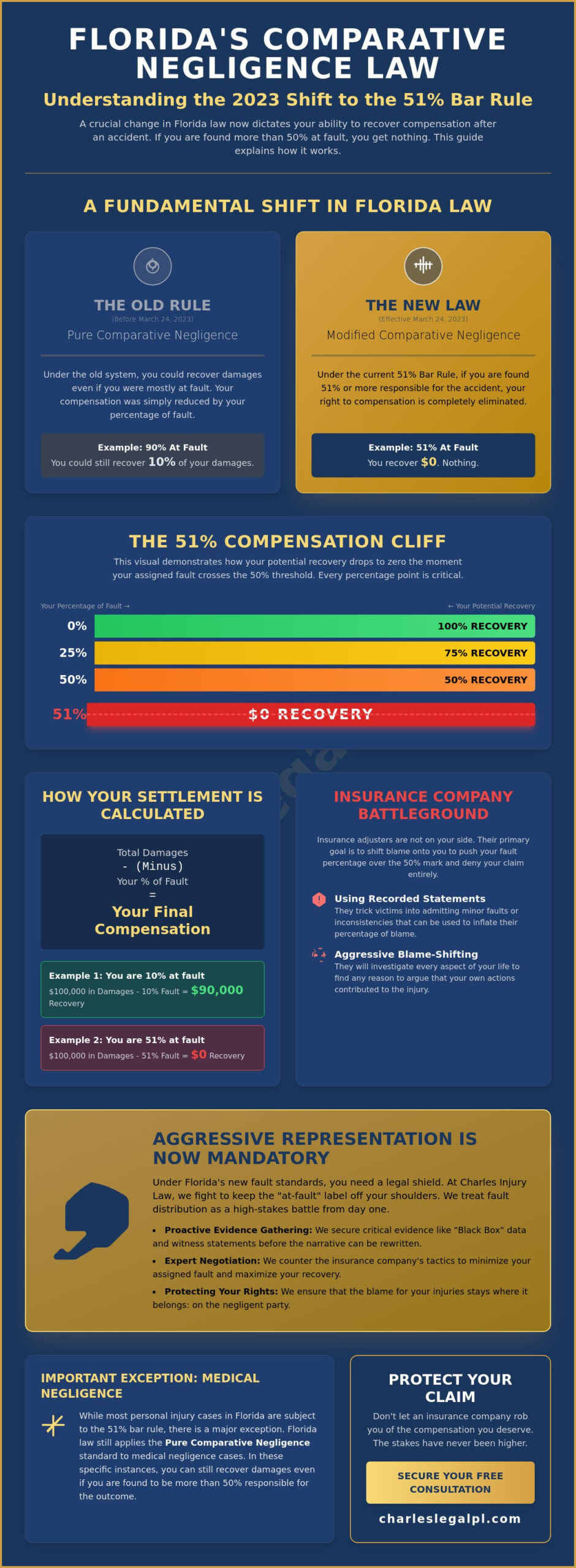
Calculating Your Recovery: How Fault Percentages Reduce Settlements in Florida
Understanding the specific math behind your settlement is the only way to protect your future. Under Florida’s New Fault Standards, your financial recovery is directly tied to the percentage of negligence assigned to you. If you’re found 50% or less at fault, you can still recover damages, but the total check is reduced by your share of the blame. This calculation isn’t just a suggestion; it’s a legal mandate that affects every dollar you receive for medical bills, lost wages, and pain and suffering in Florida. Every percentage point the insurance company pins on you is money they get to keep in their pockets. Charles Injury Law views every settlement negotiation as a battle for these percentages.
The Cost of Fault: A Quick Comparison
- 0% Fault: You receive 100% of your awarded damages.
- 25% Fault: Your total recovery is reduced by one-quarter.
- 50% Fault: You receive exactly half of your total damages.
- 51% Fault: Your recovery is legally barred. You receive $0.
The Math of a Florida Injury Settlement
The stakes of fault assignment are highest when the injuries are severe. Imagine a jury returns a verdict of $200,000 for your damages. If the evidence shows you were 25% responsible for the incident, the court automatically deducts $50,000 from your award. You take home $150,000. This math becomes even more dangerous in high-stakes litigation, such as truck accidents in Florida. In these cases, the damages are often massive, making even a 5% shift in fault worth tens of thousands of dollars. We use aggressive advocacy to ensure the jury sees the full picture of the defendant’s negligence.
Hitting the 51% Cliff: A Case Study
This is where the Florida comparative negligence law explained becomes a nightmare for the unprepared. The difference between 50% and 51% fault is the most expensive 1% in the legal world. Consider two victims with $100,000 in damages. Victim A is found 50% at fault and recovers $50,000. Victim B is found 51% at fault and recovers nothing. That single percentage point creates a total loss of recovery. Insurance adjusters in Miami and Fort Lauderdale are trained to find that extra 1% to kill your claim. Charles Injury Law uses accident reconstruction experts and forensic evidence to keep our clients on the right side of that line. We don’t just explain the law; we fight the math that insurance companies use against you.
Defending Your Claim: How to Prove Liability in Miami and Fort Lauderdale
Proving liability is your first line of defense in a system designed to deny your recovery. Under the Florida comparative negligence law explained in previous sections, the burden of proof sits squarely on your shoulders. You must demonstrate that the defendant’s negligence was the primary cause of your injuries. This isn’t a friendly negotiation; it’s a high-stakes investigation. Insurance companies in Miami and Fort Lauderdale are already working to build a case against you. To secure a superlative outcome, you must secure the evidence before it disappears or is manipulated by opposing adjusters.
Winning isn’t accidental. It requires immediate, aggressive action to preserve facts. For example, gathering “Black Box” or Event Data Recorder (EDR) information is essential for proving speed and braking patterns in rideshare accidents in Florida. Witness statements must be recorded immediately. If you wait too long, memories fade or insurance representatives may influence their story. Charles Injury Law acts as your shield, deploying investigators to lock down the facts while you focus on healing.
4 Steps to Protect Your Right to Recovery
- Step 1: Never admit fault or apologize at the scene in Florida. Even a polite “I’m sorry” can be twisted into a legal admission of liability.
- Step 2: Document the scene with photos and video from every angle. Capture skid marks, traffic signals, and vehicle damage.
- Step 3: Seek immediate medical attention to link your injuries directly to the crash. Gaps in treatment provide insurers with an excuse to deny your claim.
- Step 4: Contact Charles Injury Law before speaking to any insurance adjuster. We handle the communication so you don’t accidentally sabotage your own case.
Using Accident Reconstruction to Beat the 51% Rule
In complex disputes, expert accident reconstruction is often the only way to beat an unfair fault assignment. We work with engineers who use forensic data to prove speed, braking, and the exact point of impact. This scientific evidence is difficult for a jury to ignore. It can shift a dangerous 60/40 fault split back to a 30/70 split, moving you from zero recovery to a significant settlement. Our trial-ready philosophy means we prepare every case as if it’s going to court. We don’t accept the insurance company’s version of the truth. If you want a firm that fights the “at-fault” designation with every resource available, you should contact our team for a case review immediately.
Why Aggressive Representation is Mandatory Under Florida’s New Fault Standards
The transition to a modified system has turned every insurance negotiation into a high-stakes litigation battle. With the Florida comparative negligence law explained, it’s clear that insurance companies are no longer looking for a fair middle ground. They are looking for a way to trigger the 51% bar and pay you nothing. This shift has removed the “slow” phase of legal recovery. You are either winning the fight for liability or you are losing your right to compensation. Passivity is the quickest path to a denied claim.
Insurers in Palm Beach and Boca Raton maintain extensive databases on law firms. They know exactly which attorneys are willing to go to trial and which ones will settle for the first lowball offer. If your representation lacks a confrontational spirit, the insurance company will exploit that weakness. Charles Injury Law is built on a trial-ready philosophy. We don’t just file paperwork. We prepare every case to be decided by a Florida jury if the opposing party refuses to acknowledge the truth of their negligence. We demand superlative outcomes for our clients.
Combative Advocacy Against Insurance Giants
We do not negotiate from a position of weakness. Our approach to denied insurance claims in Florida is rooted in accountability. We demand full restitution for your injuries and will not accept excuses from corporate adjusters. Charles Injury Law acts as your shield. We take the aggressive hits from defense lawyers and insurance giants so you can focus entirely on your physical recovery. We are the expert advocate you need when the stakes are at their highest.
Secure Your Future with Charles Injury Law
The path to recovery involves a clear, rapid process: consultation, investigation, litigation, and finally, your financial restitution. Time is your greatest enemy in 2026. As part of the 2023 tort reform, the statute of limitations for general negligence was reduced from four years to just two years for incidents occurring after March 24, 2023. If you wait, you lose. Evidence disappears and legal deadlines expire. You need a professional force handling the conflict on your behalf immediately. You should contact Charles Injury Law for a free case evaluation in Florida to lock in your rights before the clock runs out.
Secure Your Restitution Under Florida’s New Fault Standards
The legal standards in Florida have changed. Insurance companies now use the 51% bar as a weapon to deny legitimate claims entirely. This Florida comparative negligence law explained guide highlights why you cannot leave your recovery to chance. Your settlement depends on keeping your fault percentage low. If you don’t have a trial-ready force fighting for you, you risk receiving zero compensation for your medical bills and pain and suffering.
Charles Injury Law has provided protective advocacy for victims in Florida since 2012. We possess the expertise in Florida insurance litigation needed to counter aggressive adjusters in Miami and Palm Beach. We don’t settle for less than you deserve. We prepare every case to win in front of a jury. You focus on your physical recovery while we act as your shield against corporate tactics.
Don’t let an insurance company dictate the value of your life. Fight back against unfair fault assignments; Schedule your free consultation with Charles Injury Law today. You have the right to seek maximum compensation. We are ready to stand by your side and secure the superlative outcome you need to move forward.
Frequently Asked Questions
What is the 51% rule in Florida?
The 51% rule is a legal barrier that prevents you from recovering any compensation if you are found more than 50% responsible for your own injuries. This modified standard became effective on March 24, 2023, under Florida Statute § 768.81. If you hit that 51% threshold, the law bars your claim entirely. We fight to keep your liability below this cliff to protect your financial future.
Can I still sue if I was partially at fault for an accident in Florida?
You can still recover damages if you were partially at fault, provided your responsibility doesn’t exceed 50%. Under the Florida comparative negligence law explained in this guide, your total award is simply reduced by your percentage of fault. If you’re 30% responsible, you receive 70% of the verdict. Charles Injury Law ensures the other party pays their maximum fair share.
How is fault determined in a Florida car accident?
Fault is determined by a jury or insurance adjuster based on the preponderance of evidence collected after the crash. This includes police reports, traffic camera footage, and witness testimony in Miami or Fort Lauderdale. We utilize accident reconstruction experts to analyze vehicle data and physical evidence. This aggressive investigation prevents insurance companies from unfairly inflating your fault percentage.
Does the modified comparative negligence law apply to slip and fall cases in Florida?
The modified comparative negligence standard applies to most slip and fall cases in Florida. If a business owner in Boca Raton proves you were 51% responsible for your fall, you recover nothing. We counter these defenses by proving the property owner’s failure to maintain a safe environment. Protective advocacy is essential to overcome the “open and obvious” arguments used by defense lawyers.
What happens if a jury finds me exactly 50% at fault in Florida?
You are still eligible for recovery if you are found exactly 50% at fault. In this scenario, you receive exactly half of your total damages. The 51% bar only triggers when your negligence is greater than the combined negligence of all other parties. This narrow one percent margin is why every piece of evidence we gather is critical to your case outcome.
How did the 2023 tort reform change negligence laws in Florida?
The 2023 tort reform shifted Florida from a pure system to a modified system for most personal injury claims. This Florida comparative negligence law explained section shows why the change is so dangerous for victims. The reform also reduced the statute of limitations for general negligence from four years to two years for incidents occurring after March 24, 2023. You must act quickly to secure your right to sue.
Can I recover damages if I wasn’t wearing a seatbelt in Florida?
You can still recover damages even if you weren’t wearing a seatbelt, but it will likely increase your fault percentage. The defense will argue that your failure to use a safety device contributed to the severity of your injuries. We fight to minimize the impact of this seatbelt defense. We focus on the defendant’s actions as the primary cause of the collision to secure your restitution.
Why is a lawyer necessary to fight a comparative negligence claim in Miami?
A lawyer is necessary because insurance companies in Miami use the new law to deny claims entirely. They have a massive financial incentive to push your fault past the 51% mark. Charles Injury Law acts as your shield, handling all communications and building a trial-ready case. If you don’t have an expert advocate, you’re walking into a high-stakes battle without protection.
Disclaimer
The information provided on this blog is for general informational purposes only and does not constitute legal advice. Viewing this content does not create an attorney-client relationship with the firm. You should not act or rely on any information contained herein without seeking legal advice from a qualified attorney regarding your individual situation.