



A rental company isn’t automatically liable just because its vehicle was involved in a crash. In Florida, responsibility may rest with the rental-car driver, another driver, or the rental company if negligent maintenance or entrustment contributed to the collision. A lawyer for a car accident with Budget Rent a Car can help assess potential responsibility and identify relevant evidence.
It’s understandable to worry about medical bills, missed income, and damage to your vehicle while the insurance questions are still unfolding. Fault can affect who pays, and the severity of an injury can shape the losses you may pursue. This article explains how liability may work after a rental-car crash in Fort Lauderdale and how injury-related costs and settlement factors fit into the picture.
You’ll learn how a rental company’s role differs from a driver’s, which records can help clarify a crash, and how medical expenses, lost income, property damage, and injury severity may relate to a claim. The aim is to help you understand the issues and consider your next steps.
Key Takeaways
- A rental company isn’t automatically responsible for a crash. Liability may depend on whether negligent maintenance or entrustment contributed to it.
- Fault can involve more than one driver, and evidence about the collision may affect how responsibility is assessed.
- Medical records, treatment history, proof of missed income, and property damage documentation can help show the financial impact of an accident.
- Injury severity can affect the losses considered in a settlement, including ongoing medical needs and effects on daily life.
- Rental-car damage charges and accident-related expenses may raise separate insurance questions from an injury claim.
Who Pays After a Rental Car Accident?
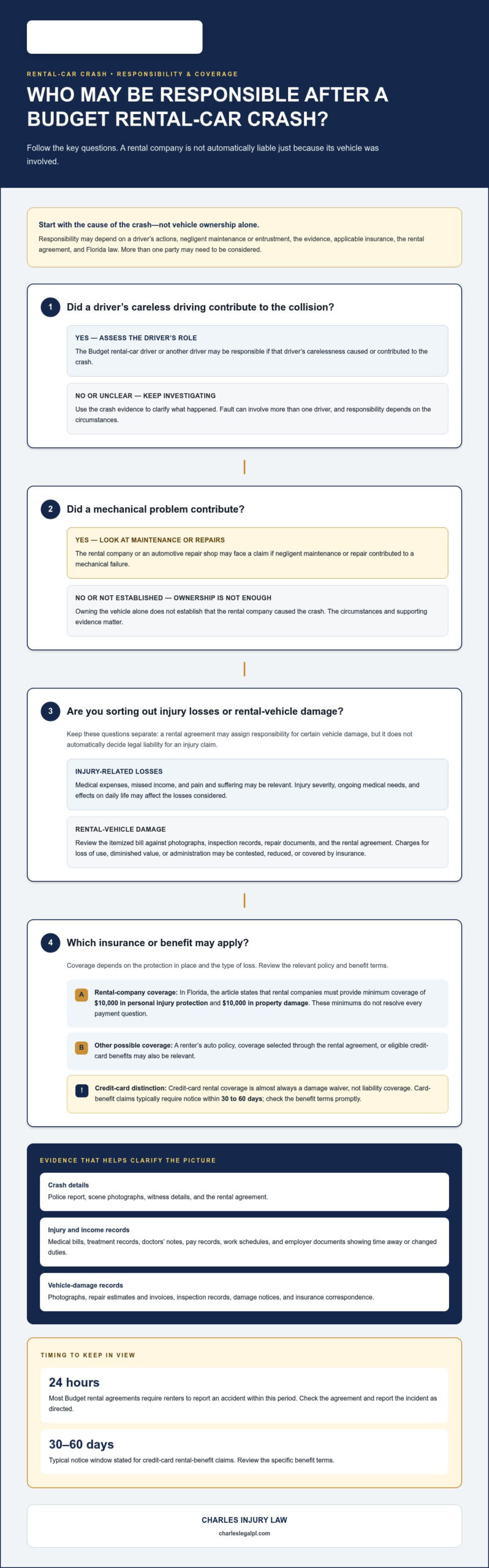
Responsibility after a Budget rental-car accident depends on the circumstances, including whether a driver or another party’s negligence contributed. A rental agreement may assign the renter responsibility for certain vehicle damage, but it does not automatically determine legal liability for an injury claim. The agreement, insurance policies, crash evidence, and Florida law may all be relevant.
Potentially responsible parties may include the Budget rental-car driver, another driver, the rental company, or an automotive shop. A driver may be liable for a collision caused by careless driving. A company or repair shop may also face a claim if negligent maintenance contributed to a mechanical failure. Vehicle ownership alone does not establish that the rental company caused the crash.
In Florida, according to the Florida Legislature, rental companies must provide minimum coverage of $10,000 in personal injury protection and $10,000 in property damage. That minimum does not resolve every payment question. A renter’s auto insurance, coverage selected through the rental agreement, or other applicable insurance may also affect which policy handles injury or vehicle-damage claims.
Most Budget rental agreements require renters to report an accident within 24 hours. Contact the rental company using its emergency number, ask what to do with the vehicle, and report the incident. Notify your insurer and any card-benefits provider promptly. A police report, scene photographs, witness details, and the rental agreement can help establish what happened and which coverage may apply.
Does Budget’s rental agreement make the renter responsible for accident damage or injuries? It may assign contractual responsibility for certain vehicle damage, but it does not by itself decide legal liability for injuries. The driver’s actions, the agreement, and applicable insurance terms may help clarify responsibility.
What should I do after a car accident involving a Budget vehicle? Report the crash to Budget within the agreement’s 24-hour period, contact your insurer, and preserve the police report and photographs. Get medical care for injuries, and keep treatment records and witness contact details.
What insurance coverage applies to a Budget rental-car accident in Florida? The rental company’s applicable coverage, a personal auto policy, rental coverage, or eligible card benefits may be relevant. Review the applicable policy terms, since coverage depends on the protection in place and the type of loss.
To find a personal injury lawyer for a rental-car accident in Florida, look for an attorney who handles car-accident injury claims under Florida law. A lawyer for a car accident involving Budget Rent a Car may help assess disputed liability or coverage. Attorney fees depend on the written agreement; under a contingency arrangement, the fee is tied to recovery, with the terms explained in that agreement.
Medical expenses, lost income, and property damage
Medical costs after a rental-car accident may include hospital care, surgery, follow-up visits, medication, and rehabilitation. Keep bills, treatment records, and doctors’ notes together. These records document care and how treatment progresses. If symptoms continue, note each visit and how the injury affects everyday tasks, such as driving or working.
Lost income may include pay missed during treatment or recovery. Save pay records, schedules, and employer documents showing time away from work. If an injury limits your duties after you return, keep records of the changes and dates. A claim may also include future medical expenses or missed income when the injury’s effects continue beyond initial treatment.
Document property damage separately. Photograph the damaged vehicle and keep repair estimates, invoices, and insurance correspondence. Witness accounts and a police report may provide additional information about the collision. Compare repair charges with the documented damage. A rental-car damage bill does not measure every loss related to a personal injury.
Compensation may also include pain and suffering related to an injury. Effects may include distress, disrupted sleep, or difficulty returning to normal activities. Note concrete changes and discuss symptoms with treating medical professionals. If a loved one dies in a crash, a wrongful-death claim may address losses suffered by eligible surviving family members and expenses connected with the death.
Budget may send a vehicle-damage bill weeks or months after the accident. Review its itemized charges against photographs, inspection records, repair documents, and the rental agreement. Charges for loss of use, diminished value, or administration can be contested, reduced, or covered by insurance. Ask for supporting records for disputed items, then send the insurer copies of the bill and relevant evidence.
A collision damage waiver is different from liability coverage. The Federal Trade Commission says rental companies may offer additional coverage, and renters may already have protection through an auto or homeowner’s policy. Credit-card rental coverage is almost always a damage waiver, not liability coverage. Card-benefit claims typically require notice within 30 to 60 days after the incident, so review the benefit terms promptly.
Keep the rental agreement, damage notices, medical records, income documents, repair paperwork, and insurance correspondence together. Separate rental-vehicle repair charges from injury-related losses. This helps distinguish the policies and evidence relevant to each part of a claim. Clear records also make it easier to identify charges that do not match the documented damage.
How injury severity may affect a settlement
Injury severity can affect a claim because it influences the losses connected to the crash. A brief injury with limited treatment differs from a fracture requiring surgery and extended rehabilitation. Consider how the injury affected health, work, and daily activities over time, as well as the initial symptoms.
Medical records can document how an injury progresses. Emergency evaluations, diagnostic findings, treatment plans, and follow-up notes show what happened and what care was provided. For example, records of continued treatment for a back injury provide a fuller picture than a single visit. Keep appointment records and bills together to make the treatment timeline and expenses easier to review.
Recovery time matters because injuries can disrupt work and everyday responsibilities. A shoulder injury might prevent lifting at work, while a leg injury could make driving difficult. Pay records and employer documents can show missed work; records of modified duties can document continuing limitations. If symptoms persist, note their effects on specific tasks rather than relying only on a general description of pain.
Some injuries resolve, while others require continuing care. Future medical needs may be relevant when supported by treatment records and medical assessments. A claim review may consider expected follow-up care, rehabilitation, or lasting limits on movement. Distinguish completed treatment from anticipated care and document how each relates to the crash.
Pain and suffering may involve the practical effects of an injury. Difficulty sleeping, reduced mobility, or inability to take part in regular activities can help describe the personal impact. A dated journal can record changes as they occur. Specific examples, such as needing help with household tasks during recovery, add context alongside clinical records.
Insurance coverage and the applicable policy can shape a claim. Available coverage, documented losses, and evidence about the collision may affect settlement discussions. Florida’s comparative-fault rules can affect recovery when an injured person contributed to a crash. Reliable evidence is important, particularly when drivers’ accounts differ.
Before evaluating an offer, organize medical records, expense documents, work records, and evidence of continuing limitations. Compare the offer with the losses those materials support, not just the first medical bill. A lawyer for a car accident involving Budget Rent a Car can assess whether the documented injuries, recovery impact, and coverage issues have been addressed. The clearer the record, the harder it is to overlook the full effect of the injury.
Driver negligence and other accident causes
A rental-car crash may result from one driver’s actions or several contributing events. For example, a driver turning across oncoming traffic may cause a collision, while another driver’s speed may leave little time to avoid impact. Responsibility depends on the circumstances and each person’s conduct, not simply on which vehicle was rented.
Examples of driving conduct that may contribute to a crash include distraction, unsafe lane changes, following too closely, and failing to yield. A driver who looks away from traffic and strikes a vehicle ahead may have caused the initial impact. If another driver also made an unsafe maneuver, the evidence may need to account for both actions. The sequence of events matters.
Multiple vehicles can make a crash harder to understand. In a chain collision, the first impact may push one vehicle into another, or separate drivers may cause separate impacts. Damage locations, vehicle positions, witness accounts, and the police report may help distinguish these possibilities. A witness who saw the vehicles before impact may clarify which driver changed lanes or stopped suddenly.
A crash may involve causes beyond a driver’s decisions. A vehicle defect or maintenance problem could contribute if it affects steering, braking, or another function. For instance, evidence of brake failure could raise questions about the vehicle’s condition and service history. Document a mechanical concern promptly with photographs, repair records, and inspection findings.
Florida law also considers whether an injured person contributed to an accident. If the claimant’s conduct played a part, recovery may be reduced under Florida’s comparative-fault rules. A driver’s failure to yield, for example, may be considered alongside another driver’s speed. Any conclusions about each person’s contribution should be based on evidence.
Useful evidence may include the police report, scene photographs, vehicle damage, witness accounts, and available video. Compare accounts with physical evidence. For example, photographs showing the point of impact may help assess a claim that a vehicle was already stopped. Keep original files and note who provided each record so details can be traced during an insurance review.
When accounts conflict, insurers may dispute who caused the crash or how much each person contributed. A serious injury can make that disagreement more consequential because responsibility may affect recovery. A lawsuit may involve closer examination of witness testimony, vehicle damage, and other records. Evidence of the collision sequence can help distinguish supported conclusions from speculation.
Focus on the cause, each party’s possible contribution, and the available proof. If a driver’s action, a vehicle problem, or several events combined, document each issue separately. This gives insurers and, if needed, a court a clearer basis to evaluate responsibility and losses connected to the crash.
Financial losses and accident-related expenses
A rental-car crash can result in separate losses for injured people and vehicle owners. Organize expenses by category and connect each item to the collision. For example, keep transportation receipts separate from treatment bills. This helps distinguish costs related to injury, property damage, or the rental agreement.
Medical costs may continue after the first appointment. Save invoices, prescription records, and receipts for treatment-related travel. If a doctor recommends follow-up care, keep the appointment notes and related paperwork. A clear sequence helps explain why each expense arose and how it relates to the crash.
Keep a separate record of lost income. Save pay statements, employer correspondence, and schedules showing missed shifts. If a worker returns with modified duties, preserve documentation of the change. For a self-employed person, records of canceled work and ordinary business income may help explain the interruption. The evidence should connect the missed income to the injury.
Property-related charges require careful review. Budget may assess repair costs, loss of use, diminished value, or administrative fees. Compare each item with the rental agreement, damage photographs, inspection records, and repair documents. If a charge lacks supporting detail, request an itemized explanation through the claim process. Keep the response with the bill and insurance correspondence.
Some charges may be disputed, reduced, or covered by insurance. Send the insurer the bill, rental agreement, and photographs, then ask how each charge is being evaluated. A collision damage waiver may address damage to the rental vehicle, but it is distinct from liability coverage. Review the relevant policy terms before treating a waiver as payment for every loss.
Also record practical expenses caused by the crash. For example, damage to a personal vehicle may require alternative transportation while repairs are underway. Keep receipts and note why the expense was necessary. Avoid combining unrelated household purchases with accident costs. A dated expense log can help trace each amount, its purpose, and its connection to the collision.
Potential compensation depends on documented losses, available coverage, and the parties’ responsibility. An insurer’s payment for vehicle damage does not automatically resolve an injured person’s claim. Keep settlement offers, releases, and payment records together. Before accepting terms, understand which claims or expenses the document addresses, especially if medical treatment continues.
Attorneys reviewing accident-related losses can separate injury damages from rental charges and identify missing documentation. If Budget’s bill or an insurer’s position leaves expenses unresolved, discuss the accident-related losses with an attorney. Bring the rental agreement, bills, receipts, and insurance letters so the financial picture can be assessed clearly.
Personal Injury Attorney in Fort Lauderdale: Injuries suffered from Car Accidents
Charles Injury Law represents people injured in car accidents and can help assess the records and issues involved in a claim. If you need attorneys for personal injuries, bring crash documents, medical records, and insurance correspondence for discussion. The firm also handles injuries from truck, semi, and tractor-trailer accidents, Uber and Lyft rideshare accidents, and pedestrian incidents.
People comparing a personal injury firm near me, an injury lawyer near me, or a personal injury lawyer near me may also see phrases like attorneys personal injury, lawyers for auto accidents, and auto accident lawyers near me. Focus on finding representation that handles the type of crash involved. Contact Charles Injury Law to discuss your car-accident injury in Fort Lauderdale.
Call Now: (954) 390-2228 Available 24 Hours a Day, 7 Days a Week.
Choose Your Next Step With Clarity
Before signing a release or accepting a proposed resolution, understand which claims it addresses and whether unresolved issues remain. A lawyer for a car accident involving Budget Rent a Car can review the documents, explain their effect, and help you make an informed decision about your next move.
Charles Injury Law represents people injured in car accidents, truck, semi, and tractor-trailer accidents, and Uber and Lyft rideshare accidents. If you need help assessing your options after a crash, start a conversation with the firm and share the documents or questions weighing on you.
Contact Charles Injury Law about your accident claim. Taking a clear, informed next step can help you move forward with greater confidence.
Frequently Asked Questions
Is the Rental Car Company Liable for Damages?
Not simply because the rental company owns the vehicle. A rental company may be liable if negligent maintenance contributed to the crash or it entrusted the vehicle to someone who should not have been driving. The driver or another road user may also bear responsibility. For example, evidence of a mechanical problem could raise questions about maintenance, while the rental agreement separately addresses the renter’s contractual obligations.
What If You Are Not Covered?
If personal or selected rental coverage does not apply, a crash-related bill may remain unresolved while insurers review available policies. The Federal Trade Commission says rental companies may offer additional coverage, and existing auto or homeowner’s policies may provide protection. Review the rental agreement and policy documents to understand their limits. If coverage is disputed, a lawyer for a car accident with Budget Rent a Car can review the documents and explain potential options.
Who may be liable in an accident involving a Budget rental car: the driver, renter, or Budget?
Responsibility may involve the driver, renter, Budget, or another party, depending on their conduct and the rental agreement. The driver may be responsible for actions that caused the collision. The renter’s contract may address vehicle damage separately from injury claims. Budget may face a claim if negligent maintenance or entrustment contributed. Keep the agreement and relevant crash records together so each party’s role can be assessed separately.
What compensation may be available for injuries, medical bills, lost wages, and vehicle damage?
Potential compensation categories may include medical expenses, future care, lost wages, reduced earning capacity, pain and suffering, and property damage. Treatment records can support medical costs, while employer documents can show missed income. The evidence and applicable insurance affect which losses may be pursued. This information is general and is not legal advice. Charles Injury Law can review the available documents and explain how they relate to your circumstances.
Disclaimer
The information provided on this blog is for general informational purposes only and does not constitute legal advice. Viewing this content does not create an attorney-client relationship with the firm. You should not act or rely on any information contained herein without seeking legal advice from a qualified attorney regarding your individual situation.