



A rental car company isn’t automatically liable just because its vehicle was involved in a crash. If you need a lawyer for a car accident with Thrifty Car Rental, the key question is whether the driver, rental company, or another party contributed to the collision. The rental company may face liability if its own negligence, such as improper vehicle maintenance, played a role.
It’s understandable to wonder which insurance applies and who may pay for your injuries and losses. Coverage can depend on the driver’s insurance, protection purchased with the rental, who was authorized to drive, and the facts recorded after the crash.
This article explains when a rental company may be liable, how insurance coverage may come into play, and why the rental agreement, driver status, and accident records matter. Whether you’re considering a personal injury firm near me, attorneys for personal injuries, attorneys’ personal injury representation, an injury lawyer near me, a personal injury lawyer near me, lawyers for auto accidents, or auto accident lawyers near me, understanding these issues can help you prepare for a conversation about your claim after a crash in Fort Lauderdale.
Key Takeaways
- A rental company’s ownership of the vehicle alone doesn’t establish liability; the company’s own conduct, including vehicle maintenance, may matter.
- Insurance options can depend on the renter’s personal policy, protections purchased with the rental, and who was driving.
- If the renter has no applicable insurance, the available path to compensation may depend on other coverage or the renter’s personal assets.
- Rental agreements, driver authorization, and accident records can help clarify which policies and parties may be involved.
- Preserve crash details and records so you can better assess responsibility and the next steps for an injury claim.
What If the Renter Had No Private Insurance?
If the renter has no private auto insurance, compensation may depend on rental coverage, another applicable policy, or the renter’s personal assets. To start a claim, notify Thrifty and relevant insurers, identify the available coverage, and submit injury or vehicle-damage documentation to the appropriate claims department.
Available Insurance Coverage
Coverage may come from a policy purchased through the rental, an existing personal policy, travel insurance, or a credit card. Identifying each possible source matters because a renter without private auto insurance may still have protections elsewhere. Thrifty may offer optional collision damage waivers, liability insurance, and personal accident insurance. A collision damage waiver concerns rental-car damage, not medical expenses.
Some personal auto policies extend to rental cars, while some credit cards provide secondary rental-car insurance when used to pay for the rental. Secondary coverage may depend on other applicable insurance paying first. Travel insurance may also include relevant benefits, depending on its terms. If relying on a card’s damage waiver, report the crash to the card company promptly and follow its claim requirements.
Notifying the Rental Company and Insurers
Prompt notice means informing the rental company and potentially responsible insurers about the crash without delay. Rental agreements commonly require notice, so contact Thrifty and the renter’s insurance company promptly, even if the renter says no private policy applies. Give factual details, including the accident date, vehicle, location, and contact information for those involved.
If a credit-card damage waiver may apply, notify the card company too. Its policy may set a reporting deadline, and late notice could affect the waiver. Keep copies of messages, claim numbers, and the rental agreement. Don’t speculate about fault or sign a settlement release before understanding which claims and losses it covers.
Filing Injury and Property Damage Claims
To file an injury or property damage claim after a Thrifty rental accident, report it to the relevant insurer or claims administrator and provide supporting records. Identify the renter and authorized driver, describe the crash, and distinguish bodily injuries from vehicle or other property damage. If anyone is injured, call 911. In Florida’s no-fault system, an injured person may first seek available benefits through their own policy; Florida Statute 627.7407 is identified as underlying those rules.
When no applicable renter or rental coverage exists, an injured person’s claim may depend on the renter’s personal assets or another responsible party’s insurance. Preserve medical records, repair estimates, photographs, and the rental agreement. Before accepting an insurance company’s settlement, have its terms and the claimed losses reviewed; a settlement may be negotiable. A car accident claim review can help assess available evidence and coverage.
Is the Rental Car Company Liable for Damages?
Owning the rental vehicle doesn’t, by itself, make the rental company responsible for a driver’s crash. In Florida, the key distinction is whether the company’s own negligence contributed or the claim concerns only the renter’s conduct.
Rental Company Responsibility for Owned Vehicles
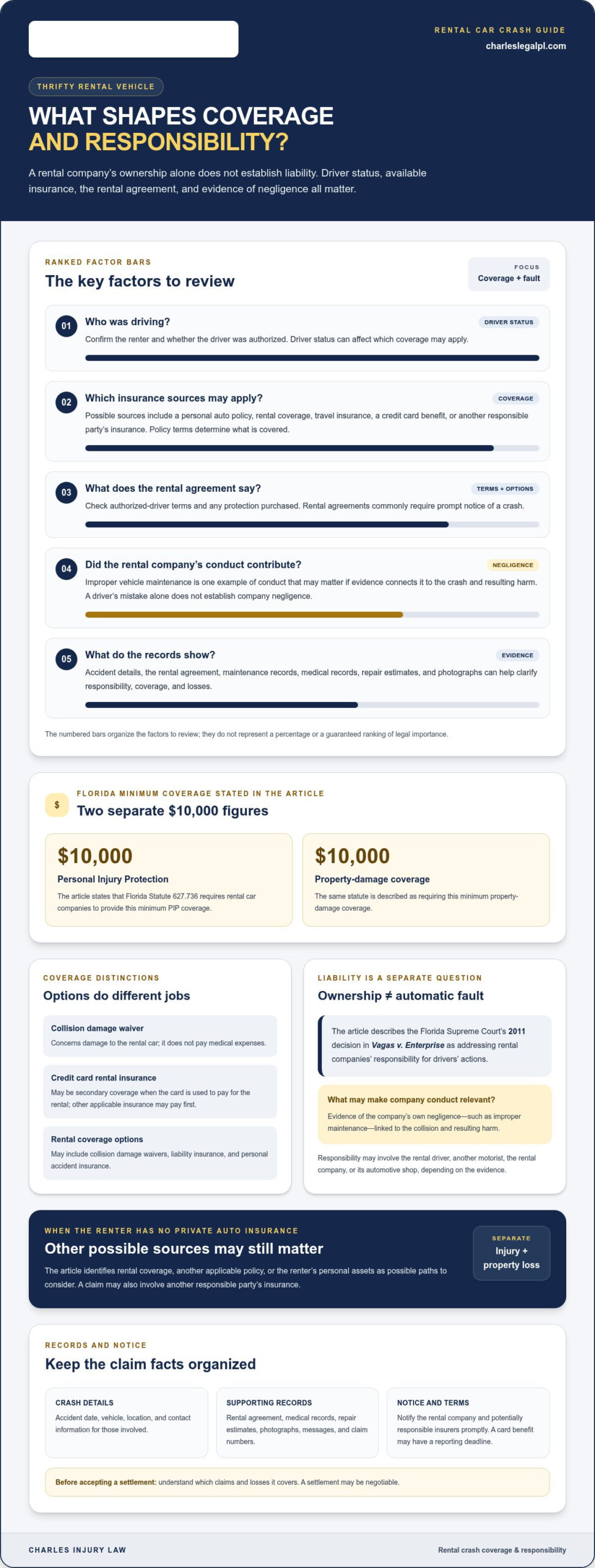
Vehicle ownership alone doesn’t establish that a rental company must pay for injuries caused by a renter. The Florida Supreme Court’s 2011 decision in Vagas v. Enterprise addressed rental companies’ responsibility for their drivers’ actions. A claim against the company therefore needs evidence beyond the fact that its name appears on the vehicle. That distinction matters when identifying potentially responsible parties.
Coverage from Personal, Rental, and Credit Card Sources
Insurance coverage and legal liability are separate questions. A driver’s personal auto policy may extend to rental cars, while a credit card used to pay for the rental may provide secondary rental-car insurance. According to the Federal Trade Commission, rental companies may offer additional coverage, and existing auto or homeowner’s insurance may already provide some protection. Policy terms determine what each source covers.
Coverage Purchased Through the Rental Company
Rental transactions may offer optional collision damage waivers, liability insurance, and personal accident insurance. These products serve different purposes, so the name of a purchased option doesn’t establish that it covers every loss. A collision damage waiver, for example, doesn’t pay medical expenses. In Florida, Statute 627.736 requires rental car companies to provide $10,000 in minimum Personal Injury Protection coverage and $10,000 in minimum property-damage coverage.
Liability and Negligence
A rental company may face responsibility when its own negligence contributes to a crash. Improper vehicle maintenance is one example: a mechanical problem linked to poor maintenance could make the company’s conduct relevant. The key is evidence connecting that conduct to the collision and resulting harm. A driver’s mistake alone doesn’t establish company negligence, so vehicle condition and maintenance records should be considered separately.
Responsibility can involve more than one party. The rental driver, another motorist, the rental company, or its automotive shop may be implicated, depending on the evidence. For example, a crash caused by a renter’s driving raises a different liability question from a collision linked to an improperly maintained vehicle. Separate these possibilities from insurance questions, then identify the evidence supporting each claim.
If maintenance records or vehicle condition raise questions about responsibility, discuss the crash and available evidence with a legal professional.
What Insurance Usually Matters Most in a Rental Car Crash?
Potential compensation after a rental-car crash can come from the driver’s personal insurance, coverage purchased through the rental, or the driver’s personal assets. The responsible source depends on the policies, who caused the collision, and the losses involved.
To find a lawyer for a crash involving a Thrifty rental car, look for a Florida car-accident attorney who can assess rental claims. Bring the rental agreement, insurance details, crash records, and injury documentation to a consultation. These materials help identify which policies and parties may require closer review.
Start by separating insurance coverage from legal responsibility. A driver’s private policy may cover a rental vehicle or damage to another person’s property. Coverage purchased with the rental may apply under its terms. If the renter has no applicable insurance, the renter’s personal assets could become relevant to an injured person’s claim.
More than one potential source of coverage may exist. For example, if another motorist caused the crash, that driver’s insurance may be relevant. If the rental driver caused it, their policy or purchased rental coverage may matter. A claim review should identify each involved driver and distinguish bodily injury losses from vehicle or other property damage.
An injury’s severity can affect settlement discussions, but life-altering harm isn’t required to pursue legal action. Medical records can document the diagnosis, treatment, and continuing effects of an injury. For example, someone needing follow-up care can keep records of those visits and related expenses, rather than relying only on an initial emergency-room record.
Financial losses may include hospital fees, surgery costs, ongoing treatment, and physical therapy. A personal injury claim may also seek compensation for pain and suffering, including mental anguish caused by the crash. Keep bills, treatment records, and receipts together. These documents help connect claimed expenses and effects to the rental-car collision.
Evaluate a settlement offer against the documented losses and available coverage. Before accepting, review which claims the agreement resolves and whether it addresses medical expenses, treatment needs, and other claimed harm. For instance, a payment for vehicle damage alone doesn’t necessarily resolve an injured person’s separate bodily injury claim.
In Florida, a lawyer can review crash evidence, insurance policies, and settlement terms to help identify which compensation sources may apply. Bring the Thrifty rental agreement, insurer correspondence, medical records, and repair documents. An organized file can reveal unanswered coverage questions and help keep injury and property-damage claims distinct.
Identifying authorized drivers and purchased coverage
After a rental-car crash, the rental agreement can help establish who rented the vehicle and who had permission to drive. Compare the named renter and authorized drivers with the person actually behind the wheel. That distinction matters because coverage may depend on driver status, policy terms, and protections purchased with the rental.
Start with the rental agreement and identify every listed driver. Then compare those names with the driver’s license and the accident report. Note whether the renter was driving. If someone else was behind the wheel, determine whether the agreement authorized that person. For example, a claim involving an unlisted driver may raise different coverage questions from one involving the renter.
Record the specific protection selected during the rental transaction. The agreement can show whether the renter bought a collision damage waiver, liability insurance, or personal accident insurance. These options serve different purposes. A collision damage waiver concerns rental-car damage, while personal accident insurance may relate to injuries. Read the agreement’s terms and exclusions rather than assuming one selection covers every loss.
Next, gather the driver’s personal auto policy information and identify relevant coverage terms. Some policies extend to rental cars, but the policy language determines whether the driver, vehicle, and crash circumstances are covered. Note where the crash occurred and who was operating the vehicle. Those details may matter when an insurance company evaluates a claim or applies a limitation.
Keep payment and protection records together. If a credit card paid for the rental, identify the card and preserve its benefit information. Some credit cards provide secondary rental-car insurance, but the card’s terms determine its scope. Record whether another policy may apply first, and keep notices sent to the card company with the rental agreement and insurer correspondence.
Driver status can also affect the investigation into how the crash happened. Compare the driver’s account with witness details, police records, and the names in the rental documents. If two people give conflicting accounts about who drove, preserve both statements and note when each was made. Attorneys reviewing a Florida claim can use these records to distinguish questions about responsibility from questions about coverage.
Organize the documents into three groups: driver identity, rental protections, and outside insurance. Include the rental agreement, driver’s license details, policy declarations, card-payment records, and claim correspondence. The file may reveal missing information, such as an unclear authorization term or a protection whose exclusion affects the claim. A careful comparison gives the insurance company a clearer basis for evaluating responsibility and coverage.
Police reports and documenting the accident scene
A police report and clear scene documentation can preserve important details after a rental-car crash. In Florida, call police if anyone is injured or property damage is substantial; call 911 if someone is hurt or damage appears to exceed $500.
Even after a minor rental-car collision, obtaining a police report can create a record of the event. Give the officer accurate information about the location, vehicles, drivers, and what you observed. Don’t guess about speed or fault. If you don’t know an answer, say so. A report can help insurers understand the situation, but it doesn’t decide liability by itself.
Record the rental company’s name shown on the vehicle, along with its license plate and identifying details. Photograph the vehicles before they’re moved, if it’s safe. Capture damage from multiple angles, nearby traffic signs, road conditions, and the vehicles’ positions. For example, a photo showing a damaged side panel may help clarify which part of the car was struck.
- Write down each driver’s name and contact details.
- Collect witness names and their contact information.
- Photograph vehicle damage, the scene, and visible injuries.
- Note the rental company name and vehicle details.
- Keep the police report information and related claim records.
Make notes as soon as practical, while details remain fresh. Record the time and place, the direction each vehicle traveled, and what happened immediately before impact. Separate what you personally saw from what someone else told you. If a witness describes a different sequence, preserve that account without changing your own observations.
Scene evidence can support a claim, but it may not answer every question. A police report, photographs, witness accounts, and vehicle damage can each provide part of the picture. Keep original photos and copies of documents together. If an insurer disputes how the collision happened, organized records can help you explain your account clearly and protect your rights.
Don’t argue about fault at the scene or make assumptions about the other driver’s insurance. Focus on safety, accurate information, and preserving evidence. If injuries emerge after the crash, keep records of when symptoms began and what care you received. That timeline can connect later medical documentation to the collision.
If a rental-car crash left you injured and the report or scene evidence raises questions, discuss your accident records and injury claim.
Personal Injury Attorney in Fort Lauderdale: Injuries suffered from Car Accidents
Charles Injury Law represents people injured in car accidents, including crashes involving rental vehicles. The firm can assess how driver status, insurance coverage, and accident records affect an injury claim. Consider legal support when insurers dispute responsibility, coverage is unclear, or an injury has disrupted your life.
The firm also represents people injured in truck, semi, and tractor-trailer accidents; Uber and Lyft crashes; and pedestrian accidents involving bicycling, jogging, or walking. These cases can involve different evidence and parties, so clear records matter.
Contact Charles Injury Law to discuss an injury claim after a rental-car crash. Call Now: (954) 390-2228 Available 24 Hours a Day, 7 Days a Week
Choose Your Next Step With Confidence
Before deciding what to do next, identify what you need clarified: who is handling each claim, what issues remain unresolved, and what decision is approaching. A short list can keep a conversation focused. Note how the crash has affected your daily routine, work, or family responsibilities.
Choosing a lawyer for a car accident with Thrifty Car Rental gives you a chance to discuss unanswered questions and the path ahead. You don’t need every document organized before seeking guidance. Explain what you have, what you’ve been told, and what still concerns you. Ask what work may follow, how communication will proceed, and which decisions remain yours. Those answers can help you decide whether legal support fits your priorities.
Contact Charles Injury Law to discuss your situation and next steps. Reach out to Charles Injury Law when you’re ready to talk. You can move forward one clear decision at a time.
Frequently Asked Questions
What If You Are Not Covered?
If no applicable policy covers a loss, an insurer may not be available to pay that claim. Ask for a written coverage decision identifying the policy reviewed and the reason for its position. Keep the letter with the claim number and rental documents. If the decision addresses only vehicle damage, don’t assume it also resolves a separate injury claim.
Who Pays After a Rental Car Accident?
Who pays depends on the specific loss and responsible party, not simply on whose name appears on the rental agreement. A vehicle repair claim and an injury claim can follow different paths. Ask each claims representative to identify the loss being evaluated and any documents still needed. Keep written decisions together so you can compare what each actually addresses.
Why Do Rental-Car Cases Turn Into Coverage Fights So Fast?
Different policies and agreements can impose different claim conditions. The rental agreement, an auto policy, and a credit-card benefit may each use separate definitions and exclusions. That can raise questions about the transaction, the driver, or the type of loss before payment is considered. Keep each claim number and notice date in one record, and note which company requested each item.
Who Is Liable for an Accident Involving a Thrifty Rental Car: the Driver, Renter, or Rental Company?
The driver’s actions, the renter’s agreement, and the rental company’s own conduct present separate questions. In Vagas v. Enterprise, the Florida Supreme Court decided rental companies are not responsible for their drivers’ actions. A renter’s name on the agreement doesn’t establish that the renter was driving. Keep these issues distinct when reviewing a claim or discussing the evidence.
Does the Graves Amendment Protect Thrifty From Liability for a Renter’s Car Accident?
For a Florida claim, the Florida Supreme Court’s decision in Vagas v. Enterprise states that rental companies are not responsible for their drivers’ actions. That does not answer every possible allegation against a company. A claim based on the company’s own conduct raises a different issue from one based only on vehicle ownership. The evidence and specific legal theory matter.
What Steps Should I Take After a Car Accident Involving a Thrifty Rental Vehicle?
After immediate safety needs are addressed, keep a dated record of calls, claim numbers, and requests from each company. Ask how to obtain the report number and retain copies of documents submitted. Preserve original photos and messages rather than relying only on summaries. Before giving an insurer a recorded statement, consult counsel so you understand the request and its potential significance.
What Evidence and Documents Should I Collect for a Thrifty Rental Car Accident Claim?
Keep records showing how the injury affected ordinary activities, such as appointment summaries, work schedules, and correspondence about missed shifts. Save original photographs and messages with their dates intact. If a repair shop provides more than one estimate, retain each version and its date. These details can clarify how the claim developed over time, beyond the initial account of the collision.
What Is the Average Settlement for Injuries in a Rental Car Accident, and What Affects the Amount?
There is no dependable average settlement that predicts what a particular rental-car injury claim will be worth. A figure without context can leave out the treatment course, documented income impact, disputed issues, and terms of a proposed release. Compare an offer with the losses it addresses and the claims it would resolve. This information is general and not legal advice. Every case is different.
Disclaimer
The information provided on this blog is for general informational purposes only and does not constitute legal advice. Viewing this content does not create an attorney-client relationship with the firm. You should not act or rely on any information contained herein without seeking legal advice from a qualified attorney regarding your individual situation.