

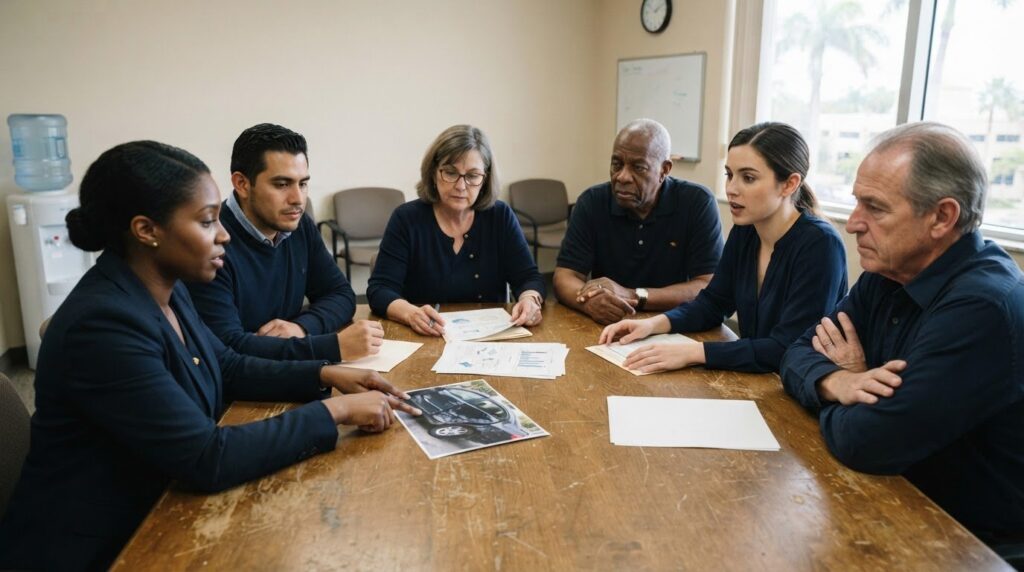

A jury’s verdict is based on evidence, not sympathy. To understand how a jury decides a personal injury case, focus on three questions: Was the defendant negligent? Did that negligence cause the injury? What compensation does the evidence support? The judge explains the law, and jurors apply it to the evidence presented at trial.
It’s natural to wonder how jurors put a value on an injury that changed someone’s life. They weigh testimony and records, assess responsibility, and consider both measurable losses and the effects of pain and suffering. Their decision must be based on the case presented in court, not on outside research or assumptions.
This guide explains how jurors are selected, what they decide about fault and damages, and how they assess pain and suffering. It also explains why clear, well-supported evidence matters when a jury decides whether compensation is warranted and what amount the evidence supports.
Key Takeaways
- Understand how the judge’s instructions guide jurors as they weigh admitted evidence and decide the verdict.
- See how questioning prospective jurors helps identify bias or conflicts before the trial begins.
- Learn what evidence can help explain pain, suffering, and changes to daily life.
- Know how the preponderance-of-the-evidence standard shapes decisions about fault and compensation.
- Recognize the key questions jurors consider when assessing responsibility, causation, and damages.
How Does a Jury Decide its Verdict?
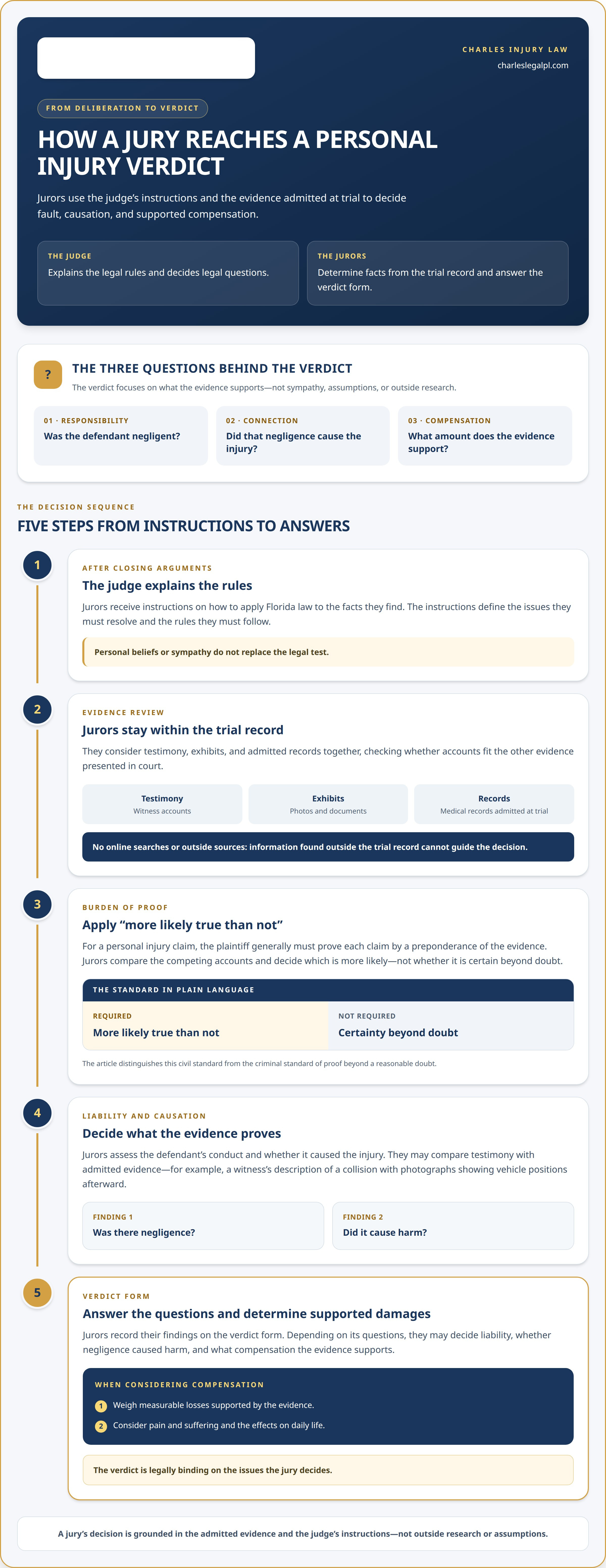
After closing arguments, the judge explains the legal rules jurors must follow during deliberations. Jurors review the admitted evidence, answer the questions on the verdict form, and decide whether the parties have proved their claims or defenses.
Following the Judge’s Instructions
The judge’s instructions explain how jurors must apply Florida law to the facts they find. Jurors cannot replace the legal test with personal beliefs or sympathy. For example, they must consider whether the evidence supports negligence and causation, not simply whether an injury seems unfair. The instructions define the issues jurors must resolve and the rules for deciding them.
Applying the Burden of Proof
The burden of proof tells jurors how persuasive the evidence must be before they decide an issue for one party. In a personal injury trial, the plaintiff generally must prove each claim by a preponderance of the evidence, meaning it is more likely true than not. This differs from the criminal standard of proof beyond a reasonable doubt and guides how jurors assess conflicting accounts.
That standard applies to the plaintiff’s claims about the defendant’s conduct, the cause of the injury, and the damages sought. Suppose a witness describes a collision and photographs show the vehicles’ positions afterward. Jurors compare both with testimony and records. They decide whether the plaintiff’s account is more likely than the alternative, not whether it is certain beyond doubt.
The judge also instructs jurors to rely only on evidence admitted at trial. They must not search online, consult outside sources, or use personal research to fill gaps. If a medical record is admitted, jurors may consider its contents. A fact found only in an outside article or internet search cannot guide their decision.
During deliberations, jurors consider testimony, exhibits, and the judge’s instructions together. They may discuss whether a witness’s account fits other admitted evidence, such as a photograph or document. The judge decides legal questions; jurors determine facts from the trial record. This division keeps the verdict focused on the evidence and the rules that govern the case.
The verdict form turns those decisions into formal answers about liability and damages. Depending on the questions, jurors may decide whether the defendant was negligent, whether that negligence caused harm, and what compensation is supported. Their verdict is legally binding on those issues. The evidence in a personal injury case must therefore address the specific questions jurors are instructed to answer.
Jury selection and voir dire
Before testimony begins, the court and attorneys work to select jurors who can assess the evidence fairly. This questioning stage, called voir dire, helps identify potential bias that could affect how jurors determine responsibility and compensation.
Questions About Potential Bias
Voir dire is the process of questioning prospective jurors about experiences, opinions, and relationships that could affect their judgment. The answers matter because injury cases may involve disputed events, medical evidence, and insurance issues. Attorneys might ask whether someone has been involved in a similar collision or holds strong views about injury claims. Candid answers help the court assess impartiality before trial.
Excusing Potential Jurors
A prospective juror may be excused if an answer shows they cannot evaluate the case objectively. An attorney can ask the judge to dismiss a juror for cause, and the judge decides whether the reason is sufficient. Attorneys may also use peremptory challenges to remove some jurors without stating a reason. These procedures help form a panel able to consider both parties’ evidence.
Courts generally select prospective jurors from public records, which may include voter registration and driver’s license lists. The court brings the pool to the courthouse and questions people individually or as a group. Being called for possible jury service does not mean someone will ultimately hear the case. The judge and attorneys first assess whether each person can serve fairly.
Questions may explore whether a prospective juror knows a party, witness, or attorney. They may also address views about lawsuits, injuries, or insurance claims. Someone who assumes every injury claim is exaggerated may have difficulty weighing evidence neutrally. Another person’s experience may also affect their perspective. The purpose is to identify potential concerns, not to determine which side a juror favors.
If an answer suggests a conflict or fixed bias, an attorney can explain the concern to the judge and request removal for cause. The judge considers the answer and decides whether the person can remain impartial. A challenge for cause may be raised when a prospective juror shows they cannot decide the case objectively. A peremptory challenge, by contrast, does not require an explanation.
Questioning also helps attorneys understand how potential jurors approach evidence and disagreement. They may ask whether someone could follow the judge’s instructions even if they personally disagree. A juror who says they would disregard a legal instruction raises a different concern from someone who simply has questions about how a trial works. The court assesses suitability, not the likelihood of a particular verdict.
Once the court resolves challenges, the remaining jurors are selected to hear testimony and decide the issues presented. If you’re facing a claim involving a fatal injury, discussing the case and its trial process can help clarify what comes next.
Non-economic damages such as pain and suffering
Under Florida’s comparative fault rule, jurors may assign responsibility among the parties, and the injured person’s recovery may be reduced by their share of fault. Florida law governs how a person’s own fault affects recovery, as explained by the judge.
After deciding liability, jurors consider which losses the evidence supports. Economic damages cover measurable financial harm, such as medical bills or lost wages. Non-economic damages address effects without a precise invoice, including pain, emotional distress, and reduced enjoyment of daily activities. The verdict must reflect the evidence and the court’s instructions, not an arbitrary amount.
Medical records can document treatment, while testimony can explain how an injury affects daily routines. For example, someone with a back injury might describe difficulty sitting through a work shift or lifting groceries. A treating provider may explain the condition and its effects. Jurors compare those details with the records and other admitted evidence.
Pain and suffering have no single receipt or formula. Jurors consider the evidence, the judge’s instructions, and what they determine is fair and reasonable. They may consider the nature of the injury, treatment, ongoing symptoms, and limits on daily activities. A claim is better supported when testimony and records clearly connect those effects to the incident.
Damages may include past losses and supported future effects. Bills and wage records can show costs already incurred, while testimony may describe continuing pain or restrictions. Jurors assess whether the claimed loss resulted from the defendant’s conduct. If the evidence does not establish that connection, the jury may reject or limit that part of the requested compensation.
Liability and damages are separate decisions. A jury may find a party responsible but decide that some claimed losses lack adequate support. Clear evidence of treatment and lasting limitations may help jurors understand an injury’s impact. The verdict should distinguish direct financial losses from personal effects rather than treating every claimed harm alike.
For example, after a pedestrian collision, medical bills may document treatment, while testimony may describe difficulty walking or returning to usual activities. Jurors weigh each piece of evidence before deciding which damages are justified. In a wrongful-death case, the claimed losses differ from an injured person’s pain and suffering, so the evidence and legal instructions determine which damages jurors may consider.
How Do Courts Determine How Much My Personal Injury Case Is Worth?
A jury evaluates the evidence presented by both parties, then follows the judge’s instructions to decide liability and supported damages. In a Florida personal injury trial, the plaintiff generally must prove each claim by a preponderance of the evidence. This means jurors must find the plaintiff’s account more likely true than not.
This standard guides how jurors assess conflicting accounts. A witness may describe a fall one way, while photographs show where objects were afterward. Jurors compare each account with records, testimony, and other admitted evidence. They decide which explanation is more persuasive, not which is certain beyond doubt.
Before trial, evidence exchange and discovery help define the issues in dispute. Relevant materials may include medical records, photographs, incident reports, and wage documentation. Each item can support or challenge part of the plaintiff’s account. For example, a treatment record may document an injury, while another record may help establish when symptoms began.
At trial, attorneys present evidence through witnesses and exhibits. The plaintiff may testify about the incident and its effects. A treating professional may explain medical findings, while photographs can show physical conditions or damage. The defendant can present evidence and question witnesses. Jurors consider how each answer fits the complete record.
Cross-examination tests the details of testimony. An attorney may ask a witness to clarify timing, observations, or differences between trial testimony and an earlier statement. The answer may strengthen or weaken a point, but jurors weigh it alongside other evidence. One disputed detail does not decide the case by itself.
Jurors first determine whether the defendant’s conduct caused the claimed injury. They then assess which losses the evidence supports. Medical bills and wage records can document past financial losses. Testimony may describe continuing limitations, while qualified expert evidence may explain future economic effects. The judge’s instructions guide which damages jurors may consider.
Preparation matters because evidence must connect the defendant’s conduct to specific harm. A photograph without context may carry less weight than one explained by a witness. A medical record may document treatment, while testimony explains how it relates to the incident. Jurors assess that connection rather than simply adding every claimed loss together.
For a claim involving inadequate security, records and testimony about the incident may help frame what jurors must assess. Discussing the evidence and trial questions can help clarify how disputed facts may be presented.
Questions juries decide in personal injury trials
Understanding how a jury decides a personal injury case starts with the questions submitted for decision. In Florida, jurors apply the judge’s instructions to the trial evidence to decide whether negligence caused harm. They then consider which damages the evidence supports. Florida law governs those decisions, and the verdict form organizes the issues jurors must resolve.
Jurors assess whether the defendant acted negligently and whether that conduct caused the plaintiff’s injury. They may compare witness accounts with photographs, medical records, and other evidence from the incident. If the court asks whether the plaintiff shared responsibility, jurors address that question under the judge’s instructions. Their findings shape the remaining decisions about compensation.
Florida law determines the rules jurors must apply to fault and damages. The judge instructs jurors on the law that applies to the case. This matters when the verdict form asks jurors to assess responsibility or consider a particular type of loss. The instructions connect the legal rules to the facts presented by the parties.
Jury size and the agreement required for a verdict depend on the court and rules governing the trial. Jurors deliberate together, review the questions submitted, and record their answers. If they cannot reach the required agreement, the court may need to take further action. The length of deliberations does not reveal which party has the stronger case.
Trial duration also depends on the evidence and disputed issues. A case with a short witness list may proceed differently from one involving extensive medical testimony, conflicting accounts, and future-loss evidence. Deliberations may last hours or weeks, depending on complexity. Time alone does not predict the verdict.
A settlement resolves a claim without asking jurors to decide liability and damages. At trial, the outcome depends on the evidence and the judge’s instructions. A verdict may differ from a settlement offer, so parties weigh the evidence and risks when discussing resolution. That decision is separate from the jury’s task of answering the questions presented in court.
After a verdict, a party may pursue available post-trial procedures or appeal legal issues under the governing rules. An appeal is not simply another chance to present the same evidence to a new jury. People may search for “attorneys personal injury,” “attorneys for personal injuries,” or “a personal injury firm near me.” Others use phrases such as “injury lawyer near me,” “personal injury lawyer near me,” “lawyers for auto accidents,” or “auto accident lawyers near me.” The legal questions remain focused on the evidence and Florida law.
If negligence, damages, or a settlement decision remains disputed, discuss your trial options with a legal professional.
Personal Injury Attorney in Fort Lauderdale
Personal Injury Attorney in Fort Lauderdale helps injured people understand how evidence, fault, and damages may shape a personal injury claim. The firm handles car, truck, and rideshare accident cases, as well as pedestrian injury cases. If you’re weighing a settlement or preparing for trial, careful case preparation can clarify the facts and losses at issue to show how does a jury decide a personal injury case.
Consider reaching out when an insurer disputes responsibility, questions the extent of an injury, or challenges the evidence supporting compensation. Contact Personal Injury Attorney in Fort Lauderdale to discuss your situation.
Call Now: (954) 390-2228 Available 24 Hours a Day, 7 Days a Week
Take the Next Step Toward Clarity
Understanding how a jury decides a personal injury case can help you consider the choices ahead. The next step is to connect the legal standards to your evidence, losses, and goals. A case involving a car, truck, or rideshare accident may raise different factual questions, but each requires careful assessment of responsibility and support for the claimed harm.
Before making decisions about settlement or trial, consider how disputed facts could be presented and what evidence supports your position. Charles Injury Law represents people injured in car accidents, truck and tractor-trailer accidents, and Uber and Lyft rideshare accidents. A conversation can help you understand how those issues relate to your situation and what questions deserve attention.
Contact Charles Injury Law to discuss your case. A clear next step can make a difficult process feel more manageable.
Frequently Asked Questions
What Happens During a Personal Injury Trial?
A personal injury trial moves from opening statements to evidence, closing arguments, jury instructions, and deliberations. Witnesses answer questions, and attorneys may challenge testimony through cross-examination. The judge decides what evidence jurors may consider. For example, jurors may consider a photograph if it is admitted, but material excluded by the judge cannot support a verdict. This process gives each side an opportunity to present its account.
What elements must a personal injury plaintiff prove at trial?
A plaintiff generally must prove the defendant’s negligence, show that it caused the injury, and establish the damages claimed. Jurors compare testimony and exhibits to determine whether each element is supported. For example, a medical record may document treatment, but the plaintiff must also connect the injury to the defendant’s conduct. The judge explains the applicable legal standards, which depend on the claim and evidence.
How does a jury evaluate evidence and witness credibility in a personal injury case?
Jurors assess whether testimony is consistent with other evidence and whether a witness had a clear opportunity to observe events. They may compare a witness’s account with photographs, records, or earlier statements. A difference does not automatically make testimony unreliable; jurors consider its significance and explanation. Their decision must be based on evidence admitted at trial, not personal assumptions or outside research.
How do jurors decide whether the defendant caused the plaintiff’s injuries?
Jurors look for evidence connecting the defendant’s conduct to the claimed injury. They can compare the incident timeline with medical records, witness accounts, and testimony about when symptoms began. For example, records documenting treatment soon after an accident may help explain the sequence, while other evidence may raise questions. The jury weighs the full record rather than treating any single document as conclusive.
How do jurors calculate economic damages such as medical bills and lost wages?
Jurors review evidence of financial losses, such as medical bills and wage records. They may compare treatment dates with the claimed injury and examine employment information supporting missed income. Future costs require evidence explaining why additional care or other expenses are expected. Expert testimony may help establish projected economic losses. Jurors assess the amounts supported by evidence, not simply every figure requested.
How do jurors value pain and suffering and other non-economic damages?
Jurors consider how an injury affected a person’s comfort, routine, and ability to enjoy daily activities. Testimony can describe practical changes, such as difficulty sleeping or returning to regular tasks, while treatment records provide context. The jury follows the judge’s instructions and decides what amount is fair and reasonable based on the evidence. No invoice directly assigns a dollar value to these personal effects.
What jury instructions guide jurors in personal injury cases?
The judge’s instructions explain the legal rules jurors must apply and the issues they need to resolve. They may address negligence, causation, damages, and the burden of proof relevant to the case. Jurors must follow those directions even if they would personally prefer a different rule. They also rely on trial evidence, not online searches, conversations, or information obtained outside court.
What verdict forms and decision steps do juries use in personal injury trials?
A verdict form sets out questions jurors must answer, such as whether a defendant was liable and what damages the evidence supports. It may also ask jurors to address fault allocation when that issue applies. Jurors discuss the questions using admitted evidence and the judge’s instructions, then record their conclusions. The completed verdict resolves the issues submitted to the jury, subject to later court procedures.
Disclaimer
The information provided on this blog is for general informational purposes only and does not constitute legal advice. Viewing this content does not create an attorney-client relationship with the firm. You should not act or rely on any information contained herein without seeking legal advice from a qualified attorney regarding your individual situation.