



After a car crash in Florida, the official police report becomes the single most important document in your case. It is not just a summary of events; it is the foundation of your insurance claim and the first piece of evidence an adjuster will use to determine fault. Understanding how to get this report, what it says, and how to correct inaccuracies is critical to protecting your right to fair compensation.
Insurance companies often use the initial findings in a Florida car accident report to devalue or deny a claim. They count on you not knowing how to interpret the codes, diagrams, and officer narratives. This guide provides the strategic knowledge you need to obtain your report and use it as a tool for recovery, not a weapon against you.
Mandatory Reporting Requirements for Accidents in Florida
A Florida Traffic Crash Report is the official document completed by a law enforcement officer who investigates a collision. It contains vital details about the drivers, vehicles, location, conditions, and the officer’s preliminary assessment of what happened. Florida law mandates when an accident must be reported to the police.
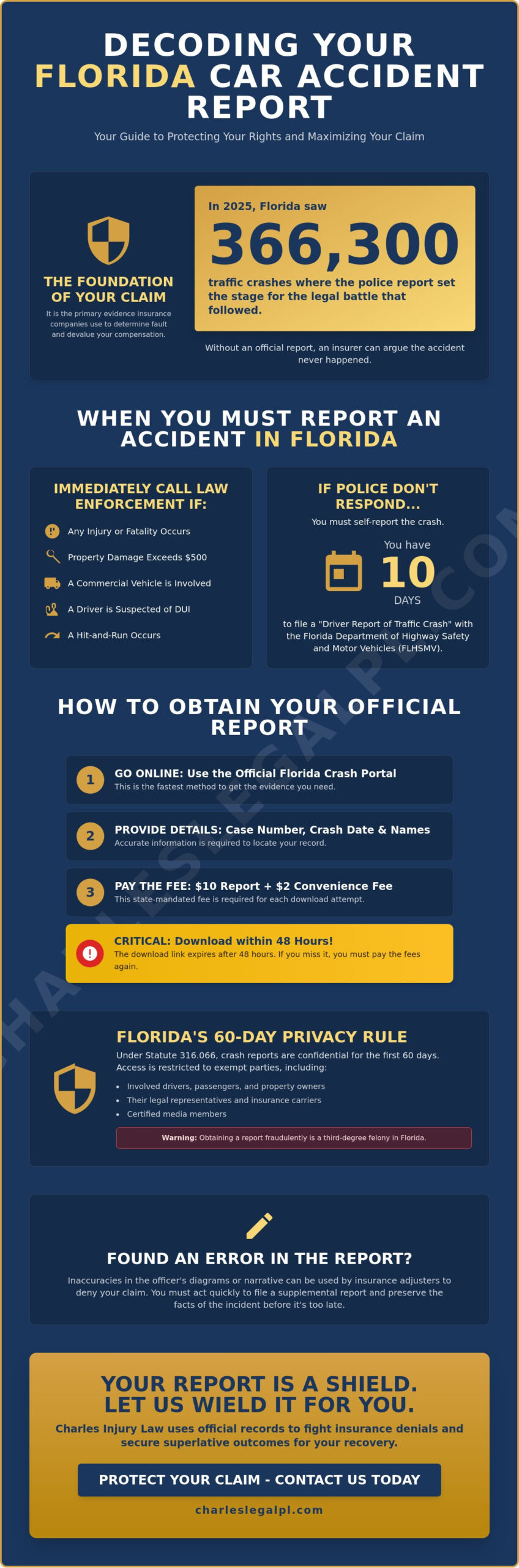
- Legal Requirement: Under Section 316.065 of the Florida Statutes, drivers must give immediate notice of a crash to the local police department, sheriff’s office, or Florida Highway Patrol.
- Reporting Thresholds: A report is legally required for any crash involving injury, death, or a hit-and-run.
- The $500 Property Damage Rule: The law also requires a report if the crash results in property damage that appears to be at least $500. Given the high cost of modern vehicle repairs, almost any collision will meet this threshold. A minor bumper scuff can easily exceed this amount.
When You Must Call the Police in Florida
You are legally obligated to call law enforcement and file an official report under specific circumstances. Failure to do so can result in serious legal consequences, including fines and license suspension. Always call 911 if:
- The crash involves a commercial motor vehicle.
- You suspect any driver is under the influence of alcohol or drugs (DUI).
- A vehicle is disabled and requires a tow truck to be removed from the scene.
- Anyone has been injured or killed.
- A driver has left the scene of the accident (hit-and-run).
Leaving the scene without exchanging information or rendering aid is a crime. An official police report documents your compliance with the law and establishes a clear record of the incident.
Self-Reporting Minor Crashes in Florida
For very minor accidents where no one is injured and property damage is clearly under $500, drivers may not be required to call the police. However, you still need to document the event. In these situations, you can file a “Driver Report of Traffic Crash” yourself.
- The Process: You must complete and submit the form to the Florida Department of Highway Safety and Motor Vehicles (FLHSMV) within 10 days of the crash.
- Why It Matters: Even if the other driver seems cooperative at the scene, they could later change their story. Filing a self-report creates an official record that is crucial for any future insurance litigation and protects you from false claims.
How to Request Your Florida Car Accident Report
Once an officer files a crash report, it is processed and stored by the FLHSMV. The primary method for obtaining your record is through their official online portal.
- Visit the Florida Crash Portal online.
- Provide the required information to locate your record, such as the case number, date of the accident, and the last name of a driver involved.
- Pay the statutory fee of $10.00 plus a small convenience fee for online processing.
- Download a digital copy of your report.
Be aware that reports are not available immediately. It typically takes up to 10 days for the investigating agency to submit the report to the state and for it to become available on the portal.
Online vs. Mail-In Requests
While the online portal is the fastest method, you can also request a report through other means. The choice often comes down to speed versus convenience.
- Online: Provides an immediate digital download once the report is available. This is the most efficient option.
- Mail-In: You can mail a request form to the FLHSMV in Tallahassee. However, this process is much slower, often taking 4-6 weeks to receive a physical copy.
- In-Person: You can visit the local police department or Florida Highway Patrol (FHP) Troop Station that responded to your crash to request a copy directly from the agency.
Privacy Laws and the 60-Day Rule
Florida law protects the privacy of individuals involved in a crash. Under Section 316.066 of the Florida Statutes, a car accident report is confidential and exempt from public disclosure for the first 60 days after it is filed.
- Who Can Get It Immediately: During this 60-day period, only “exempt parties” can access the report. This includes the drivers involved, their passengers, their legal representatives, and their insurance companies.
- Penalties: Unlawfully obtaining or sharing confidential crash information is a felony in Florida. This law is designed to prevent fraudulent claims and protect victims from unwanted solicitation.
Decoding the Anatomy of a Florida Traffic Crash Report
A Florida crash report is filled with codes, diagrams, and technical information that can be confusing. Knowing how to read it is the first step in understanding how an insurance company will view your case.
- Long Form vs. Short Form: The “Long Form” (HSMV 90010S) is used for crashes involving injuries, fatalities, or commercial vehicles. It is highly detailed and carries significant legal weight. The “Short Form” is used for minor property-damage-only incidents.
- Officer’s Diagram: This drawing shows the positions of the vehicles before, during, and after impact. It illustrates points of impact and the presumed paths of travel, providing a visual narrative of the collision.
- “Contributing Actions” Section: Here, the officer uses codes to assign preliminary fault. They may indicate actions like “Failed to Yield Right-of-Way” or “Exceeded Stated Speed Limit.” Insurance adjusters heavily rely on this section.
- Condition Codes: The report includes codes for weather, road surface (wet, dry), and lighting conditions, all of which can be factors in determining liability.
The Narrative Section: The Officer’s Perspective
Perhaps the most influential part of the report is the officer’s written summary. This narrative explains the officer’s conclusions based on physical evidence, driver statements, and witness interviews. Insurance adjusters often give this section immense weight when making liability decisions.
- Witness Statements: The narrative will summarize or include statements from independent witnesses. These can be powerful evidence in personal injury claims.
- Citations vs. Liability: It is important to note that a traffic citation issued at the scene is not a final determination of civil liability. While it is strong evidence of fault, it can be challenged in court.
Identifying Insurance and Vehicle Data
The report is a critical source of information about the other party. It should contain the names, addresses, and contact information for all drivers and vehicle owners. Be sure to locate and verify:
- VIN and Insurance Policy Numbers: This information is essential for initiating a claim with the at-fault driver’s insurance company.
- Event Data Recorder (EDR) Notations: The officer may note if a vehicle’s “black box” data was or should be retrieved. This can provide objective data about speed and braking.
- Commercial Carrier Information: For truck accidents in Florida, the report will list the motor carrier’s name and USDOT number, which is vital for pursuing a claim against the trucking company.
Correcting Errors in a Florida Car Accident Report
Police officers are human, and mistakes happen. An error on your crash report—whether it’s a simple typo or a significant factual inaccuracy—can jeopardize your entire claim. You must act quickly to correct it.
- Common Errors: Look for transposed numbers in a license plate, incorrect insurance policy information, misspelled names, or the wrong date of the accident.
- The Supplemental Report: The official process for correcting an error is to request that the reporting officer file a “Supplemental Report” or an addendum to the original document.
- Act Quickly: It is much easier to amend a report before it has been finalized and formally submitted to the FLHSMV.
At Charles Injury Law, we frequently assist clients in correcting damaging inaccuracies on their reports. We gather the necessary proof and communicate directly with the law enforcement agency to ensure the official record is accurate.
Factual Errors vs. Opinion Disagreements
There is a major difference between a correctable factual error and a disagreement with the officer’s opinion of fault.
- Factual Errors: These are objective mistakes, such as an incorrect street name or a wrong tag number. You can typically get these fixed by providing the officer with documentary proof (e.g., your vehicle registration).
- Opinion Disagreements: If you disagree with the officer’s conclusion about who was at fault, you cannot simply ask them to change their mind. To challenge their opinion, you must present compelling independent evidence, such as dashcam footage, surveillance video, or expert accident reconstruction analysis.
The Role of the Supplemental Report
When an officer agrees to amend the report, they file a supplemental report that is permanently attached to the original crash record. This new information becomes part of the official file. Under Florida law, insurance companies are required to consider all supplemental evidence when evaluating a claim. A strong legal review before submitting your own statement or evidence is crucial to ensure it helps, rather than harms, your case.
How Charles Injury Law Uses Crash Reports to Secure Compensation
An accident report is just the starting point of a successful injury claim. At Charles Injury Law, we leverage the report as a powerful tool to build your case and fight for the compensation you deserve.
- Countering Denials: We use the facts in the report to challenge and overturn denied insurance claims in Florida.
- Investigating Beyond the Report: If the report is incomplete or inaccurate, we launch our own investigation to uncover the hidden evidence needed to prove liability.
- A Shield Against Insurers: We use the report to protect you from adjusters who will try to twist the details to blame you and reduce their payout.
- Foundation for Complex Claims: A detailed and accurate report is the cornerstone of a serious injury or wrongful death claim in Florida.
Aggressive Advocacy Against Insurance Adjusters
Insurance adjusters are trained to use any ambiguity in a crash report against you. They will seize on unfavorable “contributing action” codes or vague narrative language to assign partial fault and offer a low-ball settlement. Our firm knows these tactics and how to defeat them. We dissect the report, disprove incorrect findings of comparative negligence, and build a case so strong that insurers have no choice but to pay what you are owed.
Your Mission for Maximum Recovery
After a crash, your focus should be on your physical and emotional recovery. Our mission is to handle the legal battle and secure maximum financial recovery on your behalf. The moments after an accident are critical, and getting immediate legal advice can make all the difference. Contact Charles Injury Law for a free, no-obligation review of your car accident report. We will help you understand your rights and chart a path toward justice.
Frequently Asked Questions (FAQs)
How long do I have to get a car accident report in Florida?
You can request a car accident report at any time after it is filed. However, it is subject to a 60-day confidentiality period where only involved parties, their lawyers, and insurers can access it. It is best to obtain it as soon as it becomes available, typically within 10 days of the crash.
Can a Florida car accident report be used as evidence in court?
Generally, the accident report itself is considered hearsay and is not admissible as primary evidence in a Florida court. However, the officer who wrote the report can testify about their observations, and the information within the report can be used to question witnesses and refresh memories.
What should I do if the police officer didn’t show up to my accident in Florida?
If the accident was minor (no injuries, damage under $500) and police did not respond, you should exchange information with the other driver and file a “Driver Report of Traffic Crash” with the FLHSMV within 10 days to document the incident.
Is there a fee to get a copy of my Florida crash report?
Yes. The state of Florida charges a statutory fee of $10.00 per report. If you order online through the Florida Crash Portal, there is an additional convenience fee of a few dollars.
How do I find my Florida crash report case number?
The responding officer should provide you with a card or piece of paper at the scene that includes the case number or agency report number. If you do not have it, you can often find the report on the online portal by searching with the date of the crash and a driver’s last name.
What happens if the other driver lied on the Florida car accident report?
If the other driver provided false information that is included in the report, you must gather evidence to contradict their statement. This can include witness testimony, photos from the scene, or dashcam video. An attorney can help you present this evidence to the insurance company and, if necessary, to the reporting police agency to supplement the report.
Can I get a Florida car accident report if I was a passenger?
Yes. As a passenger involved in the crash, you are considered an “exempt party” under Florida law and have the right to obtain a copy of the report, even during the 60-day confidentiality period.
How do I get a car accident report for a crash in Miami or Fort Lauderdale?
The process is the same regardless of the city. All official crash reports are submitted to the statewide Florida Crash Portal. You can also request a copy directly from the local police department that responded, such as the Miami Police Department or the Fort Lauderdale Police Department.
Disclaimer
The information provided on this blog is for general informational purposes only and does not constitute legal advice. Viewing this content does not create an attorney-client relationship with the firm. You should not act or rely on any information contained herein without seeking legal advice from a qualified attorney regarding your individual situation.