

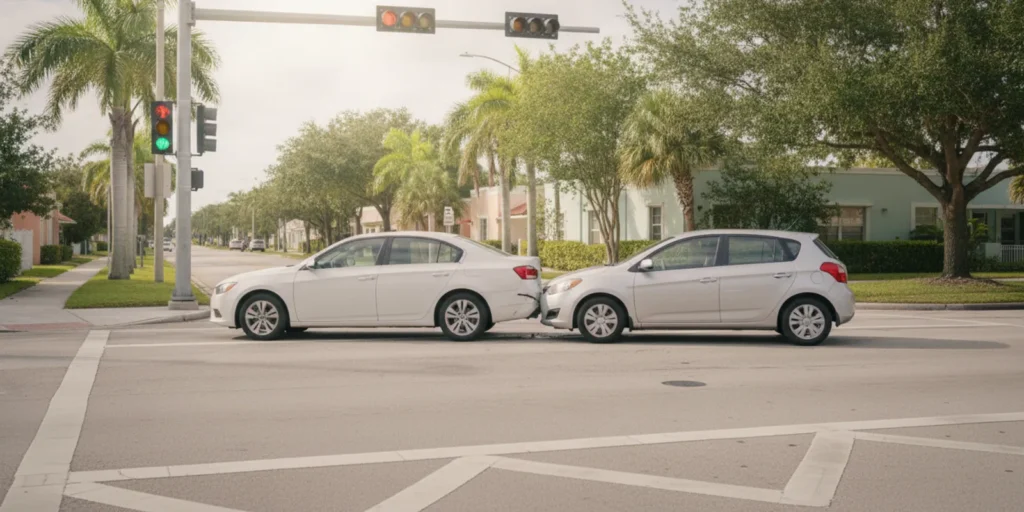
Intersection accident fault Florida drivers ask about is not settled by the point of impact or by the first story someone tells. A careful review looks at signals, movements, speed, and what records can show. The useful step after a crash is to keep those facts intact.
Call (786) 525-8784 to request a free case review, or use the contact form.
How intersection accident fault Florida reviews start
A reviewer rebuilds the sequence. Where did each vehicle come from? Which lane was it in? When did it enter the intersection, and what happened just before and after impact? Those questions come before any conclusion about who was at fault.
Start with a simple sketch if you can. Mark north, the lanes, and where each car stopped. A sketch made the same day can explain a photo that is hard to read later. You do not need art skills. You need directions and distances you actually saw.
A side impact can fit more than one sequence. It may show where the vehicles met. It does not, by itself, show who had the right of way, what signal each driver saw, or whether anyone had time to react.
Traffic controls and driver conduct are reviewed together. One driver may report a green light. A reviewer still asks whether that driver was attentive and what else was visible. Another driver may be accused of entering against a signal, while the timing and the view of the signal remain disputed.
The record may support a clear account, or it may leave important points open. One photo or a confident memory is rarely a substitute for the full set of facts. For the firm’s car-crash practice, see the car accident page.
Which intersection details can change the analysis?
Signals, arrows, signs, and lane controls
A signal phase, turn arrow, stop sign, yield sign, or lane marking may explain what each driver was directed to do. A photo of a signal does not prove what it showed at the moment that mattered.
A witness may have looked away. A recording may show a vehicle entering without showing the signal head. Drivers often remember a short event differently. Write each account down as it was given. Do not pick a version because it sounds more confident.
Useful questions include whether any recording shows the signal head and the approaches, whether a witness watched the light the whole time, and whether a signal or intersection record might exist. Do not assume a particular record is available until someone confirms it.
Turning, crossing, and entering from another road
Left turns, right turns on red, and vehicles entering from a side road raise different questions than two cars going straight. A turning driver may have a duty to yield even with a permitted movement. A driver going straight may still have been speeding or distracted.
Write down the movement you intended and the movement you actually made. They are not always the same. A driver who planned to turn left may have started the turn, stopped, and then been hit. That sequence is different from a driver who drove through a red light. Photos of debris and final positions can help separate those stories.
Note the intended path, the actual path, and where the vehicles came to rest. Those three facts often disagree with a single sentence such as “I had the light.”
Speed, attention, and chance to respond
Right of way is not the only question. Speed, following distance, phone use, and whether a driver braked or swerved can all matter. A driver with the better signal may still have had a chance to avoid the crash, or may not have. That is a fact question, not a slogan.
Visibility, weather, and road design
Sun glare, rain, a hill, a blocked view, or a confusing lane layout can change what a careful driver could see. Photograph the approach from the driver’s direction, not only the damaged cars. Note the time of day and the weather while you still remember them.
What evidence may explain what happened?
Evidence is useful when it is saved early and labeled clearly. It is less useful when it is edited, lost, or described from memory weeks later. Use the table as a map. It is not a checklist that proves fault.
| Source | What it may show | Limit of that source |
|---|---|---|
| Scene photos | Damage, positions, signs, and sight lines. | They do not prove right of way. |
| Video | Approach and sometimes the signal. | They miss what the camera did not face. |
| Witness notes | What a person says they saw, and from where. | The account may be incomplete. |
| Crash report | Names, a diagram, and statements. | It does not decide a civil claim. |
| Medical records | Injuries evaluated after the crash. | They do not show the traffic movement. |
Keep originals. If you must share a photo, share a copy. Note the date and where the file came from. A short timeline written the same day is often more reliable than a longer one written later.
Label each file in plain words. “Signal from the north approach” is more useful than a camera number. If a passenger took the photos, note that too. A reviewer should be able to tell who created the file and when.
Video needs the same care. Save the original file before you crop it or post it. A clip that starts at impact can still help, but a clip that includes the approach is better. If a business camera might have faced the intersection, ask soon. Many systems overwrite footage within days.
Medical records answer a different question from the crash itself. They can show that an injury was evaluated and when. They do not show the signal color. Keep them with the crash file so the two records are not mixed up later.
How can accounts and records differ?
Drivers, passengers, and witnesses can all be sincere and still disagree. People notice the impact more than the seconds before it. A report may mix what an officer saw with what a driver said. Read the diagram and the narrative separately.
When two people both say they had a green light, keep both versions. Then look for something outside those versions: a witness position, a recording of the signal head, or damage that fits one path better than another. Disagreement alone does not pick a winner.
Do not argue the other driver into a new story. Do not suggest words to a witness. Ask what the person saw, where they were, and whether they saw the approach or only the crash.
How Florida comparative fault can affect a claim
Florida’s comparative fault statute is section 768.81. In a negligence action, fault charged to the claimant reduces the damages for that person’s share, but the statute says that reduction does not bar recovery, subject to subsection (6). Subsection (6) says a party found greater than 50 percent at fault for their own harm may not recover damages in a negligence action to which the section applies. The official text is on the Florida Legislature’s page for section 768.81.
That rule is why a small dispute about a turn or a speed can matter. A finding of some fault is not the same as a finding of more than half the fault. Percentages are decided from the evidence in that case. This article cannot assign one.
More than one person can share responsibility. A passenger, another driver, or a road condition may be part of the facts. Whether any of those facts supports a claim is a case-specific legal question, not a conclusion from the damage location.
What should you do after an intersection collision?
Safety comes first. Move out of traffic if you can do so safely, and get medical care for anyone who is hurt. Then preserve facts while they are still available.
- Photograph vehicle positions, damage, signals, signs, and the view from each approach.
- Get names and phone numbers for drivers, passengers, and witnesses. Write what each person said.
- Save dash-cam files and ask nearby businesses about cameras before footage is overwritten.
- Get a copy of the crash report and mark what is an observation versus a statement.
- Keep medical and repair records together with the date of each visit or estimate.
- Avoid recorded statements to an insurer until you understand what is being asked.
A deadline can also matter. Florida Statutes section 95.11 lists an action founded on negligence among actions that shall be commenced within two years. Confirm how that period applies to your facts, because exceptions and different claim types exist. The current text is on the Florida Senate’s page for section 95.11. For a separate discussion of filing time, see how long you may have to file a car accident claim.
What can make an intersection-fault review harder?
Some crashes stay unclear even after a careful look. No camera faced the signal. Witnesses left. Cars were moved before photos. A report diagram does not match the photos. Those gaps should be named, not filled in with guesses.
A tow or a rainstorm can erase scene evidence quickly. If the cars were moved for safety, say so. If you returned later to photograph the intersection, say that the photos are of the location, not of the vehicles in place. Mixing those two kinds of photos creates confusion.
Passengers and other drivers may also have injuries and their own accounts. Keep their names with your notes. Do not assume that a quiet passenger saw nothing. Also do not assume that a loud account is the accurate one. The job is to preserve what each person said.
Insurance arguments often focus on the same gaps. An insurer may treat a turn as automatic fault, or treat a police diagram as a final decision. Neither shortcut replaces the signal, the paths, and the other records.
This guide does not rank dollar outcomes and does not estimate what a claim is “worth.” Injury, coverage, and fault are separate questions. Mixing them too early leads to confident numbers that the facts do not support.
How an attorney can review a potential claim
Charles Injury Law is an attorney-led South Florida personal-injury practice. Car and truck crashes are part of that injury work, with Fort Lauderdale and Miami among the service markets. A review can look at the sequence, the records you saved, and the questions that are still open.
The firm describes direct attorney access, investigation, insurer negotiation, and trial preparation as its approach. Those are descriptions of the work, not a promise about staffing, response time, or a result. A broader overview is on what injured drivers should know about a Florida motor vehicle accident attorney.
Bring the photos, names, report, and any video you still have. Also bring a short timeline in your own words. A free initial case review is a chance to share that information and ask questions. It is not a promise of representation or of recovery.
Useful questions at that review are practical. Which facts are documented? Which facts are still only memories? Is there a deadline concern? What records are missing? An attorney can help sort those questions. The attorney cannot responsibly assign a fault percentage from a single phone photo.
Coverage questions are separate from fault questions. A crash can involve more than one policy, including the other driver and your own auto policy. This guide does not interpret a policy. Bring the declarations page if you have it, and ask which coverages might matter. Uninsured-motorist questions have their own rules. A related overview is on whether uninsured motorist coverage is required in Florida.
Fee terms are matter-specific. Do not treat a percentage mentioned for another kind of case as the fee for this one. Ask what the written agreement would say about fees and costs before you decide. The firm’s disclaimer also states that an inquiry does not create an attorney-client relationship, and that past results do not guarantee future outcomes.
Call (786) 525-8784 to ask about a free case review, or send the facts through the contact form.
Frequently asked questions
Does the location of vehicle damage prove who caused the crash?
No. Damage can help show how the vehicles may have met. It does not, by itself, establish who had the right of way. Signals, paths, speed, and statements still matter.
What if both drivers say they had a green light?
Keep both accounts. Look for a witness, a recording of the signal head, or another record that does not depend on either driver. A disagreement does not decide which version is right.
Can a crash report decide fault for a civil claim?
A report can be useful. It may not resolve every issue, and it does not by itself decide a civil claim. Read what the report marks as an observation and what it attributes to a driver or witness.
What if there is no video of the intersection?
Photos, witness names, vehicle positions, and a same-day timeline can still help. Missing video does not prove either driver’s story. It does mean other records should be saved quickly.
Does some fault on my part end a Florida injury claim?
Not automatically. Under section 768.81, a claimant’s share of fault can reduce damages, and a party found greater than 50 percent at fault for their own harm may be barred in a covered negligence action. The percentage in your case depends on the evidence.