



What if you need medical care after an injury but can’t pay for it upfront? A letter of protection in Florida is an arrangement in which a medical provider agrees to wait for payment from a future personal injury settlement or court award. It can help address the timing gap between treatment and recovery, but the balance still matters.
If you’re unsure what a letter of protection in Florida means for your care, the key point is that it doesn’t erase your medical bills. It sets out how a provider may be paid from a case recovery, and its terms can affect what happens if the recovery is less than expected or the case is unsuccessful.
This article explains how treatment and provider billing work under a letter of protection, what to understand before signing, and how an outstanding balance may be handled when a case resolves. You’ll also learn how the arrangement fits into a Florida injury claim and what financial questions to consider while focusing on your recovery.
Key Takeaways
- A letter of protection can arrange for a provider to defer payment until an injury case resolves, but it does not erase the medical balance.
- Florida Personal Injury Protection benefits are limited to a total of $10,000.00, according to the Florida Legislature.
- Before signing, understand how the agreement treats a settlement that falls short of the medical bills or a case that does not succeed.
- At settlement, unpaid medical balances may affect how much of the recovery remains for you.
- The agreement’s terms and Florida’s disclosure rules can shape how medical expenses are handled in a claim.
What Is A Letter of Protection (LOP) in Florida?
A letter of protection is a payment arrangement involving an injured patient, a medical provider, and often the patient’s attorney. It may allow treatment to proceed while payment waits for a settlement or judgment, but it does not erase the medical expenses.
Deferred Medical Bills During a Claim
A letter of protection lets a provider defer payment for specified medical treatment until a personal injury claim resolves. This may help when a patient cannot pay upfront, but the balance still matters: the agreement may require payment from a settlement or court award. It does not guarantee that the recovery will cover every bill.
Treatment While a Claim Is Pending
A patient may receive treatment while a Florida injury claim is pending, with the provider billing under the letter’s terms. The treatment and charges should relate to the injury and be documented in the provider’s records. If health insurance can cover treatment without delaying necessary care, using available insurance may be preferable to deferred billing.
Requirements, Legal Effect, and Restrictions
A letter of protection may bind the parties according to its terms, which should identify the provider, payment arrangement, covered procedures, schedule, and service limitations. The arrangement does not itself authorize the provider to send medical records to an attorney. A separate, valid patient authorization is generally needed for that disclosure.
Florida Statute § 768.0427(3) makes disclosure a condition precedent to claiming medical expenses associated with a letter of protection. Required materials include the letter, itemized bills with CPT, ICD, and HCPCS codes, the patient’s insurance status, documentation of any sale of the receivable, and whether the provider received a referral connected to the case. These details can affect how medical-expense evidence is presented.
For motor-vehicle injuries, Florida Personal Injury Protection benefits are limited to a total of $10,000.00, according to the Florida Legislature. A letter may address treatment costs beyond available coverage, but it is not a blanket payment source for every expense or fee. Its terms control which provider charges and procedures are covered.
At settlement, an attorney may negotiate with a provider to reduce an outstanding letter-of-protection balance. Medicare and Medicaid rates do not automatically replace the agreement’s terms; any reduction depends on negotiation and the provider’s agreement. Florida personal injury claims can involve these billing questions alongside evidence about the injury and treatment.
What happens to LOP balances at settlement?
A medical provider’s balance can affect how much of an injury recovery reaches the patient. Payment depends on the agreement, the case outcome, and the settlement or judgment funds available.
Payment From Settlements or Judgments
After a personal injury case resolves, the provider’s LOP balance is generally addressed from the settlement or judgment proceeds. The provider’s agreement may secure payment from those funds, reducing what remains for the patient.
Settlement proceeds are not automatically the patient’s take-home amount. Attorney fees, case expenses, and unpaid medical bills may be paid before the remainder is distributed. The final calculation depends on the recovery and the obligations tied to the claim.
A provider may have a lien on settlement or judgment proceeds under the arrangement. If the balance is disputed, the provider and patient may disagree about distribution. A separate lawsuit may follow, and disputed funds may be deposited into a court registry for a judge to divide.
Patient Responsibility After a Loss or Small Settlement
The agreement’s wording determines whether a patient still owes a provider when a case is lost or settles for less than the medical bills. A personal injury recovery that falls short does not automatically cancel the unpaid balance.
For example, if the settlement cannot cover the full LOP balance, the agreement may leave the patient responsible for some or all of the difference. A patient who loses may also remain responsible for treatment charges, depending on the agreement’s terms.
That risk makes the written payment obligation important to understand before signing. Review how the document addresses an unsuccessful claim, a dismissed case, or a recovery too small to cover all bills. If the agreement leaves a balance due and the injury claim produces no payment, the provider may pursue collection.
Timing of Medical Bill Payments
Payment under an LOP generally follows settlement or judgment, rather than each treatment visit. A claim may take months or longer to resolve, so the provider may wait while the case proceeds. The agreement’s payment terms govern how the balance is handled when funds become available.
Once the case resolves, the settlement distribution accounts for attorney fees and unpaid medical bills before the patient receives the remainder. Funds may be released after the provider confirms receipt of payment in writing. That confirmation documents the amount the provider received from the recovery.
If no settlement occurs, or the case is dismissed, the provider may seek payment under the agreement rather than from nonexistent proceeds. If a balance is contested, the disputed amount can remain unresolved while the parties pursue a court decision. A review of the agreement and proposed distribution can clarify the obligation; discuss LOP settlement questions with Charles Injury Law.
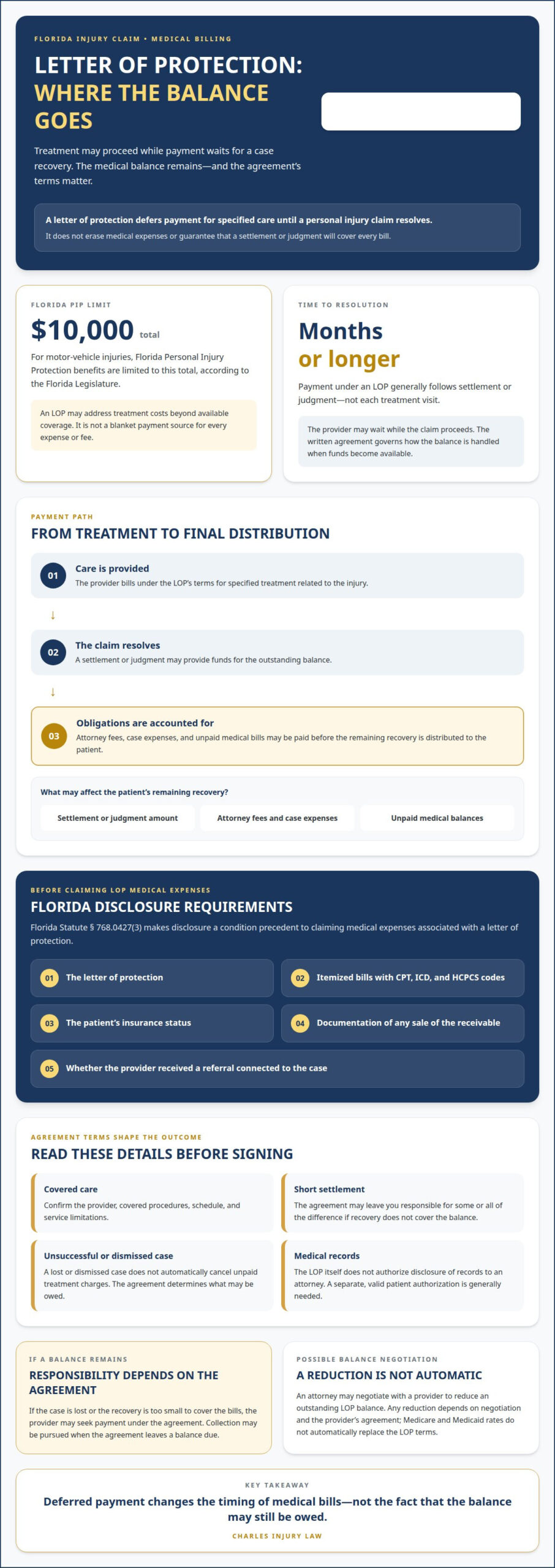
Definition and purpose of a letter of protection in Florida
Florida Statute § 768.0427(1)(d) broadly defines a letter of protection as an arrangement in which a medical provider treats a patient in exchange for a promise of payment from an injury settlement. Its purpose is to address a timing problem: an injured person may need treatment before a personal injury case produces a recovery. The provider waits for payment, while the patient receives care under the agreement’s terms.
The arrangement is not the same as having a medical expense paid immediately. A provider may defer collection while the claim proceeds, but the patient’s balance remains subject to the agreement. For example, a letter may cover treatment from a particular provider while excluding services outside its stated scope. The agreement defines which expenses are deferred and how payment is expected.
This option may matter after an accident if a patient lacks sufficient health insurance, has exhausted available Personal Injury Protection coverage, or cannot afford treatment costs upfront. It can help bridge the gap between receiving care and resolving the injury claim. If health insurance can cover treatment without delaying necessary care, using it may be preferable to relying on deferred payment.
The provider also takes on financial risk. Payment may be delayed while the personal injury case proceeds toward settlement or judgment, and the provider may not receive the full billed amount. Providers may charge higher rates under these arrangements because they defer payment and accept collection risk. The promised payment, covered care, and outstanding balance are therefore important terms, not minor details.
A letter of protection also affects how medical expenses are presented in a Florida case. Florida law values expenses associated with these arrangements based on amounts actually paid or payable, rather than automatically treating the full billed charge as recoverable. The provider’s bill and the amount ultimately owed can therefore serve different purposes. Resolving a claim may require attention to both the evidence and the patient’s payment obligation.
In practical terms, the arrangement connects treatment to a future case recovery, but it does not determine whether the claim will succeed or how much it will settle for. Understand which services the agreement covers, when payment becomes due, and what happens if the recovery does not cover the balance. Those terms define the purpose and limits of the protection.
How a letter of protection in Florida works
After an accident, a letter of protection connects medical treatment to a pending injury claim. The medical provider agrees to wait for payment from a future settlement or judgment. The patient receives care before the claim resolves, while the agreement records how the provider expects to be paid. It does not guarantee that the claim will produce enough to cover every bill.
To pursue this arrangement, the injured person discusses treatment needs and payment options with a lawyer. The patient and attorney can send a letter of protection to a medical provider, asking the provider to defer payment. The provider decides whether to accept it under its own practice and policies. Having an injury claim does not automatically secure an LOP.
If the provider accepts, the patient and provider proceed under the written arrangement. The letter should clarify which treatment and expenses it covers, how payment is expected, and any limits on services. For example, a letter covering one provider’s care does not necessarily cover treatment from another provider. Understand the scope before relying on it for ongoing care.
Health insurance is another important part of the process. Florida patients should generally use available health insurance rather than a letter of protection when insurance can cover treatment without delaying necessary care. After a car accident, Personal Injury Protection may also apply to eligible expenses. An LOP may be an option when coverage is insufficient, exhausted, or unavailable for the needed care.
During treatment, the medical provider documents services and charges while the personal injury case proceeds. The lawyer can account for the agreement and related medical expenses as the claim develops. Florida Statute § 768.0427(3) requires disclosure of a letter of protection as a condition precedent to claiming associated medical expenses. That requirement connects the payment arrangement to the evidence used to support damages.
When the case settles or results in a judgment, payment is handled under the letter and the distribution of the recovery. The provider’s balance may be paid from the proceeds, affecting what remains for the patient. A disagreement about the balance can complicate distribution. The key takeaway: a letter can bridge the gap between needed care and delayed payment, but it also ties specified medical expenses to the claim’s eventual outcome.
Who can issue a letter of protection in Florida, and who can receive one?
A Florida letter of protection involves an injured patient, a medical provider, and often the patient’s attorney. The patient and attorney can send a proposed arrangement to a provider, who decides whether to accept it under the provider’s practice and policies. Providers are not required to offer or accept an LOP.
The medical provider is the party agreeing to defer payment for specified treatment. A physician, specialist, or other healthcare provider may consider the arrangement when an injured patient needs care before a personal injury claim resolves. Acceptance depends on the provider’s policies and the proposed terms. A provider who declines the arrangement is not required to treat the patient under an LOP.
The patient receiving care is the person whose treatment and payment obligation the agreement addresses. The injury must be connected to a claim for which a future settlement or judgment may provide funds. For example, someone injured in a crash may seek care from a provider willing to wait for payment tied to the injury claim. The agreement does not determine whether the claim will succeed.
The attorney may help prepare and send the letter and may sign it as part of the arrangement. The attorney’s role may include promising that the provider will be paid from future case proceeds. That promise is separate from the provider’s decision to accept the letter and the patient’s agreement to its terms. Each participant’s role should be clear in the written document.
Before treatment proceeds under an LOP, the agreement should identify the parties, covered procedures, compensation, payment schedule, and service limitations. Those details distinguish covered care from services outside the arrangement. A patient receiving treatment from multiple providers may encounter separate agreements, because one provider’s letter does not automatically bind another provider.
Acceptance does not make the letter a health insurance policy or guarantee payment. The provider waits for payment connected to the case, while the patient remains subject to the agreement’s terms. If the claim produces no recovery or the proceeds do not cover the balance, the written terms matter. The patient’s responsibility depends on what the agreement says about those outcomes.
In short, the patient and attorney can present an LOP, but the medical provider controls whether to accept it. The patient’s injury claim, needed treatment, provider policies, and written payment terms shape the arrangement. Discuss a letter of protection with Charles Injury Law if you need help understanding how the arrangement may affect your injury claim.
Personal Injury Attorney in Fort Lauderdale
Charles Injury Law can help you understand how a letter of protection may affect your injury claim and potential recovery. If you were injured in a car, truck, or rideshare accident, or while walking or bicycling, legal guidance can clarify the agreement’s payment terms and how medical balances may affect settlement proceeds.
Consider reaching out when you’re weighing treatment options, reviewing an LOP, or facing questions about provider bills as your case progresses. Understanding your obligations can help prevent billing issues from adding uncertainty to your recovery.
Contact Charles Injury Law to discuss your injury claim. Call Now: (954) 390-2228 Available 24 Hours a Day, 7 Days a Week.
Make Your Next Decision With Confidence
Understanding what a letter of protection in Florida means is a starting point. Before deciding about treatment, consider how the proposed arrangement fits your care and injury claim. Asking clear questions can help you understand the document and avoid surprises as the claim progresses.
Bring the agreement and any provider billing information to a conversation with a personal injury attorney. You can discuss the terms, how they relate to your claim, and what to consider before proceeding. If you’re dealing with injuries from a car, truck, or Uber or Lyft accident, legal guidance can help you assess your next steps.
Contact Charles Injury Law to discuss your situation. You deserve clear information as you make decisions about your care and recovery.
Frequently Asked Questions
Can I use my health insurance instead of an LOP?
Yes. Health insurance may cover eligible treatment, and the insurer’s explanation of benefits can show what it paid, adjusted, or left unpaid. Keep that document with provider statements so you can compare the figures. This can clarify whether a balance reflects patient responsibility or an insurance adjustment, rather than assuming the original billed amount is still due.
So What Does All Of This Really Mean?
It means the paperwork matters as much as the treatment plan. People searching for a personal injury firm near me, attorneys for personal injuries, or attorneys personal injury should look for clear explanations of documents affecting their claim. Keep the agreement, provider statements, and insurance explanations together. These records can help distinguish treatment charges from amounts paid or adjusted during the claim.
What happens if I lose my case?
The agreement’s language determines what happens to the provider account after an unsuccessful case. Before signing, identify the clauses addressing the end of the claim, any remaining balance, the due date, and collection activity. If you’re considering an injury lawyer near me or a personal injury lawyer near me, ask for an explanation of those specific terms rather than relying on a general description of LOPs.
Will the insurance company use my LOP bills against me at trial?
The opposing side may scrutinize the provider’s charges, treatment decisions, and any relevant financial interest. A treating provider may be questioned about why particular care was provided and how charges were determined. That scrutiny does not, by itself, prove that treatment was unnecessary or a bill invalid. The case records and testimony matter to how those issues are evaluated.
What is a letter of protection in Florida personal injury cases?
A letter of protection in Florida matters because it connects treatment charges to a potential injury recovery, not to an insurer’s promise to pay. The practical issue for the patient is understanding how the written terms affect the provider account. The document also matters when medical expenses are presented as evidence. Its existence alone does not determine damages or the outcome of a case.
How does a letter of protection in Florida work between an injured patient, doctor, and attorney?
The provider must accept the arrangement: a patient and attorney cannot require a doctor to treat under a letter the doctor has not accepted. Keep a copy showing the provider, covered services, and any amendments. An LOP does not authorize the release of medical records by itself. A separate, valid patient authorization is generally needed for that disclosure.
How is a letter of protection different from health insurance, a medical lien, or a medical payment agreement in Florida?
The practical difference is which document governs the account and payment source. Insurance is governed by the policy and its coverage decisions; an LOP is governed by its written terms. A medical lien concerns a claim against recovery proceeds. “Medical payment agreement” can refer to different arrangements, so review the actual document rather than relying on its label to understand the obligations it creates.
What happens if a Florida personal injury case settles for less than the medical bills under a letter of protection?
A smaller settlement can leave the provider account unresolved, so the distribution should not be treated as complete until the outstanding balance is addressed. Lawyers for auto accidents or auto accident lawyers near me may help explain how provider-balance negotiations fit into resolving a claim. Document any reduction in writing, including the agreed amount and the provider’s confirmation of payment.
Disclaimer
The information provided on this blog is for general informational purposes only and does not constitute legal advice. Viewing this content does not create an attorney-client relationship with the firm. You should not act or rely on any information contained herein without seeking legal advice from a qualified attorney regarding your individual situation.