

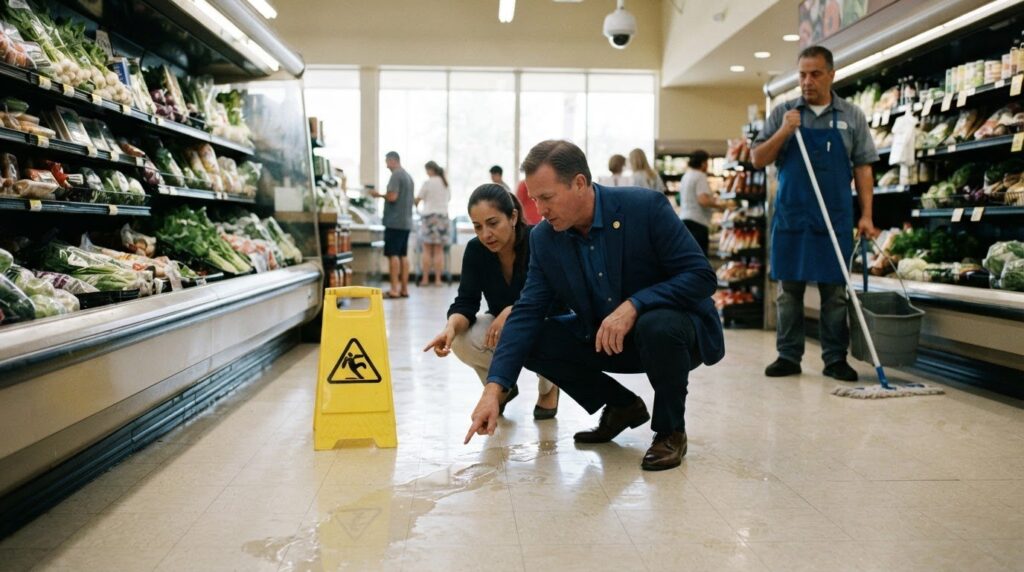

Does a wet floor sign automatically defeat a Florida slip-and-fall claim? No. The key question is whether the store created the hazard or had actual or constructive notice of it. Proving a store knew about a dangerous condition may depend on what employees saw, how long the spill remained, and whether similar hazards had occurred before.
A warning sign may matter, but it doesn’t establish when the danger appeared or whether the store responded appropriately. The spill’s source, nearby objects, and inspection timing can all help explain what the evidence shows.
After a store fall, people may search for a personal injury firm, an injury lawyer, or a personal injury lawyer. Others may look for attorneys handling personal injuries or auto accidents when considering legal help for different injuries. This article explains how spill evidence, sweep logs, surveillance footage, and employee-created hazards may help establish notice in Florida. You’ll learn why a sweep record alone may not settle the issue and what video can reveal about employees’ opportunity to act.
Key Takeaways
- A wet floor sign doesn’t automatically resolve a Florida slip-and-fall claim; the circumstances and other evidence still matter.
- Employee knowledge, customer complaints, and incident records may help show whether the store knew about the specific spill.
- Surveillance footage can help establish when a hazard appeared and whether employees had an opportunity to respond.
- Sweep logs provide context, but they may not prove how long a spill existed without other supporting evidence.
- If store operations or an employee created the hazard, that evidence may support a claim without showing that another worker later discovered it.
When Is a Grocery Store Responsible for a Slip and Fall?
In Florida, a grocery store may be responsible when it created a dangerous condition or had actual or constructive knowledge of it. For a spill involving a transitory foreign substance, Florida Statutes section 768.0755 makes notice a central issue in a slip-and-fall claim.
Actual Notice of a Specific Hazard
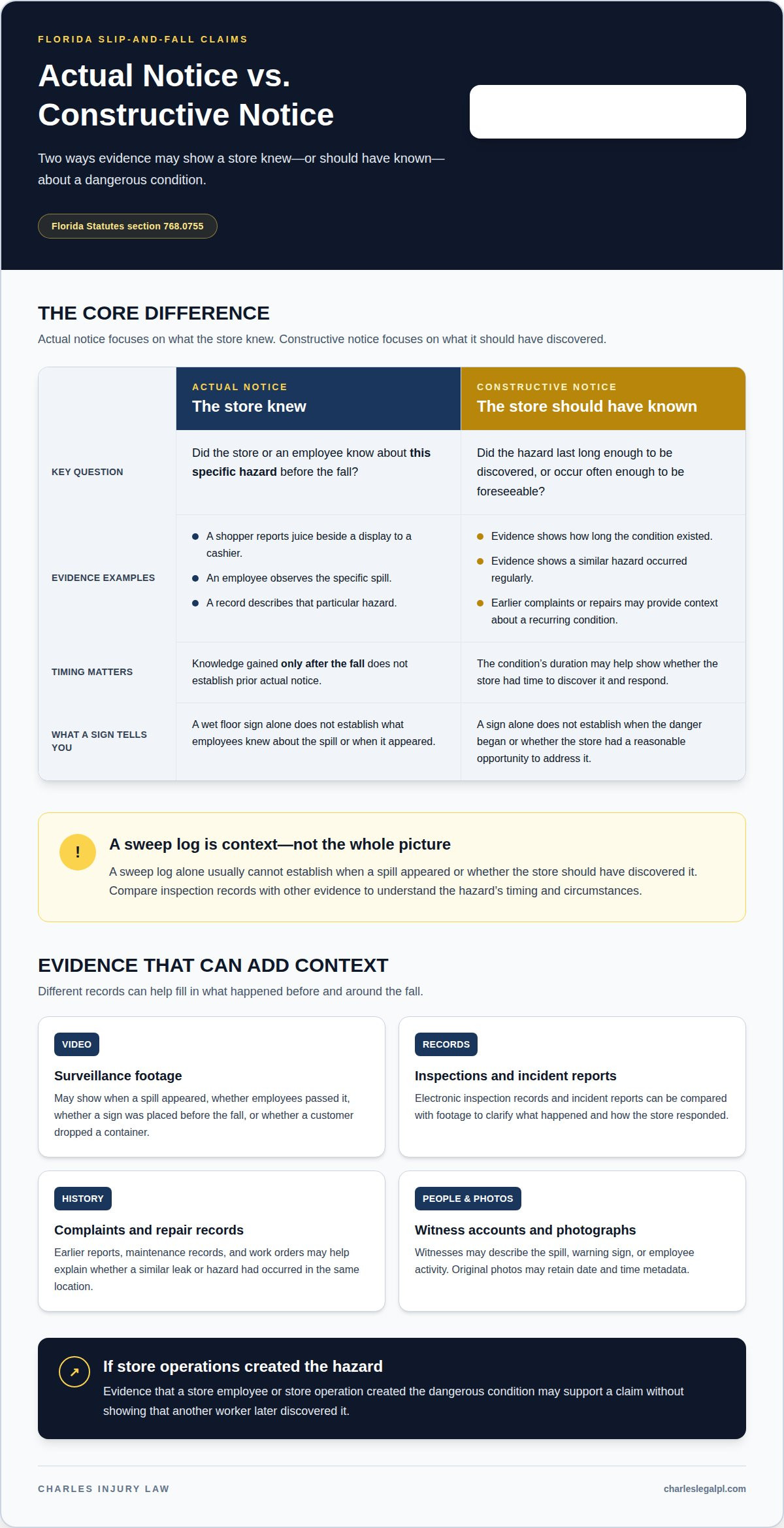
Actual notice means the store or an employee knew about the specific hazard before the fall. For example, a shopper’s report to a cashier about juice beside a display may show that the store received notice of the spill. The evidence must connect the store’s knowledge to the hazard that injured the person, not merely to a general risk elsewhere in the aisle.
A store’s ownership of a bottle near a puddle does not, by itself, prove that the bottle caused the spill or that an employee knew liquid had reached the floor. A customer complaint, an employee’s observation, or a record describing that particular spill may help establish actual notice. Timing matters: knowledge acquired only after the fall does not establish prior actual notice.
Florida Notice Rules
Florida law recognizes actual notice and constructive notice as ways to show that a business knew, or should have known, about a dangerous condition. Under Florida Statutes section 768.0755, constructive knowledge may be supported when the condition existed long enough for the business to discover it, or when it occurred regularly enough to be foreseeable.
These two forms of notice raise different questions. Actual notice focuses on what the store or its workers knew about the specific hazard; constructive notice focuses on its duration or recurring pattern. A warning sign can be relevant evidence, but its presence alone doesn’t establish when the spill occurred, what employees knew, or whether the store had a reasonable opportunity to address it.
Burden of Proof and Filing Deadlines
Under Florida law, an injured person generally must prove the elements of the claim, including the applicable notice requirement and that the dangerous condition caused harm.
Florida’s general limitations statute provides two years to file an action founded on negligence, subject to exceptions and other rules. The deadline is not a substitute for evidence: records and witness accounts must still connect the store to the hazard. Florida’s comparative fault law also generally bars recovery in a covered negligence action if the injured person is found more than 50% at fault, according to the Florida Legislature.
Surveillance footage and evidence preservation
Surveillance video can help establish when a spill appeared and what happened before the fall. Inspection records, witness accounts, and photographs can add context about the incident and potential liability.
Surveillance Footage Preservation
An attorney can send a written preservation request identifying footage and related records to retain. Prompt action matters because video may be overwritten or become unavailable. A request can identify cameras covering the aisle, nearby checkout areas, and entrances, as well as relevant inspection data, photographs, and incident reports.
Footage may show when a spill first appeared, whether employees passed it, and whether anyone placed a warning sign before the fall. It can also reveal activity outside the immediate area, such as a customer dropping a container. Those details help assess the circumstances and whether the hazard existed long enough for the store to respond.
Prior Leak Complaints and Repairs
Earlier complaints and repair records may show that a leak or similar hazard had occurred in the same location before the incident. An attorney can seek maintenance reports, work orders, inspection records, and prior incident reports related to the floor, refrigeration unit, or other suspected source.
For example, repeated reports of water near a refrigerator may help explain why the same area needed attention. A repair record can identify the reported problem and the response. These documents don’t automatically establish negligence, but they may provide context about recurring conditions and what store personnel knew.
Evidence Gathering After a Fall With an Attorney
An attorney can gather evidence by identifying relevant witnesses, requesting store records, and organizing available photographs and video. Witness statements may describe the spill’s appearance, the location of warning signs, or employee activity before the fall. A prompt account can preserve details while memories are fresh.
Preserve original photographs because their metadata may contain date and time information. An attorney can also request the incident report and electronic inspection records, then compare them with surveillance footage. Together, these materials can clarify what happened, whether the hazard existed before the fall, and how the store responded.
If you were injured and need help addressing evidence preservation, contact Charles Injury Law.
Are Sweep Logs Enough to Prove the Store Should Have Known About the Spill?
A sweep log alone usually cannot establish when a spill appeared or whether the store should have discovered it. In Florida, constructive notice may be shown through evidence about the hazard’s duration or recurring pattern.
How Long the Hazard Existed
Constructive notice based on duration means the hazard remained long enough that the store should have discovered it. The length of time matters because it can show whether a reasonable inspection would have found the condition before someone fell.
A sweep log records an inspection, but the entry may not establish when the spill occurred. If a log shows an employee checked an aisle and a customer fell shortly afterward, that timing is relevant. It still doesn’t reveal whether liquid was already on the floor during the inspection or appeared later. Surveillance footage or witness accounts may help fill that gap.
There is no automatic number of minutes that proves constructive notice in every case. The evidence must establish what happened in that store and aisle. Video showing a spill remained on the floor while shoppers and employees passed may support an argument that the condition should have been discovered. A photograph of the liquid alone may not establish how long it was there.
Inspection Practices and Duties
Inspection practices matter because they can show whether the store took reasonable steps to identify and address hazards. A log’s entries, timestamps, location details, and recorded follow-up can help explain what inspections occurred and whether anyone responded to a problem.
For example, a record might show an aisle inspection without noting a spill, while video shows a puddle was already present. That conflict may raise questions about the inspection’s accuracy or whether the employee checked the relevant area. If a log records a spill but no response, other evidence can clarify whether the store addressed it before the fall.
Florida law also recognizes constructive notice when a dangerous condition occurred regularly, making its recurrence foreseeable. Repeated reports about leaks in the same area, paired with maintenance or inspection records, may help establish that pattern. A single sweep entry cannot settle whether the store failed to identify a recurring hazard.
Assess the evidence together. Logs can be compared with surveillance, incident reports, maintenance records, and witness statements to build a timeline. Medical records may document the injured person’s harm, but they do not establish when the spill appeared or what the store knew. The central question is whether the evidence connects the hazard’s duration or repeated occurrence to the store’s opportunity to discover it.
How Quickly Should an Attorney Request Surveillance Video?
An attorney should request relevant footage promptly after a store fall. A written preservation request can identify surveillance video, electronic inspection data, photographs, incident reports, and other records to retain. Quick action matters because footage may no longer be available later.
The request should describe the incident location and identify cameras that may have captured it. A camera above the aisle might show the spill, while another near the entrance could reveal when it appeared. Footage from nearby areas may also show employees passing, inspecting the area, or placing a warning before the fall.
Video is most useful when evaluated alongside other evidence. An attorney can compare footage with sweep logs, inspection records, and the store’s incident report. If a log records an inspection but video shows a hazard already present, the difference may raise questions about what the inspection covered. If video shows an employee discovering the spill, the timing and response may matter.
Witness accounts offer another view of the premises. A customer may remember seeing liquid before the fall, noticing a warning sign, or watching an employee walk through the area. An attorney can gather witness statements and compare their descriptions with video and store records. That comparison can help clarify what happened and whether the condition was discovered before the injury.
Florida premises liability principles recognize a property owner’s duty to regularly inspect for dangerous conditions and repair them or warn invitees. Consider an inspection record in context, rather than treating it as proof by itself. The timing, location, recorded observations, and follow-up can help evaluate whether the store took reasonable steps. A premises liability claim may turn on how those details fit together.
An attorney can also seek maintenance records, witness accounts, and reports related to a recurring problem. For example, an inspection entry alongside a report of water near a cooler may help explain what the store knew and when. The goal is to establish a reliable timeline: when the hazard appeared, whether staff could have discovered it, and what action followed.
Preserving the full record matters. A short clip without its surrounding context may leave out an inspection, employee activity, or warning that changes how the incident is understood. Promptly identifying relevant footage and comparing it with records gives the evidence a clearer role in evaluating notice and possible negligence.
Hazards created by store employees or operations
A store-created hazard raises a different notice question from a spill caused by an unknown customer. If an employee’s work creates the danger, that evidence may support a claim without showing that another worker later discovered it.
Employee-Created Hazards
An employee-created hazard is a dangerous condition arising from store work, such as cleaning, stocking, moving equipment, or performing maintenance. This matters because evidence of the employee’s actions may connect the store directly to the hazard, rather than relying only on proof of how long it existed.
For example, a worker mopping an aisle may leave a wet substance where customers walk. A stocking employee may drop produce, or maintenance work may leave equipment in a walkway. Video, witness accounts, and an incident report can help establish what task occurred, where the hazard was left, and whether a warning appeared before the injury.
Recurring Hazards and Preventive Measures
A recurring hazard is a condition that repeatedly occurs in the same area or through the same store operation. Repeated leaks near a cooler, for example, may help show that the danger was foreseeable and that preventive measures deserved attention.
Maintenance records, prior reports, and inspection logs can help establish whether the same substance or problem returned. Those records may show whether repairs addressed the source or only cleaned the floor. A recurring condition can also make the timing and adequacy of inspections important, especially if similar incidents occurred in the same location.
Evidence of store operations can clarify how a hazard formed. A video may show an employee moving a leaking container, while a witness may describe liquid appearing immediately afterward. A report identifying the employee’s task, the location, and the time can help connect the work to the dangerous condition. These details may support actual notice without requiring proof that another employee later saw the spill.
A store may argue that the danger was open and obvious or that the injured person voluntarily encountered a known and understood risk. Visibility is only part of the circumstances. Lighting, the customer’s path, nearby displays, and the substance’s appearance may affect what could be seen. For instance, clear liquid on a reflective floor may be harder to notice than a brightly colored spill.
Preserve evidence showing both the hazard and its setting. An incident report, photographs, surveillance footage, employee accounts, and records of earlier occurrences can help explain what happened. Together, they may show whether store work created the danger, whether a warning was present, and whether the store took preventive steps after earlier problems.
If an employee’s work may have caused your fall, contact Charles Injury Law about your injury.
Personal Injury Attorney in Fort Lauderdale: Accusations of Shoplifting at businesses such as Malls, Convenience Stores, etc.
Charles Injury Law is a next step if a store incident also involves an accusation of shoplifting at a mall or convenience store. That accusation is separate from whether a spill caused a fall, so keep the two matters distinct when describing what happened.
For a store injury, the timeline, inspection records, and surveillance footage can help show how the hazard arose and what employees knew. If the incident also involved a shoplifting accusation, details about where and when it occurred may help explain the broader circumstances. Charles Injury Law also handles injury matters involving car, truck, and rideshare accidents.
If you’d like to discuss your situation, contact Charles Injury Law. Call Now: (954) 390-2228 Available 24 Hours a Day, 7 Days a Week
Take the Next Step Toward Accountability
Deciding what to do after a store fall can feel difficult, especially while you’re managing an injury. Proving a store knew about a dangerous condition depends on the available evidence and how it connects to your experience. A legal review can help clarify which issues deserve attention and what options may be available.
Charles Injury Law also represents people injured in car accidents, truck, semi-truck, and tractor-trailer accidents, and Uber and Lyft rideshare accidents. Each matter calls for a careful review of its specific circumstances. You don’t have to face questions about responsibility alone.
Discuss your situation with Charles Injury Law. Call Now: (954) 390-2228 Available 24 Hours a Day, 7 Days a Week. Taking that first step can help you move forward with greater clarity.
Frequently Asked Questions
Does a Wet Floor Sign Prevent a Slip and Fall Claim?
No. A wet floor sign may be relevant, but its presence alone doesn’t settle whether a store is responsible. The sign’s placement, visibility from the customer’s approach, and relationship to the actual spill may matter. For example, a sign around a corner may not alert someone entering an aisle. Consider the evidence in the context of the specific fall and the store’s response.
Did the Store Create the Hazard?
If a store employee’s work created the dangerous condition, that may support a claim even without proof that another employee later noticed it. Cleaning, stocking, or moving equipment can leave a slippery substance or obstruction. Evidence may show what the employee was doing, where the hazard appeared, and whether the area was marked. The key is connecting the store’s activity to the condition that caused the injury.
What Compensation May Be Available?
Potential damages may include medical expenses, future medical care, lost wages, reduced earning capacity, pain and suffering, emotional distress, permanent disability, and property damage. The losses must relate to the injury and be supported by the circumstances and available records. For example, medical bills and treatment records can document care, while employment records may help show missed work. This is general information, not legal advice.
What Does It Mean for a Store to Have Notice?
Notice means the store knew about the specific dangerous condition or, under Florida law, should have discovered it. The distinction matters because a store’s general awareness that spills can happen does not establish knowledge of every particular spill. For example, evidence that staff received a report about a specific wet area before a customer fell may help show notice of that condition.
What If the Spill Came From Produce, Ice, or a Leaking Cooler?
The spill’s likely source can help explain how the condition occurred, but nearby produce or a cooler alone doesn’t prove what caused it or what employees knew. For instance, a crushed grape beside a slick spot may support an explanation, but additional evidence may be needed to connect the grape to the spill. A leaking cooler’s repair history or related reports may also help establish whether the problem recurred.
What Must a Customer Prove to Show a Store Knew About a Dangerous Condition?
Under Florida Statutes section 768.0755, a claim involving a transitory foreign substance generally requires evidence of actual or constructive knowledge. The injured person must also connect the condition to the fall and resulting harm. Evidence can include a witness who saw an employee create or encounter the hazard, or records that help establish when it appeared. The specific facts determine how those pieces fit together.
What Is Actual Notice Versus Constructive Notice in a Store Injury Case?
Actual notice concerns direct knowledge of the particular hazard, such as an employee receiving a complaint about a spill. Constructive notice concerns whether the store should have discovered it, based on its duration or repeated occurrence. This distinction can shape what evidence matters: a report may show direct awareness, while repeated maintenance records may help demonstrate a recurring condition.
How Long Must a Hazard Exist for a Store to Have Constructive Notice?
Florida law does not set a universal number of minutes that automatically establishes constructive notice. The question is whether the hazard lasted long enough that the business should have discovered it, or occurred regularly enough to make its recurrence foreseeable. A video timeline or inspection records may help show the condition’s duration. A photograph showing the spill’s appearance alone may not establish when it began.
Disclaimer
The information provided on this blog is for general informational purposes only and does not constitute legal advice. Viewing this content does not create an attorney-client relationship with the firm. You should not act or rely on any information contained herein without seeking legal advice from a qualified attorney regarding your individual situation.