

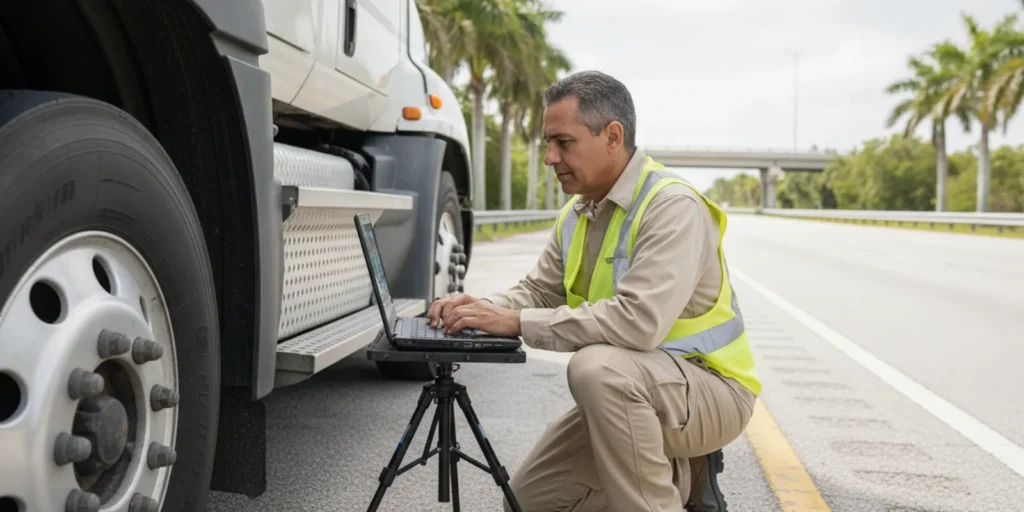
After a commercial truck crash, people often want to know what the vehicle recorded. They also ask how that record could affect a truck accident settlement amount. Truck black box evidence in a Florida accident may include engine data, event records, electronic logs, GPS or telematics, and video. The phrase “black box” does not describe one universal device, and no single record necessarily explains a collision. A Florida truck accident lawyer guide covers the broader claim. This page stays on what electronic records may show, and why they should not be treated as a dollar figure by themselves.
Call (786) 525-8784 to request a free case review, or use the contact form.
What does “black box” mean in a truck?
“Black box” is a familiar shorthand, not the name of one standard piece of equipment installed in every commercial truck. It may refer to an engine control module (ECM) or an event data recorder (EDR). It may also mean an electronic logging device (ELD), a camera, GPS, telematics, or a fleet platform. Those systems can serve different purposes, collect different fields, and store information in different places. Some may be integrated, while others are separate devices or services.
An ECM monitors engine and vehicle functions. Depending on the truck’s equipment, it may retain engine speed, vehicle speed, and throttle position. It may also retain brake activity, cruise-control status, or diagnostic codes. An EDR, if installed and triggered under its system’s conditions, may store a limited snapshot of vehicle status around a qualifying event. That is not necessarily a continuous recording of the entire trip.
An ELD is generally associated with recording a commercial driver’s duty status and driving time. GPS and telematics may record location, routes, stops, or vehicle movement. A forward-facing camera might capture part of the road; a cab-facing camera may capture something different. A fleet platform may combine several sources or preserve information that is not stored in the truck itself. The exact capabilities depend on the equipment, settings, service, and retention practices involved.
These terms are not interchangeable. A driver log is not a crash video. A GPS point is not a complete reconstruction. A warning code does not by itself prove a mechanical defect caused an impact. Before drawing conclusions, a reviewer needs to identify the particular system. The reviewer also needs to know what it was designed to record and whether the record relates to this event.
How might electronic data affect a truck accident settlement amount?
Electronic records do not set a truck accident settlement amount. They may help test a disputed fact, such as recorded speed, braking, route, or timing. Whether that fact changes negotiations depends on the rest of the evidence, the injuries, insurance coverage, and the law that applies. No article can predict a number, and past results do not guarantee a future outcome.
If records exist and can be interpreted, they may help clarify a specific factual issue. Vehicle data could indicate recorded speed, movement, braking, throttle, or engine activity at a particular time. A location record may help place a truck along a route. An ELD record may provide context about a driving period or duty status. Video may show vehicles, road conditions, signals, or actions within the camera’s field of view.
The most useful question is usually not “What does the black box prove?” Ask what specific fact this record could help evaluate. An investigator might ask whether a vehicle was moving before an event. Another question is whether a system registered braking. A third is whether the route and timing match other records. Narrow questions are easier to test against the system’s actual data and known limitations.
- Speed and movement: Some devices may record speed or movement at selected times. The measurement method, sampling interval, clock, and source of the reading matter.
- Braking or throttle: A record may indicate a brake-related signal or throttle activity. It may not reveal why the driver responded, how much traction was available, or the full stopping conditions.
- Engine or diagnostic information: Operating values and fault codes may help frame a mechanical inquiry. A code alone does not establish when a problem began or whether it contributed to a crash.
- Location and route: GPS or telematics may help identify a vehicle’s approximate location or path, depending on how often it records and the system’s accuracy.
- Video: Footage may show an event within the camera’s view, but a lens can miss activity outside its angle, be obstructed, or record unclear images.
- Driver-hours information: ELD or related records may help establish recorded duty-status details. They do not, without more, establish a driver’s actual alertness or explain the collision.
For example, imagine one record indicates that the truck was moving at a certain speed shortly before a reported impact. That may be a useful point for investigation, but it is not yet a complete answer. A reviewer would want to understand the record’s time reference. The reviewer would also ask whether the system was maintained, how often the value was captured, and whether other evidence supports the timing.
A record that indicates braking does not show that the truck stopped in time. It also does not show the braking distance or that the driver could have avoided the collision. A record that contains no brake event is not necessarily proof that no braking occurred. The data format, triggering conditions, recording interval, device state, and meaning of each field need to be understood before interpreting an apparent gap or value.
How is electronic data different from other truck records?
Electronic evidence is one part of a broader factual picture. A crash report, witness account, photographs, roadway marks, vehicle damage, medical records, dispatch messages, driver logs, inspection records, and maintenance files may answer different questions. No category should be treated as a substitute for all the others. A digital record can be valuable and still incomplete; a paper record can be important without describing the collision itself.
| Evidence type | What it may help clarify | Important limitation |
|---|---|---|
| ECM or event data. | Recorded vehicle activity around a period or event. | Capabilities, timing, triggering, and retention vary by system. |
| ELD or driver logs. | Recorded duty-status or driving-time information. | Does not by itself establish how the collision happened or how a driver felt. |
| GPS or fleet telematics. | Route, approximate location, stops, or movement. | Accuracy, update frequency, and detail depend on the system and records. |
| Camera footage. | Events visible within the camera’s field of view. | May be limited, unclear, obstructed, or overwritten. |
| Maintenance and inspection files. | Documented service, inspections, or reported issues. | Entries need context; they do not automatically prove a defect caused a crash. |
| Dispatch and business communications. | Instructions, route changes, timing, or communications. | May be incomplete and should be read with other evidence. |
Consider a hypothetical collision in which a truck’s electronic record shows a change in speed, a witness describes the truck changing lanes, and photographs show damage to the side of another vehicle. Each item contributes a different kind of information. The electronic record might help with a timing or movement question. The witness may describe what was visible. Photographs may show the point and pattern of contact. None should be stretched beyond what it directly supports.
Another example: a maintenance file may show that a component was inspected weeks before the crash, while an onboard system later records a fault. The dates and meanings of both entries matter. The inspection entry does not necessarily establish the component’s condition at the time of the collision. A later fault does not necessarily establish that the condition existed earlier or caused the crash. Further technical review may be needed to connect or distinguish the records.
The firm’s truck accident information provides a route to broader information about truck-collision issues. The focus here is narrower: what electronic records might contribute, and why they should be considered alongside physical and documentary evidence.
Why can preserving the data be time-sensitive?
Electronic information may be held in the vehicle, a motor carrier’s system, a fleet platform, or by a technology vendor. Some systems retain records only for a defined period, while routine operations may replace older material. Other information may remain available longer, be transferred to a central account, or require steps to retrieve. There is no single retention schedule that applies to every truck, system, company, or data type.
A vehicle’s status can change after a crash. It might be repaired, moved, returned to service, or sold. A device could be disconnected or reset during ordinary work. A camera may record over older footage as new footage is created. None of these possibilities means every record disappears immediately, and no one should assume that a record exists simply because a truck has electronic equipment. They do explain why it can be sensible to raise the preservation question promptly with an attorney.
Preserving evidence is not the same as proving a claim. A request cannot create information that was never recorded. It also cannot restore missing data or guarantee that a record will answer a disputed question. It can be one step in identifying potentially relevant material and asking that it not be altered or discarded while its availability is assessed. Which steps are appropriate depends on the facts and requires legal review.
It can also matter where the information lives. A truck may have onboard data while the company keeps a separate telematics account. A video system might save clips to a server or only to local storage. A driver’s ELD records may be maintained through a service provider. Identifying the vehicle owner, carrier, system type, and possible record custodian can therefore be part of figuring out what should be requested. The driver may not personally possess data stored in a company or vendor platform.
If you have a crash date, approximate time, location, truck number, company name, or vehicle markings, keep those details in one place. They may help distinguish the specific vehicle and event when questions are later asked. Do not contact a technology vendor or attempt to access a truck’s equipment yourself; access, preservation, and interpretation should be handled through appropriate channels.
What practical steps can you take after a truck crash?
Start with safety and medical attention. An injured person should not put themselves at risk to collect evidence, return to a dangerous roadway, approach a truck, or operate electronic equipment. If you are able to keep information safely, focus on records and observations already available to you. You do not need to know the technical name of a device before asking what records may exist.
- Write down basic event details. Record the date, approximate time, location, direction of travel, weather or visibility as you recall it, and the vehicles involved. Mark uncertain details as estimates rather than presenting a guess as exact. Note any safely observed company name, truck number, trailer number, or identifying markings.
- Keep original materials. Save photographs, messages, paperwork, and any video in their original form when possible. Avoid editing the only copy. If you make notes from memory later, label when you wrote them and distinguish what you directly remember from information learned afterward.
- Preserve contact information voluntarily shared. Keep names and contact details for witnesses, passengers, or responders if they are provided. Do not pressure anyone to provide information or coordinate what people should say.
- Organize communications. Save letters, emails, claim references, and messages from insurers or companies. Keep a simple dated list of who contacted you and what documents were requested or sent. Avoid speculating about technical readings you have not seen.
- Keep medical and expense records. Retain records you already receive, such as appointment information, discharge papers, bills, and receipts. These are separate from truck data, but they may document the effects of an injury and help an attorney understand the situation.
- Ask about potentially relevant records. In a case review, explain that electronic vehicle information may exist and share the truck and crash details you have. An attorney can discuss whether a preservation request or another step may be appropriate for the circumstances.
Do not try to remove a device, connect a laptop, enter a truck, or obtain a private company account. Apart from safety concerns, an untrained attempt could affect equipment or data, and a person outside the company may not have authorization. It is enough to identify what you observed and raise the issue with a qualified attorney.
For related background, you can read the firm’s overview of how Florida personal injury claims work and its answers to common personal injury questions. Those pages offer general information; they do not determine what records exist or what a particular claim involves.
What can make electronic evidence hard to interpret?
Even when a record is available, interpretation can take more than reading a screen or spreadsheet. Systems may use different clocks. A device may record at intervals rather than continuously. The vehicle’s clock may not match a phone, roadway camera, dispatch record, or police report. A few seconds of difference can matter when comparing events, so the time source and any adjustment should be documented rather than assumed.
Data fields can also have specialized meanings. A displayed speed may be measured or calculated in a particular way. A brake-related value may refer to a sensor or command, not necessarily the full physical braking process. A fault code may report a condition without explaining its cause, duration, or effect. Understanding what the system measures is different from concluding what happened on the road.
Recording conditions matter too. Some event data may be stored only if a qualifying trigger occurs. Video may be continuous, motion-triggered, or saved in short clips. An ELD may record status changes but not every detail of a trip. System damage, loss of power, disconnected components, storage limits, or settings can affect what remains. The absence of a particular entry does not automatically show that an event did not happen.
For a camera, field of view is central. A forward-facing lens may not capture a vehicle approaching from the side or an event behind the truck. Reflections, glare, rain, darkness, dirt, vibration, and obstructions can reduce detail. A clip may begin after a key event or stop before its aftermath. A video’s timestamp also may need comparison with other clocks before it is aligned with a timeline.
For GPS or telematics, the number of recorded location points and their precision matter. A route map may connect sparse updates with straight lines, even if the truck stopped or changed direction between updates. The map display is not necessarily the original underlying record. A reviewer should distinguish a visual summary from raw data and consider how the platform processes location information.
For logs, the distinction between a recorded status and the underlying real-world activity matters. A log may contain entries that need explanation or comparison with other records. A duty-status entry cannot alone describe alertness, road conditions, or the driver’s full behavior. The right interpretation depends on the record and the surrounding evidence, not a broad assumption about what a device normally does.
These limits do not make electronic information useless. They shape what questions it can answer and how much confidence to place in a conclusion. A careful review separates three things: what the record directly contains, what it may reasonably suggest, and what would require additional evidence or expert interpretation. That distinction helps prevent a partial data point from being presented as a complete collision reconstruction.
How should electronic records be compared with other evidence?
A practical review starts by building a timeline from multiple sources, not by treating one device as the entire story. The crash time may be estimated from a report, a phone call, a camera, a vehicle log, or a witness. Each source may carry a different clock and a different level of precision. Aligning them requires noting the source, time zone if relevant, possible clock drift, and whether a time is exact or approximate.
Next, the reviewer can identify the question each item addresses. A photo may show the final positions of vehicles but not their speeds before impact. A witness may describe a lane change but not see what happened in the cab. A service record may document a repair but not prove the component’s condition during a particular trip. An ECM extract might show selected operating values but not explain a driver’s decision. Keeping those distinctions clear makes contradictions easier to investigate.
Suppose a witness recalls the truck slowing before contact, while one electronic data summary appears to show a speed change at a different time. The useful response is not to declare one source false at once. Questions include whether the clocks are aligned and what interval the system records. They also include whether the witness saw the truck continuously and what other evidence is available. A discrepancy can point to a question that needs resolution rather than a ready-made conclusion.
Or suppose a company record shows a repair before the collision and a fault code after it. The reviewer would need to know what the repair addressed. The reviewer would also ask whether the code can be dated, what conditions produce it, and whether the part relates to the crash. Maintenance history, inspection materials, physical examination, and technical explanation may all matter. An isolated entry rarely supplies every link in that reasoning.
Where appropriate, qualified technical professionals may be needed to extract or interpret data. Their work should be tied to the specific equipment and record, with methods and assumptions made clear. A conclusion should not claim more certainty than the underlying record supports. Legal responsibility is a separate question that depends on the facts and applicable law; a device reading by itself does not determine it.
Who may hold relevant truck records?
Possible record holders include the truck owner, motor carrier, fleet manager, maintenance provider, technology vendor, or another company that administers a platform. Which source matters depends on the truck and the information sought. The carrier may have telematics access, while a vendor hosts the service. The vehicle may retain some data locally. A maintenance contractor may hold inspection paperwork. One organization may not possess every record.
There can also be questions about who controlled or maintained the vehicle and who configured a system. Those details may affect where inquiries are directed. A company that stores data is not automatically responsible for a crash. Similarly, multiple possible record holders do not mean every company has relevant information. The parties and records that matter are case-specific.
Useful identifying information can include the truck’s visible unit number, license plate if safely recorded, company name, trailer markings, and any report or claim reference. Even an approximate description may help an attorney determine what information is already known and what questions remain. Do not infer ownership, employer relationships, or responsibility solely from a logo or vehicle marking.
Questions about records can overlap with wider truck-crash questions involving a driver, carrier, vehicle, maintenance, cargo, or road conditions. This article does not resolve those issues. The firm’s truck accident page is a starting point for general service information. An individual matter still requires review of its particular facts.
What should you avoid assuming?
- Do not assume every commercial truck has one universal black box or that every system stores the same information.
- Do not assume an ELD, ECM, event recorder, GPS unit, fleet platform, and camera capture identical events.
- Do not assume the device recorded the collision, retained a record, or used a clock synchronized with other sources.
- Do not treat a speed value, brake signal, fault code, map, or video clip as a complete reconstruction on its own.
- Do not assume a missing entry proves that an action did not occur. The system may not record that event, or it may use a different trigger.
- Do not assume a record’s existence, or a company’s possession of it, proves wrongdoing or legal responsibility.
- Do not access a truck or electronic system yourself, and do not put safety at risk to collect evidence.
- Do not rely on an online article to decide legal deadlines, liability, eligibility, or the value of a claim.
These cautions are not reasons to disregard electronic records. They help keep the inquiry accurate. A careful account can say that a particular system appears to have recorded a value at a particular time, then identify what remains unknown. That is more useful than claiming that a device definitively proves an entire sequence when the record has not been fully reviewed.
Call (786) 525-8784 to discuss your truck crash, or send details through the contact form.
Frequently asked questions
Does every truck have a black box?
No single device or configuration is universal. A truck may have one or more electronic systems, and their capabilities, settings, and data retention differ. The term “black box” is often used loosely, so the actual equipment has to be identified.
Can black box data prove who caused a crash?
Electronic data may help evaluate specific facts, such as recorded movement or a system’s activity. It does not automatically establish fault or explain every event. Its meaning should be considered with other evidence and with the limitations of the device.
Can I get the truck’s electronic data myself?
Records may be controlled by a carrier, truck owner, or technology provider and may require specialized access. Do not enter a vehicle or try to connect to its systems. You can share the details you have with an attorney and ask what steps may be appropriate.
How quickly should truck data be preserved?
There is no single retention period for every system. Some information may be overwritten or become unavailable through ordinary operations, while other records may remain accessible. Promptly raising the concern with an attorney can help assess what, if anything, should be done.
Does an electronic record replace witnesses or a crash report?
No. Different sources may address different parts of an event, and they can be compared for context. An electronic record is one potential evidence source, not a substitute for witness accounts, physical evidence, reports, or other relevant records.
Important information
This article provides general information, not legal advice. Florida laws and deadlines can depend on the facts and may change; legal claims and current rules require attorney review. Contacting a law firm or submitting an inquiry does not by itself create an attorney-client relationship. Past results do not guarantee future outcomes.
Truck electronic data can be one useful part of a larger factual picture. Its value depends on what was recorded, whether it remains available, and how it fits with the other evidence.