

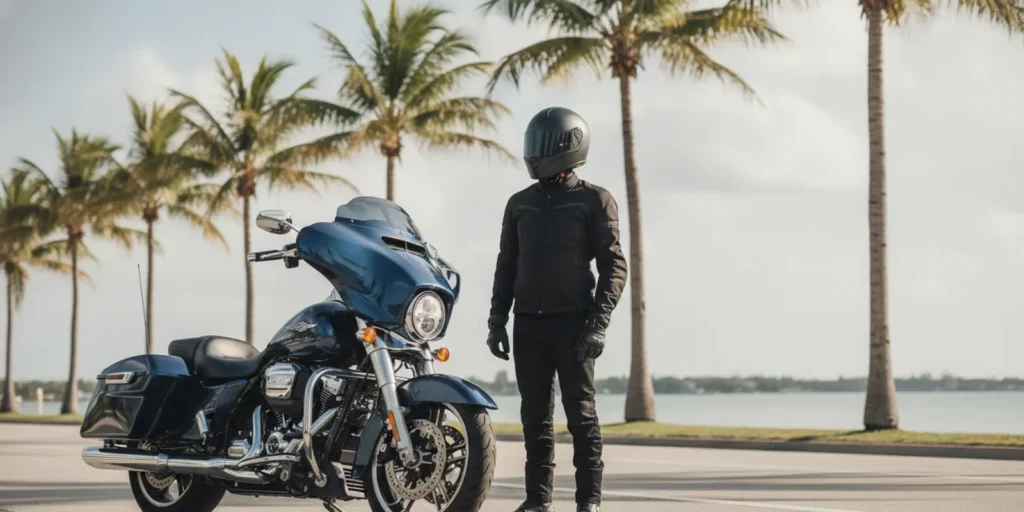
A motorcycle accident no helmet Florida question usually starts with a worry that one missing piece of gear ends the claim. It does not. Not wearing a helmet can matter when the injury involves the head, but it does not by itself explain who caused the crash or what every injury is worth. The collision, the particular injury, the records, and current Florida law all have to be reviewed together. This is general information, not legal advice.
Request a free case review, or call (786) 525-8784.
How can a motorcycle accident no helmet Florida claim be affected?
The effect depends on which question is being asked. One question is how the vehicles moved and what contributed to the collision. Another is how a particular injury happened and what the medical records show. A helmet is head protection. It may be relevant to a head injury. It usually does not explain a broken arm, a leg injury, or the path of the other vehicle.
Florida’s comparative-fault statute, section 768.81, says a claimant’s own fault reduces economic and noneconomic damages in proportion to that fault, subject to the statute’s bar in subsection (6). It does not say that missing protective gear automatically ends a negligence claim. Whether helmet use is “fault” for a given injury is a legal question. It has to be decided from the facts, not from a slogan.
Do not treat this page as a decision about whether a claim can proceed or what damages may be available. The firm’s legal disclaimer explains that website information and an inquiry do not create an attorney-client relationship. Representation ordinarily requires a written agreement.
What does Florida law say about riding without a helmet?
Section 316.211, Florida Statutes, is the equipment rule for motorcycle and moped riders. In general, a person may not operate or ride a motorcycle unless protective headgear is worn and securely fastened, and that headgear must comply with Federal Motor Vehicle Safety Standard 218. Eye protection is a separate requirement for the operator. A violation is a noncriminal traffic infraction, punishable as a nonmoving violation.
The same statute has a limited exception. A person over 21 may ride without that headgear if an insurance policy provides at least $10,000 in medical benefits for injuries from a motorcycle crash. The Florida Highway Safety and Motor Vehicles helmet-exemption page says limited motorcycle medical coverage can meet the requirement. It also says personal-injury-protection coverage on a passenger-car policy is not enough for the operator or a passenger. A health-insurance card, policy, or declarations page may be the proof an officer expects.
Age, the insurance policy, and the motorcycle itself can change the answer. The statute also has a separate rule for low-power motorcycles and for riders under 16 on a moped. A general article cannot decide whether a particular rider met the rule. Bring the policy, the rider’s age, and an honest account of what was worn. If a detail is unknown, label it unknown.
Meeting the equipment rule and winning an injury claim are not the same event. A rider who was allowed to ride without a helmet can still face questions about a head injury. A rider who was required to wear one can still have a claim if someone else caused the crash. The traffic infraction, if any, is only one fact. It is not a damages formula, and it is not a finding about who turned, who changed lanes, or who failed to look.
Why are the crash and the head injury different questions?
People use “fault” for several different things. A driver may have turned, changed lanes, or failed to notice a motorcycle. Separately, the parties may need to understand which injuries followed and how they relate to the impact. A video may help show where the vehicles were. Medical records may help document an injury and the care that followed. Neither item answers both questions by itself.
The statute’s definition of “accident” reaches events related to the incident and events related to the alleged injuries, including enhanced injuries. That is a reason to keep the timeline clean, not a reason to guess. A hypothetical rider with a broken arm still needs the collision and the arm injury reviewed on their own facts. A rider with a head injury may face extra questions about the impact and the helmet, and those questions still do not tell the whole story of how the crash happened.
A useful early note separates what you remember from what you learned later. Record the approximate time, the location, and the direction each vehicle was traveling. Mark which details came from a report, another person, or a later conversation. If you cannot recall a speed, a distance, or the sequence, say that you are unsure. A clear limit is more useful than a confident guess.
Which records help explain helmet use and the injury?
Write a simple sequence while your memory is as clear as it will be. Include the road, your lane, the signals or signs you recall, the weather, and what happened just before and after impact. Then set aside the items that may fill gaps. Not every item will exist, and a crash report does not settle every dispute.
| Record | What it may show | What it does not prove |
|---|---|---|
| Helmet, riding gear, and original photos. | Condition after the crash, including cracks, marks, or missing parts. | When a mark was made, or what injury it prevented. |
| Insurance card, policy, or declarations page. | Whether a medical-benefits policy may relate to the over-21 equipment rule. | That the policy covers this crash or this person. |
| Crash or incident report. | Location, parties, and the officer’s recorded observations. | Every movement, speed, or cause. |
| Scene and vehicle photos or video. | Visible damage, positions, signals, and road conditions at one moment. | The full sequence, especially if vehicles were moved. |
| Medical records. | Reported symptoms, findings, and the care that followed. | A legal cause, or which expenses are recoverable. |
| Witness names and possible camera locations. | Who may have seen the event, and where a recording might exist. | That a recording was saved or that a witness saw everything. |
Keep original files. If you want to point out a feature, write a separate note instead of editing the image. Note who took each photo and about when. If a witness sends a clip, save the original and write down who sent it. A short clip may start after the important moment, so do not treat it as the whole event.
Medical records and your own notes may use different words. That does not mean one of them is false. You might say your head hurt that evening, while a record uses a clinical term. If you notice a mismatch, write a neutral note and share both versions. Do not ask a provider or a witness to rewrite an accurate account so the papers look tidier.
For a broader look at vehicle-crash investigations, the firm’s car accident lawyer page explains how collision facts are reviewed. That page is general information. It cannot assess this crash or decide how helmet use fits a motorcycle injury.
What should you preserve, and what should you avoid saying?
Get medical care first. If you can safely keep the helmet and riding gear, do not throw them away, repair them, or clean away damage before asking whether they should be preserved. Photograph them from several angles and store them where they will not be damaged further. Do not climb into a dangerous scene to retrieve an item, and do not try to recreate the crash or test the helmet.
Write down what you remember about how the helmet was worn, whether it was fastened, and its condition before the ride. If you do not know the brand, model, purchase date, or whether it was fastened, do not guess. A receipt or an older photo can help if you already have one. Searching for it should not delay care.
Insurers may ask for a statement, photos, or a signed form. Keep the date, the person’s name, and the request. Answer truthfully, and do not guess about speed, legal fault, or what a different helmet might have changed. Consider speaking with an attorney before a detailed recorded statement or before signing a release. This is a precaution, not a direction to ignore a deadline.
Be careful with public posts. A short photo can leave out the context, and a comment can be read differently later. Keep crash discussion private, and do not delete or alter records to change how the events look. If you already posted something, save it and ask how to handle it. Missing a helmet does not prove the rider caused the collision, and wearing one does not prove the other driver did.
Passengers need the same care with the facts. The equipment rule covers a person who rides on the motorcycle, not only the operator. A passenger’s age, seating, and insurance situation can differ from the operator’s. Say which role you had, and do not borrow the operator’s account of speed or lane position if you did not see it yourself.
How can you prepare a free case review?
You do not need a finished investigation before an initial review. A one-page timeline is enough to start: date and approximate time, general location, the sequence you remember, first symptoms, medical visits, insurer contacts, and what you have already preserved. Mark estimates as estimates. Group the rest by type, and list what you cannot find without guessing what the missing item would have shown.
Location can matter for local records. The firm’s locations page describes service across South Florida. Fort Lauderdale is a service market. The documented offices are in Lauderdale Lakes and Miami, so a city in the service area is not the same thing as an office in that city.
The firm’s stated approach includes investigation, insurer communication, and trial preparation when appropriate. Those are process descriptions, not a promise that a particular investigation will happen, that a case will be filed, or that a result will follow. A free case review does not by itself create an attorney-client relationship. Injury matters may use a recovery-dependent fee, but the percentage and the treatment of costs depend on the written agreement for that matter. There is no universal fee schedule, and no outcome should be promised. The firm’s personal injury FAQs offer more general background.
Questions worth asking include:
- Which collision facts need to be verified before anyone reaches a conclusion?
- Should the helmet, damaged gear, and original photos be preserved?
- Which records would help explain the crash and the care you received?
- What is missing, and what is a reasonable next step to locate it?
- If the firm considers the matter, what written fee and cost terms would apply?
Contact the firm to discuss a case review, or call (786) 525-8784.
Frequently asked questions
Does riding without a helmet automatically end a Florida injury claim?
Do not assume that it does. Helmet use may matter to some injury questions, especially a head injury, but the claim still depends on the crash, the evidence, and current law. A lawyer has to review the particular facts before reaching a conclusion.
Can helmet use matter if another driver caused the crash?
Yes, it can come up, because the cause of the collision and the proof of a particular injury are related but separate. Other evidence may explain how the crash happened. The effect, if any, depends on the facts and on section 768.81’s comparative-fault rules.
Who may legally ride without a helmet in Florida?
Under section 316.211, a person over 21 may ride without the required headgear only if an insurance policy provides at least $10,000 in medical benefits for a motorcycle crash. Other riders generally must wear compliant, fastened headgear. Whether a specific policy qualifies needs a review of that policy.
Should I keep a damaged helmet after a crash?
If it is safe and practical, do not discard, repair, or clean it before asking whether it should be preserved. Take original photos. Medical care comes first. Do not take a risk to retrieve an item, and do not test the helmet yourself.
Should I wait for every record before a case review?
No. Bring what you already have, list what is missing, and say what you have requested. This article does not set a deadline. Ask a lawyer about timing for your own circumstances.