



The faster-looking option can give someone else more control over the outcome. In arbitration vs mediation for car accident claims, mediation lets the parties decide whether to settle, while a nonbinding arbitrator evaluates the evidence and makes a recommendation the parties may reject. Neither process guarantees an agreement.
It makes sense to want a clear path after a crash, especially when an insurer is involved and medical bills or missed work are adding pressure. The right choice depends on the evidence, the dispute, and how much control you want over settlement. People considering a personal injury firm near me, attorneys for personal injuries, or attorneys personal injury representation need to understand these options. An injury lawyer near me or personal injury lawyer near me can help assess how the process may affect a claim.
This guide explains how insurers may be involved and how mediation, nonbinding arbitration, and court compare. Whether you are considering lawyers for auto accidents or auto accident lawyers near me, learn what to weigh before choosing how to pursue compensation for your injuries.
Key Takeaways
- Before agreeing to arbitration, understand whether the decision is binding or nonbinding and what options remain if you disagree.
- Use mediation when you want to negotiate while keeping control over whether to settle.
- Weigh the evidence, injury impact, willingness to negotiate, and risks of each process before choosing a path.
- An insurer may participate in negotiations or mediation, while arbitration may depend on an applicable policy agreement.
- Organize medical records, accident reports, and witness information to support your position in dispute resolution.
What Is Nonbinding Arbitration?
Arbitration puts a dispute before a neutral arbitrator rather than a judge or jury. Each side presents arguments and evidence, such as medical records documenting an injury claim. The arbitrator evaluates the material and issues a decision. Whether that decision controls the outcome depends on whether the arbitration is binding or nonbinding, as well as the agreement and Florida law.
In nonbinding arbitration, the arbitrator’s decision is a recommendation, not a final ruling. The parties may accept it as a basis for settlement or reject it. If either side rejects the recommendation, the dispute may proceed to trial. For example, a claimant and insurer could disagree with the arbitrator’s view of fault, leaving litigation as a possible next step.
Binding arbitration works differently. The parties submit the dispute to an arbitrator whose decision is intended to resolve it. An arbitrator can issue a binding decision when the applicable agreement and Florida law provide for that authority. Before agreeing, identify which process applies. The label “arbitration” alone does not explain whether the result can be rejected.
A binding award generally limits the ability to appeal simply because a party dislikes the result. Review may be narrow, so a party usually cannot treat arbitration as a practice trial before presenting the case again in court. The agreement can set the process, while Florida law affects the arbitrator’s authority and the available review. Understand those terms before submitting evidence.
Mediation differs from both forms of arbitration. A mediator helps the parties communicate and consider settlement options but does not decide who wins or impose an outcome. Mediation can leave the outcome to the parties, rather than having the mediator decide it. If the parties reach a settlement, it becomes binding when they agree to its terms and sign the settlement agreement. If they do not agree, the mediator cannot force a resolution.
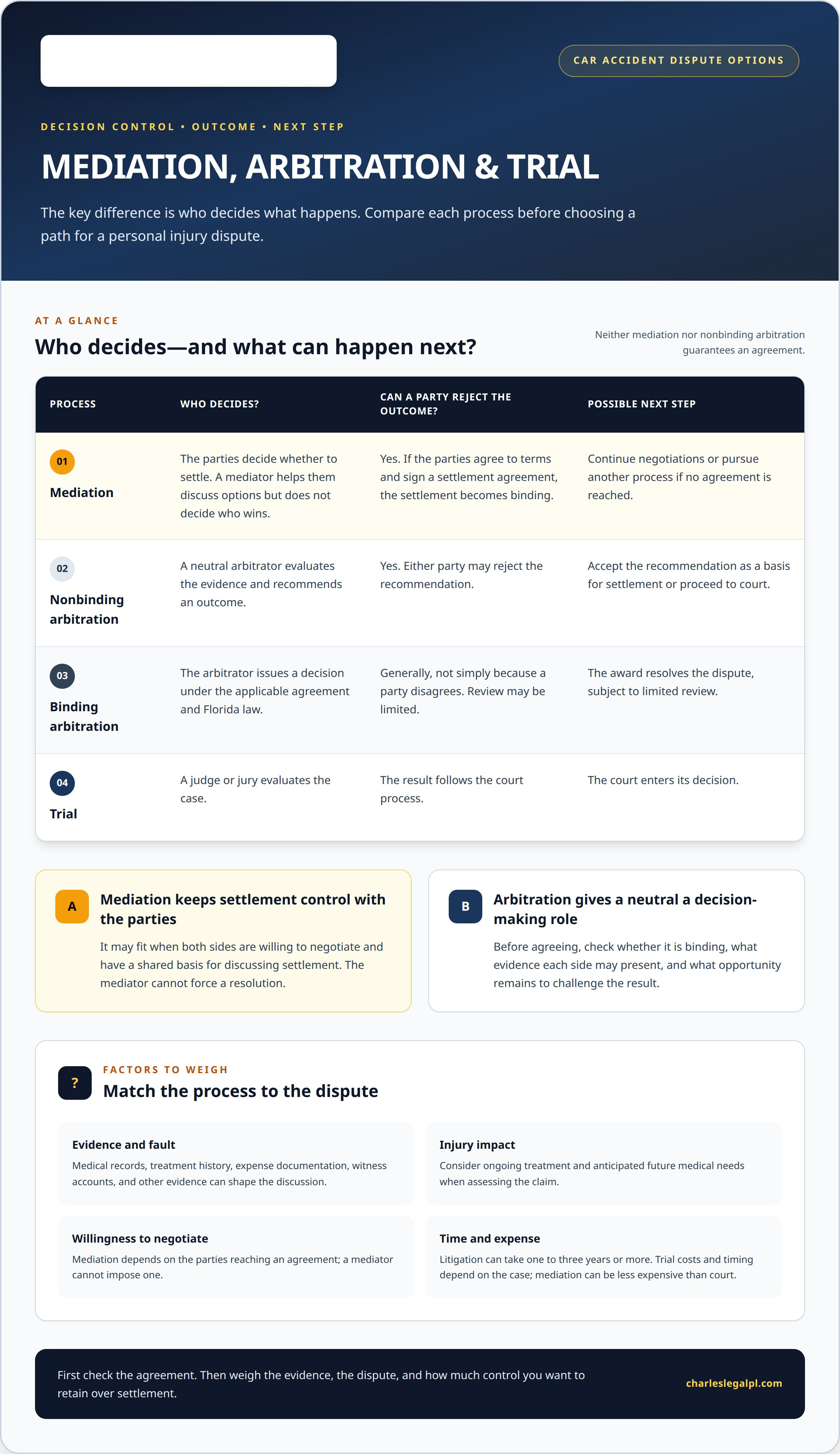
The table compares who controls the decision and what may happen next.
| Option | Who decides? | Can a party reject the outcome? | Possible next step |
|---|---|---|---|
| Mediation | The parties decide whether to settle. | Yes, unless they agree to settlement terms. | Continue negotiations or pursue another process. |
| Nonbinding arbitration | A neutral arbitrator recommends an outcome. | Yes. | Accept the recommendation or proceed to court. |
| Binding arbitration | The arbitrator issues a decision under the applicable agreement and Florida law. | Generally, not simply because a party disagrees. | The award resolves the dispute, subject to limited review. |
| Trial | A judge or jury evaluates the case. | The result follows the court process. | The court enters its decision. |
Check the agreement first, then weigh whether you want a recommendation, a binding decision, or continued control over settlement.
Which Option Is Right for Your Personal Injury Case?
Choose a dispute-resolution process by weighing the evidence, the injury’s impact, the prospects for negotiation, and the consequences of each outcome. A car crash with documented treatment and agreed fault presents different choices from a collision where liability remains contested.
Choosing Mediation or Arbitration
Mediation may fit when both sides are willing to negotiate and the evidence gives them a shared basis for discussing settlement. The parties retain control over whether to agree. Arbitration shifts decision-making to a neutral who evaluates the dispute and provides an outcome. Compare the process terms, the strength of the records, and how much control you want to retain.
Choosing Arbitration for a Claim
Arbitration may suit a personal injury claim when both sides want a neutral’s decision rather than continued bargaining. It can also be an alternative to a full court trial. Before choosing, review whether the process is binding, what evidence each side can present, and what opportunity remains to challenge the result.
Choosing Mediation, Arbitration, or Trial
Mediation favors a negotiated resolution; arbitration asks a neutral to decide, while a trial leaves the outcome to a judge or jury. Mediation can be less expensive than court, but it works only if the parties reach an agreement. A trial may suit a dispute where evidence needs to be tested through litigation, though the outcome remains uncertain.
Match the evidence to the dispute. Medical records, treatment history, and expense documentation can help show an injury’s impact. If fault is disputed, witness accounts and other evidence may be more important. An attorney can assess whether the available record supports negotiation or whether more information may be needed before deciding.
- Negotiation: Consider mediation when both sides will discuss terms in good faith.
- Decision control: Compare a mediator-facilitated agreement with an arbitrator’s decision.
- Injury impact: Account for ongoing treatment and anticipated future medical needs.
- Time and expense: Litigation can take one to three years or more, while trial costs and timing depend on the case.
For example, if an insurer disputes the extent of treatment despite consistent records, the parties can consider whether negotiation may address the disagreement. If liability remains contested and key evidence needs to be tested, trial may provide a formal process for presenting it. The choice should reflect the actual conflict, not simply the label attached to a process.
Before agreeing to arbitration, consider the binding effect and any limits on challenging its decision. Before mediation, decide which settlement terms matter and what evidence supports them. To discuss how these factors apply to an injury claim, talk through your case.
What are the differences between arbitration and mediation?
Mediation centers on negotiation; arbitration asks a neutral to evaluate evidence and decide or recommend an outcome. In Florida injury claims, the agreement, Florida law, and the dispute shape which process is available.
For accident victims, mediation preserves control over settlement but can leave the dispute unresolved; arbitration offers a decision but may limit later options. The parties’ agreement and applicable Florida law can affect process rules and available procedures. Costs depend on the process and circumstances: mediation may cost less after a quick agreement, while overall costs may be similar or arbitration may sometimes cost less. In an insurance claim, mediation brings the claimant and insurer together to negotiate, often with a mediator facilitating discussion.
How Mediation Works
In a car accident insurance claim, the parties present their positions and negotiate with a mediator’s help. The mediator can explore settlement options but cannot decide fault or impose payment terms. In a personal injury lawsuit, an insurance adjuster may join mediation if negotiations have not resolved the claim. If the parties agree, they put the settlement in writing and finalize it; otherwise, the claim remains unresolved.
How Arbitration Works
In arbitration, each side presents evidence and arguments to a neutral arbitrator. Attorneys may question parties who testify, and the arbitrator considers the evidence before issuing a decision or recommendation. Unlike mediation, the arbitrator evaluates the dispute rather than guiding negotiation. The agreement and Florida law determine whether the decision is binding and what options remain afterward.
Advantages and Disadvantages
Mediation can support a flexible agreement and lets the parties decide whether settlement terms are acceptable. Its limitation is the same feature: without agreement, the session does not resolve the dispute. Arbitration can move the dispute to a decision-maker, which may help when negotiation stalls. But a binding award can restrict a party’s ability to pursue the dispute in court.
Costs and Fees
Mediation may cost less than arbitration when the parties reach a quick agreement. The processes can cost about the same overall, and arbitration can sometimes cost less depending on the arbitration company. The number of sessions, preparation, and whether the dispute settles affect total expense. Before choosing, compare the agreement’s cost terms and consider whether unresolved mediation could lead to additional proceedings.
Florida procedures must be assessed under Florida law and the rules that apply to the case. Examples from other states do not establish the process for a Florida claim. Focus on the actual agreement, whether an insurer is involved, and what the parties need the neutral to do. Those details distinguish guided settlement talks from an arbitrator’s evaluation.
Arbitrating with the at-fault driver’s insurer
An arbitration clause in an insurance policy may provide a way to resolve a car accident claim outside court. Before considering it, identify who the clause covers, whether the insurer will participate, and whether the decision would bind the parties.
If no applicable clause provides for arbitration and the insurer refuses to participate, a claimant may need to file a lawsuit to continue pursuing the dispute. The policy language matters because it can shape who is involved and which process applies. It does not, by itself, establish that the insurer accepts responsibility for the crash or the claimed injuries.
An adjuster may represent the insurer in claim discussions, while the injured person may have legal representation. In arbitration, the parties present evidence and arguments for the neutral to consider. The record can include medical records describing treatment, accident reports, and evidence relevant to disputed fault. The arbitrator’s assessment can affect the claim’s outcome, so each side’s presentation should address responsibility and the documented impact of the injuries.
A typical arbitration timeline divides preparation into stages: filing, starting the process, and selecting an arbitrator occur within days 1 through 60; information exchange and preparation take place during days 61 through 90. The hearing occurs between days 91 and 100 and may last one or more days. The arbitrator’s decision is placed between days 101 and 110. Actual steps depend on the process and agreement.
Arbitration can address how the parties allocate responsibility for the loss based on the evidence presented. It may also involve medical treatment costs, rehabilitative therapy, and anticipated future medical expenses related to the injuries. Medical records help document treatment and support claimed losses. The policy clause and arbitration agreement determine the process, not an assumption about what the insurer must pay.
Mediation is another option when an adjuster and claimant are still negotiating. A mediator helps both sides discuss potential settlement terms but cannot decide the dispute. The parties retain control over whether to agree. If the insurer and claimant reach a settlement, they can put the agreed terms in writing; if negotiations fail, mediation does not resolve the claim.
You are not required to hire a lawyer for arbitration, but legal representation can help assess policy terms, organize evidence, and present the injury claim. A personal injury attorney can also help determine whether an arbitration clause applies and what effect it may have. Before entering the process, understand the decision’s effect and what options remain if the result is unfavorable.
For a claim arising from a car accident injury, the key steps are to review the applicable policy language, determine whether the insurer will participate, and prepare records supporting fault and injury-related losses. Those details help clarify whether arbitration, mediation, or litigation is the next practical route.
Mediation and arbitration for personal injury disputes
In a personal injury dispute, the process affects who shapes the result and how evidence reaches a decision-maker. Focus on the injury record, disputed responsibility, and the compensation sought.
Before mediation, organize the claim around specific issues. Medical records document treatment; bills and wage records support financial losses; witness statements can help explain how an incident happened. An injury claim can also include rehabilitative therapy, anticipated future medical expenses, and compensation for pain and suffering. A clear record helps the parties discuss what is supported and what remains contested.
- Identify the disputed points: Separate disagreement about fault from disagreement about injury severity or compensation.
- Prepare supporting records: Gather medical documentation, accident reports, expense records, and witness information relevant to those issues.
- Set negotiation priorities: Determine which settlement terms address the documented losses and which points remain open.
During mediation, the mediator facilitates communication rather than deciding the claim. The parties can discuss a mutually acceptable resolution, including settlement terms that address documented losses. For example, an insurer and an injured person might disagree about whether treatment relates to the accident. Medical records and the treatment timeline give them concrete information to discuss. Neither side has to accept a proposal simply because it was raised in mediation.
Arbitration uses evidence differently. The arbitrator evaluates the parties’ arguments and supporting material, including witness testimony when presented. This structure can help focus a dispute on particular facts, such as conflicting accounts of a collision. The tradeoff is decision-making authority: unlike a mediator, an arbitrator issues a decision or recommendation, and the agreement determines whether that decision binds the parties.
Readiness matters. If treatment is ongoing, the record may not yet show the full course of care or anticipated needs. If the parties already have medical records, expense documentation, and a clear account of fault, they can address those points directly in negotiation. For claims involving negligent security injuries, evidence about the incident and the injury likewise helps define what the dispute concerns.
The practical takeaway is to match the process to the disagreement. Choose mediation to work toward terms both sides accept; consider arbitration when a neutral’s evaluation is needed. If you need help assessing evidence and resolution options for an injury claim, contact the legal team.
Personal Injury Attorney in Fort Lauderdale
Charles Injury Law helps injured people assess their claims and consider whether mediation, arbitration, or litigation may fit. If an insurer disputes fault, questions the extent of an injury, or makes settlement negotiations difficult, legal guidance can help clarify the evidence and the consequences of each process.
The firm handles injury claims involving car, truck, and rideshare accidents, as well as pedestrian injuries. Its role is to evaluate the claim and advocate for accountability, not promise a particular outcome. Understanding your options can help you make informed decisions about pursuing compensation.
If you are weighing a dispute-resolution path after an accident, contact Charles Injury Law in Fort Lauderdale to discuss your claim and next steps.
Move Forward With a Clear Plan
Before agreeing to a process, turn your priorities into a practical plan. Identify what remains disputed, which records support your position, and which terms matter most to you. Then consider whether the next step preserves the options you need. The choice between arbitration and mediation for car accident claims should reflect the facts of your injury and the decision-making process you are prepared to accept.
If an insurer is pressing for a decision, take time to understand the proposed process and its effect on your claim. A personal injury attorney can help assess the evidence, explain the available paths, and advocate for your interests as you pursue compensation. Preparation can help you make an informed choice.
Contact Charles Injury Law to discuss your next steps. Call Now: (954) 390-2228 Available 24 Hours a Day, 7 Days a Week. You deserve clear guidance as you move forward.
Frequently Asked Questions
What Is Mediation?
Mediation is a facilitated negotiation where the people involved discuss possible ways to resolve a dispute. In an injury claim, the discussion can focus on what each side accepts, what remains contested, and which settlement terms could address the losses. A useful preparation step is identifying the central disagreement, such as whether a proposed amount accounts for the injury’s impact. This information is general and not legal advice.
Can I Include My Medical Bills in the Arbitration Process?
Yes, medical bills may be part of an arbitration claim when they relate to the injuries at issue. A practical way to present them is to connect each expense to the treatment it reflects, rather than presenting bills as an unexplained total. The claim may also address rehabilitative therapy and anticipated future medical expenses. The arbitrator considers material within the scope of the process and the parties’ dispute.
Can I Arbitrate With the At-Fault Driver’s Insurance Company?
Possibly, if the insurer participates in arbitration under an applicable policy provision or agreement. Consider whether the relevant terms cover the particular claim and identify the parties who must take part. The insurer’s participation does not resolve disputed responsibility or the value of the losses. If arbitration is unavailable, other resolution paths may remain, depending on the circumstances.
Can I Claim Property Damage in the Arbitration Process?
Property damage may be included when it falls within the arbitration’s scope. In a collision claim, vehicle damage is distinct from bodily injury losses, so the two categories should be clearly identified in the materials submitted. The process agreement determines what the arbitrator may address. Separating repair-related losses from injury-related compensation can make the issues easier to understand and prevent one category from obscuring another.
Do Most Personal Injury Cases Settle at Mediation?
There is no universal outcome for personal injury mediations. Whether the parties settle depends partly on the injuries involved and whether they can agree on acceptable terms. For example, a disagreement about an injury’s lasting effects may require closer attention to treatment and anticipated needs before settlement discussions can progress. Mediation creates an opportunity to negotiate, but it does not guarantee a settlement.
How Does the Insurance Adjuster Factor Into the Arbitration Process?
An adjuster presents or explains the insurer’s position on the claim; the adjuster is not the neutral who evaluates the dispute. For example, the insurer may contest whether particular losses relate to the accident, while the injured person presents a different account. The arbitrator considers each side’s position under Florida law. Understanding which issues the insurer disputes can help keep the presentation focused.
What Is the Difference Between Arbitration and Mediation for Car Accident Claims?
The key practical difference is who controls the decision: the parties negotiate terms in mediation, while an arbitrator evaluates the dispute and issues a decision or recommendation. Before choosing, identify what you need from the process. If you want to assess settlement proposals directly, that points toward negotiation; if the parties need a neutral evaluation, arbitration may address that need. The agreement’s terms also matter.
Is Arbitration Binding or Nonbinding in Car Accident Disputes?
It can be either; the agreement and Florida law determine the effect. Before participating, read the process terms closely and identify whether the arbitrator’s outcome is intended to bind the parties. Also consider what the terms say about the claims submitted and the procedure for presenting them. A decision’s effect matters as much as the evidence because it shapes the choices available after the arbitrator rules.
Disclaimer
The information provided on this blog is for general informational purposes only and does not constitute legal advice. Viewing this content does not create an attorney-client relationship with the firm. You should not act or rely on any information contained herein without seeking legal advice from a qualified attorney regarding your individual situation.